





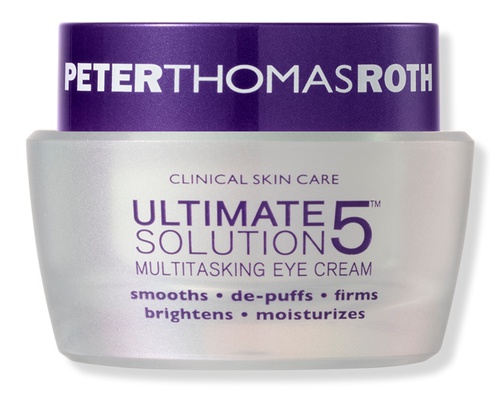
Ultimate Solution 5 Multitasking Eye Cream
Ingredients overview
Highlights
Key Ingredients
Other Ingredients
Skim through
Peter Thomas Roth Ultimate Solution 5 Multitasking Eye CreamIngredients explained
Good old water, aka H2O. The most common skincare ingredient of all. You can usually find it right in the very first spot of the ingredient list, meaning it’s the biggest thing out of all the stuff that makes up the product.
It’s mainly a solvent for ingredients that do not like to dissolve in oils but rather in water.
Once inside the skin, it hydrates, but not from the outside - putting pure water on the skin (hello long baths!) is drying.
One more thing: the water used in cosmetics is purified and deionized (it means that almost all of the mineral ions inside it is removed). Like this, the products can stay more stable over time.
Probably the most common silicone of all. It is a polymer (created from repeating subunits) molecule and has different molecular weight and thus different viscosity versions from water-light to thick liquid.
As for skincare, it makes the skin silky smooth, creates a subtle gloss and forms a protective barrier (aka occlusive). Also, works well to fill in fine lines and wrinkles and give skin a plump look (of course that is only temporary, but still, it's nice). There are also scar treatment gels out there using dimethicone as their base ingredient. It helps to soften scars and increase their elasticity.
As for hair care, it is a non-volatile silicone meaning that it stays on the hair rather than evaporates from it and smoothes the hair like no other thing. Depending on your hair type, it can be a bit difficult to wash out and might cause some build-up (btw, this is not true to all silicones, only the non-volatile types).
 We don't have description for this ingredient yet.
- A natural moisturizer that’s also in our skin
- A super common, safe, effective and cheap molecule used for more than 50 years
- Not only a simple moisturizer but knows much more: keeps the skin lipids between our skin cells in a healthy (liquid crystal) state, protects against irritation, helps to restore barrier
- Effective from as low as 3% with even more benefits for dry skin at higher concentrations up to 20-40%
- High-glycerin moisturizers are awesome for treating severely dry skin
We don't have description for this ingredient yet.
Unless you live under a rock you must have heard about shea butter. It's probably the most hyped up natural butter in skincare today. It comes from the seeds of African Shea or Karite Trees and used as a magic moisturizer and emollient.
But it's not only a simple emollient, it regenerates and soothes the skin, protects it from external factors (such as UV rays or wind) and is also rich in antioxidants (among others vitamin A, E, F, quercetin and epigallocatechin gallate). If you are looking for rich emollient benefits + more, shea is hard to beat.
Theobroma means "food of the gods" in Greek though probably "treat of the people" would be more spot on. The cacao fruits and especially the seeds in it need no introduction as everyone knows them as the magical raw material of the magical sweet treat, chocolate (the flavour is composed of more than 1200(!) substances, and the exact chemical nature of it is not really understood, so it's indeed magic. :)).
As for skincare, cocoa butter counts as a rich emollient that can moisturize and nourish even the driest skin (think chapped hands or lips). It's solid at room temperature and melts nicely when you smear it on. It's loaded with good-for-the-skin things: it contains fatty acids, mainly oleic (35%), stearic (34%), and palmitic (25%) and it also has antioxidant vitamin E and polyphenols.
An ex-vivo (made on human skin but not on real people) study examined the cocoa polyphenols and found that 0.5-0.75% of them improved skin tone and elasticity and had a similarly positive impact on GAGs (important natural moisturizing factors in the skin) and collagen synthesis than a commercial high-end moisturizer (it was an Estee Lauder one).
All in all, cocoa butter is a goodie, especially for very dry skin.
A super common emollient that makes your skin feel nice and smooth. It comes from coconut oil and glycerin, it’s light-textured, clear, odorless and non-greasy. It’s a nice ingredient that just feels good on the skin, is super well tolerated by every skin type and easy to formulate with. No wonder it’s popular.
A handy multi-tasker, white to light yellowish oil-loving wax that works very well in oil-in-water emulsions. It makes your skin feel nice and smooth (emollient), stabilizes oil-water mixes and gives body to them.
Oh, and one more thing: it's a so-called fatty alcohol - the good, emollient type of alcohol that is non-drying and non-irritating. It is often mixed with fellow fatty alcohol, Cetyl Alcohol, and the mixture is called Cetearyl Alcohol in the ingredient list.
A so-called fatty (the good, non-drying kind of) alcohol that does all kinds of things in a skincare product: it makes your skin feel smooth and nice (emollient), helps to thicken up products and also helps water and oil to blend (emulsifier). Can be derived from coconut or palm kernel oil.
Jojoba-derived emollient wax esters (fatty acid + fatty alcohol) that make your skin feel nice and smooth. Chemically speaking, pure jojoba oil is also a wax ester (read our shiny explanation here), however, the ingredients called jojoba esters on the ingredient lists are made from jojoba oil and/or hydrogenated jojoba oil via interesterification.
They have multiple versions with variable fatty acid chain length and the ingredient can have a liquid, a creamy, a soft or firm paste, or even a hard wax consistency. The common thing between all versions is, that unlike most normal triglyceride oils, jojoba esters have superior stability, provide non-greasy emolliency and are readily absorbed into the skin.
A clear, colorless, low viscosity, volatile (does not absorb into the skin but rather evaporates from it) silicone fluid that has excellent spreadability and leaves a light, silky and smooth feel on the skin.
According to manufacturer info, its big advantage is that it's compatible both with other silicones and with natural plant oils, so it's a great ingredient to formulate products with good-sounding, consumer-pleasing vegetable oils but still maintain a cosmetically elegant, non-greasy and non-tacky feel.
A common functional ingredient that helps to keep the oil-loving and water-loving ingredients together (emulsifier), stabilizes and thickens the products.
Chemically speaking, it is ethoxylated Cetearyl alcohol, meaning that some ethylene oxide is added to the fatty alcohol to increase the water-soluble part in the molecule. The result is that the mainly oil soluble, emollient fatty alcohol is converted to an emulsifier molecule that keeps oil and water mixed in creams. The number in the name of Ceteareth emulsifiers refers to the average number of ethylene oxide molecules added and 20 makes a good emulsifier.
There is definitely some craze going on for coconut oil both in the healthy eating space (often claimed to be the healthiest oil to cook with but this is a topic for another site) and in the skin and hair care space.
We will talk here about the latter two and see why we might want to smear it all over ourselves. Chemically speaking, coconut oil has a unique fatty acid profile. Unlike many plant oils that mostly contain unsaturated fatty acids (fatty acids with double bonds and kinky structure such as linoleic or oleic), coconut oil is mostly saturated (fatty acids with single bonds only) and its most important fatty acid is Lauric Acid (about 50%). Saturated fatty acids have a linear structure that can stack nice and tight and hence they are normally solid at room temperature. Coconut oil melts around 25 °C so it is solid in the tub but melts on contact with the skin.
The saturated nature of coconut oil also means that it is a heavy-duty-oil ideal for dry skin types. A double-blind research confirmed that extra virgin coconut oil is as effective in treating xerosis (aka very dry skin) as mineral oil. Another study found that coconut oil is more effective than mineral oil in treating mild to moderate atopic dermatitis (aka eczema) in children.
So when it comes to dry skin, coconut oil is a goodie, no question there. The question is if it is good or bad for acne-prone skin. Its main fatty acid, Lauric Acid has some research showing that it is a promising ingredient against evil acne-causing bacteria, P. acnes but at the same time, both Lauric Acid and coconut oil have a very high comedogenic rating (4 out of 5). Though comedogenic ratings are not very reliable, anecdotal evidence (i.e. people commenting in forums) shows that people have mixed experiences. While some claim that it worked wonders on their acne others say that it gave them serious blackheads and zits. Try it at your own risk.
As for hair care, coconut oil has pretty solid research showing that it can penetrate into the hair very well (better than mineral oil and sunflower oil) and it can prevent hair protein loss as well as combing damage. If you have problems with damaged hair, split ends, coconut oil is worth trying as a pre- or/and post-wash treatment. Labmuffin has an awesome blogpost explaining in more detail why coconut oil is good for your hair.
A couple of other things worth mentioning: coconut oil might help with wound healing (promising animal study), it has some antifungal activity (against dermatophytes that cause the thing known as ringworm) and it also works as an insect repellent against black flies.
Overall, coconut oil is definitely a goodie for the hair and dry skin. If that warrants for the magic oil status it enjoys, we don't know.
Butylene glycol, or let’s just call it BG, is a multi-tasking colorless, syrupy liquid. It’s a great pick for creating a nice feeling product.
BG’s main job is usually to be a solvent for the other ingredients. Other tasks include helping the product to absorb faster and deeper into the skin (penetration enhancer), making the product spread nicely over the skin (slip agent), and attracting water (humectant) into the skin.
It’s an ingredient whose safety hasn’t been questioned so far by anyone (at least not that we know about). BG is approved by Ecocert and is also used enthusiastically in natural products. BTW, it’s also a food additive.
A fatty acid that can be found naturally in the skin. In fact, it's the most common saturated fatty acid found in animals and plants.
As for skincare, it can make the skin feel nice and smooth in moisturizers (emollient) or it can act as a foam building cleansing agent in cleansers. It's also a very popular ingredient in shaving foams.
Sunflower does not need a big intro as you probably use it in the kitchen as cooking oil, or you munch on the seeds as a healthy snack or you adore its big, beautiful yellow flower during the summer - or you do all of these and probably even more. And by even more we mean putting it all over your face as sunflower oil is one of the most commonly used plant oils in skincare.
It’s a real oldie: expressed directly from the seeds, the oil is used not for hundreds but thousands of years. According to The National Sunflower Association, there is evidence that both the plant and its oil were used by American Indians in the area of Arizona and New Mexico about 3000 BC. Do the math: it's more than 5000 years – definitely an oldie.
Our intro did get pretty big after all (sorry for that), so let's get to the point finally: sunflower oil - similar to other plant oils - is a great emollient that makes the skin smooth and nice and helps to keep it hydrated. It also protects the surface of the skin and enhances the damaged or irritated skin barrier. Leslie Bauman notes in Cosmetic Dermatology that one application of sunflower oil significantly speeds up the recovery of the skin barrier within an hour and sustains the results 5 hours after using it.
It's also loaded with fatty acids (mostly linoleic (50-74%) and oleic (14-35%)). The unrefined version (be sure to use that on your skin!) is especially high in linoleic acid that is great even for acne-prone skin. Its comedogen index is 0, meaning that it's pretty much an all skin-type oil.
Truth be told, there are many great plant oils and sunflower oil is definitely one of them.
A common multi-tasker fatty acid. It makes your skin feel nice and smooth (emollient), gives body to cream type products and helps to stabilize water and oil mixes (aka emulsions).
A common fatty acid that can be found in lots of plant oils. Its name, "oleic", means derived from olive oil, a plant oil rich in oleic acid, but avocado, macadamia and marula oils, just to name a few, are also oleic rich.
Its chemical structure is monounsaturated, meaning it has one double bond (cis-9) that makes it less kinky than polyunsaturated fatty acids with multiple double bonds. Less kinkiness means that oleic acid and OA-rich oils are a bit thicker and heavier than their LA-rich siblings.
Maybe this thickness is the reason that Oleic acid is considered comedogenic, and if you have acne-prone skin avoid OA-rich plant oils, and choose linoleic acid-rich versions instead.
The thickness of OA also means that OA-rich oils are considered more nourishing and moisturizing than their LA-rich counterparts, and are generally considered to be more suitable for dry, mature skin types.
As for oleic acid in its free form (and by free we mean that it is not bound up in a triglyceride structure like it is in oils), it mostly serves as an emulsifier or emulsion stabilizer in small amounts in regular cosmetic products. It is also quite well researched and is used in the pharmaceutical industry as a penetration enhancer.
Propanediol is a natural alternative for the often used and often bad-mouthed propylene glycol. It's produced sustainably from corn sugar and it's Ecocert approved.
It's quite a multi-tasker: can be used to improve skin moisturization, as a solvent, to boost preservative efficacy or to influence the sensory properties of the end formula.
Though it says fruit oil in its name, the rosehip fruit contains the seeds that contain the oil. So this one is the same as Rosa Canina Seed Oil, or Rosehip Oil, known for its high omega fatty acid content (linoleic acid - 51%, linolenic acid - 19% and oleic acid - 20%) and skin-regenerative properties.
There is a common misconception that rosehip oil contains vitamin C as the fruit itself does, but vitamin C is a water-soluble vitamin hence it is not contained in the oil. The antioxidant and regenerative properties of the oil probably come from the oil-soluble tocopherols (vitamin E) and carotenoids (pro-vitamin A). Read more here.
A really famous peptide that is part of Matrixyl 3000, the most sold peptide complex in the word. Before we go and find out what the big deal with Matrixyl 3000 is, let's just focus on Palmitoyl Tripeptide-1 itself for a bit.
It's a small three amino acid (they are the building blocks of all proteins) peptide with the amino sequence of glycine-histidine-lysine, or GHK. GHK is attached to palmitic acid (a fatty acid) to increase oil solubility and skin penetration.
The GHK part is the important one as it's a type I collagen fragment. When collagen naturally breaks down in the skin, the resulting peptide fragments signal to the skin that it should get to work and create some nice, new collagen. Adding in collagen fragment peptides, like GHK, might trick the skin into thinking that collagen has broken down and it's time to create some more.
Therefore, Palmitoyl Tripeptide-1 is believed to be able to stimulate collagen production in the skin, and more collagen means fewer wrinkles and younger looking skin.
In Matrixyl 3000, Palmitoyl Tripeptide-1 is coupled with Palmitoyl Tetrapeptide-7 and the duo works in synergy to reduce wrinkles and give younger looking skin. According to the manufacturer's in-vivo (made on real people) test, applying 3% Matrixyl 3000 twice a day for 2 months resulted in all of the following things:
- 39.4% reduction in surface occupied by deep wrinkles
- 32.9% reduction in main wrinkle density
- 19.9% reduction in main wrinkle average depth
- 16% improvement in roughness
- 16.2% in lifting effect
- 5.5% improvement in elasticity
- 15.5% improvement in skin tone
Manufacturer results, of course, always have to be taken with a pinch of salt, but if you like peptides, the Matryxil 3000 duo is one of the best-proven and most well-known ones and it's something that is worth trying.
A four amino acid peptide with the amino sequence of glycine-glutamine-proline-arginine. It is attached to palmitic acid (a fatty acid) to increase oil solubility and skin penetration.
It works by reducing the production of the signal molecule, interleukin-6 (IL-6) which promotes inflammation in the skin and less inflammation means slower degradation of important things (like collagen) that results in younger looking skin for a longer time.
It works in synergy with its pal, Palmitoyl Tripeptide-1 in the famous Matrixyl 3000 complex. You can read some more about the famous duo here.
If you see a cosmetic product that claims that it has "Botox-like effect" then two things are almost certain: one, the product overpromises and two, it contains Argireline.
So this one is the famous peptide that's marketed by its manufacturer as the "Botox in a jar". The basis for this claim is that it targets the same wrinkle forming mechanism (wrinkles caused by facial muscle movement) as Botox, but the way it works is very different. In addition, the extent to which it can prevent muscles from contracting (and to smooth wrinkles) is very different (otherwise why would anyone use still Botox?).
The manufacturer did several studies to prove that Argireline really works and it does (just not as well as Botox). In-vivo (made on real people) tests showed that using 10% Argireline solution around the eyes for 15 days decreased wrinkles depth by 17%, while a 5% Argireline formula applied for 28 days did almost the same with a decrease in wrinkle depth by 16.26%. A Spanish University also did some research and found that Argireline increased the level of skin moisturization and decreased both the depth and width of wrinkles "significantly".
This means, Acetyl Hexapeptide-8 does have some ability to smooth wrinkles (but not as well as Botox - sorry, if we sound like a broken record). Also, we have to agree with TruthInAging, that it's not a collagen builder and not a preventer of structural aging (think vitamin C, AHAs or retinol); it's just a quick fix. If you are looking for one, this could be your thing. If you are more of a "let's treat this aging thing properly" type, then it's probably not your thing.
We don't have description for this ingredient yet.
The big and important protein molecule that usually comes from animal skin such as fish or bovine. The gist of the "collagen in topical skincare" subject is to know that collagen in a jar has nothing to do with wrinkles but everything to do with skin hydration. We have a shiny explanation about this at soluble collagen, so click here to read more >>
- It’s the second most researched AHA after glycolic acid
- It gently lifts off dead skin cells to reveal newer, fresher, smoother skin
- It also has amazing skin hydrating properties
- In higher concentration (10% and up) it improves skin firmness, thickness and wrinkles
- Choose a product where you know the concentration and pH value because these two greatly influence effectiveness
- Don’t forget to use your sunscreen (in any case but especially so next to an AHA product)
It’s the - sodium form - cousin of the famous NMF, hyaluronic acid (HA). If HA does not tell you anything we have a super detailed, geeky explanation about it here. The TL; DR version of HA is that it's a huge polymer (big molecule from repeated subunits) found in the skin that acts as a sponge helping the skin to hold onto water, being plump and elastic. HA is famous for its crazy water holding capacity as it can bind up to 1000 times its own weight in water.
As far as skincare goes, sodium hyaluronate and hyaluronic acid are pretty much the same and the two names are used interchangeably. As cosmetic chemist kindofstephen writes on reddit "sodium hyaluronate disassociates into hyaluronic acid molecule and a sodium atom in solution".
In spite of this, if you search for "hyaluronic acid vs sodium hyaluronate" you will find on multiple places that sodium hyaluronate is smaller and can penetrate the skin better. Chemically, this is definitely not true, as the two forms are almost the same, both are polymers and the subunits can be repeated in both forms as much as you like. (We also checked Prospector for sodium hyaluronate versions actually used in cosmetic products and found that the most common molecular weight was 1.5-1.8 million Da that absolutely counts as high molecular weight).
What seems to be a true difference, though, is that the salt form is more stable, easier to formulate and cheaper so it pops up more often on the ingredient lists.
If you wanna become a real HA-and-the-skin expert you can read way more about the topic at hyaluronic acid (including penetration-questions, differences between high and low molecular weight versions and a bunch of references to scientific literature).
Hello, our favorite molecule that helps us wake up in the morning and then keeps us going through the day. As a super well-known stimulant from coffee, tea and plenty of other soft drinks, Caffeine needs no introduction. So we will skip right to the part where we talk about what the hell it does in so-so many cosmetic products.
Looking at the research, we were surprised to find how versatile Caffeine is. It is a small, water-loving molecule with pretty good skin penetration abilties. Once in the skin, it has nice antioxidant properties, meaning that it reduces the formation of evil free radicals and it might even be useful in preventing UV-induced skin cancers.
A well-known thing about Caffeine is that it improves the microcirculation of the blood vessels. Though conventional wisdom and anecdotal evidence says that this property is helpful for dark under-eye circles and puffy eyes, we have to mention that the double-blind research we have found about a 3% caffeine gel concluded that "the overall efficacy of the selected caffeine gel in reducing puffy eyes was not significantly different from that of its gel base." But you know, the proof is in the pudding.
Another thing Caffeine is used for in body care products is its anti-cellulite effects. In theory, it can speed up the lipolysis process (the "fat burning" by our cells) and stimulate the draining lymph system that might lead to the improvement of cellulite. But here again, the evidence that it actually makes a measurable, let alone visible, improvement on actual human beings is limited (we could find only some animal skin studies or caffeine being combined with other actives).
Last, but not least, we have to write about caffeine and hair growth. The theory is that it can inhibit the activity of the 5-α-reductase enzyme that plays an important role in hair loss and allows a renewed growth phase of the hair. We have found some recent and promising research to back this up. A 2017 study compared a 0.2% caffeine liquid with a 5% Minoxidil (an FDA approved active to treat baldness) solution and found that "a caffeine-based topical liquid should be considered as not inferior to minoxidil 5% solution in men with androgenetic alopecia", or English translation means that the caffeine liquid was pretty much as good as the FDA-approved Minoxidil stuff. Not bad!
Overall, we think that caffeine is a very versatile and biologically active ingredient. Even though some of its effects are more hyped up than backed up, it is still a nice to have on many ingredient lists.
- A multi-functional skincare superstar with several proven benefits for the skin
- Great anti-aging, wrinkle smoothing ingredient used at 4-5% concentration
- Fades brown spots alone or in combination with amino sugar, acetyl glucosamine
- Increases ceramide synthesis that results in a stronger, healthier skin barrier and better skin hydration
- Can help to improve several skin conditions including acne, rosacea, and atopic dermatitis
One of the many types of ceramides that can be found naturally in the upper layer of the skin. Ceramides make up about 50% of the goopy stuff that's between our skin cells and play a super important role in having a healthy skin barrier and keeping the skin hydrated. It works even better when combined with its pal, Ceramide 1.
We wrote way more about ceramides at ceramide 1, so click here to know more.
We don't have description for this ingredient yet.
We don't have description for this ingredient yet.
It seems to us that squalane is in fashion and there is a reason for it. Chemically speaking, it is a saturated (no double bonds) hydrocarbon (a molecule consisting only of carbon and hydrogen), meaning that it's a nice and stable oily liquid with a long shelf life.
It occurs naturally in certain fish and plant oils (e.g. olive), and in the sebum (the oily stuff our skin produces) of the human skin. As f.c. puts it in his awesome blog post, squalane's main things are "emolliency, surface occlusion, and TEWL prevention all with extreme cosmetic elegance". In other words, it's a superb moisturizer that makes your skin nice and smooth, without being heavy or greasy.
Another advantage of squalane is that it is pretty much compatible with all skin types and skin conditions. It is excellent for acne-prone skin and safe to use even if you have fungi-related skin issues, like seborrhea or fungal acne.
The unsaturated (with double bonds) and hence less stable version of Squalane is Squalene, you can read about it here >>
Cucumber is a nice, non-irritating plant extract that’s known for it’s soothing and emollient properties. It’s not something new to put it on our face: even Cleopatra used it to “preserve her skin”.
It’s commonly believed that cucumber is the answer to puffy eyes, but there is no research confirming this. What research does confirm is that it contains amino acids and organic acids that’s helpful for the skin’s acid mantle. There is also an enzyme (called shikimate dehydrigenase) in the pulp that’s shown to have anti-inflammatory properties.
A 14 carbon length fatty acid that can be naturally found in nutmeg, palm kernel oil, coconut oil and butter fat. It's used as a foam building cleansing agent. Paula Begoun writes that it can be a bit drying to the skin.
The oil coming from the pulp of one of the most nutritious fruits in the world, the avocado. It's loaded with the nourishing and moisturizing fatty acid, oleic (70%) and contains some others including palmitic (10%) and linoleic acid (8%). It also contains a bunch of minerals and vitamins A, E and D.
Avocado oil has extraordinary skin penetration abilities and can nourish different skin layers. It's a very rich, highly moisturizing emollient oil that makes the skin smooth and nourished. Thanks to its vitamin E content it also has some antioxidant properties. As a high-oleic plant oil, it is recommended for dry skin.
We don't have description for this ingredient yet.
A non-essential amino acid (a building block of skin proteins like collagen or elastin) that hydrates the skin.
A semi-essential (infants cannot synthesize it, but adults can) amino acid that is one of the primary building blocks of hair keratin and skin collagen. It's a natural moisturizing factor, a skin hydrator and might also help to speed up wound healing.
Arginine usually has a positive charge (cationic) that makes it substantive to skin and hair (those are more negatively charged surfaces) and an excellent film former. Thanks to the positive charge, it also creates a complex with AHAs (AHAs like to lose a hydrogen ion and be negatively charged, so the positive and the negative ions attract each other) that causes a "time-release AHA effect" and reduces the irritation associated with AHAs.
A non-essential amino acid (important building block of collagen and elastin) that hydrates the skin. It is also used to set the pH of the cosmetic product (buffering).
Glutamic acid is a little molecule and non-essential (our body can synthesize it) amino acid with the important job of being a neurotransmitter in the human body meaning that it helps your nervous system work correctly.
As for what it's doing in cosmetics, Glutamic acids' main thing (similar to other amino acids) is being a humectant moisturizer and skin-conditioning agent (sidenote: if you attach lots of glutamic acid molecules, you get polyglutamic acid that is claimed to be a better than hyaluronic acid humectant). It also seems to affect skin barrier repair, however, it is not clear-cut in which direction.
The complication is that glutamic acid has two distinct forms, L-glutamic acid and D-glutamic acid, that are the mirror images of each other (think of it like your left and right hand). Studies show that a topical application of L-glutamic acid on damaged skin delayed skin repair, while D-glutamic acid application sped up skin repair. As both forms are used by the industry, it is a bit uncertain what you are getting with just glutamic acid on the ingredient list (but if it is a Shiseido group product, it is probably the goodie D-form :)).
Other than that, Glutamic acid can also be used as a pH adjuster and can be processed via biological pathways into pyrrolidone carboxylic acid, the sodium salt of which is a goodie and one of your skin’s natural moisturizing factors.
A non-essential amino acid (the building blocks of skin proteins, like collagen or elastin), that the body can produce itself, but its production decreases with age. When you put it all over your face, it works as a moisturizer and maybe more.
According to great skincare blog Futurederm, glycine might help with wound healing and tissue repair and when used together with other amino acids, leucine and proline it might improve wrinkles.
BTW, it's also a building block of a bunch of important and famous peptides, including copper-tripeptide-1, palmitoyl tripeptide-1 or palmitoyl hexapeptide-12.
A semi-essential amino acid meaning that enough has to be eaten from it so that the body does not use up essential amino acids (that our body cannot produce itself) to synthesize it. It has an important role in regulating the immune defense, allergic reactions, and inflammatory processes in the body.
As for skincare, it's a skin moisturizer that might also protect from some skin infections.
A branch-chained, essential amino acid that can be found in things like almond, cashew or soy protein. When taken orally it may promote protein synthesis. As for skincare - like all the amino acids - it's a skin-identical ingredient and moisturizer. It also seems to be useful as a barrier repair ingredient.
We don't have description for this ingredient yet.
We don't have description for this ingredient yet.
An essential amino acid that the body cannot produce itself but has to take from the diet. Combined with UVA exposure, phenylalanine is used in the treatment of vitiligo (a pigmentation disorder where patches of the skin lose the pigment).
A non-essential amino acid (meaning that our body can produce it) that's also one of the major building blocks of collagen. According to the Futurederm blog, it might be able to improve wrinkles when combined with other amino acids, glycine and leucine
Serine is an amino acid that most often comes to the formula as part of a moisturizing complex. It's a non-essential amino acid (meaning that our body can synthesize it) and serves as a water-binding ingredient.
In general, amino acids are great skincare ingredients that play an important role in proper skin hydration but there is not much info out there about what specifically serine can do for the skin.
An essential amino acid that's also a key building block of collagen and elastin. When taken orally, it helps the digestive and intestinal tracts function more smoothly and also helps the absorption of nutrients. As for skincare, it is not clear what it does other than being a skin hydrator.
We don't have description for this ingredient yet.
An essential amino acid (a building block of skin proteins like collagen) that our body cannot produce itself but has to take from external sources, like diet.
It's a branched chain amino acid that is claimed to enhance energy, increase endurance and aid in muscle tissue recovery and repair when taken as a supplement. It's not clear what valine does when you put it on the skin, but as all amino acids, it must be at least a great skin hydrator.
PCA stands for Pyrrolidone Carboxylic Acid and though it might not sound like it, it is a thing that can be found naturally in our skin. The sodium salt form of PCA is an important skin-identical ingredient and great natural moisturizer that helps the skin to hold onto water and stay nicely hydrated.
We don't have description for this ingredient yet.
- Works best between a concentration of 5-20%
- Boosts the skin’s own collagen production
- Fades pigmentation and brown spots
- If used under sunscreen it boosts its UV protection
- Extremely unstable and oxidizes very easily in presence of light or air
- Stable in solutions with water only if pH is less than 3.5 or in waterless formulations
- Vit E + C work in synergy and provide superb photoprotection
- Ferulic acid doubles the photoprotection effect of Vit C+E and helps to stabilize Vit C
- Potent Vit. C serums might cause a slight tingling on sensitive skin
We don't have description for this ingredient yet.
We don't have description for this ingredient yet.
A 12 carbon length fatty acid that can be found naturally in coconut milk, coconut oil, laurel oil, and palm kernel oil. It's also in breast milk. As a skincare ingredient, it can be used as an emulsifier or as a cleansing agent.
What's more, there is emerging research about lauric acid being a good anti-acne ingredient. A 2009 study found that the lowest concentration to prevent evil acne-causing P. acnes growth of lauric acid is over 15 times lower than that of gold standard anti-acne ingredient benzoyl peroxide.
Though the studies are only in-vitro (made in the lab, not on real people), and it also has a high comedogenicity index, it might be worth a try if you are prone to inflamed acne (the type that's caused by P. acnes bacteria).
We don't have description for this ingredient yet.
We don't have description for this ingredient yet.
We don't have description for this ingredient yet.
- Primary fat-soluble antioxidant in our skin
- Significant photoprotection against UVB rays
- Vit C + Vit E work in synergy and provide great photoprotection
- Has emollient properties
- Easy to formulate, stable and relatively inexpensive
We don't have description for this ingredient yet.
The unfancy name for it is lye. It’s a solid white stuff that’s very alkaline and used in small amounts to adjust the pH of the product and make it just right.
For example, in case of AHA or BHA exfoliants, the right pH is super-duper important, and pH adjusters like sodium hydroxide are needed.
BTW, lye is not something new. It was already used by ancient Egyptians to help oil and fat magically turn into something else. Can you guess what? Yes, it’s soap. It still often shows up in the ingredient list of soaps and other cleansers.
Sodium hydroxide in itself is a potent skin irritant, but once it's reacted (as it is usually in skin care products, like exfoliants) it is totally harmless.
The flower wax coming from Mimosa that has nice skin protecting and film-forming properties. It also has a nice, sweet smell well known to perfumers.
Mimosa wax often comes to the formula together with sunflower and jojoba waxes as the three of them is trade named Acticire and form a natural texture agent that works both as an emollient bringing softness to the formula as well as an active ingredient with skin-repairing, protecting, and moisturizing properties.
It’s a handy multi-tasking ingredient that gives the skin a nice, soft feel. At the same time, it also boosts the effectiveness of other preservatives, such as the nowadays super commonly used phenoxyethanol.
The blend of these two (caprylyl glycol + phenoxyethanol) is called Optiphen, which not only helps to keep your cosmetics free from nasty things for a long time but also gives a good feel to the finished product. It's a popular duo.
A high-molecular-weight silicone elastomer (rubber-like elastic material) that is usually blended with a base silicone fluid (such as dimethicone or cyclopentasiloxane) to give the formula a silky smooth feel and to act as a thickening agent.
A type of silicone elastomer (rubber-like material with both viscosity and elasticity) whose major function is forming a nice film on the skin.
It is also cosmetically very elegant with a non-tacky, non-oily and smooth skin feel. It also works as a stable delivery system of active materials, has sebum absorption and control properties and upon application, it transforms into a matte appearance with a powdery after feel.
A multi-functional, silky feeling helper ingredient that can do quite many things. It's used as an emulsion stabilizer, solvent and a broad spectrum antimicrobial. According to manufacturer info, it's also a moisturizer and helps to make the product feel great on the skin. It works synergistically with preservatives and helps to improve water-resistance of sunscreens.
If you have spotted ethylhexylglycerin on the ingredient list, most probably you will see there also the current IT-preservative, phenoxyethanol. They are good friends because ethylhexylglycerin can boost the effectiveness of phenoxyethanol (and other preservatives) and as an added bonus it feels nice on the skin too.
Also, it's an effective deodorant and a medium spreading emollient.
It's one of the most commonly used thickeners and emulsion stabilizers. If the product is too runny, a little xanthan gum will make it more gel-like. Used alone, it can make the formula sticky and it is a good team player so it is usually combined with other thickeners and so-called rheology modifiers (helper ingredients that adjust the flow and thus the feel of the formula). The typical use level of Xantha Gum is below 1%, it is usually in the 0.1-0.5% range.
Btw, Xanthan gum is all natural, a chain of sugar molecules (polysaccharide) produced from individual sugar molecules (glucose and sucrose) via fermentation. It’s approved by Ecocert and also used in the food industry (E415).
Three glycerin molecules attached together. It is a humectant and moisturizer ingredient just like glycerin, but the larger molecular structure penetrates slower into the skin and gives milder, longer lasting moisture.
It's one of those things that help your cosmetics not to go wrong too soon, aka a preservative. It’s not a strong one and doesn’t really work against bacteria, but more against mold and yeast. To do that it has to break down to its active form, sorbic acid. For that to happen, there has to be water in the product and the right pH value (pH 3-4).
But even if everything is right, it’s not enough on its own. If you see potassium sorbate you should see some other preservative next to it too.
BTW, it’s also a food preservative and even has an E number, E202.
The sodium salt of lactic acid. It's a great skin moisturizer and also used to regulate the pH value of the cosmetic formula. It's a natural ingredient approved by both ECOCERT and COSMOS.
A helper ingredient that helps to make the products stay nice longer, aka preservative. It works mainly against fungi.
It’s pH dependent and works best at acidic pH levels (3-5). It’s not strong enough to be used in itself so it’s always combined with something else, often with potassium sorbate.
A big molecule created from repeated subunits (a polymer of acrylic acid) that magically converts a liquid into a nice gel formula. It usually has to be neutralized with a base (such as sodium hydroxide) for the thickening to occur and it creates viscous, clear gels that also feel nice and non-tacky on the skin. No wonder, it is a very popular and common ingredient. Typically used at 1% or less in most formulations.
It's a common little helper ingredient that helps water and oil to mix together. Also, it can help to increase the solubility of some other ingredients in the formula.
It's a type of glycol that - according to the manufacturer - is an extremely good replacement for other glycols like propylene or butylene glycol. Its main job is to be a solvent, but it has also very good antimicrobial properties and acts as a true preservative booster. Also helps with skin hydration without stickiness or tacky feel.
A super versatile and common mineral powder that comes in different particle sizes. It is a multi-tasker used to improve skin feel, increase product slip, give the product light-reflecting properties, enhance skin adhesion or serve as an anti-caking agent.
It is also the most commonly used "base" material for layered composite pigments such as pearl-effect pigments. In this case, mica is coated with one or more metal oxides (most commonly titanium dioxide) to achieve pearl effect via the physical phenomenon known as interference.
Red Iron Oxide is the super common pigment that gives the familiar, "rust" red color. It is also the one that gives the pink tones in your foundation. Chemically speaking, it is iron III oxide (Fe2O3).
It’s pretty much the current IT-preservative. It’s safe and gentle, but even more importantly, it’s not a feared-by-everyone-mostly-without-scientific-reason paraben.
It’s not something new: it was introduced around 1950 and today it can be used up to 1% worldwide. It can be found in nature - in green tea - but the version used in cosmetics is synthetic.
Other than having a good safety profile and being quite gentle to the skin it has some other advantages too. It can be used in many types of formulations as it has great thermal stability (can be heated up to 85°C) and works on a wide range of pH levels (ph 3-10).
It’s often used together with ethylhexylglycerin as it nicely improves the preservative activity of phenoxyethanol.
You may also want to take a look at...
| what‑it‑does | solvent |
| what‑it‑does | emollient |
| irritancy, com. | 0, 1 |
| what‑it‑does | skin-identical ingredient | moisturizer/humectant |
| irritancy, com. | 0, 0 |
| what‑it‑does | emollient |
| what‑it‑does | emollient |
| irritancy, com. | 0, 4 |
| what‑it‑does | emollient |
| what‑it‑does | emollient | viscosity controlling | emulsifying | surfactant/cleansing |
| irritancy, com. | 2, 2 |
| what‑it‑does | emollient | viscosity controlling |
| irritancy, com. | 2, 2 |
| what‑it‑does | soothing | emollient | moisturizer/humectant |
| what‑it‑does | emollient |
| what‑it‑does | emulsifying | surfactant/cleansing |
| irritancy, com. | 3, 2 |
| what‑it‑does | emollient | perfuming |
| irritancy, com. | 0, 4 |
| what‑it‑does | emollient |
| what‑it‑does | moisturizer/humectant | solvent |
| irritancy, com. | 0, 1 |
| what‑it‑does | skin-identical ingredient | emollient | emulsifying |
| irritancy, com. | 0, 2 |
| what‑it‑does | emollient |
| irritancy, com. | 0, 0 |
| what‑it‑does | emollient | viscosity controlling |
| irritancy, com. | 0, 2-3 |
| what‑it‑does | emollient | emulsifying |
| what‑it‑does | solvent | moisturizer/humectant |
| what‑it‑does | emollient |
| what‑it‑does | emollient | emulsifying |
| what‑it‑does | cell-communicating ingredient |
| what‑it‑does | cell-communicating ingredient |
| what‑it‑does | cell-communicating ingredient | moisturizer/humectant |
| what‑it‑does | moisturizer/humectant |
| what‑it‑does | buffering |
| what‑it‑does | buffering | exfoliant |
| what‑it‑does | exfoliant | moisturizer/humectant | buffering |
| what‑it‑does | skin-identical ingredient | moisturizer/humectant |
| irritancy, com. | 0, 0 |
| what‑it‑does | antioxidant | perfuming |
| what‑it‑does | cell-communicating ingredient | skin brightening | anti-acne | moisturizer/humectant |
| what‑it‑does | skin-identical ingredient |
| what‑it‑does | skin-identical ingredient | emollient |
| irritancy, com. | 0, 1 |
| what‑it‑does | soothing | emollient |
| what‑it‑does | surfactant/cleansing | emulsifying | perfuming |
| irritancy, com. | 0, 3 |
| what‑it‑does | antioxidant | emollient |
| irritancy, com. | 0, 0-3 |
| what‑it‑does | skin-identical ingredient |
| what‑it‑does | skin-identical ingredient |
| what‑it‑does | skin-identical ingredient |
| what‑it‑does | moisturizer/humectant |
| what‑it‑does | skin-identical ingredient |
| what‑it‑does | skin-identical ingredient | moisturizer/humectant |
| what‑it‑does | skin-identical ingredient |
| what‑it‑does | skin-identical ingredient |
| what‑it‑does | skin-identical ingredient |
| what‑it‑does | skin-identical ingredient |
| what‑it‑does | skin-identical ingredient |
| what‑it‑does | skin-identical ingredient |
| what‑it‑does | skin-identical ingredient | moisturizer/humectant |
| irritancy, com. | 0, 0 |
| what‑it‑does | antioxidant | skin brightening | buffering |
| what‑it‑does | surfactant/cleansing | emulsifying |
| what‑it‑does | anti-acne | surfactant/cleansing | emulsifying |
| irritancy, com. | 1, 4 |
| what‑it‑does | antioxidant | viscosity controlling |
| what‑it‑does | emollient |
| irritancy, com. | 0, 3 |
| what‑it‑does | antioxidant |
| irritancy, com. | 0-3, 0-3 |
| what‑it‑does | viscosity controlling |
| what‑it‑does | buffering |
| what‑it‑does | emollient |
| what‑it‑does | moisturizer/humectant | emollient |
| what‑it‑does | viscosity controlling |
| what‑it‑does | solvent | moisturizer/humectant |
| what‑it‑does | preservative |
| what‑it‑does | viscosity controlling |
| what‑it‑does | moisturizer/humectant |
| what‑it‑does | buffering |
| what‑it‑does | preservative |
| what‑it‑does | buffering | moisturizer/humectant |
| what‑it‑does | preservative |
| what‑it‑does | viscosity controlling |
| irritancy, com. | 0, 1 |
| what‑it‑does | emulsifying | surfactant/cleansing |
| irritancy, com. | 0, 0 |
| what‑it‑does | solvent |
| what‑it‑does | buffering |
| what‑it‑does | colorant |
| what‑it‑does | colorant |
| irritancy, com. | 0, 0 |
| what‑it‑does | preservative |