





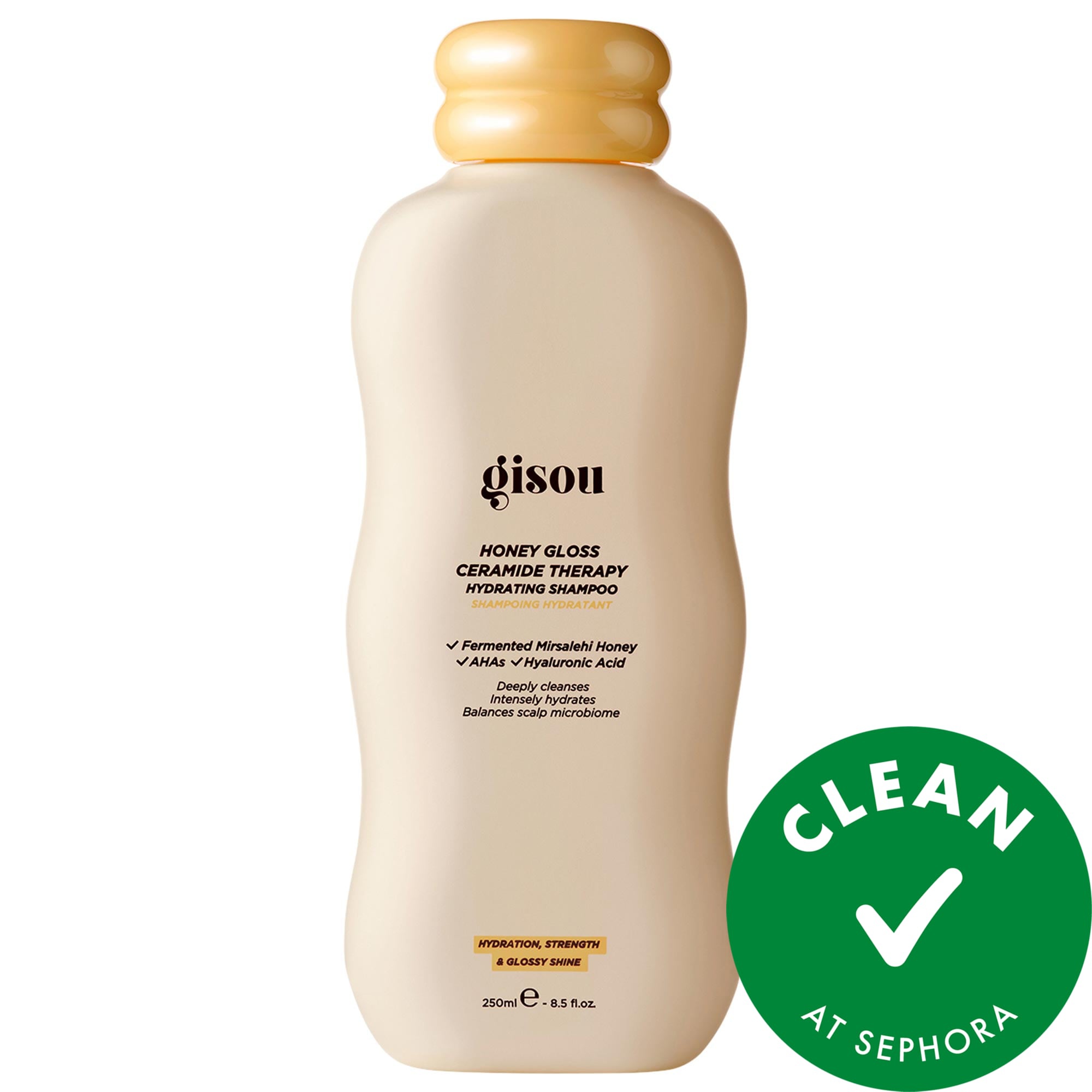
Honey Gloss Ceramide Therapy Hydrating Shampoo
Ingredients overview
Highlights
Key Ingredients
Other Ingredients
Skim through
Gisou Honey Gloss Ceramide Therapy Hydrating ShampooIngredients explained
Good old water, aka H2O. The most common skincare ingredient of all. You can usually find it right in the very first spot of the ingredient list, meaning it’s the biggest thing out of all the stuff that makes up the product.
It’s mainly a solvent for ingredients that do not like to dissolve in oils but rather in water.
Once inside the skin, it hydrates, but not from the outside - putting pure water on the skin (hello long baths!) is drying.
One more thing: the water used in cosmetics is purified and deionized (it means that almost all of the mineral ions inside it is removed). Like this, the products can stay more stable over time.
A very mild cleansing agent with a dense and luxurious foam and an elegant after feel. It also has excellent water solubility and thus good rinsability.
A cleansing agent that's claimed to be so gentle on the skin that it hardly impacts the skin barrier. It also gives a rich, creamy foam, it's based on vegetable fatty acids and is readily biodegradable.
It's an especially important and popular ingredient in "syndet bars" (or soapless soaps). Dr. Leslie Baumann says in her great Cosmetic Dermatology book that thanks to the unique molecular characteristic of Sodium Cocoyl Isethionate, it "has defined a new dimension in the mildness of cleansing bars".
Super common ingredient in all kinds of cleansing products: face and body washes, shampoos and foam baths.
Number one reason for its popularity has to do with bubbles. Everyone loves bubbles. And cocamidopropyl betaine is great at stabilizing them.
The other reason is that it’s mild and works very well combined with other cleansing agents and surfactants. The art of cleansing is usually to balance between properly cleansing but not over-cleansing and cocamidopropyl betaine is helpful in pulling off this balance right.
Oh, and one more nice thing: even though it’s synthetic it’s highly biodegradable.
More info on CAPB on Collins Beaty Pages.
A vegetable origin (coconut/palm kernel oil, glucose) cleansing agent that gives moderate to high stable foam. It's also biodegradable and mild to the skin.
A vegetable based co-surfactant that helps to create mild cleansing formulas.
Exactly what it sounds: nice smelling stuff put into cosmetic products so that the end product also smells nice. Fragrance in the US and parfum in the EU is a generic term on the ingredient list that is made up of 30 to 50 chemicals on average (but it can have as much as 200 components!).
If you are someone who likes to know what you put on your face then fragrance is not your best friend - there's no way to know what’s really in it.
Also, if your skin is sensitive, fragrance is again not your best friend. It’s the number one cause of contact allergy to cosmetics. It’s definitely a smart thing to avoid with sensitive skin (and fragrance of any type - natural is just as allergic as synthetic, if not worse!).
A mildly viscous, amber-colored liquid with fatty odor, made from Castor Oil and polyethylene glycol (PEG).
If it were a person, we’d say, it’s agile, diligent & multifunctional. It’s mostly used as an emulsifier and surfactant but most often it is used to solubilize fragrances into water-based formulas.
Sodium chloride is the fancy name of salt. Normal, everyday table salt.
If (similar to us) you are in the weird habit of reading the label on your shower gel while taking a shower, you might have noticed that sodium chloride is almost always on the ingredient list. The reason for this is that salt acts as a fantastic thickener in cleansing formulas created with ionic cleansing agents (aka surfactants) such as Sodium Laureth Sulfate. A couple of percents (typically 1-3%) turns a runny surfactant solution into a nice gel texture.
If you are into chemistry (if not, we understand, just skip this paragraph), the reason is that electrolytes (you know, the Na+ and Cl- ions) screen the electrostatic repulsion between the head groups of ionic surfactants and thus support the formation of long shaped micelles (instead of spherical ones) that entangle like spaghetti, and viola, a gel is formed. However, too much of it causes the phenomenon called "salting out", and the surfactant solution goes runny again.
Other than that, salt also works as an emulsion stabilizer in water-in-oil emulsions, that is when water droplets are dispersed in the outer oil (or silicone) phase. And last but not least, when salt is right at the first spot of the ingredient list (and is not dissolved), the product is usually a body scrub where salt is the physical exfoliating agent.
We all know honey as the sweet, gooey stuff that is lovely to sweeten a good cup of tea and we have good news about putting honey all over our skin. It is just as lovely on the skin as it is in the tea.
The great review article about honey in the Journal of Cosmetic Dermatology writes that it is arguably the oldest skincare ingredient and evidence from around 4500 BC mentions honey in some eye cream recipes. Chemically speaking, it is a bee-derived, supersaturated sugar solution. About 95% of honey dry weight is sugar and the other 5% consists of a great number of other minor components including proteins, amino acids, vitamins, enzymes, and minerals.
This unique and complex chemical composition gives honey a bunch of nice skin care properties: it is very moisturizing, has soothing and antioxidant abilities as well as significant antibacterial and antifungal magic powers. There is also a lot of empirical evidence with emerging scientific backup that honey dressing promotes the healing of wounds and burns.
One tricky thing about honey though, is that it can have lots of different floral sources and different types of honey have a somewhat different composition and thus somewhat different properties. For example, the darker the honey the richer it is in antioxidant phenolic compounds. Two special types of honey are acacia and manuka. The former is unique and popular because of its higher than usual fructose content that makes it more water-soluble and easier to stabilize in cosmetic formulas. The latter comes from the Leptospermum Scoparium tree native to New Zeland and its special thing is its extra strong antibacterial power due to a unique component called methylglyoxal.
Overall, honey is a real skin-goodie in pretty much every shape and form, and it is a nice one to spot on the ingredient list.
One of the many types of ceramides that can be found naturally in the upper layer of the skin. Ceramides make up about 50% of the goopy stuff that's between our skin cells and play a super important role in having a healthy skin barrier and keeping the skin hydrated. It works even better when combined with its pal, Ceramide 1.
We wrote way more about ceramides at ceramide 1, so click here to know more.
It’s the - sodium form - cousin of the famous NMF, hyaluronic acid (HA). If HA does not tell you anything we have a super detailed, geeky explanation about it here. The TL; DR version of HA is that it's a huge polymer (big molecule from repeated subunits) found in the skin that acts as a sponge helping the skin to hold onto water, being plump and elastic. HA is famous for its crazy water holding capacity as it can bind up to 1000 times its own weight in water.
As far as skincare goes, sodium hyaluronate and hyaluronic acid are pretty much the same and the two names are used interchangeably. As cosmetic chemist kindofstephen writes on reddit "sodium hyaluronate disassociates into hyaluronic acid molecule and a sodium atom in solution".
In spite of this, if you search for "hyaluronic acid vs sodium hyaluronate" you will find on multiple places that sodium hyaluronate is smaller and can penetrate the skin better. Chemically, this is definitely not true, as the two forms are almost the same, both are polymers and the subunits can be repeated in both forms as much as you like. (We also checked Prospector for sodium hyaluronate versions actually used in cosmetic products and found that the most common molecular weight was 1.5-1.8 million Da that absolutely counts as high molecular weight).
What seems to be a true difference, though, is that the salt form is more stable, easier to formulate and cheaper so it pops up more often on the ingredient lists.
If you wanna become a real HA-and-the-skin expert you can read way more about the topic at hyaluronic acid (including penetration-questions, differences between high and low molecular weight versions and a bunch of references to scientific literature).
 We don't have description for this ingredient yet.
It's a super small, chemically chopped up version of sodium hyaluronate. Its trade name is miniHA, and its molecular weight is 10 kDa. This counts as really tiny given that "normal" HA has a molecular weight of 0.5-2 million Da.
To be honest, low molecular weight (LMW), and especially this ultra-low molecular weight HA is a controversial ingredient. On the upside, it can penetrate the skin better (though 10kDa still counts as big!) and might be able to moisturize the deeper layers of the skin where normal HA cannot get. Also, according to the manufacturer of miniHA, it has better antioxidant activity than a 1.6MDa version HA and it also has better sun protection and after-sun repair abilities than the higher MW versions. It also works in synergy with higher molecular weight versions, and the combination of 0.1% 1.45MDa-HA + 0.1% 380 kDa-HA + 0.1% miniHA hydrated the skin significantly better than 0.3% 1.45MDa-HA alone.
On the downside, the biological role of LMW-HA in the skin is being a pro-inflammatory signaling agent and there is a study by another manufacturer called Evonik showing that HA versions with smaller than 50kDa molecular weight might be pro-inflammatory when put on the skin. Granted, the study was only done on reconstituted human epidermis, so it might or might not be like this on real human skin.
If you wanna get confused and read much more about hyaluronic acid and what the different molecular weight versions might or might not do, click here and read our excruciatingly long description.
- Primary fat-soluble antioxidant in our skin
- Significant photoprotection against UVB rays
- Vit C + Vit E work in synergy and provide great photoprotection
- Has emollient properties
- Easy to formulate, stable and relatively inexpensive
We don't have description for this ingredient yet.
A goodie plant oil coming from the polyphenol-rich seeds of the grape. It's a light emollient oil that makes your skin feel smooth and nice and also contains a bunch of good-for-the-skin stuff. It's a great source of antioxidant polyphenols, barrier repair fatty acid linoleic acid (about 55-77%, while oleic acid is about 12-27%) and antioxidant, skin-protectant vitamin E.
Sunflower does not need a big intro as you probably use it in the kitchen as cooking oil, or you munch on the seeds as a healthy snack or you adore its big, beautiful yellow flower during the summer - or you do all of these and probably even more. And by even more we mean putting it all over your face as sunflower oil is one of the most commonly used plant oils in skincare.
It’s a real oldie: expressed directly from the seeds, the oil is used not for hundreds but thousands of years. According to The National Sunflower Association, there is evidence that both the plant and its oil were used by American Indians in the area of Arizona and New Mexico about 3000 BC. Do the math: it's more than 5000 years – definitely an oldie.
Our intro did get pretty big after all (sorry for that), so let's get to the point finally: sunflower oil - similar to other plant oils - is a great emollient that makes the skin smooth and nice and helps to keep it hydrated. It also protects the surface of the skin and enhances the damaged or irritated skin barrier. Leslie Bauman notes in Cosmetic Dermatology that one application of sunflower oil significantly speeds up the recovery of the skin barrier within an hour and sustains the results 5 hours after using it.
It's also loaded with fatty acids (mostly linoleic (50-74%) and oleic (14-35%)). The unrefined version (be sure to use that on your skin!) is especially high in linoleic acid that is great even for acne-prone skin. Its comedogen index is 0, meaning that it's pretty much an all skin-type oil.
Truth be told, there are many great plant oils and sunflower oil is definitely one of them.
The oil coming from the seeds of the yellow flowered safflower plant. Similar to other plant oils, it's loaded with nourishing and moisturizing fatty acids: it's a high linoleic acid oil (70%) and has only smaller amounts of oleic acid (11%) (this might be great for acne-prone skin). It also contains antioxidant vitamin E (44mg/100g alpha-tocopherol).
The extract coming from the popular garden plant Calendula or Marigold. According to manufacturer info, it's used for many centuries for its exceptional healing powers and is particularly remarkable in the treatment of wounds. It contains flavonoids that give the plant anti-inflammatory and antioxidant properties.
The oil coming from the seeds of the nice, little, yellow-flowered plant called Evening Primrose. Similar to other plant oils, it's loaded with nourishing and moisturizing fatty acids. It's a very rich source of linoleic acid (66-76%), and also contains the soothing and healing superstar fatty acid, gamma-linolenic acid (aka GLA, 7-12%) (Btw, the richest known source of GLA is the borage oil, but evening primrose still counts as a very good source of it). It also contains oleic acid, but not too much around 6-15%.
Since the 1980's, EPO is a well-known food supplement and there are quite a lot of studies examining what happens if you take it orally. It seems to be helpful with a bunch of things: atopic dermatitis, dry eyes, brittle nails, sunburn and even acne.
As for the skin, it's a great hydrating plant oil, that can also reduce inflammation and irritation. It's a superb healing agent that can truly help dry skin, not just on the surface by covering it (and not letting water to evaporate) but by initiating structural changes within the skin. If that's not enough, it also helps skin cell regeneration.
All in all, a real goodie especially for dry, easily irritated skin.
We have to start by writing that there are about 900 citrus species in the world, and plenty of them are used to make different kinds of extracts used in cosmetics. This particular one, Citrus Aurantium Dulcis Fruit Extract is a very common ingredient, however, the species "Citrus Aurantium Dulcis" seem to exist only on ingredient lists and the real world calls this guy Citrus Sinensis or, you know, orange.
To complicate matters further, there are lots of varieties and lots of extraction methods, so it is a bit hard to know what you are getting with this one, but we will try our best to summarize the possibilities.
A very common scenario is that Citrus Aurantium Dulcis Fruit Extract is on the ingredient list for its mild, natural exfoliant properties. It contains mainly citric acid and some malic acid, AHA exfoliants known for their skin renewing properties. If that's the case, it is usually combined with other AHA containing fruits such as bilberry, sugar cane, lemon, and sugar maple in a super popular ingredient mix trade named ACB Fruit Mix.
But orange fruit is loaded with lots of other active compounds with a wide variety of possible effects. A well-known one is the antioxidant vitamin C, aka ascorbic acid, but the dosage will vary based on the extraction method, and it’s possible that some of the ascorbic acid content will degrade before extraction process even takes place. If you want vitamin C in your skincare, that is smart, but do not rely on orange fruit extract for it.
Flavonoids (hesperidin, naringin, luteolin, and ferulic acid) are also nice active compounds with possible antioxidant, anti-inflammatory, and vasoprotective effects. Some of them (namely hesperidin and luteolin) might even have skin brightening activity by inhibiting tyrosinase, the famous enzyme needed for melanin production.
The orange extract also contains carbohydrates, aka sugars (mostly glucose, fructose, and sucrose, but also some bigger polysaccharides such as pectin) giving the ingredient some moisturizing properties.
Some essential oil content is usually also present in citrus fruit extracts, which means a nice scent and antibacterial properties, but also some questionable compounds such as fragrance allergen limonene or phototoxic compound bergaptene. If the amount is big enough to worry about is questionable, probably not, however, the same question applies to all the nice beneficial compounds.
Overall, we think that the orange fruit extract is a very complex ingredient with lots of potentially good things in it, but we could not find proper in-vivo (made on real people) studies made with standardized extracts to validate what it really does or does not under real-world use cases.
If life gives the cosmetic industry lemon, it makes lemon fruit extract. As to why, we can write here extremely similar things to our shiny description of orange fruit extract. Being both of them citruses, they contain very similar active compounds with very similar (potential) effects on the skin.
Just like orange fruit, lemon fruit also contains citric acid so it is commonly used as a natural, mild exfoliating agent. If this is the case, it is usually combined with other AHA containing fruit extracts such as bilberry, sugar cane, orange, and sugar maple in a super popular ingredient mix trade named ACB Fruit Mix.
But, citrus fruits are chemically complex mixtures with a bunch of other active components such as vitamin C, flavonoids, phenolics, carbohydrates and essential oil (this latter one coming from the rind of the fruit, but still present in some amount in the fruit extract). These have the potential to give lemon extract antioxidant, antibacterial, anti-dandruff, venotonic and moisturizing properties, but the essential oil also brings some questionable compounds such as fragrance allergen limonene or phototoxic compound bergaptene. If your skin is sensitive, be careful with citrus extracts.
Though it says fruit oil in its name, the rosehip fruit contains the seeds that contain the oil. So this one is the same as Rosa Canina Seed Oil, or Rosehip Oil, known for its high omega fatty acid content (linoleic acid - 51%, linolenic acid - 19% and oleic acid - 20%) and skin-regenerative properties.
There is a common misconception that rosehip oil contains vitamin C as the fruit itself does, but vitamin C is a water-soluble vitamin hence it is not contained in the oil. The antioxidant and regenerative properties of the oil probably come from the oil-soluble tocopherols (vitamin E) and carotenoids (pro-vitamin A). Read more here.
We don't have description for this ingredient yet.
We don't have description for this ingredient yet.
The oil-soluble extract coming from the edible, orange part of the carrot. It is created by macerating the carrot root in a carrier oil such as sunflower or olive oil, and the resulting thing (base oil + carrot root extract) is often called carrot oil or carrot root oil. (Not to be confused with carrot seed oil, that can be fixed or essential and comes from the seeds.)
The root extract is known for containing the orange pigment beta-carotene, aka provitamin A. It is a famous molecule for being a potent antioxidant, suntan accelerator and having skin-regenerative abilities. Carrot oil also contains vitamin E and some fatty acids that give the oil further antioxidant and barrier repairing properties.
It's one of the active parts of Chamomile that contains about 30% of bisabolol. It's a clear oily fluid that is used in skincare as a nice anti-inflammatory and soothing ingredient.
We don't have description for this ingredient yet.
- A natural moisturizer that’s also in our skin
- A super common, safe, effective and cheap molecule used for more than 50 years
- Not only a simple moisturizer but knows much more: keeps the skin lipids between our skin cells in a healthy (liquid crystal) state, protects against irritation, helps to restore barrier
- Effective from as low as 3% with even more benefits for dry skin at higher concentrations up to 20-40%
- High-glycerin moisturizers are awesome for treating severely dry skin
If you have spotted ethylhexylglycerin on the ingredient list, most probably you will see there also the current IT-preservative, phenoxyethanol. They are good friends because ethylhexylglycerin can boost the effectiveness of phenoxyethanol (and other preservatives) and as an added bonus it feels nice on the skin too.
Also, it's an effective deodorant and a medium spreading emollient.
The attachment of glycerin and oleic acid that works mainly as a co-emulsifier and stabilizer to create stable water-oil mixes, aka emulsions. It is also popular in cleansing products as it helps to thicken them up and has some refatting and skin-smoothing effect.
We don't have description for this ingredient yet.
A cellulose derived polymer (a big molecule that consists of many parts) that can help to thicken up products, form a nice film on the skin or hair and is considered to be an excellent hair conditioner.
A really multi-functional helper ingredient that can do several things in a skincare product: it can bring a soft and pleasant feel to the formula, it can act as a humectant and emollient, it can be a solvent for some other ingredients (for example it can help to stabilize perfumes in watery products) and it can also help to disperse pigments more evenly in makeup products. And that is still not all: it can also boost the antimicrobial activity of preservatives.
Also known as Sugarcane, Saccharum Officinarum is a handy moisturizing ingredient mostly used as a humectant. This means that it can help the skin to attract water and then to hold onto it.
It bears a close relationship to AHA superstar, Glycolic Acid that can be derived from it, so it's often claimed that Sugarcane Extract itself also exfoliates and brightens the skin. We could not find any research studies to back this up, but Saccharum Officinarum very often comes to the formula combined with other acid containing plant extracts trade named ACB Fruit Mix. According to manufacturer data, 5% of the fruit mix increases cellular renewal by 24%, while 4% pure Glycolic did the same by 33%. So maybe, a tiny bit of exfoliation, but if you want proven efficacy, stick to pure acids.
The extract coming from the Sugar Maple tree, the one whose leaf is on the Canadian flag and gives us maple syrup.
The main reason it is used in skin care is that it contains natural AHA acids, namely Malic and Tartaric, and hence why it supposedly helps slough off dead skin cells in combination with other acid-containing fruit extracts as part of the trade name ACB Fruit Mix. The manufacturer claims that both malic and tartaric increase elasticity in the skin, but from our research, the only confirmed uses of these acids are as pH adjusters, especially in the tiny amounts they can be found in the Fruit Mix (less than 1%).
The caramel in cosmetics is pretty much the same one that you know from the kitchen. It is derived by controlled heat treatment of food-grade carbohydrates (sugars) and works as a brown colorant.
A so-called diester created from two stearic acid molecules and an ethylene glycol molecule. Its main thing is being an opacifier and pearling agent in cleansing products making them white and glossy. It can also give body to creams and emulsions.
A nice little helper ingredient that can thicken up cosmetic products and create beautiful gel formulas. It's derived from cellulose, the major component of the cell wall of green plants. It is compatible with most co-ingredients and gives a very good slip to the formulas.
- It's a helper ingredient that improves the freeze-thaw stability of products
- It's also a solvent, humectant and to some extent a penetration enhancer
- It has a bad reputation among natural cosmetics advocates but cosmetic scientists and toxicology experts do not agree (read more in the geeky details section)
Citric acid comes from citrus fruits and is an AHA. If these magic three letters don’t tell you anything, click here and read our detailed description on glycolic acid, the most famous AHA.
So citric acid is an exfoliant, that can - just like other AHAs - gently lift off the dead skin cells of your skin and make it more smooth and fresh.
There is also some research showing that citric acid with regular use (think three months and 20% concentration) can help sun-damaged skin, increase skin thickness and some nice hydrating things called glycosaminoglycans in the skin.
But according to a comparative study done in 1995, citric acid has less skin improving magic properties than glycolic or lactic acid. Probably that’s why citric acid is usually not used as an exfoliant but more as a helper ingredient in small amounts to adjust the pH of a formulation.
A mild, natural preservative that usually comes to the formula together with its other mild preservative friends, such as Benzoic Acid and/or Dehydroacetic Acid. Btw, it's also used as a food preservative.
The unfancy name for it is lye. It’s a solid white stuff that’s very alkaline and used in small amounts to adjust the pH of the product and make it just right.
For example, in case of AHA or BHA exfoliants, the right pH is super-duper important, and pH adjusters like sodium hydroxide are needed.
BTW, lye is not something new. It was already used by ancient Egyptians to help oil and fat magically turn into something else. Can you guess what? Yes, it’s soap. It still often shows up in the ingredient list of soaps and other cleansers.
Sodium hydroxide in itself is a potent skin irritant, but once it's reacted (as it is usually in skin care products, like exfoliants) it is totally harmless.
- It's one of the gold standard ingredients for treating problem skin
- It can exfoliate skin both on the surface and in the pores
- It's a potent anti-inflammatory agent
- It's more effective for treating blackheads than acne
- For acne combine it with antibacterial agents like benzoyl peroxide or azelaic acid
It's one of those things that help your cosmetics not to go wrong too soon, aka a preservative. It’s not a strong one and doesn’t really work against bacteria, but more against mold and yeast. To do that it has to break down to its active form, sorbic acid. For that to happen, there has to be water in the product and the right pH value (pH 3-4).
But even if everything is right, it’s not enough on its own. If you see potassium sorbate you should see some other preservative next to it too.
BTW, it’s also a food preservative and even has an E number, E202.
A helper ingredient that helps to make the products stay nice longer, aka preservative. It works mainly against fungi.
It’s pH dependent and works best at acidic pH levels (3-5). It’s not strong enough to be used in itself so it’s always combined with something else, often with potassium sorbate.
It's one of those things that help your cosmetics not to go wrong too soon, aka a preservative. It can be naturally found in fruits and teas but can also be made synthetically.
No matter the origin, in small amounts (up to 1%) it’s a nice, gentle preservative. Has to be combined with some other nice preservatives, like potassium sorbate to be broad spectrum enough.
In high amounts, it can be a skin irritant, but don’t worry, it’s never used in high amounts.
The essential oil coming from the rind of the orange (the sweet one). In general, the main component of citrus peel oils is limonene (83-97% for sweet orange peel), a super common fragrant ingredient that makes everything smell nice (but counts as a frequent skin sensitizer).
Other than that, citrus peel also contains the problematic compound called furanocoumarin that makes them mildly phototoxic. Orange peel contains less of it than some other citruses (like bergamot or lime), but still, be careful with it especially if it is in a product for daytime use.
A common fragrance ingredient that has a sweet, vanilla, nutty scent. When diluted it smells like freshly-mown hay.
It’s one of the “EU 26 fragrances” that has to be labelled separately (and cannot be simply included in the term “fragrance/perfume” on the label) because of allergen potential. Best to avoid if your skin is sensitive.
A common fragrance ingredient that smells like jasmine. It is one of the “EU 26 fragrances” that has to be labelled separately because of allergen potential. Best to avoid if your skin is sensitive.
A super common and cheap fragrance ingredient. It's in many plants, e.g. rosemary, eucalyptus, lavender, lemongrass, peppermint and it's the main component (about 50-90%) of the peel oil of citrus fruits.
It does smell nice but the problem is that it oxidizes on air exposure and the resulting stuff is not good for the skin. Oxidized limonene can cause allergic contact dermatitis and counts as a frequent skin sensitizer.
Limonene's nr1 function is definitely being a fragrance component, but there are several studies showing that it's also a penetration enhancer, mainly for oil-loving components.
All in all, limonene has some pros and cons, but - especially if your skin is sensitive - the cons probably outweigh the pros.
Linalool is a super common fragrance ingredient. It’s kind of everywhere - both in plants and in cosmetic products. It’s part of 200 natural oils including lavender, ylang-ylang, bergamot, jasmine, geranium and it can be found in 90-95% of prestige perfumes on the market.
The problem with linalool is, that just like limonene it oxidises on air exposure and becomes allergenic. That’s why a product containing linalool that has been opened for several months is more likely to be allergenic than a fresh one.
A study made in the UK with 483 people tested the allergic reaction to 3% oxidised linalool and 2.3% had positive test results.
We don't have description for this ingredient yet.
We don't have description for this ingredient yet.
You may also want to take a look at...
| what‑it‑does | solvent |
| what‑it‑does | surfactant/cleansing |
| what‑it‑does | surfactant/cleansing |
| what‑it‑does | surfactant/cleansing |
| what‑it‑does | surfactant/cleansing |
| what‑it‑does | surfactant/cleansing |
| what‑it‑does | perfuming |
| what‑it‑does | emulsifying | surfactant/cleansing |
| what‑it‑does | viscosity controlling |
| what‑it‑does | soothing | moisturizer/humectant | antimicrobial/antibacterial |
| what‑it‑does | skin-identical ingredient |
| what‑it‑does | skin-identical ingredient | moisturizer/humectant |
| irritancy, com. | 0, 0 |
| what‑it‑does | moisturizer/humectant |
| what‑it‑does | antioxidant |
| irritancy, com. | 0-3, 0-3 |
| what‑it‑does | emollient |
| what‑it‑does | antioxidant | emollient |
| what‑it‑does | emollient |
| irritancy, com. | 0, 0 |
| what‑it‑does | antioxidant | emollient |
| irritancy, com. | 0, 0-2 |
| what‑it‑does | soothing | antioxidant | perfuming |
| what‑it‑does | soothing | emollient |
| irritancy, com. | 2, 3 |
| what‑it‑does | emollient |
| what‑it‑does | antioxidant | emollient |
| what‑it‑does | soothing |
| what‑it‑does | skin-identical ingredient | moisturizer/humectant |
| irritancy, com. | 0, 0 |
| what‑it‑does | preservative |
| what‑it‑does | emollient | emulsifying | perfuming |
| what‑it‑does | viscosity controlling |
| what‑it‑does | viscosity controlling |
| what‑it‑does | solvent |
| what‑it‑does | moisturizer/humectant |
| what‑it‑does | colorant |
| what‑it‑does | emollient | emulsifying | viscosity controlling |
| what‑it‑does | viscosity controlling |
| what‑it‑does | moisturizer/humectant | solvent |
| irritancy, com. | 0, 0 |
| what‑it‑does | buffering |
| what‑it‑does | preservative |
| what‑it‑does | buffering |
| what‑it‑does | exfoliant | anti-acne | soothing | preservative |
| what‑it‑does | preservative |
| what‑it‑does | preservative |
| what‑it‑does | preservative | perfuming | solvent | viscosity controlling |
| what‑it‑does | perfuming |
| what‑it‑does | perfuming |
| what‑it‑does | perfuming |
| what‑it‑does | perfuming | solvent |
| what‑it‑does | perfuming |
| what‑it‑does | colorant |