





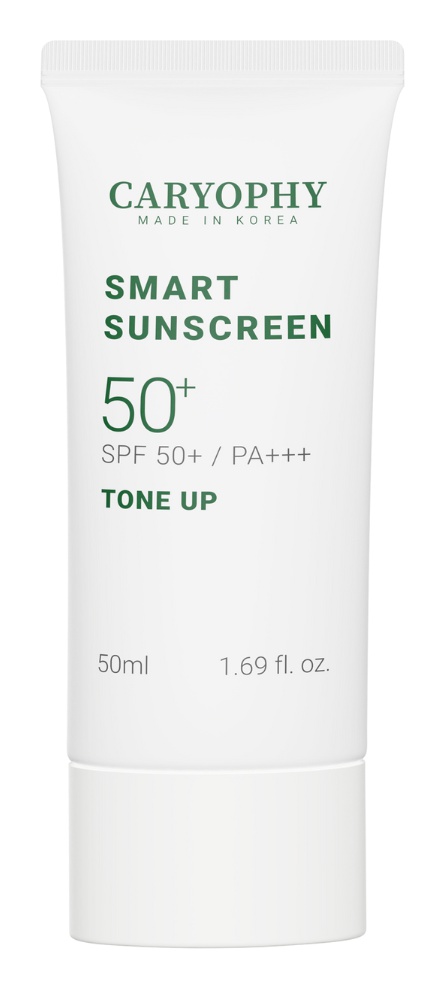
Smart Sunsccreen Tone Up
Ingredients overview
Highlights
Key Ingredients
Other Ingredients
Skim through
CARYOPHY Smart Sunsccreen Tone UpIngredients explained
Good old water, aka H2O. The most common skincare ingredient of all. You can usually find it right in the very first spot of the ingredient list, meaning it’s the biggest thing out of all the stuff that makes up the product.
It’s mainly a solvent for ingredients that do not like to dissolve in oils but rather in water.
Once inside the skin, it hydrates, but not from the outside - putting pure water on the skin (hello long baths!) is drying.
One more thing: the water used in cosmetics is purified and deionized (it means that almost all of the mineral ions inside it is removed). Like this, the products can stay more stable over time.
A super commonly used 5 unit long, cyclic structured silicone that is water-thin and does not stay on the skin but evaporates from it (called volatile silicone). Similar to other silicones, it gives skin and hair a silky, smooth feel.
It's often combined with the non-volatile (i.e. stays on the skin) dimethicone as the two together form a water-resistant, breathable protective barrier on the skin without a negative tacky feel.
When it comes to sunscreen agents, Zinc Oxide is pretty much in a league of its own. It's a physical (or inorganic) sunscreen that has a lot in common with fellow inorganic sunscreen Titanium Dioxide (TiO2) but a couple of things make it superior even to TiO2.
If physical sunscreens don't tell you anything, go ahead and read about the basics here. Most of what we wrote about Titanium Dioxide is also true for Zinc Oxide so we will focus here on the differences.
The first main difference is that while TiO2 gives a nice broad spectrum protection, Zinc Oxide has an even nicer and even broader spectrum protection. It protects against UVB, UVA II, and UVA I almost uniformly, and is considered to be the broadest range sunscreen available today.
It's also highly stable and non-irritating. So much so that Zinc Oxide also counts as a skin protectant and anti-irritant. It's also often used to treat skin irritations such as diaper rash.
As for the disadvantages, Zinc Oxide is also not cosmetically elegant. It leaves a disturbing whitish tint on the skin, although, according to a 2000 research paper by Dr. Pinnell, it's slightly less white than TiO2. Still, it's white and disturbing enough to use Zinc Oxide nanoparticles more and more often.
We wrote more about nanoparticles and the concerns around them here, but the gist is that if nanoparticles were absorbed into the skin that would be a reason for legitimate health concerns. But luckily, so far research shows that sunscreen nanoparticles are not absorbed but remain on the surface of the skin or in the uppermost (dead) layer of the skin. This seems to be true even if the skin is damaged, for example, sunburnt.
All in all, if you've found a Zinc Oxide sunscreen that you are happy to use every single day, that's fantastic and we suggest you stick with it. It's definitely one of the best, or probably even the best option out there for sun protection available worldwide.
A clear, oil-soluble, "cosmetically-elegant" liquid that is the most commonly used chemical sunscreen. It absorbs UVB radiation (at wavelengths: 280-320 nm) with a peak protection at 310nm.
It only protects against UVB and not UVA rays (the 320-400 nm range) – so always choose products that contain other sunscreens too. It is not very stable either, when exposed to sunlight, it kind of breaks down and loses its effectiveness (not instantly, but over time - it loses 10% of its SPF protection ability within 35 mins). To make it more stable it can be - and should be - combined with other sunscreen agents to give stable and broad-spectrum protection (the new generation sunscreen agent, Tinosorb S is a particularly good one for that).
Regarding safety, there are also some concerns around Octinoxate. In vitro (made in the lab not on real people) and animal studies have shown that it may produce hormonal (estrogen-like) effects. Do not panic, the studies were not conducted under real life conditions on real human people, so it is probably over-cautious to avoid Octinoxate altogether. However, if you are pregnant or a small child (under 2 yrs. old), choose a physical (zinc oxide/titanium dioxide) or new-generation Tinosorb based sunscreen, just to be on the super-safe side. :)
Overall, Ethylhexyl Methoxycinnamate is an old-school chemical sunscreen agent. There are plenty of better options for sun protection today, but it is considered "safe as used" (and sunscreens are pretty well regulated) and it is available worldwide (can be used up to 10% in the EU and up to 7.5% in the US).
 We don't have description for this ingredient yet.
A biodegradable emollient that gives a fresh gliding sensation and a powdery after feel. It works well with all kinds of oils including natural and silicone oils.
A chemical sunscreen agent that gives strong protection in the UVB (280-320nm) range with its peak protection at 306 nm. Its special property is that unlike most sunscreen agents, it is not oil but water soluble, so it is ideal to create light, oily skin compatible formulas. It is also fairly photostable and can be used to protect other less stable UV filters (like famous UVA blocker, avobenzone) in the formula. It is approved worldwide and can be used up to 4% in the US and up to 8% in the EU.
We don't have description for this ingredient yet.
A silicone emulsifier that helps water and silicone oils to mix nicely together.
Titanium Dioxide is one of the two members of the elite sunscreen group called physical sunscreens (or inorganic sunscreens if you’re a science geek and want to be precise).
Traditionally, UV-filters are categorized as either chemical or physical. The big difference is supposed to be that chemical agents absorb UV-light while physical agents reflect it like a bunch of mini umbrellas on top of the skin. While this categorization is easy and logical it turns out it's not true. A recent, 2016 study shows that inorganic sunscreens work mostly by absorption, just like chemical filters, and only a little bit by reflection (they do reflect the light in the visible spectrum, but mostly absorb in the UV spectrum).
Anyway, it doesn't matter if it reflects or absorbs, Titanium Dioxide is a pretty awesome sunscreen agent for two main reasons: it gives a nice broad spectrum coverage and it's highly stable. Its protection is very good between 290 - 350 nm (UVB and UVA II range), and less good at 350-400 nm (UVA I) range. Regular sized Titanium Dioxide also has a great safety profile, it's non-irritating and is pretty much free from any health concerns (like estrogenic effect worries with some chemical filters).
The disadvantage of Titanium Dioxide is that it's not cosmetically elegant, meaning it's a white, "unspreadable" mess. Sunscreens containing Titanium Dioxide are often hard to spread on the skin and they leave a disturbing whitish tint. The cosmetic industry is, of course, really trying to solve this problem and the best solution so far is using nanoparticles. The itsy-bitsy Nano-sized particles improve both spreadability and reduce the whitish tint a lot, but unfortunately, it also introduces new health concerns.
The main concern with nanoparticles is that they are so tiny that they are absorbed into the skin more than we want them (ideally sunscreen should remain on the surface of the skin). Once absorbed they might form unwanted complexes with proteins and they might promote the formation of evil free radicals. But do not panic, these are concerns under investigation. A 2009 review article about the safety of nanoparticles summarizes this, "to date, in-vivo and in-vitro studies have not demonstrated percutaneous penetration of nanosized particles in titanium dioxide and zinc oxide sunscreens". The English translation is, so far it looks like sunscreens with nanoparticles do stay on the surface of the skin where they should be.
All in all, Titanium Dioxide is a famous sunscreen agent and for good reason, it gives broad spectrum UV protection (best at UVB and UVA II), it's highly stable, and it has a good safety profile. It's definitely one of the best UV-filter agents we have today, especially in the US where new-generation Tinosorb filters are not (yet) approved.
A silicone fluid that gives a nonoily, easy to spread emolliency to the formulas. It is also used as a water repellent additive and to reduce the tackiness and stickiness of other ingredients. It also imparts gloss, softness and better manageability to hair.
Sodium chloride is the fancy name of salt. Normal, everyday table salt.
If (similar to us) you are in the weird habit of reading the label on your shower gel while taking a shower, you might have noticed that sodium chloride is almost always on the ingredient list. The reason for this is that salt acts as a fantastic thickener in cleansing formulas created with ionic cleansing agents (aka surfactants) such as Sodium Laureth Sulfate. A couple of percents (typically 1-3%) turns a runny surfactant solution into a nice gel texture.
If you are into chemistry (if not, we understand, just skip this paragraph), the reason is that electrolytes (you know, the Na+ and Cl- ions) screen the electrostatic repulsion between the head groups of ionic surfactants and thus support the formation of long shaped micelles (instead of spherical ones) that entangle like spaghetti, and viola, a gel is formed. However, too much of it causes the phenomenon called "salting out", and the surfactant solution goes runny again.
Other than that, salt also works as an emulsion stabilizer in water-in-oil emulsions, that is when water droplets are dispersed in the outer oil (or silicone) phase. And last but not least, when salt is right at the first spot of the ingredient list (and is not dissolved), the product is usually a body scrub where salt is the physical exfoliating agent.
Portulaca Oleracea is a nice succulent with bright yellow flowers and edible nutritious vegetables. It's a famous plant in Korean traditional medicine to treat infection and irritated skin.
Modern research confirms that it's loaded with skin-goodies: it's the richest green plant source of omega-3 fatty acids (α-linolenic acid), contains NMFs (polysaccharides and amino acids), vitamins (β-carotene), minerals, and antioxidants (yellow betaxanthins and reddish betacyanins). Thanks to all its beneficial components, Purslane Extract has several magic properties: it's a great anti-inflammatory and antioxidant agent and also has wound healing abilities.
Centella Asiatica - or sometimes also called Gotu Kola or Cica - has been used in folk medicine for hundreds of years. It’s traditionally used to improve small wounds, burns and scratches and it’s also a well known anti-inflammatory agent for eczema.
Recently science has taken an interest in Gotu Kola as well and it turns out it really has many active compounds with several benefits. Just for hard-core geeks, the main biologically active compounds are pentacyclic triterpenoid saponins called asiaticoside, madecassoside, asiatic and madecassic acid (also called centellosides).
One of the biological activities of the centellosides is to be able to stimulate GAGs (glycosaminoglycans - polysaccharides that are part of the liquidy stuff between our skin cells), and especially hyaluronic acid synthesis in our skin. This is probably one of the reasons why Centella Asiatica Extract has nice skin moisturizing properties that was confirmed by a 25 people, four weeks study along with Centella's anti-inflammatory effects.
Madecassoside can also help in burn wound healing through increasing antioxidant activity and enhancing collagen synthesis. Asiaticoside was shown to increase antioxidant levels on rats skin when applied at 0.2%.
Centella Asiatica also often shows up in products that try to treat cellulite or striae. Of course, it cannot make a miracle but it might have some effect via regulating microcirculation and normalizing the metabolism in the cells of connective tissues.
Bottom line: Gotu Kola is a great plant ingredient with proven wound healing, anti-inflammatory, and antioxidant properties. Nice to spot on any ingredient list.
We don't have description for this ingredient yet.
Beetroot is a beautifully colored vegetable that you probably know from the kitchen. As for skincare - according to manufacturer info - it works as a natural moisturizer that might be able to increase the concentration of NMFs (natural moisturizing factors) in the upper layer of the skin giving skin both immediate and longer term hydration.
According to Paula's Choice, it's also a colorant and a source of antioxidants.
The famous omega-6 fatty acid, the mother of all ω-6 fatty acids in our body. It is a so-called polyunsaturated fatty acid meaning it has more than one (in this case two) double bonds and a somewhat kinky structure that makes LA and LA-rich oils a thin liquid.
It is also an essential fatty acid meaning our body cannot synthesize it and has to take it from food. This is not hard at all as plenty of nuts (such as flax, poppy or sesame seeds) and vegetable oils (such as sunflower or safflower) are rich in LA. The hard thing seems to be eating enough omega-3-s, more specifically eating a healthy ratio of omega-6 to omega-3, but that is a topic for a what-is-good-to-eat-site and not for us.
As for linoleic acid and the skin, LA is a really important little guy found naturally in our skin. It is the most abundant fatty acid in the epidermis and it serves as a structural precursor for important skin lipids called ceramides. Knowing this, it will not come as a surprise that Linoleic acid has a central role in the structure and function of stratum corneum permeability, aka healthy skin barrier. LA deficiency leads to an impaired more permeable skin barrier and the topical application of LA-rich sunflower oil can fix this issue rapidly (while oleic-rich olive oil did not have the same barrier repairing effect).
LA is not only important for dry, barrier damaged skin types but also for acne-prone skin. Research shows that problem skin has lower levels of linoleic acid (and higher levels of oleic acid) than normal skin. So LA-deficiency in the skin seems to be connected not only to an impaired skin barrier but also to acne and smearing LA all over your face might help with your problem skin. A double-blind study using a 2.5% LA gel for 4 weeks found a 25% reduction in the size of microcomedones, the tiny blocked pores that can later lead to acne.
If that was not enough, we have one more thing to report about LA. It lightens hyperpigmentation (aka UVB caused sun spots) both by blocking the melanin production of melanocytes (the skin cells that make the pigment melanin) and by enhancing the desquamation of melanin pigment from the upper layers of the skin.
Overall, linoleic acid is a multi-functional skin goodie with barrier repairing, acne-reducing, and skin-lightening magic abilities. It's a nice one to spot on the ingredient list pretty much for any skin type.
The famous omega-3 fatty acid, the mother of all ω-3 fatty acids in our body. Next to linoleic acid, it is the other essential fatty acid that our body cannot synthesize and we have to ingest it from our food. It is also a PUFA, aka polyunsaturated fatty acid with three double bonds, a kinky chemical structure and thus a liquid consistency.
While linoleic acid is abundant in the skin, this is not the case with alpha-linolenic acid (ALA). It is not entirely clear if it is meant to be like that or if this is a consequence of not eating enough Omega-3 with the typical Western diet.
Leafy green vegetables, walnuts, flax seeds and fish oils are rich sources of ALA and if you are not eating a lot from these, supplementing with fish oil is a pretty good idea backed by research. It is a good idea both in terms of general health benefits as well as potentially improving inflammation-related skin issues such as atopic dermatitis or acne.
As for using ALA topically, we have to say that its role and effects seem to be less direct than with LA. ALA's main role in the skin appears to be modulating the immune response of the epidermis. This is probably helpful for inflammatory skin diseases but most studies examine ALA as an oral supplement and not when applied topically. One exception, we could find, is a study that found that topically applied ALA has nice spot-fading abilities.
To be honest, it seems to us that oral supplementation of ALA is more important than smearing it all over your face. However, that is not to say that topical ALA is a bad thing, it is a good thing. It is a skin-identical ingredient, it is probably moisturizing and anti-inflammatory but its topical effects are less established than that of fellow omega fatty acid, linoleic acid.
Bifida Ferment Lysate is a probiotic ingredient that’s used in one of the most iconic serums in the world, the Estee Lauder Advanced Night Repair. Based on manufacturer info it potently protects against UV-induced damage in the skin and helps with DNA repair. An Estee Lauder patent from 2009 also talks about DNA repair activity.
As far as published research goes we could find one promising one. It showed that applying 10% bacterial extract to sensitive, reactive skin helped with better barrier function and decreased skin sensitivity.
Overall, it is definitely a promising ingredient, even for sensitive skin types but not the most proven one (yet).
It’s the - sodium form - cousin of the famous NMF, hyaluronic acid (HA). If HA does not tell you anything we have a super detailed, geeky explanation about it here. The TL; DR version of HA is that it's a huge polymer (big molecule from repeated subunits) found in the skin that acts as a sponge helping the skin to hold onto water, being plump and elastic. HA is famous for its crazy water holding capacity as it can bind up to 1000 times its own weight in water.
As far as skincare goes, sodium hyaluronate and hyaluronic acid are pretty much the same and the two names are used interchangeably. As cosmetic chemist kindofstephen writes on reddit "sodium hyaluronate disassociates into hyaluronic acid molecule and a sodium atom in solution".
In spite of this, if you search for "hyaluronic acid vs sodium hyaluronate" you will find on multiple places that sodium hyaluronate is smaller and can penetrate the skin better. Chemically, this is definitely not true, as the two forms are almost the same, both are polymers and the subunits can be repeated in both forms as much as you like. (We also checked Prospector for sodium hyaluronate versions actually used in cosmetic products and found that the most common molecular weight was 1.5-1.8 million Da that absolutely counts as high molecular weight).
What seems to be a true difference, though, is that the salt form is more stable, easier to formulate and cheaper so it pops up more often on the ingredient lists.
If you wanna become a real HA-and-the-skin expert you can read way more about the topic at hyaluronic acid (including penetration-questions, differences between high and low molecular weight versions and a bunch of references to scientific literature).
One of the main biologically active components of the famous medicinal plant, Centella Asiatica, aka Gotu Kola. It has well established wound healing and antioxidant activities.
In-vitro (made in the lab) studies also show that Asiaticoside stimulates GAGs (glycosaminoglycans - polysaccharides that are part of the liquidy stuff between our skin cells) production as well as collagen I synthesis. Read more at Gotu Kola >>
One of the biologically active components of Gotu Kola that is thought to contribute to the plant extract's well-documented skin regenerating, wound healing, and moisturizing properties.
If you are into Gotu Kola we have some more info at Centella Asiatica Extract and its other biologically active components Madecassoside, Asiaticoside and Asiatic Acid.
One of the biologically active components of Gotu Kola. It's a bit less prominent than its sister component, Asiaticoside, but in-vitro (made in the lab) studies show that Asiatic Acid also stimulates GAGs (glycosaminoglycans - polysaccharides that are part of the liquidy stuff between our skin cells) production as well as collagen I synthesis.
English translation equals that it probably contributes to the well-established moisturizing and wound healing abilities of Gotu Kola.
One of the main biologically active components of the famous medicinal plant, Centella Asiatica, aka Gotu Kola. It has well established wound healing, skin-soothing and antioxidant activities.
There is also a study by La Roche Posay (belongs to L'Oreal) that examined the anti-aging effects of 5% Vitamin C combined with 0.1% Madecassoside. They mention that " Madecassoside is known to induce collagen expression and ⁄ or to modulate inflammatory mediators thus might prevent and correct some signs of aging." The surprisingly long, 6-month study observed "significant improvement of the clinical score for deep and superficial wrinkles, suppleness, firmness, roughness, and skin hydration", but Vitamin C in itself is already an anti-aging superstar, so it is hard to know how much Madecassoside did.
Another promising property of Madecassoside is that it seems to inhibit UV-induced melanin synthesis (test formula with 0.05% MA, used twice a day on 23 volunteers for 8 weeks), making it a great active for hyperpigmentation-prone skin.
If that would not be enough, the French manufacturer (Seppic) also has encouraging in-vivo studies on the molecule. Used at 0.2%, Madecassoside reduces redness and peeling in skin with light atopic dermatitis as well as itching in psoriasis-prone skin.
When it comes to grape and skincare, the seed extract and the seed oil steals most of the show. The reason for that is that the seed contains the majority of the skin goodies, the antioxidant superstar polyphenols.
The fruit also contains some, but it's less potent. However - according to manufacturer info - the fruit extract is not only an antioxidant, but it's also a soothing, moisturizing and nourishing agent.
We don't have description for this ingredient yet.
The essential oil coming from the leafs of the lovely herb, rosemary. It contains several fragrant components, including the well-known irritant, camphor (around 15%). It has a nice smell, is a potent antioxidant and it's also an antimicrobial agent.
If your skin is sensitive, it's probably a good idea to avoid it.
- A natural moisturizer that’s also in our skin
- A super common, safe, effective and cheap molecule used for more than 50 years
- Not only a simple moisturizer but knows much more: keeps the skin lipids between our skin cells in a healthy (liquid crystal) state, protects against irritation, helps to restore barrier
- Effective from as low as 3% with even more benefits for dry skin at higher concentrations up to 20-40%
- High-glycerin moisturizers are awesome for treating severely dry skin
Butylene glycol, or let’s just call it BG, is a multi-tasking colorless, syrupy liquid. It’s a great pick for creating a nice feeling product.
BG’s main job is usually to be a solvent for the other ingredients. Other tasks include helping the product to absorb faster and deeper into the skin (penetration enhancer), making the product spread nicely over the skin (slip agent), and attracting water (humectant) into the skin.
It’s an ingredient whose safety hasn’t been questioned so far by anyone (at least not that we know about). BG is approved by Ecocert and is also used enthusiastically in natural products. BTW, it’s also a food additive.
Propanediol is a natural alternative for the often used and often bad-mouthed propylene glycol. It's produced sustainably from corn sugar and it's Ecocert approved.
It's quite a multi-tasker: can be used to improve skin moisturization, as a solvent, to boost preservative efficacy or to influence the sensory properties of the end formula.
An extremely common multitasker ingredient that gives your skin a nice soft feel (emollient) and gives body to creams and lotions. It also helps to stabilize oil-water mixes (emulsions), though it does not function as an emulsifier in itself. Its typical use level in most cream type formulas is 2-3%.
It’s a so-called fatty alcohol, a mix of cetyl and stearyl alcohol, other two emollient fatty alcohols. Though chemically speaking, it is alcohol (as in, it has an -OH group in its molecule), its properties are totally different from the properties of low molecular weight or drying alcohols such as denat. alcohol. Fatty alcohols have a long oil-soluble (and thus emollient) tail part that makes them absolutely non-drying and non-irritating and are totally ok for the skin.
A sugar ester (sucrose + stearic acid) that works as a natural emulsifier (helps water and oil to mix). It's popular in oily gel cleansers as it improves the high-temperature stability of the formula.
Yellow Iron Oxide is the super common inorganic (as in no carbon atom in the molecule) pigment that gives the yellow tones in your foundation. Blended with red and black iron oxides, it is essential in all "flesh-toned" makeup products.
Chemically speaking, it is hydrated iron III oxide and depending on the conditions of manufacture, it can range from a light lemon to an orange-yellow shade.
Red Iron Oxide is the super common pigment that gives the familiar, "rust" red color. It is also the one that gives the pink tones in your foundation. Chemically speaking, it is iron III oxide (Fe2O3).
Talc is the major component of most powder makeup products (think face powder, eyeshadows, and blushers) that usually contain it up to 70%. Its two winning properties that make it very suitable for this role is its outstanding spreadability for a smooth application and its low covering power, aka translucency to avoid clown-like effects.
Chemically speaking, it is a clay mineral (hydrated magnesium silicate) that is mined in several countries. The drawback of mined minerals is potential impurities and the version used in cosmetics has to be white (not gray like cheaper grades), free from asbestos, sterilized and have thin plates for a maximum slip.
A white, elastomeric silicone powder that gives a nice silky and powdery feel to the products. It also has some oil and sebum absorption capabilities.
An organic derivative of hectorite clay, Disteardimonium Hectorite is used as a viscosity controller - it thickens up formulations to make them less runny.
It’s most popular use in cosmetics is in sunscreens, under the trademarked name Bentone 38 from Elementis. According to the manufacturer info, it is a real multi-tasker, including the ability to prevent pigments settling during storage, stabilizing a formula for longer, creating a light and smooth skin feel and enhancing the water-resistance of sunscreen formulas.
We don't have description for this ingredient yet.
It's a very alkaline stuff that helps to set the pH of the cosmetic formula to be just right. It's similar to the more often used sodium hydroxide and pretty much the same of what we wrote there applies here too.
A super common emollient that makes your skin feel nice and smooth. It comes from coconut oil and glycerin, it’s light-textured, clear, odorless and non-greasy. It’s a nice ingredient that just feels good on the skin, is super well tolerated by every skin type and easy to formulate with. No wonder it’s popular.
The snappily named Lauryl Peg-9 Polydimethylsiloxyethyl Dimethicone is a silicone emulsifier fluid whose main thing is being a good dispersant for powders such as mineral UV filters or color pigments.
According to the manufacturer Kobo, this partly water- and partly oily soluble form of dimethicone helps filters like Titanium Dioxide and Zinc Oxide disperse more evenly and thus provide better UV protection while also minimizing any white-cast that often comes hand-in-hand with mineral filters.
This is why it can also be found in makeup products like eyeshadows and concealers, as it helps disperse color pigments in the same way.
The attachment of glycerin and oleic acid that works mainly as a co-emulsifier and stabilizer to create stable water-oil mixes, aka emulsions. It is also popular in cleansing products as it helps to thicken them up and has some refatting and skin-smoothing effect.
It’s the most commonly used version of pure vitamin E in cosmetics. You can read all about the pure form here. This one is the so-called esterified version.
According to famous dermatologist, Leslie Baumann while tocopheryl acetate is more stable and has a longer shelf life, it’s also more poorly absorbed by the skin and may not have the same awesome photoprotective effects as pure Vit E.
A clear, light yellow liquid that is used to coat pigments (such as inorganic sunscreen agents or colorants) in cosmetic products. The coating helps to stabilize pigments in the formulas and also helps them to spread easily and evenly on the skin.
Officially, CosIng (the official EU ingredient database) lists Aluminum Hydroxide 's functions as opacifying (making the product white and non-transparent), as well as emollient and skin protectant.
However, with a little bit of digging, it turns out Aluminum Hyroxide often moonlights as a protective coating for UV filter superstar Titanium Dioxide. Specifically, it protects our skin from the harmful effects of nasty Reactive Oxygen Species (free radicals derived from oxygen such as Superoxide and Hydrogen Peroxide) generated when Titanium Dioxide is exposed to UV light. Btw, chlorine in swimming pool water depletes this protective coating, so one more reason to reapply your sunscreen after a dip in the pool on holiday.
Other than that, Aluminum Hydroxide also often shows up in composite pigment technologies where it is used the other way around (as the base material and not as the coating material) and helps to achieve higher color coverage with less pigment.
Probably the most common silicone of all. It is a polymer (created from repeating subunits) molecule and has different molecular weight and thus different viscosity versions from water-light to thick liquid.
As for skincare, it makes the skin silky smooth, creates a subtle gloss and forms a protective barrier (aka occlusive). Also, works well to fill in fine lines and wrinkles and give skin a plump look (of course that is only temporary, but still, it's nice). There are also scar treatment gels out there using dimethicone as their base ingredient. It helps to soften scars and increase their elasticity.
As for hair care, it is a non-volatile silicone meaning that it stays on the hair rather than evaporates from it and smoothes the hair like no other thing. Depending on your hair type, it can be a bit difficult to wash out and might cause some build-up (btw, this is not true to all silicones, only the non-volatile types).
A common multi-tasker fatty acid. It makes your skin feel nice and smooth (emollient), gives body to cream type products and helps to stabilize water and oil mixes (aka emulsions).
A handy multifunctional ingredient that works as a preservative booster, as well as an antioxidant and soothing agent.
A really multi-functional helper ingredient that can do several things in a skincare product: it can bring a soft and pleasant feel to the formula, it can act as a humectant and emollient, it can be a solvent for some other ingredients (for example it can help to stabilize perfumes in watery products) and it can also help to disperse pigments more evenly in makeup products. And that is still not all: it can also boost the antimicrobial activity of preservatives.
Super common little helper ingredient that helps products to remain nice and stable for a longer time. It does so by neutralizing the metal ions in the formula (that usually get into there from water) that would otherwise cause some not so nice changes.
It is typically used in tiny amounts, around 0.1% or less.
You may also want to take a look at...
| what‑it‑does | solvent |
| what‑it‑does | emollient | solvent |
| what‑it‑does | sunscreen |
| irritancy, com. | 0, 1 |
| what‑it‑does | sunscreen |
| irritancy, com. | 0, 0 |
| what‑it‑does | emollient |
| what‑it‑does | solvent | emollient |
| what‑it‑does | sunscreen |
| what‑it‑does | emulsifying | surfactant/cleansing |
| what‑it‑does | sunscreen | colorant |
| what‑it‑does | emollient |
| what‑it‑does | viscosity controlling |
| what‑it‑does | soothing | antioxidant |
| what‑it‑does | soothing | antioxidant | moisturizer/humectant |
| what‑it‑does | moisturizer/humectant |
| what‑it‑does | antioxidant | moisturizer/humectant |
| what‑it‑does | skin-identical ingredient | emollient | surfactant/cleansing |
| what‑it‑does | skin-identical ingredient | emollient | surfactant/cleansing | perfuming |
| what‑it‑does | skin-identical ingredient | moisturizer/humectant |
| irritancy, com. | 0, 0 |
| what‑it‑does | antioxidant | perfuming |
| what‑it‑does | antioxidant | soothing |
| what‑it‑does | soothing | antioxidant | moisturizer/humectant |
| what‑it‑does | chelating |
| what‑it‑does | antioxidant | antimicrobial/antibacterial |
| what‑it‑does | skin-identical ingredient | moisturizer/humectant |
| irritancy, com. | 0, 0 |
| what‑it‑does | moisturizer/humectant | solvent |
| irritancy, com. | 0, 1 |
| what‑it‑does | solvent | moisturizer/humectant |
| what‑it‑does | emollient | viscosity controlling | emulsifying | surfactant/cleansing |
| irritancy, com. | 1, 2 |
| what‑it‑does | emollient | emulsifying | surfactant/cleansing |
| irritancy, com. | 0, 0 |
| what‑it‑does | colorant |
| irritancy, com. | 0, 0 |
| what‑it‑does | colorant |
| irritancy, com. | 0, 0 |
| what‑it‑does | abrasive/scrub |
| irritancy, com. | 0, 1 |
| what‑it‑does | viscosity controlling |
| what‑it‑does | viscosity controlling |
| what‑it‑does | emulsifying |
| what‑it‑does | buffering |
| what‑it‑does | emollient |
| what‑it‑does | emulsifying | surfactant/cleansing |
| what‑it‑does | emollient | emulsifying | perfuming |
| what‑it‑does | antioxidant |
| irritancy, com. | 0, 0 |
| what‑it‑does | emollient | moisturizer/humectant | viscosity controlling |
| what‑it‑does | emollient |
| irritancy, com. | 0, 1 |
| what‑it‑does | emollient | viscosity controlling |
| irritancy, com. | 0, 2-3 |
| what‑it‑does | antioxidant | preservative |
| what‑it‑does | solvent |
| what‑it‑does | chelating |