





Ingredients overview
Highlights
Key Ingredients
Other Ingredients
Skim through
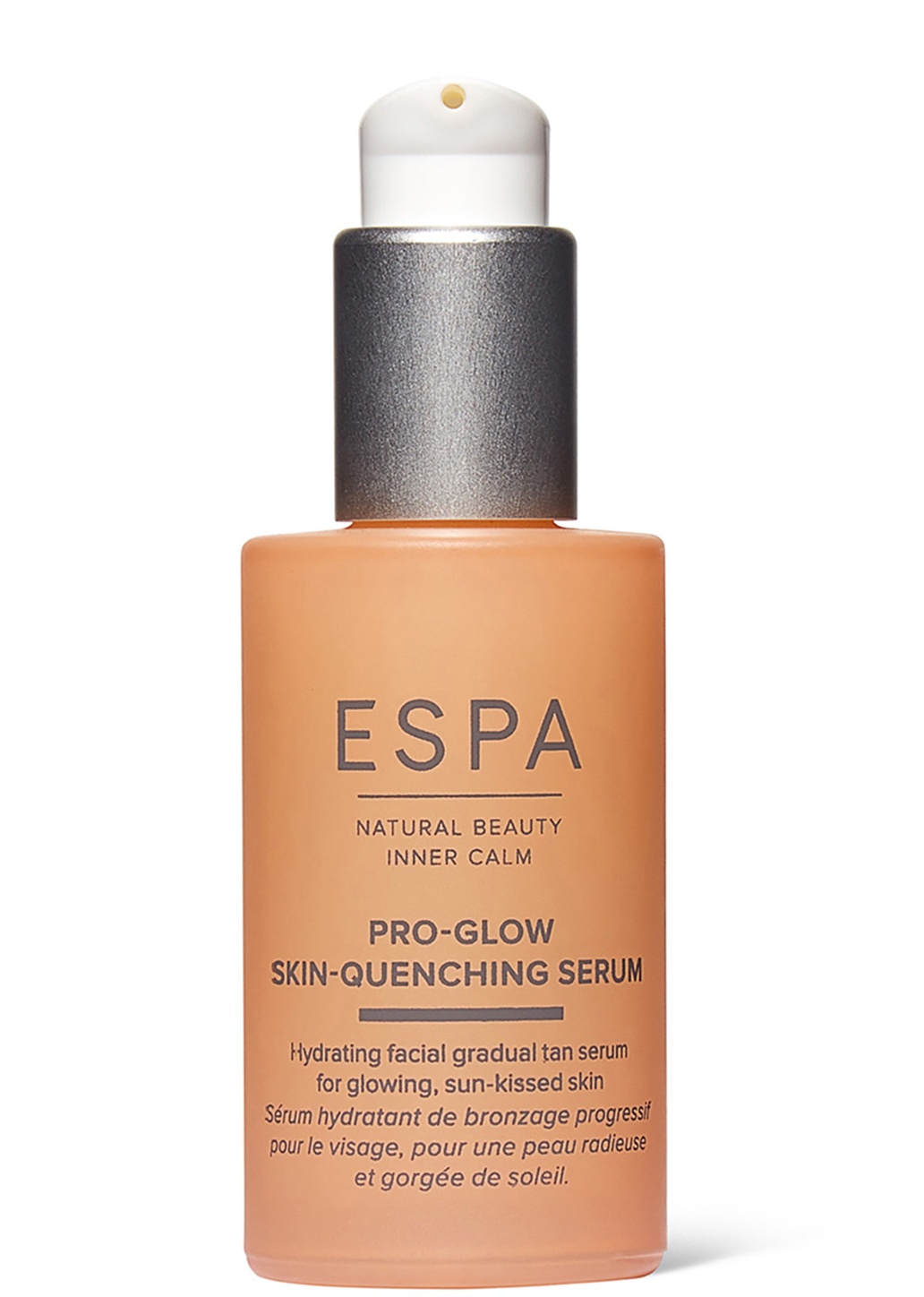
ESPA Pro-glow Skin-quenching SerumIngredients explained
Good old water, aka H2O. The most common skincare ingredient of all. You can usually find it right in the very first spot of the ingredient list, meaning it’s the biggest thing out of all the stuff that makes up the product.
It’s mainly a solvent for ingredients that do not like to dissolve in oils but rather in water.
Once inside the skin, it hydrates, but not from the outside - putting pure water on the skin (hello long baths!) is drying.
One more thing: the water used in cosmetics is purified and deionized (it means that almost all of the mineral ions inside it is removed). Like this, the products can stay more stable over time.
Aloe Vera is one of today’s magic plants. It does have some very nice properties indeed, though famous dermatologist Leslie Baumann warns us in her book that most of the evidence is anecdotal and the plant might be a bit overhyped.
What research does confirm about Aloe is that it’s a great moisturizer and has several anti-inflammatory (among others contains salicylates, polysaccharides, magnesium lactate and C-glucosyl chromone) as well as some antibacterial components. It also helps wound healing and skin regeneration in general. All in all definitely a goodie.
A multi-functional, silky feeling helper ingredient that can do quite many things. It's used as an emulsion stabilizer, solvent and a broad spectrum antimicrobial. According to manufacturer info, it's also a moisturizer and helps to make the product feel great on the skin. It works synergistically with preservatives and helps to improve water-resistance of sunscreens.
- A natural moisturizer that’s also in our skin
- A super common, safe, effective and cheap molecule used for more than 50 years
- Not only a simple moisturizer but knows much more: keeps the skin lipids between our skin cells in a healthy (liquid crystal) state, protects against irritation, helps to restore barrier
- Effective from as low as 3% with even more benefits for dry skin at higher concentrations up to 20-40%
- High-glycerin moisturizers are awesome for treating severely dry skin
Propanediol is a natural alternative for the often used and often bad-mouthed propylene glycol. It's produced sustainably from corn sugar and it's Ecocert approved.
It's quite a multi-tasker: can be used to improve skin moisturization, as a solvent, to boost preservative efficacy or to influence the sensory properties of the end formula.
A fermentation derived, natural (Ecocert approved) keto-sugar that works as a self-tanning active. It's claimed to lead to a deep, even and long-lasting tan without streaks and without causing skin dryness.
Compared to the other self-tanning active, DHA, Erythrulose works slower (takes a few days to develop the color, while with DHA it's only a couple of hours) but it also lasts longer. The two self-tanning actives are usually combined to give you fast but long lasting tans.
A 100% plant derived, natural (Ecocert approved) multi-functional ingredient that has emollient and moisturizing properties, can work as a co-emulsifier (meaning that next to other emulsifiers it can help water and oil to mix) and even more importantly has a strong antimicrobial activity.
Thanks to this last thing, it allows a lower percentage of traditional preservative or it might even be able to completely replace them.
Glyceryl stearate citrate is similar to the super common skincare ingredient glyceryl stearate, and is similarly used to help combine waters and oils (emulsifier) and to make your skin feel nice and soft (emollient).
The main difference between glyceryl stearate citrate and its cousin glyceryl stearate is that this one has a citric acid molecule also attached to its glycerin. This makes it what chemists call a diacylglycerol, which is a fancy word for two acids (in this case, citric acid and stearic acid) attached together with a glycerin bridge. But when it comes to cosmetics, all you need to know is that both glyceryl stearate citrate and glyceryl stearate are safe, tried and true emulsifiers. Expect to see them in formulas with both water-based and oil-based ingredients (think moisturizers and lotions).
A super common and cheap fragrance ingredient. It's in many plants, e.g. rosemary, eucalyptus, lavender, lemongrass, peppermint and it's the main component (about 50-90%) of the peel oil of citrus fruits.
It does smell nice but the problem is that it oxidizes on air exposure and the resulting stuff is not good for the skin. Oxidized limonene can cause allergic contact dermatitis and counts as a frequent skin sensitizer.
Limonene's nr1 function is definitely being a fragrance component, but there are several studies showing that it's also a penetration enhancer, mainly for oil-loving components.
All in all, limonene has some pros and cons, but - especially if your skin is sensitive - the cons probably outweigh the pros.
- Primary fat-soluble antioxidant in our skin
- Significant photoprotection against UVB rays
- Vit C + Vit E work in synergy and provide great photoprotection
- Has emollient properties
- Easy to formulate, stable and relatively inexpensive
 We don't have description for this ingredient yet.
The essential oil coming from the rind of the orange (the sweet one). In general, the main component of citrus peel oils is limonene (83-97% for sweet orange peel), a super common fragrant ingredient that makes everything smell nice (but counts as a frequent skin sensitizer).
Other than that, citrus peel also contains the problematic compound called furanocoumarin that makes them mildly phototoxic. Orange peel contains less of it than some other citruses (like bergamot or lime), but still, be careful with it especially if it is in a product for daytime use.
A big sugar molecule (polysaccharide) that is used as a natural thickening and gelling agent. It is similar to more commonly used Xanthan Gum, and the two are also often combined to create gel formulas or to stabilize emulsions.
It's the chemically chopped up version of normal lecithin. Most often it's used to create liposomes and to coat and stabilize other ingredients.
A helper ingredient that helps to make the products stay nice longer, aka preservative. It works mainly against fungi.
It’s pH dependent and works best at acidic pH levels (3-5). It’s not strong enough to be used in itself so it’s always combined with something else, often with potassium sorbate.
We don't have description for this ingredient yet.
An amino acid-based emulsifier that helps water and oil to mix and stay that way. It is considered as natural, environmentally friendly, and hypoallergenic.
It's one of the most commonly used thickeners and emulsion stabilizers. If the product is too runny, a little xanthan gum will make it more gel-like. Used alone, it can make the formula sticky and it is a good team player so it is usually combined with other thickeners and so-called rheology modifiers (helper ingredients that adjust the flow and thus the feel of the formula). The typical use level of Xantha Gum is below 1%, it is usually in the 0.1-0.5% range.
Btw, Xanthan gum is all natural, a chain of sugar molecules (polysaccharide) produced from individual sugar molecules (glucose and sucrose) via fermentation. It’s approved by Ecocert and also used in the food industry (E415).
The famous omega-6 fatty acid, the mother of all ω-6 fatty acids in our body. It is a so-called polyunsaturated fatty acid meaning it has more than one (in this case two) double bonds and a somewhat kinky structure that makes LA and LA-rich oils a thin liquid.
It is also an essential fatty acid meaning our body cannot synthesize it and has to take it from food. This is not hard at all as plenty of nuts (such as flax, poppy or sesame seeds) and vegetable oils (such as sunflower or safflower) are rich in LA. The hard thing seems to be eating enough omega-3-s, more specifically eating a healthy ratio of omega-6 to omega-3, but that is a topic for a what-is-good-to-eat-site and not for us.
As for linoleic acid and the skin, LA is a really important little guy found naturally in our skin. It is the most abundant fatty acid in the epidermis and it serves as a structural precursor for important skin lipids called ceramides. Knowing this, it will not come as a surprise that Linoleic acid has a central role in the structure and function of stratum corneum permeability, aka healthy skin barrier. LA deficiency leads to an impaired more permeable skin barrier and the topical application of LA-rich sunflower oil can fix this issue rapidly (while oleic-rich olive oil did not have the same barrier repairing effect).
LA is not only important for dry, barrier damaged skin types but also for acne-prone skin. Research shows that problem skin has lower levels of linoleic acid (and higher levels of oleic acid) than normal skin. So LA-deficiency in the skin seems to be connected not only to an impaired skin barrier but also to acne and smearing LA all over your face might help with your problem skin. A double-blind study using a 2.5% LA gel for 4 weeks found a 25% reduction in the size of microcomedones, the tiny blocked pores that can later lead to acne.
If that was not enough, we have one more thing to report about LA. It lightens hyperpigmentation (aka UVB caused sun spots) both by blocking the melanin production of melanocytes (the skin cells that make the pigment melanin) and by enhancing the desquamation of melanin pigment from the upper layers of the skin.
Overall, linoleic acid is a multi-functional skin goodie with barrier repairing, acne-reducing, and skin-lightening magic abilities. It's a nice one to spot on the ingredient list pretty much for any skin type.
The essential oil coming from the fruit (probably the rind) of the bergamot orange. It's a common top note in perfumes and contains (among others) fragrant compounds limonene (37%), linalyl acetate (30%) and linalool (8.8%).
A well-known issue with bergamot oil (apart from the fragrance allergens) is that it contains phototoxic compounds called furanocoumarins, but more and more commonly furanocoumarin-free versions are used in cosmetic products. Still, if you have sensitive skin and prefer fragrance-free products, bergamot oil is not for you.
The essential oil coming from the peel of the mandarin orange or tangor. In general, the main component of citrus peel oils is limonene (77-86% for mandarin peel), a super common fragrant ingredient that makes everything smell nice (but counts as a frequent skin sensitizer). Apart from smelling nice (and thus being a popular natural fragrance alternative), Mandarin Orange Oil also has significant antioxidant properties that's comparable to synthetic antioxidant BHT or oil-soluble antioxidant big shot vitamin E.
On the con side, the fragrant components of citrus peels might irritate sensitive skin and citrus peels also contain the problematic compound called furanocoumarin that makes them (mildly) phototoxic. Orange mandarin peel contains less from it than some other citruses (like bergamot or lime), but still, be careful with it especially if it's in a product for daytime use.
We don't have description for this ingredient yet.
A big sugar molecule coming from the edible fruit bodies of the Silver Ear mushroom in China. Its sugar constituents include Glucuronic acid, the same guy that is one of the building blocks of IT-moisturizer Hyaluronic Acid. It is claimed to have similarly awesome water-binding capacities meaning it works as an excellent skin moisturizer and humectant.
We have more info about Tremella Fuciformis here >>
Sunflower does not need a big intro as you probably use it in the kitchen as cooking oil, or you munch on the seeds as a healthy snack or you adore its big, beautiful yellow flower during the summer - or you do all of these and probably even more. And by even more we mean putting it all over your face as sunflower oil is one of the most commonly used plant oils in skincare.
It’s a real oldie: expressed directly from the seeds, the oil is used not for hundreds but thousands of years. According to The National Sunflower Association, there is evidence that both the plant and its oil were used by American Indians in the area of Arizona and New Mexico about 3000 BC. Do the math: it's more than 5000 years – definitely an oldie.
Our intro did get pretty big after all (sorry for that), so let's get to the point finally: sunflower oil - similar to other plant oils - is a great emollient that makes the skin smooth and nice and helps to keep it hydrated. It also protects the surface of the skin and enhances the damaged or irritated skin barrier. Leslie Bauman notes in Cosmetic Dermatology that one application of sunflower oil significantly speeds up the recovery of the skin barrier within an hour and sustains the results 5 hours after using it.
It's also loaded with fatty acids (mostly linoleic (50-74%) and oleic (14-35%)). The unrefined version (be sure to use that on your skin!) is especially high in linoleic acid that is great even for acne-prone skin. Its comedogen index is 0, meaning that it's pretty much an all skin-type oil.
Truth be told, there are many great plant oils and sunflower oil is definitely one of them.
A type of sugar that has water-binding properties and helps to keep your skin hydrated.
A common fatty acid that can be found in lots of plant oils. Its name, "oleic", means derived from olive oil, a plant oil rich in oleic acid, but avocado, macadamia and marula oils, just to name a few, are also oleic rich.
Its chemical structure is monounsaturated, meaning it has one double bond (cis-9) that makes it less kinky than polyunsaturated fatty acids with multiple double bonds. Less kinkiness means that oleic acid and OA-rich oils are a bit thicker and heavier than their LA-rich siblings.
Maybe this thickness is the reason that Oleic acid is considered comedogenic, and if you have acne-prone skin avoid OA-rich plant oils, and choose linoleic acid-rich versions instead.
The thickness of OA also means that OA-rich oils are considered more nourishing and moisturizing than their LA-rich counterparts, and are generally considered to be more suitable for dry, mature skin types.
As for oleic acid in its free form (and by free we mean that it is not bound up in a triglyceride structure like it is in oils), it mostly serves as an emulsifier or emulsion stabilizer in small amounts in regular cosmetic products. It is also quite well researched and is used in the pharmaceutical industry as a penetration enhancer.
Exactly what it sounds: nice smelling stuff put into cosmetic products so that the end product also smells nice. Fragrance in the US and parfum in the EU is a generic term on the ingredient list that is made up of 30 to 50 chemicals on average (but it can have as much as 200 components!).
If you are someone who likes to know what you put on your face then fragrance is not your best friend - there's no way to know what’s really in it.
Also, if your skin is sensitive, fragrance is again not your best friend. It’s the number one cause of contact allergy to cosmetics. It’s definitely a smart thing to avoid with sensitive skin (and fragrance of any type - natural is just as allergic as synthetic, if not worse!).
We don't have description for this ingredient yet.
Linalool is a super common fragrance ingredient. It’s kind of everywhere - both in plants and in cosmetic products. It’s part of 200 natural oils including lavender, ylang-ylang, bergamot, jasmine, geranium and it can be found in 90-95% of prestige perfumes on the market.
The problem with linalool is, that just like limonene it oxidises on air exposure and becomes allergenic. That’s why a product containing linalool that has been opened for several months is more likely to be allergenic than a fresh one.
A study made in the UK with 483 people tested the allergic reaction to 3% oxidised linalool and 2.3% had positive test results.
A super common emollient that makes your skin feel nice and smooth. It comes from coconut oil and glycerin, it’s light-textured, clear, odorless and non-greasy. It’s a nice ingredient that just feels good on the skin, is super well tolerated by every skin type and easy to formulate with. No wonder it’s popular.
We don't have description for this ingredient yet.
We don't have description for this ingredient yet.
A fatty acid that can be found naturally in the skin. In fact, it's the most common saturated fatty acid found in animals and plants.
As for skincare, it can make the skin feel nice and smooth in moisturizers (emollient) or it can act as a foam building cleansing agent in cleansers. It's also a very popular ingredient in shaving foams.
A common multi-tasker fatty acid. It makes your skin feel nice and smooth (emollient), gives body to cream type products and helps to stabilize water and oil mixes (aka emulsions).
Geraniol is a common fragrance ingredient. It smells like rose and can be found in rose oil or in small quantities in geranium, lemon and many other essential oils.
Just like other similar fragrance ingredients (like linalool and limonene) geraniol also oxidises on air exposure and becomes allergenic. Best to avoid if you have sensitive skin.
We don't have description for this ingredient yet.
We don't have description for this ingredient yet.
It’s a common fragrance ingredient that smells like lemon and has a bittersweet taste. It can be found in many plant oils, e.g. lemon, orange, lime or lemongrass.
It’s one of the “EU 26 fragrances” that has to be labelled separately (and cannot be simply included in the term “fragrance/perfume” on the label) because of allergen potential. Best to avoid if your skin is sensitive.
The famous omega-3 fatty acid, the mother of all ω-3 fatty acids in our body. Next to linoleic acid, it is the other essential fatty acid that our body cannot synthesize and we have to ingest it from our food. It is also a PUFA, aka polyunsaturated fatty acid with three double bonds, a kinky chemical structure and thus a liquid consistency.
While linoleic acid is abundant in the skin, this is not the case with alpha-linolenic acid (ALA). It is not entirely clear if it is meant to be like that or if this is a consequence of not eating enough Omega-3 with the typical Western diet.
Leafy green vegetables, walnuts, flax seeds and fish oils are rich sources of ALA and if you are not eating a lot from these, supplementing with fish oil is a pretty good idea backed by research. It is a good idea both in terms of general health benefits as well as potentially improving inflammation-related skin issues such as atopic dermatitis or acne.
As for using ALA topically, we have to say that its role and effects seem to be less direct than with LA. ALA's main role in the skin appears to be modulating the immune response of the epidermis. This is probably helpful for inflammatory skin diseases but most studies examine ALA as an oral supplement and not when applied topically. One exception, we could find, is a study that found that topically applied ALA has nice spot-fading abilities.
To be honest, it seems to us that oral supplementation of ALA is more important than smearing it all over your face. However, that is not to say that topical ALA is a bad thing, it is a good thing. It is a skin-identical ingredient, it is probably moisturizing and anti-inflammatory but its topical effects are less established than that of fellow omega fatty acid, linoleic acid.
The oil coming from the seeds of the Moringa tree, a big white-flowered tree native to India. It's a yellow oil similar to olive oil. It's rich in nourishing and moisturizing fatty acid, oleic (75%) and also contains behenic acid (up to 8%) that makes moringa very stable and gives the oil a long shelf life.
It blends easily with essential oils and can also help to stabilize scents so it's a popular oil in the perfume industry.
We don't have description for this ingredient yet.
Citric acid comes from citrus fruits and is an AHA. If these magic three letters don’t tell you anything, click here and read our detailed description on glycolic acid, the most famous AHA.
So citric acid is an exfoliant, that can - just like other AHAs - gently lift off the dead skin cells of your skin and make it more smooth and fresh.
There is also some research showing that citric acid with regular use (think three months and 20% concentration) can help sun-damaged skin, increase skin thickness and some nice hydrating things called glycosaminoglycans in the skin.
But according to a comparative study done in 1995, citric acid has less skin improving magic properties than glycolic or lactic acid. Probably that’s why citric acid is usually not used as an exfoliant but more as a helper ingredient in small amounts to adjust the pH of a formulation.
The essential oil coming from the flowers of bitter orange (which is the sister of the sweet orange we all know and eat). It contains several fragrance components including linalool (around 30%) and limonene (around 10%) and has a lovely sweet smell.
As it's an essential oil with lots of fragrant components, be careful with it if your skin is sensitive.
We are big fans of all kinds of roses as ornamental plants but when it comes to skincare, it is a mixed bag. Before we list out the good and the not so good, here is an interesting thing.
The oil content in rose is very, very low so distilling rose essential oil requires huge amounts of rose flowers. It has such a wonderful scent that there are no comparable synthetic alternatives. You can probably guess that this means rose essential oil is expensive.... very very expensive.
So the good things: thanks to its wonderful scent the high-end perfume industry loves rose oil. Also, we (humans :)) love rose oil. We love its scent so much that it can heal headaches, depression, stress, and even grief.
Rose oil contains more than 95 compounds, among them flavonoids, anthocyanins, vitamin C, and quercetin that are all known for their medicinal properties and great antioxidant effects. Similar to many other essential oils, it has antimicrobial properties too.
Now, the not-so-good thing? Out of the 95 compounds, the major ones are citronellol and geraniol, fragrant components that might irritate sensitive skin.
It's one of those things that help your cosmetics not to go wrong too soon, aka a preservative. It’s not a strong one and doesn’t really work against bacteria, but more against mold and yeast. To do that it has to break down to its active form, sorbic acid. For that to happen, there has to be water in the product and the right pH value (pH 3-4).
But even if everything is right, it’s not enough on its own. If you see potassium sorbate you should see some other preservative next to it too.
BTW, it’s also a food preservative and even has an E number, E202.
You may also want to take a look at...
| what‑it‑does | solvent |
| what‑it‑does | soothing | moisturizer/humectant |
| what‑it‑does | solvent | moisturizer/humectant |
| what‑it‑does | skin-identical ingredient | moisturizer/humectant |
| irritancy, com. | 0, 0 |
| what‑it‑does | solvent | moisturizer/humectant |
| what‑it‑does | preservative |
| what‑it‑does | emollient | emulsifying |
| what‑it‑does | perfuming | solvent |
| what‑it‑does | antioxidant |
| irritancy, com. | 0-3, 0-3 |
| what‑it‑does | emulsifying |
| what‑it‑does | perfuming |
| what‑it‑does | viscosity controlling |
| what‑it‑does | emollient | emulsifying |
| what‑it‑does | preservative |
| what‑it‑does | solvent |
| what‑it‑does | emulsifying | surfactant/cleansing |
| what‑it‑does | viscosity controlling |
| what‑it‑does | skin-identical ingredient | emollient | surfactant/cleansing |
| what‑it‑does | perfuming |
| what‑it‑does | perfuming |
| what‑it‑does | emollient | emulsifying |
| what‑it‑does | moisturizer/humectant |
| what‑it‑does | emollient |
| irritancy, com. | 0, 0 |
| what‑it‑does | moisturizer/humectant |
| what‑it‑does | emollient | emulsifying |
| what‑it‑does | perfuming |
| what‑it‑does | perfuming |
| what‑it‑does | emollient |
| what‑it‑does | skin-identical ingredient | emollient | emulsifying |
| irritancy, com. | 0, 2 |
| what‑it‑does | emollient | viscosity controlling |
| irritancy, com. | 0, 2-3 |
| what‑it‑does | perfuming |
| what‑it‑does | perfuming |
| what‑it‑does | perfuming |
| what‑it‑does | perfuming |
| what‑it‑does | skin-identical ingredient | emollient | surfactant/cleansing | perfuming |
| what‑it‑does | emollient |
| what‑it‑does | buffering |
| what‑it‑does | antioxidant | perfuming | antimicrobial/antibacterial |
| what‑it‑does | preservative |