





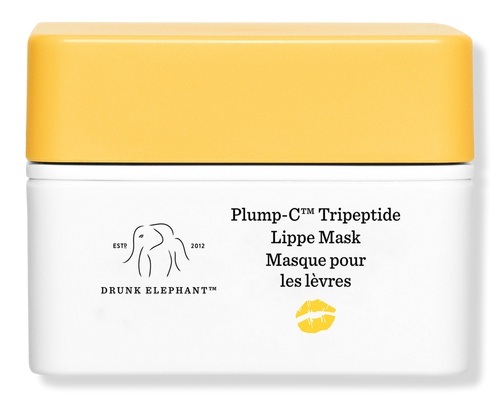
Plump-c Tripeptide Lippe Mask
Ingredients overview
Highlights
Key Ingredients
Other Ingredients
Skim through
Drunk Elephant Plump-c Tripeptide Lippe MaskIngredients explained
A thick, paste-like emollient ester that is touted as a vegetable-derived lanolin alternative. It has a smooth spreadability and touch, and it gives a substantive film to protect and moisturize the skin.
Castor oil is sourced from the castor bean plant native to tropical areas in Eastern Africa and the Mediterranean Basin. It is an age-old ingredient (it’s over 4,000 years old!) with many uses including as a shoe polish, food additive and motor lubricant. You would be reasonable to think that putting shoe polish on your face wouldn’t be the best idea, but it turns out castor oil has some unique properties that make it a stalwart in thick and gloss-giving formulas (think lipsticks and highlighters).
So what is so special about it? The answer is its main fatty acid, called ricinoleic acid (85-95%). Unlike other fatty acids, ricinoleic acid has an extra water-loving part (aka -OH group) on its fatty chain that gives Castor Oil several unique properties. First, it is thicker than other oils, then its solubility is different (e.g. dissolves in alcohol but not in mineral oil), and it allows all kinds of chemical modifications other oils do not, hence the lots of Castor oil-derived ingredients. It is also more glossy than other oils, in fact, it creates the highest gloss of all natural oils when applied to the skin. Other than that, it is a very effective emollient and occlusive that reduces skin moisture loss so it is quite common in smaller amounts in moisturizers.
While it is very unlikely (and this is true for pretty much every ingredient), cases of reactions to castor oil have been reported, so if your skin is sensitive, it never hurts to patch test.
 We don't have description for this ingredient yet.
A chemically modified version of castor oil that results in a solid, waxy material that serves as an emollient and consistency building material.
It also has some unique moisturizing properties as it is both occlusive and humectant. The former one is common for oils and waxes and it means that it sits on top of the skin hindering water to evaporate out of the top layers. The latter one, the humectant property, is surprising and comes from the unique property of ricinoleic acid (the dominant fatty acid in castor oil) having an extra water-loving -OH group on its otherwise oil-loving fatty chain. We have some more info about this at castor oil, so if you are interested, read on here.
If you have an interest in elephants and Africa, you have probably heard of elephants getting drunk from the fruit of the Marula tree. Though this seems to be only a legend, what is true is that the Marula fruit is really nice (and elephants do love to eat it) and there is a stone in it with several oil-rich kernels inside.
So the Marula oil - similar to many other plant oils - is a really nice nourishing and moisturizing oil that can improve skin hydration and smoothness and it can even reduce skin redness. It's traditionally used in South Africa to massage babies with and as a body lotion for face, feet, and hands.
As for its composition, it's loaded with skin goodies: it's very rich in fatty acids, including oleic (73%), palmitic (15%), and linoleic (9%) acids. It also contains some natural antioxidants, including Vitamin E and the oil shows an outstanding oxidative stability.
If you have dry skin that needs some pampering, Marula oil is a good choice.
A so-called dispersant or dispersing agent that's used in inorganic (titanium dioxide/zinc oxide based) sunscreens or in make-up products to help to distribute the pigments nicely and evenly on the skin. It's also claimed to increase the UV absorption of the sunscreen formula as well as to reduce the annoying white cast left behind by inorganic sunscreens.
Unless you live under a rock you must have heard about shea butter. It's probably the most hyped up natural butter in skincare today. It comes from the seeds of African Shea or Karite Trees and used as a magic moisturizer and emollient.
But it's not only a simple emollient, it regenerates and soothes the skin, protects it from external factors (such as UV rays or wind) and is also rich in antioxidants (among others vitamin A, E, F, quercetin and epigallocatechin gallate). If you are looking for rich emollient benefits + more, shea is hard to beat.
We don't have description for this ingredient yet.
The soft solid, off-white to ivory butter or oil coming from the kernel (the seed inside of the seed) of the Mango. Similar to many other plant oils, it's a great moisturizing and nourishing emollient oil. It has medium spreadability and gives skin a creamy-dry feel.
It's loaded with a bunch of good-for-the-skin stuff: it contains almost all of the essential amino acids, has several antioxidant phenolic compounds (including famous antioxidant ferulic acid) and is a rich source of nourishing fatty acids (like stearic and oleic acid).
All in all, a skin goodie especially for dry skin types.
The oil coming from the pulp of one of the most nutritious fruits in the world, the avocado. It's loaded with the nourishing and moisturizing fatty acid, oleic (70%) and contains some others including palmitic (10%) and linoleic acid (8%). It also contains a bunch of minerals and vitamins A, E and D.
Avocado oil has extraordinary skin penetration abilities and can nourish different skin layers. It's a very rich, highly moisturizing emollient oil that makes the skin smooth and nourished. Thanks to its vitamin E content it also has some antioxidant properties. As a high-oleic plant oil, it is recommended for dry skin.
The emollient plant oil coming from the kernel (the seed of the seed) of the delicious apricot fruit. Like other plant oils, it contains antioxidant vitamin E and nourishing fatty acids (mostly oleic acid 54-74%, linoleic acid 12-35%).
It's a nice general purpose emollient, has nourishing and moisturizing properties (as a high oleic oil it's ideal for dry skin types) and is quite easily absorbed into the skin.
If you have an interest in elephants and Africa, you have probably heard of elephants getting drunk from the fruit of the Marula tree. Though this seems to be only a legend, what is true is that the Marula fruit is really nice (and elephants do love to eat it) and there is a stone in it with several oil-rich kernels inside.
So the Marula oil - similar to many other plant oils - is a really nice nourishing and moisturizing oil that can improve skin hydration and smoothness and it can even reduce skin redness. It's traditionally used in South Africa to massage babies with and as a body lotion for face, feet, and hands.
As for its composition, it's loaded with skin goodies: it's very rich in fatty acids, including oleic (73%), palmitic (15%), and linoleic (9%) acids. It also contains some natural antioxidants, including Vitamin E and the oil shows an outstanding oxidative stability.
If you have dry skin that needs some pampering, Marula oil is a good choice.
A vegetable wax coming from the leaves of the North Mexican candelilla shrubs (Euphorbia cerifera and Euphorbia antisyphilitica). Similar to other waxes, it is used to stabilize products and give body to them, or to keep stick type formulas solid. It has a melting point around 70C and has high gloss making it a good choice for lip products.
PCA stands for Pyrrolidone Carboxylic Acid and though it might not sound like it, it is a thing that can be found naturally in our skin. The sodium salt form of PCA is an important skin-identical ingredient and great natural moisturizer that helps the skin to hold onto water and stay nicely hydrated.
A super common, medium-spreading emollient ester that gives richness to the formula and a mild feel during rubout. It can be a replacement for mineral oil and is often combined with other emollients to achieve different sensorial properties.
A really famous peptide that is part of Matrixyl 3000, the most sold peptide complex in the word. Before we go and find out what the big deal with Matrixyl 3000 is, let's just focus on Palmitoyl Tripeptide-1 itself for a bit.
It's a small three amino acid (they are the building blocks of all proteins) peptide with the amino sequence of glycine-histidine-lysine, or GHK. GHK is attached to palmitic acid (a fatty acid) to increase oil solubility and skin penetration.
The GHK part is the important one as it's a type I collagen fragment. When collagen naturally breaks down in the skin, the resulting peptide fragments signal to the skin that it should get to work and create some nice, new collagen. Adding in collagen fragment peptides, like GHK, might trick the skin into thinking that collagen has broken down and it's time to create some more.
Therefore, Palmitoyl Tripeptide-1 is believed to be able to stimulate collagen production in the skin, and more collagen means fewer wrinkles and younger looking skin.
In Matrixyl 3000, Palmitoyl Tripeptide-1 is coupled with Palmitoyl Tetrapeptide-7 and the duo works in synergy to reduce wrinkles and give younger looking skin. According to the manufacturer's in-vivo (made on real people) test, applying 3% Matrixyl 3000 twice a day for 2 months resulted in all of the following things:
- 39.4% reduction in surface occupied by deep wrinkles
- 32.9% reduction in main wrinkle density
- 19.9% reduction in main wrinkle average depth
- 16% improvement in roughness
- 16.2% in lifting effect
- 5.5% improvement in elasticity
- 15.5% improvement in skin tone
Manufacturer results, of course, always have to be taken with a pinch of salt, but if you like peptides, the Matryxil 3000 duo is one of the best-proven and most well-known ones and it's something that is worth trying.
A form of skincare superstar, Vitamin C. If you do not know, what the big deal about Vitamin C is, click here and read all about it, we will wait here for you.
So now you know that pure vitamin C (aka ascorbic acid, AA) is really unstable and hard to formulate so the cosmetics industry is coming up with a bunch of derivatives to solve the problem and Magnesium Ascorbyl Phosphate (or MAP) is one of them.
MAP does solve the stability problem: it's stable up to pH 7, so far so good. What is not so good is that, as the great review study about vitamin C derivatives in the Journal of Cosmetic Dermatology writes, MAP is "at very best, poorly absorbed in comparison to AA."
Moreover, derivatives not only have to be absorbed into the skin, they also have to be converted into pure AA. The good news is that in-vitro data shows that MAP does convert, but the bad news is we do not really know if the same is true on real, living human skin. Even if it does, we don't know how good the conversion rate is (but to be fair the same is true for all other derivatives).
Regarding the three magic abilities of pure vitamin C (antioxidant, collagen booster, skin brightener), there is no published data about MAP's antioxidant or photoprotection capabilities. We have better news about the other two things: in-vitro data shows that MAP can boost collagen synthesis similar to AA (though in the case of AA it's proven in-vivo) and even better, MAP is proven to work as a skin brightener in-vivo (on real people).
Bottom line: when it comes to vitamin C derivatives, MAP is definitely an option. We especially recommend it if you are after skin brightening as this seems to be the strongest point of MAP.
If EGCG does not tell you anything, green tea sure does. We have written about green tea in excruciating details, so if you wanna become an expert in the "green tea in skincare" topic, click here and read it.
So now you know that EGCG is the magic ingredient in green tea. It's the most active polyphenol that green tea owes most of its magic properties to. It's a fantastic antioxidant, anti-inflammatory and anticarcinogenic agent. Be happy, if you spot it on the ingredient list.
It's a special "cross-linked" from of IT-moisturizer, hyaluronic acid (HA). Cross-linked means that "normal" HA pieces (1-2 million Da molecular weight) are chemically bound togeather to create a big, "infinite" mesh.
The special HA mesh has a remarkable water-binding capacity, 5 times more than the already crazy water-binding capacity of "normal" HA. This water filled crosslinked HA gel forms a smooth film on the skin and continuously delivers the bound water, so it gives long-term moisturizing benefits.
Btw, crosslinking HA was developed for dermal fillers (as crosslinking helps their longevity), and this guy is the topical version of FDA approved dermal filler called Hylan B gel. Smearing crosslinked version all over ourselves is a newish thing, and incoming evidence so far suggests that it's a great idea, even better than normal HA.
A very recent, 2016 research article compared the topical moisturizing effect of crosslinked HA (not Hylan B gel specifically, but something called Resilient HA or RHA), HMW-HA and LMW-HA and found that "TEWL (that is trans-epidermal water loss, the water that evaporates from the skin) was reduced by 27.8% with RHA, and by 15.6% with HMW HA, but increased by 55.5% with LMW HA." (You can read much more about HMW and LMW HA here in the geeky details section.)
All in all, we think Sodium Hyaluronate Crosspolymer is an awesome version of HA, probably superior to traditional versions, so be happy to spot it on the ingredient list.
The sodium salt of lactic acid. It's a great skin moisturizer and also used to regulate the pH value of the cosmetic formula. It's a natural ingredient approved by both ECOCERT and COSMOS.
A common fatty acid that can be found in lots of plant oils. Its name, "oleic", means derived from olive oil, a plant oil rich in oleic acid, but avocado, macadamia and marula oils, just to name a few, are also oleic rich.
Its chemical structure is monounsaturated, meaning it has one double bond (cis-9) that makes it less kinky than polyunsaturated fatty acids with multiple double bonds. Less kinkiness means that oleic acid and OA-rich oils are a bit thicker and heavier than their LA-rich siblings.
Maybe this thickness is the reason that Oleic acid is considered comedogenic, and if you have acne-prone skin avoid OA-rich plant oils, and choose linoleic acid-rich versions instead.
The thickness of OA also means that OA-rich oils are considered more nourishing and moisturizing than their LA-rich counterparts, and are generally considered to be more suitable for dry, mature skin types.
As for oleic acid in its free form (and by free we mean that it is not bound up in a triglyceride structure like it is in oils), it mostly serves as an emulsifier or emulsion stabilizer in small amounts in regular cosmetic products. It is also quite well researched and is used in the pharmaceutical industry as a penetration enhancer.
PCA stands for Pyrrolidone Carboxylic Acid and though it might not sound like it, it is a thing that can be found naturally in our skin. In fact, after amino acids, it is the second biggest NMF component of the skin with 12% being PCA of the NMF composition of normal skin. So similar to other NMFs, it's a skin goodie that helps the skin to hold onto water and stay nicely hydrated.
A non-essential amino acid (a building block of skin proteins like collagen or elastin) that hydrates the skin.
A semi-essential (infants cannot synthesize it, but adults can) amino acid that is one of the primary building blocks of hair keratin and skin collagen. It's a natural moisturizing factor, a skin hydrator and might also help to speed up wound healing.
Arginine usually has a positive charge (cationic) that makes it substantive to skin and hair (those are more negatively charged surfaces) and an excellent film former. Thanks to the positive charge, it also creates a complex with AHAs (AHAs like to lose a hydrogen ion and be negatively charged, so the positive and the negative ions attract each other) that causes a "time-release AHA effect" and reduces the irritation associated with AHAs.
A non-essential amino acid (the building blocks of skin proteins, like collagen or elastin), that the body can produce itself, but its production decreases with age. When you put it all over your face, it works as a moisturizer and maybe more.
According to great skincare blog Futurederm, glycine might help with wound healing and tissue repair and when used together with other amino acids, leucine and proline it might improve wrinkles.
BTW, it's also a building block of a bunch of important and famous peptides, including copper-tripeptide-1, palmitoyl tripeptide-1 or palmitoyl hexapeptide-12.
A semi-essential amino acid meaning that enough has to be eaten from it so that the body does not use up essential amino acids (that our body cannot produce itself) to synthesize it. It has an important role in regulating the immune defense, allergic reactions, and inflammatory processes in the body.
As for skincare, it's a skin moisturizer that might also protect from some skin infections.
A branch-chained, essential amino acid that can be found in things like almond, cashew or soy protein. When taken orally it may promote protein synthesis. As for skincare - like all the amino acids - it's a skin-identical ingredient and moisturizer. It also seems to be useful as a barrier repair ingredient.
An essential amino acid that the body cannot produce itself but has to take from the diet. Combined with UVA exposure, phenylalanine is used in the treatment of vitiligo (a pigmentation disorder where patches of the skin lose the pigment).
A non-essential amino acid (meaning that our body can produce it) that's also one of the major building blocks of collagen. According to the Futurederm blog, it might be able to improve wrinkles when combined with other amino acids, glycine and leucine
Serine is an amino acid that most often comes to the formula as part of a moisturizing complex. It's a non-essential amino acid (meaning that our body can synthesize it) and serves as a water-binding ingredient.
In general, amino acids are great skincare ingredients that play an important role in proper skin hydration but there is not much info out there about what specifically serine can do for the skin.
An essential amino acid that's also a key building block of collagen and elastin. When taken orally, it helps the digestive and intestinal tracts function more smoothly and also helps the absorption of nutrients. As for skincare, it is not clear what it does other than being a skin hydrator.
An essential amino acid (a building block of skin proteins like collagen) that our body cannot produce itself but has to take from external sources, like diet.
It's a branched chain amino acid that is claimed to enhance energy, increase endurance and aid in muscle tissue recovery and repair when taken as a supplement. It's not clear what valine does when you put it on the skin, but as all amino acids, it must be at least a great skin hydrator.
A fatty acid that can be found naturally in the skin. In fact, it's the most common saturated fatty acid found in animals and plants.
As for skincare, it can make the skin feel nice and smooth in moisturizers (emollient) or it can act as a foam building cleansing agent in cleansers. It's also a very popular ingredient in shaving foams.
The salt form of one of the main anti-inflammatory ingredients in the licorice plant, monoammonium glycyrrhizinate. It’s a yellowish powder with a nice sweet smell.
It’s used mainly for its soothing and anti-inflammatory properties, but according to manufacturer info, it’s also sebum regulating so it's a perfect ingredient for problem skin products.
Read more about licorice and why it's a skincare superstar here.
The famous omega-6 fatty acid, the mother of all ω-6 fatty acids in our body. It is a so-called polyunsaturated fatty acid meaning it has more than one (in this case two) double bonds and a somewhat kinky structure that makes LA and LA-rich oils a thin liquid.
It is also an essential fatty acid meaning our body cannot synthesize it and has to take it from food. This is not hard at all as plenty of nuts (such as flax, poppy or sesame seeds) and vegetable oils (such as sunflower or safflower) are rich in LA. The hard thing seems to be eating enough omega-3-s, more specifically eating a healthy ratio of omega-6 to omega-3, but that is a topic for a what-is-good-to-eat-site and not for us.
As for linoleic acid and the skin, LA is a really important little guy found naturally in our skin. It is the most abundant fatty acid in the epidermis and it serves as a structural precursor for important skin lipids called ceramides. Knowing this, it will not come as a surprise that Linoleic acid has a central role in the structure and function of stratum corneum permeability, aka healthy skin barrier. LA deficiency leads to an impaired more permeable skin barrier and the topical application of LA-rich sunflower oil can fix this issue rapidly (while oleic-rich olive oil did not have the same barrier repairing effect).
LA is not only important for dry, barrier damaged skin types but also for acne-prone skin. Research shows that problem skin has lower levels of linoleic acid (and higher levels of oleic acid) than normal skin. So LA-deficiency in the skin seems to be connected not only to an impaired skin barrier but also to acne and smearing LA all over your face might help with your problem skin. A double-blind study using a 2.5% LA gel for 4 weeks found a 25% reduction in the size of microcomedones, the tiny blocked pores that can later lead to acne.
If that was not enough, we have one more thing to report about LA. It lightens hyperpigmentation (aka UVB caused sun spots) both by blocking the melanin production of melanocytes (the skin cells that make the pigment melanin) and by enhancing the desquamation of melanin pigment from the upper layers of the skin.
Overall, linoleic acid is a multi-functional skin goodie with barrier repairing, acne-reducing, and skin-lightening magic abilities. It's a nice one to spot on the ingredient list pretty much for any skin type.
The famous omega-3 fatty acid, the mother of all ω-3 fatty acids in our body. Next to linoleic acid, it is the other essential fatty acid that our body cannot synthesize and we have to ingest it from our food. It is also a PUFA, aka polyunsaturated fatty acid with three double bonds, a kinky chemical structure and thus a liquid consistency.
While linoleic acid is abundant in the skin, this is not the case with alpha-linolenic acid (ALA). It is not entirely clear if it is meant to be like that or if this is a consequence of not eating enough Omega-3 with the typical Western diet.
Leafy green vegetables, walnuts, flax seeds and fish oils are rich sources of ALA and if you are not eating a lot from these, supplementing with fish oil is a pretty good idea backed by research. It is a good idea both in terms of general health benefits as well as potentially improving inflammation-related skin issues such as atopic dermatitis or acne.
As for using ALA topically, we have to say that its role and effects seem to be less direct than with LA. ALA's main role in the skin appears to be modulating the immune response of the epidermis. This is probably helpful for inflammatory skin diseases but most studies examine ALA as an oral supplement and not when applied topically. One exception, we could find, is a study that found that topically applied ALA has nice spot-fading abilities.
To be honest, it seems to us that oral supplementation of ALA is more important than smearing it all over your face. However, that is not to say that topical ALA is a bad thing, it is a good thing. It is a skin-identical ingredient, it is probably moisturizing and anti-inflammatory but its topical effects are less established than that of fellow omega fatty acid, linoleic acid.
A non-essential amino acid (important building block of collagen and elastin) that hydrates the skin. It is also used to set the pH of the cosmetic product (buffering).
A hard wax coming from sunflower that has a high melting point and gives excellent thermal stability to the formulas. Similar to other waxes, it is used to stabilize products and give body to them, or to keep stick type formulas, such as lip balms, solid.
It's the triglyceride of behenic acid that works as a thickening or gelling agent, as a compacting agent for pressed powders, and improves heat stability of emulsions.
A common multi-tasker fatty acid. It makes your skin feel nice and smooth (emollient), gives body to cream type products and helps to stabilize water and oil mixes (aka emulsions).
- Primary fat-soluble antioxidant in our skin
- Significant photoprotection against UVB rays
- Vit C + Vit E work in synergy and provide great photoprotection
- Has emollient properties
- Easy to formulate, stable and relatively inexpensive
A multi-functional, silky feeling helper ingredient that can do quite many things. It's used as an emulsion stabilizer, solvent and a broad spectrum antimicrobial. According to manufacturer info, it's also a moisturizer and helps to make the product feel great on the skin. It works synergistically with preservatives and helps to improve water-resistance of sunscreens.
A handy helper ingredient that helps water and oil to mix nicely together, aka emulsifier. It is especially recommended for protective, baby care and general purpose emollient creams.
It also helps to disperse insoluble particles (think color pigments or zinc/titanium dioxide sunscreen) nice and even in cosmetic formulas.
- It’s the second most researched AHA after glycolic acid
- It gently lifts off dead skin cells to reveal newer, fresher, smoother skin
- It also has amazing skin hydrating properties
- In higher concentration (10% and up) it improves skin firmness, thickness and wrinkles
- Choose a product where you know the concentration and pH value because these two greatly influence effectiveness
- Don’t forget to use your sunscreen (in any case but especially so next to an AHA product)
Good old water, aka H2O. The most common skincare ingredient of all. You can usually find it right in the very first spot of the ingredient list, meaning it’s the biggest thing out of all the stuff that makes up the product.
It’s mainly a solvent for ingredients that do not like to dissolve in oils but rather in water.
Once inside the skin, it hydrates, but not from the outside - putting pure water on the skin (hello long baths!) is drying.
One more thing: the water used in cosmetics is purified and deionized (it means that almost all of the mineral ions inside it is removed). Like this, the products can stay more stable over time.
If you have spotted ethylhexylglycerin on the ingredient list, most probably you will see there also the current IT-preservative, phenoxyethanol. They are good friends because ethylhexylglycerin can boost the effectiveness of phenoxyethanol (and other preservatives) and as an added bonus it feels nice on the skin too.
Also, it's an effective deodorant and a medium spreading emollient.
You may also want to take a look at...
| what‑it‑does | emollient |
| what‑it‑does | emollient | perfuming |
| irritancy, com. | 0, 0-1 |
| what‑it‑does | emollient |
| what‑it‑does | emollient | viscosity controlling | emulsifying | surfactant/cleansing |
| irritancy, com. | 0, 1 |
| what‑it‑does | emollient |
| what‑it‑does | emulsifying |
| what‑it‑does | emollient |
| what‑it‑does | moisturizer/humectant |
| what‑it‑does | emollient |
| what‑it‑does | antioxidant | emollient |
| irritancy, com. | 0, 0-3 |
| what‑it‑does | emollient |
| irritancy, com. | 0, 1-2 |
| what‑it‑does | emollient |
| what‑it‑does | emollient |
| irritancy, com. | 0, 1 |
| what‑it‑does | skin-identical ingredient | moisturizer/humectant |
| irritancy, com. | 0, 0 |
| what‑it‑does | emollient |
| irritancy, com. | 0, 2-4 |
| what‑it‑does | cell-communicating ingredient |
| what‑it‑does | skin brightening | antioxidant |
| what‑it‑does | antioxidant | soothing |
| what‑it‑does | skin-identical ingredient | antioxidant | moisturizer/humectant |
| what‑it‑does | buffering | moisturizer/humectant |
| what‑it‑does | emollient | emulsifying |
| what‑it‑does | skin-identical ingredient | moisturizer/humectant |
| what‑it‑does | skin-identical ingredient |
| what‑it‑does | skin-identical ingredient |
| what‑it‑does | skin-identical ingredient |
| what‑it‑does | skin-identical ingredient | moisturizer/humectant |
| what‑it‑does | skin-identical ingredient |
| what‑it‑does | skin-identical ingredient |
| what‑it‑does | skin-identical ingredient |
| what‑it‑does | skin-identical ingredient |
| what‑it‑does | skin-identical ingredient |
| what‑it‑does | skin-identical ingredient |
| what‑it‑does | skin-identical ingredient | emollient | emulsifying |
| irritancy, com. | 0, 2 |
| what‑it‑does | soothing | moisturizer/humectant |
| what‑it‑does | skin-identical ingredient | emollient | surfactant/cleansing |
| what‑it‑does | skin-identical ingredient | emollient | surfactant/cleansing | perfuming |
| what‑it‑does | skin-identical ingredient |
| what‑it‑does | emollient |
| what‑it‑does | emollient |
| what‑it‑does | emollient | viscosity controlling |
| irritancy, com. | 0, 2-3 |
| what‑it‑does | antioxidant |
| irritancy, com. | 0-3, 0-3 |
| what‑it‑does | solvent | moisturizer/humectant |
| what‑it‑does | emulsifying |
| irritancy, com. | 0, 1-2 |
| what‑it‑does | exfoliant | moisturizer/humectant | buffering |
| what‑it‑does | solvent |
| what‑it‑does | preservative |