





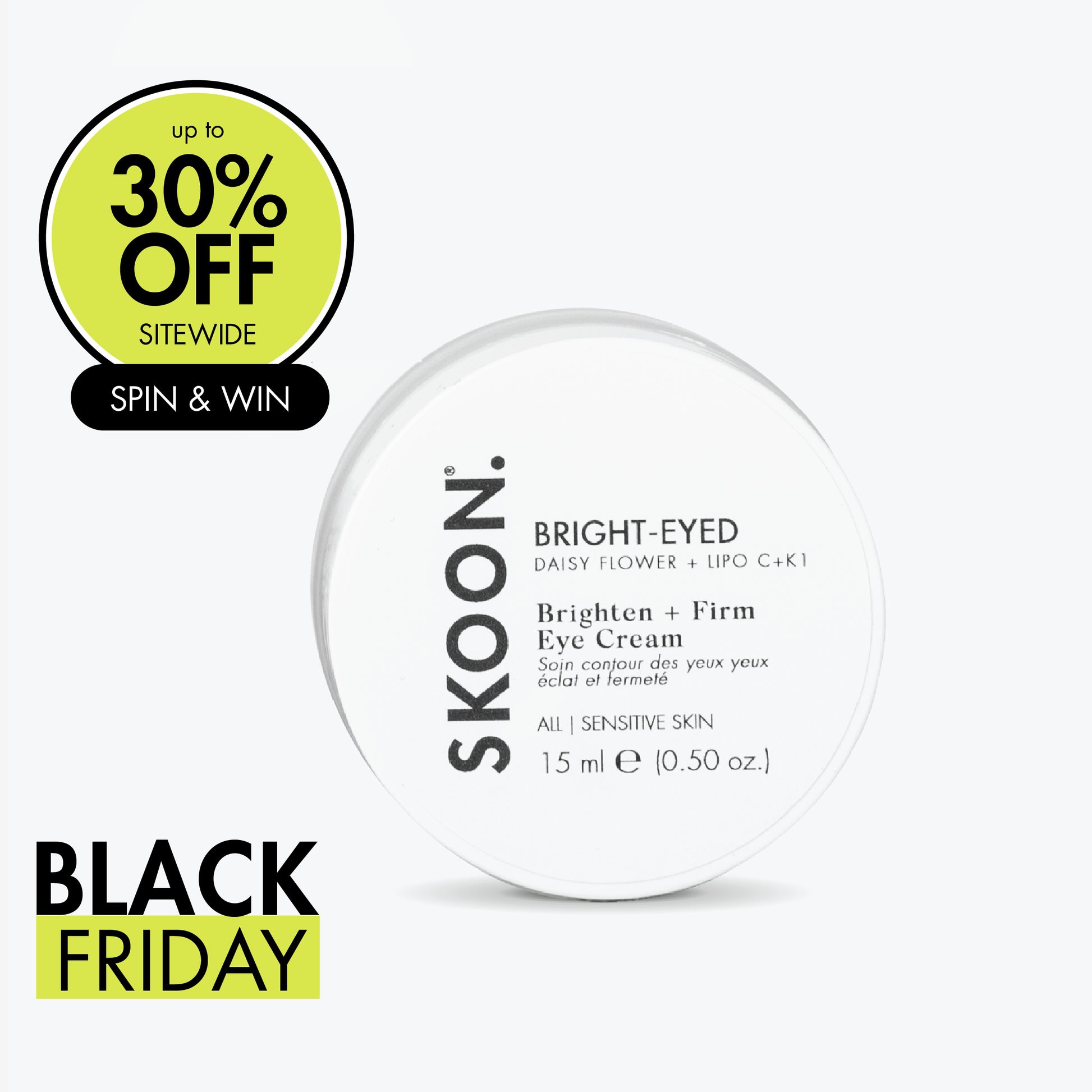
Bright-eyed Brighten + Firm Eye Cream
Ingredients overview
Highlights
Key Ingredients
Other Ingredients
Skim through
SKOON Bright-eyed Brighten + Firm Eye CreamIngredients explained
Good old water, aka H2O. The most common skincare ingredient of all. You can usually find it right in the very first spot of the ingredient list, meaning it’s the biggest thing out of all the stuff that makes up the product.
It’s mainly a solvent for ingredients that do not like to dissolve in oils but rather in water.
Once inside the skin, it hydrates, but not from the outside - putting pure water on the skin (hello long baths!) is drying.
One more thing: the water used in cosmetics is purified and deionized (it means that almost all of the mineral ions inside it is removed). Like this, the products can stay more stable over time.
Glyceryl stearate citrate is similar to the super common skincare ingredient glyceryl stearate, and is similarly used to help combine waters and oils (emulsifier) and to make your skin feel nice and soft (emollient).
The main difference between glyceryl stearate citrate and its cousin glyceryl stearate is that this one has a citric acid molecule also attached to its glycerin. This makes it what chemists call a diacylglycerol, which is a fancy word for two acids (in this case, citric acid and stearic acid) attached together with a glycerin bridge. But when it comes to cosmetics, all you need to know is that both glyceryl stearate citrate and glyceryl stearate are safe, tried and true emulsifiers. Expect to see them in formulas with both water-based and oil-based ingredients (think moisturizers and lotions).
- A natural moisturizer that’s also in our skin
- A super common, safe, effective and cheap molecule used for more than 50 years
- Not only a simple moisturizer but knows much more: keeps the skin lipids between our skin cells in a healthy (liquid crystal) state, protects against irritation, helps to restore barrier
- Effective from as low as 3% with even more benefits for dry skin at higher concentrations up to 20-40%
- High-glycerin moisturizers are awesome for treating severely dry skin
The oil coming from the seeds of the yellow flowered safflower plant. Similar to other plant oils, it's loaded with nourishing and moisturizing fatty acids: it's a high linoleic acid oil (70%) and has only smaller amounts of oleic acid (11%) (this might be great for acne-prone skin). It also contains antioxidant vitamin E (44mg/100g alpha-tocopherol).
There is definitely some craze going on for coconut oil both in the healthy eating space (often claimed to be the healthiest oil to cook with but this is a topic for another site) and in the skin and hair care space.
We will talk here about the latter two and see why we might want to smear it all over ourselves. Chemically speaking, coconut oil has a unique fatty acid profile. Unlike many plant oils that mostly contain unsaturated fatty acids (fatty acids with double bonds and kinky structure such as linoleic or oleic), coconut oil is mostly saturated (fatty acids with single bonds only) and its most important fatty acid is Lauric Acid (about 50%). Saturated fatty acids have a linear structure that can stack nice and tight and hence they are normally solid at room temperature. Coconut oil melts around 25 °C so it is solid in the tub but melts on contact with the skin.
The saturated nature of coconut oil also means that it is a heavy-duty-oil ideal for dry skin types. A double-blind research confirmed that extra virgin coconut oil is as effective in treating xerosis (aka very dry skin) as mineral oil. Another study found that coconut oil is more effective than mineral oil in treating mild to moderate atopic dermatitis (aka eczema) in children.
So when it comes to dry skin, coconut oil is a goodie, no question there. The question is if it is good or bad for acne-prone skin. Its main fatty acid, Lauric Acid has some research showing that it is a promising ingredient against evil acne-causing bacteria, P. acnes but at the same time, both Lauric Acid and coconut oil have a very high comedogenic rating (4 out of 5). Though comedogenic ratings are not very reliable, anecdotal evidence (i.e. people commenting in forums) shows that people have mixed experiences. While some claim that it worked wonders on their acne others say that it gave them serious blackheads and zits. Try it at your own risk.
As for hair care, coconut oil has pretty solid research showing that it can penetrate into the hair very well (better than mineral oil and sunflower oil) and it can prevent hair protein loss as well as combing damage. If you have problems with damaged hair, split ends, coconut oil is worth trying as a pre- or/and post-wash treatment. Labmuffin has an awesome blogpost explaining in more detail why coconut oil is good for your hair.
A couple of other things worth mentioning: coconut oil might help with wound healing (promising animal study), it has some antifungal activity (against dermatophytes that cause the thing known as ringworm) and it also works as an insect repellent against black flies.
Overall, coconut oil is definitely a goodie for the hair and dry skin. If that warrants for the magic oil status it enjoys, we don't know.
A clear, slightly yellow, odorless oil that's a very common, medium-spreading emollient. It makes the skin feel nice and smooth and works in a wide range of formulas.
A multi-functional, silky feeling helper ingredient that can do quite many things. It's used as an emulsion stabilizer, solvent and a broad spectrum antimicrobial. According to manufacturer info, it's also a moisturizer and helps to make the product feel great on the skin. It works synergistically with preservatives and helps to improve water-resistance of sunscreens.
The extract coming from the bark of the White Willow, a big (25 m/80 ft.) tree that likes to live on riverbanks. It's famous for containing anti-inflammatory natural salicylates (this powder, for example, is standardized to contain 53-65%), a close chemical relative to famous exfoliant salicylic acid.
Thanks to its salicin content, willow bark is often touted as a natural alternative to salicylic acid, though it's quite questionable how effective it is as a chemical exfoliant in the tiny amounts used in cosmetics. Apart from soothing salicin, it also contains flavonoids and phenolic acids that give willow bark tonic, astringent, and antiseptic properties.
The unsaponifiable part of sunflower oil. It's the small part of the oil that resists saponification, the chemical reaction that happens during soap making.
If you want to understand saponification more, here is a short explanation (if not, we understand, just skip this paragraph): Oils are mostly made up of triglyceride molecules (a glycerin + three fatty acids attached to it) and during the soap making process a strong base splits the triglyceride molecule up to become a separate glycerin and three soap molecules (sodium salts of fatty acids). The fantastic Labmuffin blog has a handy explanation with great drawings about the soap-making reaction.
So, the triglyceride molecules are the saponifiable part of the oil, and the rest is the unsaponifiable part. In the case of sunflower oil, it's about 1.5-2% of the oil and consists of skin nourishing molecules like free fatty acids (fatty acids not bound up in a triglyceride molecule, it contains mainly (48-74% according to its spec) barrier building linoleic acid), tocopherol (vitamin E) and sterols.
According to manufacturer's info, it's an oily ingredient that not only simply moisturizes the skin but also has great lipid-replenishing and soothing properties. The clinical study done by the manufacturer (on 20 people) found that a cream with 2% active increases skin moisturization by 48.6% after 1 hour, and 34.2% after 24 hours. Applied twice daily for 4 weeks, the study participants had a major improvement in skin dryness, roughness, and desquamation (skin peeling) parameters.
Unless you live under a rock you must have heard about shea butter. It's probably the most hyped up natural butter in skincare today. It comes from the seeds of African Shea or Karite Trees and used as a magic moisturizer and emollient.
But it's not only a simple emollient, it regenerates and soothes the skin, protects it from external factors (such as UV rays or wind) and is also rich in antioxidants (among others vitamin A, E, F, quercetin and epigallocatechin gallate). If you are looking for rich emollient benefits + more, shea is hard to beat.
- Primary fat-soluble antioxidant in our skin
- Significant photoprotection against UVB rays
- Vit C + Vit E work in synergy and provide great photoprotection
- Has emollient properties
- Easy to formulate, stable and relatively inexpensive
Sunflower does not need a big intro as you probably use it in the kitchen as cooking oil, or you munch on the seeds as a healthy snack or you adore its big, beautiful yellow flower during the summer - or you do all of these and probably even more. And by even more we mean putting it all over your face as sunflower oil is one of the most commonly used plant oils in skincare.
It’s a real oldie: expressed directly from the seeds, the oil is used not for hundreds but thousands of years. According to The National Sunflower Association, there is evidence that both the plant and its oil were used by American Indians in the area of Arizona and New Mexico about 3000 BC. Do the math: it's more than 5000 years – definitely an oldie.
Our intro did get pretty big after all (sorry for that), so let's get to the point finally: sunflower oil - similar to other plant oils - is a great emollient that makes the skin smooth and nice and helps to keep it hydrated. It also protects the surface of the skin and enhances the damaged or irritated skin barrier. Leslie Bauman notes in Cosmetic Dermatology that one application of sunflower oil significantly speeds up the recovery of the skin barrier within an hour and sustains the results 5 hours after using it.
It's also loaded with fatty acids (mostly linoleic (50-74%) and oleic (14-35%)). The unrefined version (be sure to use that on your skin!) is especially high in linoleic acid that is great even for acne-prone skin. Its comedogen index is 0, meaning that it's pretty much an all skin-type oil.
Truth be told, there are many great plant oils and sunflower oil is definitely one of them.
If you have an interest in elephants and Africa, you have probably heard of elephants getting drunk from the fruit of the Marula tree. Though this seems to be only a legend, what is true is that the Marula fruit is really nice (and elephants do love to eat it) and there is a stone in it with several oil-rich kernels inside.
So the Marula oil - similar to many other plant oils - is a really nice nourishing and moisturizing oil that can improve skin hydration and smoothness and it can even reduce skin redness. It's traditionally used in South Africa to massage babies with and as a body lotion for face, feet, and hands.
As for its composition, it's loaded with skin goodies: it's very rich in fatty acids, including oleic (73%), palmitic (15%), and linoleic (9%) acids. It also contains some natural antioxidants, including Vitamin E and the oil shows an outstanding oxidative stability.
If you have dry skin that needs some pampering, Marula oil is a good choice.
The sodium salt form of skincare superstar, vitamin C. If you do not know what the big fuss about vitamin C is, you are missing out and you have to click here and read all the geeky details about it.
Pure vitamin C (aka ascorbic acid, AA) is great and all, but its lack of stability is a big challenge for the cosmetics industry. One solution is to create stable derivatives that can be absorbed into the skin, convert there to AA and do all the magic AA is proven to do (which is being an antioxidant, a collagen booster, and a skin brightener).
SAP (the vit C derivative, not the enterprise software, obvs) is a promising derivative that has great stability up to pH 7. The challenge with it though is skin penetration. Unfortunately, it seems to be limited, or to quote a great article from the Journal of Cosmetic Dermatology "topically applied ascorbyl phosphate salts are, at very best, poorly absorbed in comparison with AA". Regarding conversion to AA, there seems to be no data about it, so we can neither deny nor confirm it.
We have better news regarding the three magic abilities of vitamin C: there is in-vivo (tested on real people) data showing that SAP does have photo-protective (aka antioxidant) properties, though less than pure AA. SAP might also aid collagen boosting; in-vitro (made in the lab) data shows that it works, but is less effective than another vitamin C derivative, called MAP (that seems to be as effective as pure AA). As for skin-brightening, there is a trade publication with in-vivo data showing that SAP can fade brown spots.
Another thing SAP might be able to do is to help with acne. A 2005 study showed in vitro (in test tubes) that 1% SAP has a strong antimicrobial activity on evil acne causing P. acnes and it also showed in vivo (on real people) that 5% SAP can strongly improve the inflammatory and non-inflammatory lesions of acne vulgaris. In fact, the results were comparable or even slightly better than with 5% benzoyl peroxide.
And there is even more regarding SAP and acne. A nice double-blind study from 2009 showed that 5% SAP reduced the inflammatory lesions by 20.14% and 48.82% within 4 and 8 weeks respectively and when combined with 0.2% retinol the results were even better. With this combination treatment, the improvement was 29.28% after 4 weeks and 63.10% after 8 weeks of application.
Aside from research studies, anecdotal evidence also supports SAP being a promising vitamin C derivative. One of the best-selling (vitamin C) serums in Sephora is the Ole Henriksen Truth Serum, while on Amazon it's the OzNaturals Vitamin C 20 Serum. Another popular choice is the Mad Hippie Vitamin C serum, and all of these contain vitamin C in the form of SAP.
Overall, we think SAP is a goody! In terms of anti-aging, it's probably not as effective as pure Ascorbic Acid, but it's totally worth a try. However, if your skin is acne-prone, SAP is your form of Vitamin C and it's a must-try.
It’s the - sodium form - cousin of the famous NMF, hyaluronic acid (HA). If HA does not tell you anything we have a super detailed, geeky explanation about it here. The TL; DR version of HA is that it's a huge polymer (big molecule from repeated subunits) found in the skin that acts as a sponge helping the skin to hold onto water, being plump and elastic. HA is famous for its crazy water holding capacity as it can bind up to 1000 times its own weight in water.
As far as skincare goes, sodium hyaluronate and hyaluronic acid are pretty much the same and the two names are used interchangeably. As cosmetic chemist kindofstephen writes on reddit "sodium hyaluronate disassociates into hyaluronic acid molecule and a sodium atom in solution".
In spite of this, if you search for "hyaluronic acid vs sodium hyaluronate" you will find on multiple places that sodium hyaluronate is smaller and can penetrate the skin better. Chemically, this is definitely not true, as the two forms are almost the same, both are polymers and the subunits can be repeated in both forms as much as you like. (We also checked Prospector for sodium hyaluronate versions actually used in cosmetic products and found that the most common molecular weight was 1.5-1.8 million Da that absolutely counts as high molecular weight).
What seems to be a true difference, though, is that the salt form is more stable, easier to formulate and cheaper so it pops up more often on the ingredient lists.
If you wanna become a real HA-and-the-skin expert you can read way more about the topic at hyaluronic acid (including penetration-questions, differences between high and low molecular weight versions and a bunch of references to scientific literature).
 We don't have description for this ingredient yet.
We don't have description for this ingredient yet.
One of the many types of ceramides that can be found naturally in the upper layer of the skin. Ceramides make up about 50% of the goopy stuff that's between our skin cells and play a super important role in having a healthy skin barrier and keeping the skin hydrated. It works even better when combined with its pal, Ceramide 1.
We wrote way more about ceramides at ceramide 1, so click here to know more.
It's one of the most commonly used thickeners and emulsion stabilizers. If the product is too runny, a little xanthan gum will make it more gel-like. Used alone, it can make the formula sticky and it is a good team player so it is usually combined with other thickeners and so-called rheology modifiers (helper ingredients that adjust the flow and thus the feel of the formula). The typical use level of Xantha Gum is below 1%, it is usually in the 0.1-0.5% range.
Btw, Xanthan gum is all natural, a chain of sugar molecules (polysaccharide) produced from individual sugar molecules (glucose and sucrose) via fermentation. It’s approved by Ecocert and also used in the food industry (E415).
A very common ingredient that can be found in all cell membranes. In cosmetics it's quite the multi-tasker: it's an emollient and water-binding ingredient but it's also an emulsifier and can be used for stabilization purposes. It's also often used to create liposomes.
A big sugar molecule (polysaccharide) that is used as a natural thickening and gelling agent. It is similar to more commonly used Xanthan Gum, and the two are also often combined to create gel formulas or to stabilize emulsions.
If you ever wondered what those little Listerine breath strips were made of, you found your answer! Pullulan is a polysaccharide polymer, which basically means that it’s a big molecule made up of smaller sugar molecule units.
It dissolves in water and can make a thin, elastic, and moisture-absorbing film when spread on the skin that can cause an instant tightening effect. It can also be used as a thickener to get a silicone-like feel and can be used in peel-off masks. Btw, it's made from fungus via fermentation.
A type of sugar molecule, that has water-binding properties and helps to keep your skin hydrated.
It’s one of those little helper ingredients that makes sure the product stays the same over time. No color change or anything like that. It does so by neutralizing the metal ions in the formula (that usually get into there from water) that would otherwise cause some not so nice changes.
Citric acid comes from citrus fruits and is an AHA. If these magic three letters don’t tell you anything, click here and read our detailed description on glycolic acid, the most famous AHA.
So citric acid is an exfoliant, that can - just like other AHAs - gently lift off the dead skin cells of your skin and make it more smooth and fresh.
There is also some research showing that citric acid with regular use (think three months and 20% concentration) can help sun-damaged skin, increase skin thickness and some nice hydrating things called glycosaminoglycans in the skin.
But according to a comparative study done in 1995, citric acid has less skin improving magic properties than glycolic or lactic acid. Probably that’s why citric acid is usually not used as an exfoliant but more as a helper ingredient in small amounts to adjust the pH of a formulation.
A so-called fatty (the good, non-drying kind of) alcohol that does all kinds of things in a skincare product: it makes your skin feel smooth and nice (emollient), helps to thicken up products and also helps water and oil to blend (emulsifier). Can be derived from coconut or palm kernel oil.
A helper ingredient that helps to make the products stay nice longer, aka preservative. It works mainly against fungi.
It’s pH dependent and works best at acidic pH levels (3-5). It’s not strong enough to be used in itself so it’s always combined with something else, often with potassium sorbate.
It's one of those things that help your cosmetics not to go wrong too soon, aka a preservative. It’s not a strong one and doesn’t really work against bacteria, but more against mold and yeast. To do that it has to break down to its active form, sorbic acid. For that to happen, there has to be water in the product and the right pH value (pH 3-4).
But even if everything is right, it’s not enough on its own. If you see potassium sorbate you should see some other preservative next to it too.
BTW, it’s also a food preservative and even has an E number, E202.
A vegetable origin (coconut or palm kernel oil and glucose) cleansing agent with great foaming abilities. It's also mild to the skin and readily biodegradable.
We don't have description for this ingredient yet.
A little helper ingredient that is used to adjust the pH of the product. It also helps to keep products stay nice longer by neutralizing the metal ions in the formula (they usually come from water).
A white powdery thing that's the major component of glass and sand. In cosmetics, it’s often in products that are supposed to keep your skin matte as it has great oil-absorbing abilities. It’s also used as a helper ingredient to thicken up products or suspend insoluble particles.
Sodium chloride is the fancy name of salt. Normal, everyday table salt.
If (similar to us) you are in the weird habit of reading the label on your shower gel while taking a shower, you might have noticed that sodium chloride is almost always on the ingredient list. The reason for this is that salt acts as a fantastic thickener in cleansing formulas created with ionic cleansing agents (aka surfactants) such as Sodium Laureth Sulfate. A couple of percents (typically 1-3%) turns a runny surfactant solution into a nice gel texture.
If you are into chemistry (if not, we understand, just skip this paragraph), the reason is that electrolytes (you know, the Na+ and Cl- ions) screen the electrostatic repulsion between the head groups of ionic surfactants and thus support the formation of long shaped micelles (instead of spherical ones) that entangle like spaghetti, and viola, a gel is formed. However, too much of it causes the phenomenon called "salting out", and the surfactant solution goes runny again.
Other than that, salt also works as an emulsion stabilizer in water-in-oil emulsions, that is when water droplets are dispersed in the outer oil (or silicone) phase. And last but not least, when salt is right at the first spot of the ingredient list (and is not dissolved), the product is usually a body scrub where salt is the physical exfoliating agent.
You may also want to take a look at...
| what‑it‑does | solvent |
| what‑it‑does | emollient | emulsifying |
| what‑it‑does | skin-identical ingredient | moisturizer/humectant |
| irritancy, com. | 0, 0 |
| what‑it‑does | antioxidant | emollient |
| irritancy, com. | 0, 0-2 |
| what‑it‑does | emollient | perfuming |
| irritancy, com. | 0, 4 |
| what‑it‑does | emollient | perfuming |
| what‑it‑does | solvent | moisturizer/humectant |
| what‑it‑does | soothing |
| what‑it‑does | soothing | skin-identical ingredient | emollient |
| what‑it‑does | emollient |
| what‑it‑does | antioxidant |
| irritancy, com. | 0-3, 0-3 |
| what‑it‑does | emollient |
| irritancy, com. | 0, 0 |
| what‑it‑does | emollient |
| what‑it‑does | antioxidant | anti-acne |
| what‑it‑does | skin-identical ingredient | moisturizer/humectant |
| irritancy, com. | 0, 0 |
| what‑it‑does | skin-identical ingredient |
| what‑it‑does | viscosity controlling |
| what‑it‑does | emollient | emulsifying |
| what‑it‑does | viscosity controlling |
| what‑it‑does | moisturizer/humectant |
| what‑it‑does | emulsifying |
| what‑it‑does | chelating |
| what‑it‑does | buffering |
| what‑it‑does | emollient | viscosity controlling |
| irritancy, com. | 2, 2 |
| what‑it‑does | preservative |
| what‑it‑does | preservative |
| what‑it‑does | surfactant/cleansing |
| what‑it‑does | chelating | buffering |
| what‑it‑does | viscosity controlling |
| what‑it‑does | viscosity controlling |