





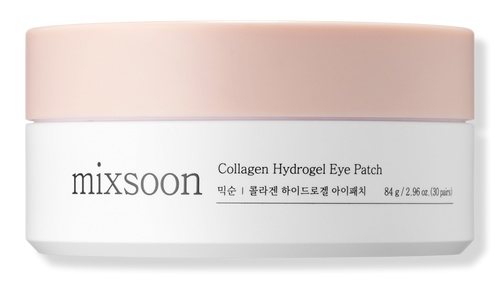
Collagen Hydrogel Eye Patch
Ingredients overview
Highlights
Key Ingredients
Skim through
Mixsoon Collagen Hydrogel Eye PatchIngredients explained
Good old water, aka H2O. The most common skincare ingredient of all. You can usually find it right in the very first spot of the ingredient list, meaning it’s the biggest thing out of all the stuff that makes up the product.
It’s mainly a solvent for ingredients that do not like to dissolve in oils but rather in water.
Once inside the skin, it hydrates, but not from the outside - putting pure water on the skin (hello long baths!) is drying.
One more thing: the water used in cosmetics is purified and deionized (it means that almost all of the mineral ions inside it is removed). Like this, the products can stay more stable over time.
- A natural moisturizer that’s also in our skin
- A super common, safe, effective and cheap molecule used for more than 50 years
- Not only a simple moisturizer but knows much more: keeps the skin lipids between our skin cells in a healthy (liquid crystal) state, protects against irritation, helps to restore barrier
- Effective from as low as 3% with even more benefits for dry skin at higher concentrations up to 20-40%
- High-glycerin moisturizers are awesome for treating severely dry skin
- A multi-functional skincare superstar with several proven benefits for the skin
- Great anti-aging, wrinkle smoothing ingredient used at 4-5% concentration
- Fades brown spots alone or in combination with amino sugar, acetyl glucosamine
- Increases ceramide synthesis that results in a stronger, healthier skin barrier and better skin hydration
- Can help to improve several skin conditions including acne, rosacea, and atopic dermatitis
A natural polysaccharide (big sugar molecule) coming from red edible seaweeds. It is used as a helper ingredient for its gelling, thickening and stabilizing properties.
Butylene glycol, or let’s just call it BG, is a multi-tasking colorless, syrupy liquid. It’s a great pick for creating a nice feeling product.
BG’s main job is usually to be a solvent for the other ingredients. Other tasks include helping the product to absorb faster and deeper into the skin (penetration enhancer), making the product spread nicely over the skin (slip agent), and attracting water (humectant) into the skin.
It’s an ingredient whose safety hasn’t been questioned so far by anyone (at least not that we know about). BG is approved by Ecocert and is also used enthusiastically in natural products. BTW, it’s also a food additive.
A really multi-functional helper ingredient that can do several things in a skincare product: it can bring a soft and pleasant feel to the formula, it can act as a humectant and emollient, it can be a solvent for some other ingredients (for example it can help to stabilize perfumes in watery products) and it can also help to disperse pigments more evenly in makeup products. And that is still not all: it can also boost the antimicrobial activity of preservatives.
 We don't have description for this ingredient yet.
A handy multifunctional ingredient that works as a preservative booster, as well as an antioxidant and soothing agent.
A plant-derived (coming from the seeds of Cyamopsis Tetragonoloba, aka Guar) big, branched sugar molecule that is used as a gelling agent.
A cellulose (the big molecule found in the cell wall of green plants) derivative that is used as an emulsion stabilizer and thickener.
We don't have description for this ingredient yet.
Super common soothing ingredient. It can be found naturally in the roots & leaves of the comfrey plant, but more often than not what's in the cosmetic products is produced synthetically.
It's not only soothing but it' also skin-softening and protecting and can promote wound healing.
Propanediol is a natural alternative for the often used and often bad-mouthed propylene glycol. It's produced sustainably from corn sugar and it's Ecocert approved.
It's quite a multi-tasker: can be used to improve skin moisturization, as a solvent, to boost preservative efficacy or to influence the sensory properties of the end formula.
A glycerin-derived gentle cleansing agent that is described as being skin and eye-friendly, and not leaving the skin dry or tight. It's also used as a co-emulsifier or solubilizer that helps to blend small amounts of oily things into water-based products.
An easy-to-formulate, commonly used, nice to have ingredient that’s also called pro-vitamin B5. As you might guess from the “pro” part, it’s a precursor to vitamin B5 (whose fancy name is pantothenic acid).
Its main job in skincare products is to moisturise the skin. It’s a humectant meaning that it can help the skin to attract water and then hold onto it. There is also research showing that panthenol can help our skin to produce more lovely lipids that are important for a strong and healthy skin barrier.
Another great thing about panthenol is that it has anti-inflammatory and skin protecting abilities. A study shows that it can reduce the irritation caused by less-nice other ingredients (e.g. fragrance, preservatives or chemical sunscreens) in the product.
Research also shows that it might be useful for wound healing as it promotes fibroblast (nice type of cells in our skin that produce skin-firming collagen) proliferation.
If that wasn’t enough panthenol is also useful in nail and hair care products. A study shows that a nail treatment liquide with 2% panthenol could effectively get into the nail and significantly increase the hydration of it.
As for the hair the hydration effect is also true there. Panthenol might make your hair softer, more elastic and helps to comb your hair more easily.
A type fo sugar, usually refined from cane or beet sugar. On the skin, it has water-binding properties and helps to keep your skin hydrated.
We don't have description for this ingredient yet.
The salt form of one of the main anti-inflammatory ingredients in the licorice plant, monoammonium glycyrrhizinate. It’s a yellowish powder with a nice sweet smell.
It’s used mainly for its soothing and anti-inflammatory properties, but according to manufacturer info, it’s also sebum regulating so it's a perfect ingredient for problem skin products.
Read more about licorice and why it's a skincare superstar here.
It’s a handy multi-tasking ingredient that gives the skin a nice, soft feel. At the same time, it also boosts the effectiveness of other preservatives, such as the nowadays super commonly used phenoxyethanol.
The blend of these two (caprylyl glycol + phenoxyethanol) is called Optiphen, which not only helps to keep your cosmetics free from nasty things for a long time but also gives a good feel to the finished product. It's a popular duo.
Adenosine is an important little compound in our body that has a vital cell-signalling role. Research on smearing it on our face is also promising and shows so far a couple of things:
- It can help with wound healing
- It’s a good anti-inflammatory agent
- It might even help with skin’s own collagen production and improve skin firmness and elasticity
- It helps with barrier repair and protection
- It might be even useful for the hair helping with hair thickness and hair growth
If you have spotted ethylhexylglycerin on the ingredient list, most probably you will see there also the current IT-preservative, phenoxyethanol. They are good friends because ethylhexylglycerin can boost the effectiveness of phenoxyethanol (and other preservatives) and as an added bonus it feels nice on the skin too.
Also, it's an effective deodorant and a medium spreading emollient.
A semi-essential (infants cannot synthesize it, but adults can) amino acid that is one of the primary building blocks of hair keratin and skin collagen. It's a natural moisturizing factor, a skin hydrator and might also help to speed up wound healing.
Arginine usually has a positive charge (cationic) that makes it substantive to skin and hair (those are more negatively charged surfaces) and an excellent film former. Thanks to the positive charge, it also creates a complex with AHAs (AHAs like to lose a hydrogen ion and be negatively charged, so the positive and the negative ions attract each other) that causes a "time-release AHA effect" and reduces the irritation associated with AHAs.
Super common little helper ingredient that helps products to remain nice and stable for a longer time. It does so by neutralizing the metal ions in the formula (that usually get into there from water) that would otherwise cause some not so nice changes.
It is typically used in tiny amounts, around 0.1% or less.
The chemically chopped up version of the big protein molecule, collagen. It is often derived from fish or bovine sources and works as a nice moisturizer and humectant that helps the skin to hold onto water.
To understand a bit more what Hydrolyzed Collagen is, you have to know that proteins are large chains of amino acids connected with so-called peptide bonds. These bonds can be broken up when a water molecule is added and the resulting thing is a mix of shorter length amino acids, also called peptides. So Hydrolyzed Collagen is not really collagen, it is rather an undefined and varying mix of largish peptides. Based on a manufacturer's data, the whole, soluble collagen has an average molecular weight of 300 000 Da, while this chopped up mixture has an average MW of 12 000 Da (still pretty big).
The main thing of these largish peptides is to act as water-binding agents, and to make the skin nice and smooth (aka emollient). Hydrolyzed Collagen is also often used in cleansers as it can make harsh surfactants milder and in hair conditioners as it improves the flexibility and manageability of hair.
If you wanna know more about collagen in cosmetics, we have a shiny explanation about soluble collagen here >>
A non-essential amino acid (the building blocks of skin proteins, like collagen or elastin), that the body can produce itself, but its production decreases with age. When you put it all over your face, it works as a moisturizer and maybe more.
According to great skincare blog Futurederm, glycine might help with wound healing and tissue repair and when used together with other amino acids, leucine and proline it might improve wrinkles.
BTW, it's also a building block of a bunch of important and famous peptides, including copper-tripeptide-1, palmitoyl tripeptide-1 or palmitoyl hexapeptide-12.
Glutamic acid is a little molecule and non-essential (our body can synthesize it) amino acid with the important job of being a neurotransmitter in the human body meaning that it helps your nervous system work correctly.
As for what it's doing in cosmetics, Glutamic acids' main thing (similar to other amino acids) is being a humectant moisturizer and skin-conditioning agent (sidenote: if you attach lots of glutamic acid molecules, you get polyglutamic acid that is claimed to be a better than hyaluronic acid humectant). It also seems to affect skin barrier repair, however, it is not clear-cut in which direction.
The complication is that glutamic acid has two distinct forms, L-glutamic acid and D-glutamic acid, that are the mirror images of each other (think of it like your left and right hand). Studies show that a topical application of L-glutamic acid on damaged skin delayed skin repair, while D-glutamic acid application sped up skin repair. As both forms are used by the industry, it is a bit uncertain what you are getting with just glutamic acid on the ingredient list (but if it is a Shiseido group product, it is probably the goodie D-form :)).
Other than that, Glutamic acid can also be used as a pH adjuster and can be processed via biological pathways into pyrrolidone carboxylic acid, the sodium salt of which is a goodie and one of your skin’s natural moisturizing factors.
A non-essential amino acid (important building block of collagen and elastin) that hydrates the skin. It is also used to set the pH of the cosmetic product (buffering).
If you see a cosmetic product that claims that it has "Botox-like effect" then two things are almost certain: one, the product overpromises and two, it contains Argireline.
So this one is the famous peptide that's marketed by its manufacturer as the "Botox in a jar". The basis for this claim is that it targets the same wrinkle forming mechanism (wrinkles caused by facial muscle movement) as Botox, but the way it works is very different. In addition, the extent to which it can prevent muscles from contracting (and to smooth wrinkles) is very different (otherwise why would anyone use still Botox?).
The manufacturer did several studies to prove that Argireline really works and it does (just not as well as Botox). In-vivo (made on real people) tests showed that using 10% Argireline solution around the eyes for 15 days decreased wrinkles depth by 17%, while a 5% Argireline formula applied for 28 days did almost the same with a decrease in wrinkle depth by 16.26%. A Spanish University also did some research and found that Argireline increased the level of skin moisturization and decreased both the depth and width of wrinkles "significantly".
This means, Acetyl Hexapeptide-8 does have some ability to smooth wrinkles (but not as well as Botox - sorry, if we sound like a broken record). Also, we have to agree with TruthInAging, that it's not a collagen builder and not a preventer of structural aging (think vitamin C, AHAs or retinol); it's just a quick fix. If you are looking for one, this could be your thing. If you are more of a "let's treat this aging thing properly" type, then it's probably not your thing.
- GHK-Cu is a copper-peptide complex found naturally in yucky bodily fluids (plasma, saliva, and urine)
- It has unique wound healing properties by stimulating the breakdown of unhealthy, too large collagen in scar tissue and stimulating nice and healthy collagen production afterwards
- It stimulates the production of several important skin-identical ingredients (e.g. collagen, elastin, and glycosaminoglycans)
- It has significant anti-inflammatory and antioxidant effect
- There are a few promising studies showing GHK-Cu can improve skin elasticity, clarity, firmness and reduce lines and wrinkles
- It can improve hair growth by enlarging hair follicles (and bigger follicles produce longer, thicker hair)
- There are some urban legends about possible overdosing or facial hair problems (read more in geeky details)
We don't have description for this ingredient yet.
We don't have description for this ingredient yet.
We don't have description for this ingredient yet.
A semi-essential amino acid meaning that enough has to be eaten from it so that the body does not use up essential amino acids (that our body cannot produce itself) to synthesize it. It has an important role in regulating the immune defense, allergic reactions, and inflammatory processes in the body.
As for skincare, it's a skin moisturizer that might also protect from some skin infections.
An essential amino acid that's also a key building block of collagen and elastin. When taken orally, it helps the digestive and intestinal tracts function more smoothly and also helps the absorption of nutrients. As for skincare, it is not clear what it does other than being a skin hydrator.
Serine is an amino acid that most often comes to the formula as part of a moisturizing complex. It's a non-essential amino acid (meaning that our body can synthesize it) and serves as a water-binding ingredient.
In general, amino acids are great skincare ingredients that play an important role in proper skin hydration but there is not much info out there about what specifically serine can do for the skin.
A non-essential amino acid (meaning that our body can produce it) that's also one of the major building blocks of collagen. According to the Futurederm blog, it might be able to improve wrinkles when combined with other amino acids, glycine and leucine
A non-essential amino acid (a building block of skin proteins like collagen or elastin) that hydrates the skin.
An essential amino acid (a building block of skin proteins like collagen) that our body cannot produce itself but has to take from external sources, like diet.
It's a branched chain amino acid that is claimed to enhance energy, increase endurance and aid in muscle tissue recovery and repair when taken as a supplement. It's not clear what valine does when you put it on the skin, but as all amino acids, it must be at least a great skin hydrator.
We don't have description for this ingredient yet.
A branch-chained, essential amino acid that can be found in things like almond, cashew or soy protein. When taken orally it may promote protein synthesis. As for skincare - like all the amino acids - it's a skin-identical ingredient and moisturizer. It also seems to be useful as a barrier repair ingredient.
We don't have description for this ingredient yet.
We don't have description for this ingredient yet.
An essential amino acid that the body cannot produce itself but has to take from the diet. Combined with UVA exposure, phenylalanine is used in the treatment of vitiligo (a pigmentation disorder where patches of the skin lose the pigment).
A pretty famous and better-researched peptide consisting of five amino acids (the building blocks of all proteins). It was created in a joint effort by the French ingredient supplier, Sederma and the cosmetics industry big shot, Procter&Gamble.
The amino acid sequence of the peptide is lysine–threonine–threonine–lysine–serine (KTTKS). Sometimes, it's also called collagen pentapeptide, as it's a subfragment of skin-structure-giving type I collagen. The KTTKS amino sequence is then attached for better oil solubility and skin penetration to palmitic acid and BOOM; we get Palmitoyl Pentapeptide-4.
Though most research is manufacturer sponsored, the clinical studies about Palmitoyl Pentapeptide-4 are promising. In short, it can reduce fine lines, wrinkles and improve skin texture significantly (and at crazy low concentrations, the studies were done with just 3 ppm that is 0.0003%).
There are also studies comparing Palmitoyl Pentapeptide-4 with anti-aging gold standard, retinol. One of them compared 3ppm Pal-KTTKS with 700 ppm (0.07%) retinol and found that they showed similar wrinkle improving ability with the peptide showing better skin tolerability.
Bottom line, if you are into peptides, this is a good one to try.
You may also want to take a look at...
| what‑it‑does | solvent |
| what‑it‑does | skin-identical ingredient | moisturizer/humectant |
| irritancy, com. | 0, 0 |
| what‑it‑does | cell-communicating ingredient | skin brightening | anti-acne | moisturizer/humectant |
| what‑it‑does | viscosity controlling |
| what‑it‑does | moisturizer/humectant | solvent |
| irritancy, com. | 0, 1 |
| what‑it‑does | solvent |
| what‑it‑does | viscosity controlling |
| what‑it‑does | antioxidant | preservative |
| what‑it‑does | viscosity controlling |
| what‑it‑does | viscosity controlling |
| irritancy, com. | 0, 0 |
| what‑it‑does | emollient | viscosity controlling |
| what‑it‑does | soothing |
| irritancy, com. | 0, 0 |
| what‑it‑does | solvent | moisturizer/humectant |
| what‑it‑does | surfactant/cleansing | emulsifying |
| what‑it‑does | soothing | moisturizer/humectant |
| irritancy, com. | 0, 0 |
| what‑it‑does | moisturizer/humectant | soothing |
| what‑it‑does | viscosity controlling |
| what‑it‑does | soothing | moisturizer/humectant |
| what‑it‑does | moisturizer/humectant | emollient |
| what‑it‑does | cell-communicating ingredient |
| what‑it‑does | preservative |
| what‑it‑does | skin-identical ingredient |
| what‑it‑does | chelating |
| what‑it‑does | emollient | moisturizer/humectant |
| what‑it‑does | skin-identical ingredient |
| what‑it‑does | moisturizer/humectant |
| what‑it‑does | skin-identical ingredient |
| what‑it‑does | cell-communicating ingredient | moisturizer/humectant |
| what‑it‑does | cell-communicating ingredient | soothing | antioxidant |
| what‑it‑does | antioxidant | chelating |
| what‑it‑does | skin-identical ingredient | moisturizer/humectant |
| what‑it‑does | skin-identical ingredient |
| what‑it‑does | skin-identical ingredient |
| what‑it‑does | skin-identical ingredient |
| what‑it‑does | skin-identical ingredient |
| what‑it‑does | skin-identical ingredient |
| what‑it‑does | skin-identical ingredient |
| what‑it‑does | skin-identical ingredient |
| what‑it‑does | antioxidant |
| what‑it‑does | cell-communicating ingredient |