





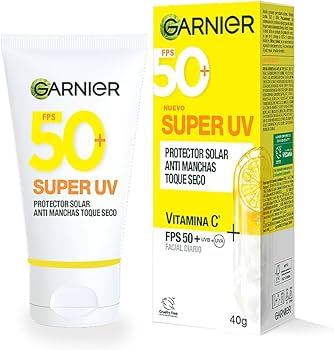
Super UV Protector Toque Seco Con Vitamina C
Ingredients overview
Highlights
Key Ingredients
Other Ingredients
Skim through
Garnier Super UV Protector Toque Seco Con Vitamina CIngredients explained
Good old water, aka H2O. The most common skincare ingredient of all. You can usually find it right in the very first spot of the ingredient list, meaning it’s the biggest thing out of all the stuff that makes up the product.
It’s mainly a solvent for ingredients that do not like to dissolve in oils but rather in water.
Once inside the skin, it hydrates, but not from the outside - putting pure water on the skin (hello long baths!) is drying.
One more thing: the water used in cosmetics is purified and deionized (it means that almost all of the mineral ions inside it is removed). Like this, the products can stay more stable over time.
A clear, colorless, practically odorless, light liquid that works as a handy helper ingredient in sunscreen formulas. It helps to create high-SPF formulas with reduced concentrations of UV-filters and it also helps to create cosmetically elegant formulas (and that's no easy feat when it comes to sunscreens). It absorbs rapidly, makes the product easily spreadable and reduces greasiness coming from the oil-soluble sunscreen agents.
Ethylhexyl Triazone is a new generation, chemical sunscreen (not available in the US due to impossible FDA regulations) that gives the highest photo-stable absorption of all available UVB filters today. It protects in the UVB range (280-320nm) with a peak protection of 314nm. It is an oil soluble, odorless, colorless powder that works well in fragrance-free formulas. It can be used up to 5% worldwide except for the US and Canada.
Its INCI name is a bit of a mouthful, but Bis-Ethylhexyloxyphenol Methoxyphenyl Triazine is worth recognizing it as it is one of the best sunscreen agents known today. Unfortunately, it's not FDA-approved so you will not find it in sunscreens coming from the US (not because it's not good, but because US regulations make it impossible for newer sunscreen agents to get approved), but it is widely available in other parts of the world like Europe, Australia or Asia.
It is a broad-spectrum (covers the whole UVB and UVA range, 280-400 nm) chemical sunscreen agent with peak protections at about 310 and 345 nm and unlike older UV filters, it's very photostable. It hardly deteriorates in the presence of UV light and it's also useful in stabilizing other less stable sunscreen agents, like the famous UVA protector, avobenzone.
It's a new generation sunscreen agent that was specifically designed for high SPF and good UVA protection and based on a 2007 study that compared 18 sunscreen agents available in the EU it really had the best SPF protection (they used the highest concentration allowed by EU regulations from each 18 sunscreens and Trinosorb S gave an SPF 20 all by itself).
It is an oil-soluble, slightly yellowish powder that is not absorbed into the skin too much. This is good news for a sunscreen agent as it needs to be on the surface of the skin to do its job properly. Regarding Bis-Ethylhexyloxyphenol Methoxyphenyl Triazine side effects, we have good news here as well: it has a great safety profile and unlike a couple of other chemical sunscreens, Trinosorb S (and M) does not show estrogenic activity.
Overall, we think Trinosorb S is one of the best sunscreen options available today.
Are you into sunscreen agents? We have shiny explanations (along with product lists) about others as well:
- Methylene Bis-Benzotriazolyl Tetramethylbutylphenol, aka Tinosorb M, the good buddy of our current molecule Tinosorb S
- Tris-Biphenyl Triazine, aka Tinosorb A2B, the newest addition to the Tinosorb family that protects strongly in an in-between wavelength that most other filters miss
- Ethylhexyl Triazone, aka Uvinul T 150, another new generation sunscreen agent with super-high UVB protection
- Diethylamino Hydroxybenzoyl Hexyl Benzoate, aka Uvinul A Plus, a new generation sunscreen for UVA protection
An often used emollient with a light and silky feel. It's very mild to both skin and eyes and spreads nicely and easily. It's often used in sunscreens as it's also an excellent solvent for sunscreen agents.
A white powdery thing that's the major component of glass and sand. In cosmetics, it’s often in products that are supposed to keep your skin matte as it has great oil-absorbing abilities. It’s also used as a helper ingredient to thicken up products or suspend insoluble particles.
The famous Avobenzone. It is a special snowflake as it is the only globally available chemical sunscreen agent that provides proper UVA protection (in the US, new generation sunscreen agents are not approved because of impossible FDA regulations). It is the global gold standard of UVA protection and is the most used UVA sunscreen in the world.
It gives very good protection across the whole UVA range (310-400 nm that is both UVA1 and UVA2) with a peak protection at 360 nm. The problem with it, though, is that it is not photostable and degrades in the sunlight. Wikipedia says that avobenzone loses 36% of its UV-absorption capacity after just one hour of sunlight (yep, this is one of the reasons why sunscreens have to be reapplied after a few hours).
The cosmetic's industry is trying to solve the problem by combining avobenzone with other UV filters that enhance its stability (like octocrylene, Tinosorb S or Ensulizole) or by encapsulating it and while both solutions help, neither is perfect. Interestingly, the combination of avobenzone with mineral sunscreens (that is titanium dioxide and zinc oxide) is not a good idea. In the US, it is flat out prohibited as avobenzone becomes unstable when combined with mineral sunscreens.
As for safety, avobenzone has a pretty good safety profile. It counts as non-irritating, and unlike some other chemical sunscreens, it shows no estrogenic effect. The maximum concentration of avobenzone permitted is 5% in the EU and 3% in the US.
- A natural moisturizer that’s also in our skin
- A super common, safe, effective and cheap molecule used for more than 50 years
- Not only a simple moisturizer but knows much more: keeps the skin lipids between our skin cells in a healthy (liquid crystal) state, protects against irritation, helps to restore barrier
- Effective from as low as 3% with even more benefits for dry skin at higher concentrations up to 20-40%
- High-glycerin moisturizers are awesome for treating severely dry skin
A handy helper ingredient that comes in a white powder form and works as an anti-caking and oil-absorbing agent. It also gives products good spreadability, long lasting and velvet touch characteristics. It is popular both in skincare and makeup products.
A chemical sunscreen agent that gives strong protection in the UVB (280-320nm) range with its peak protection at 306 nm. Its special property is that unlike most sunscreen agents, it is not oil but water soluble, so it is ideal to create light, oily skin compatible formulas. It is also fairly photostable and can be used to protect other less stable UV filters (like famous UVA blocker, avobenzone) in the formula. It is approved worldwide and can be used up to 4% in the US and up to 8% in the EU.
It’s a little helper ingredient that helps to set the pH of a cosmetic formulation to be just right. It’s very alkaline (you know the opposite of being very acidic): a 1% solution has a pH of around 10.
It does not have the very best safety reputation but in general, you do not have to worry about it.
What is true is that if a product contains so-called N-nitrogenating agents (e.g.: preservatives like 2-Bromo-2-Nitropropane-1,3-Diol, 5-Bromo-5-Nitro- 1,3-Dioxane or sodium nitrate - so look out for things with nitro, nitra in the name) that together with TEA can form some not nice carcinogenic stuff (that is called nitrosamines). But with proper formulation that does not happen, TEA in itself is not a bad guy.
But let’s assume a bad combination of ingredients were used and the nitrosamines formed. :( Even in that case you are probably fine because as far as we know it cannot penetrate the skin.
But to be on the safe side, if you see Triethanolamine in an INCI and also something with nitra, nitro in the name of it just skip the product, that cannot hurt.
A white to beige powder that is described as the golden standard emulsifier for emulsions (oil+water mixtures) that are difficult to stabilize. It is especially popular in sunscreens as it can boost SPF protection and increase the water-resistance of the formula.
A clear, colorless oil-like liquid that makes the skin feel smooth and nice (aka emollient) and it does so without it being greasy.
What's more, it can even reduce the heavy, greasy feel in products with high oil content. It's also fast-spreading meaning that it gives the formula a good, nice slip. It absorbs quickly into the skin and helps other ingredients to penetrate quicker and deeper.
Thanks to all this, it's one of the most commonly used emollients out there. There is just one little drawback: it has a high comedogenic index (5 out of 5...), so it might clog pores if you're prone to it.
Diethylamino Hydroxybenzoyl Hexyl Benzoate is a new generation, chemical sunscreen agent (not available in the US due to impossible FDA regulations) that's designed for high UVA protection and high photostability. It gives sun protection in the whole UVA range (320-400 nm) with peak protection at 354nm. It can be used up to 10% worldwide except for the US and Canada.
A form of skincare superstar, vitamin C. If you do not know why vitamin C is such a big deal in skincare, we have a really detailed, geeky description that's good to read. :)
So now you know that because pure vitamin C is such a diva (very unstable and hard to formulate) the cosmetic industry is trying to come up with some derivatives that have the badass anti-aging properties of vitamin C (antioxidant protection + collagen boosting + fading hyperpigmentation) but without the disadvantages. This is a hard task, and there is not yet a derivative that is really proven to be better in every aspect, but Ascorbyl Glucoside is one of the best options when it comes to vitamin C derivatives. Let's see why:
First, it's really stable and easy to formulate, so the problems that come with pure vitamin C are solved here.
Second, in vitro (meaning made in the lab, not on real humans) studies show that ascorbyl glucoside can penetrate the skin. This is kind of important for an anti-aging ingredient to do the job, so this is good news, though in-vivo (made on real humans) studies are still needed.
Third, in-vitro studies show that after ascorbyl glucoside is absorbed into the skin it is converted to pure vitamin C (though the rate of conversion is still a question mark). It also shows all the three anti-aging benefits (antioxidant protection + collagen boosting + fading hyperpigmentation) that pure vitamin C does.
Bottom line: ascorbyl glucoside is one of the best and most promising vitamin C derivatives that shows similar benefits to that of pure vitamin C, but it's less proven (in vivo vs. in vitro studies) and the extent of the benefits are also not the same.
A handy multifunctional ingredient that works as a preservative booster, as well as an antioxidant and soothing agent.
A mild cleansing agent that's used mainly next to other cleansing agents (co-surfactant) to improve foam density and regulate viscosity.
A common multi-tasker fatty acid. It makes your skin feel nice and smooth (emollient), gives body to cream type products and helps to stabilize water and oil mixes (aka emulsions).
It’s pretty much the current IT-preservative. It’s safe and gentle, but even more importantly, it’s not a feared-by-everyone-mostly-without-scientific-reason paraben.
It’s not something new: it was introduced around 1950 and today it can be used up to 1% worldwide. It can be found in nature - in green tea - but the version used in cosmetics is synthetic.
Other than having a good safety profile and being quite gentle to the skin it has some other advantages too. It can be used in many types of formulations as it has great thermal stability (can be heated up to 85°C) and works on a wide range of pH levels (ph 3-10).
It’s often used together with ethylhexylglycerin as it nicely improves the preservative activity of phenoxyethanol.
A handy multi-tasker, white to light yellowish oil-loving wax that works very well in oil-in-water emulsions. It makes your skin feel nice and smooth (emollient), stabilizes oil-water mixes and gives body to them.
Oh, and one more thing: it's a so-called fatty alcohol - the good, emollient type of alcohol that is non-drying and non-irritating. It is often mixed with fellow fatty alcohol, Cetyl Alcohol, and the mixture is called Cetearyl Alcohol in the ingredient list.
A very common water-loving surfactant and emulsifier that helps to keep water and oil mixed nicely together.
It's often paired with glyceryl stearate - the two together form a super effective emulsifier duo that's salt and acid tolerant and works over a wide pH range. It also gives a "pleasing product aesthetics", so no wonder it's popular.
A helper ingredient that helps to neutralize the metal ions in the formula (they usually come from water) so it stays nice longer. The special property of this particular ingredient is that it's more effective against more problematic ions, like Cu (copper) and Fe (iron) compared to less problematic ones like Ca (calcium) and Mg (magnesium).
A fatty acid that can be found naturally in the skin. In fact, it's the most common saturated fatty acid found in animals and plants.
As for skincare, it can make the skin feel nice and smooth in moisturizers (emollient) or it can act as a foam building cleansing agent in cleansers. It's also a very popular ingredient in shaving foams.
A little helper ingredient that works as a preservative. It works against bacteria and some species of fungi and yeast. It's often combined with IT-preservative, phenoxyethanol.
 We don't have description for this ingredient yet.
A handy white powder that likes to absorb oily things. It has great oil and sebum absorption (aka mattifying) abilities and can also act as a thickening agent in the oil phase of a formula.
A kind of polymer (big molecule from repeated subunits) that helps to create beautiful gel-like textures. It's also a texturizer and thickener for oil-in-water emulsions. It gives products a good skin feel and does not make the formula tacky or sticky.
It works over a wide pH range and is used between 0.5-1.2%.
A super common and cheap fragrance ingredient. It's in many plants, e.g. rosemary, eucalyptus, lavender, lemongrass, peppermint and it's the main component (about 50-90%) of the peel oil of citrus fruits.
It does smell nice but the problem is that it oxidizes on air exposure and the resulting stuff is not good for the skin. Oxidized limonene can cause allergic contact dermatitis and counts as a frequent skin sensitizer.
Limonene's nr1 function is definitely being a fragrance component, but there are several studies showing that it's also a penetration enhancer, mainly for oil-loving components.
All in all, limonene has some pros and cons, but - especially if your skin is sensitive - the cons probably outweigh the pros.
Linalool is a super common fragrance ingredient. It’s kind of everywhere - both in plants and in cosmetic products. It’s part of 200 natural oils including lavender, ylang-ylang, bergamot, jasmine, geranium and it can be found in 90-95% of prestige perfumes on the market.
The problem with linalool is, that just like limonene it oxidises on air exposure and becomes allergenic. That’s why a product containing linalool that has been opened for several months is more likely to be allergenic than a fresh one.
A study made in the UK with 483 people tested the allergic reaction to 3% oxidised linalool and 2.3% had positive test results.
It’s a common fragrance ingredient that has a light floral smell. It’s one of the “EU 26 fragrances” that has to be labelled separately (and cannot be simply included in the term “fragrance/perfume” on the label) because of allergen potential. Best to avoid if your skin is sensitive.
It's one of those things that help your cosmetics not to go wrong too soon, aka a preservative. It can be naturally found in fruits and teas but can also be made synthetically.
No matter the origin, in small amounts (up to 1%) it’s a nice, gentle preservative. Has to be combined with some other nice preservatives, like potassium sorbate to be broad spectrum enough.
In high amounts, it can be a skin irritant, but don’t worry, it’s never used in high amounts.
It’s a handy multi-tasking ingredient that gives the skin a nice, soft feel. At the same time, it also boosts the effectiveness of other preservatives, such as the nowadays super commonly used phenoxyethanol.
The blend of these two (caprylyl glycol + phenoxyethanol) is called Optiphen, which not only helps to keep your cosmetics free from nasty things for a long time but also gives a good feel to the finished product. It's a popular duo.
A vegetable wax coming from the leaves of the Brazilian tropical palm tree, Copernicia cerifera. Similar to other waxes, it is used to stabilize and give body to products, or to keep stick type formulas solid. It is the hardest natural wax with a high melting point (around 85C) and high gloss making it a great wax choice for lip products.
Though its long name does not reveal it, this polymer molecule (big molecule from repeated subunits or monomers) is a relative to the super common, water-loving thickener, Carbomer. Both of them are big molecules that contain acrylic acid units, but Acrylates/C10-30 Alkyl Acrylate Crosspolymer also contains some other monomers that are hydrophobic, i.e. water-hating.
This means that our molecule is part water- and part oil-loving, so it not only works as a thickener but also as an emulsion stabilizer. It is very common in gel-type formulas that also contain an oil-phase as well as in cleansers as it also works with most cleansing agents (unlike a lot of other thickeners).
A 14 carbon length fatty acid that can be naturally found in nutmeg, palm kernel oil, coconut oil and butter fat. It's used as a foam building cleansing agent. Paula Begoun writes that it can be a bit drying to the skin.
Geraniol is a common fragrance ingredient. It smells like rose and can be found in rose oil or in small quantities in geranium, lemon and many other essential oils.
Just like other similar fragrance ingredients (like linalool and limonene) geraniol also oxidises on air exposure and becomes allergenic. Best to avoid if you have sensitive skin.
If life gives the cosmetic industry lemon, it makes lemon fruit extract. As to why, we can write here extremely similar things to our shiny description of orange fruit extract. Being both of them citruses, they contain very similar active compounds with very similar (potential) effects on the skin.
Just like orange fruit, lemon fruit also contains citric acid so it is commonly used as a natural, mild exfoliating agent. If this is the case, it is usually combined with other AHA containing fruit extracts such as bilberry, sugar cane, orange, and sugar maple in a super popular ingredient mix trade named ACB Fruit Mix.
But, citrus fruits are chemically complex mixtures with a bunch of other active components such as vitamin C, flavonoids, phenolics, carbohydrates and essential oil (this latter one coming from the rind of the fruit, but still present in some amount in the fruit extract). These have the potential to give lemon extract antioxidant, antibacterial, anti-dandruff, venotonic and moisturizing properties, but the essential oil also brings some questionable compounds such as fragrance allergen limonene or phototoxic compound bergaptene. If your skin is sensitive, be careful with citrus extracts.
It’s a common fragrance ingredient that smells like lemon and has a bittersweet taste. It can be found in many plant oils, e.g. lemon, orange, lime or lemongrass.
It’s one of the “EU 26 fragrances” that has to be labelled separately (and cannot be simply included in the term “fragrance/perfume” on the label) because of allergen potential. Best to avoid if your skin is sensitive.
A super common, waxy, white, solid stuff that helps water and oil to mix together, gives body to creams and leaves the skin feeling soft and smooth.
Chemically speaking, it is the attachment of a glycerin molecule to the fatty acid called stearic acid. It can be produced from most vegetable oils (in oils three fatty acid molecules are attached to glycerin instead of just one like here) in a pretty simple, "green" process that is similar to soap making. It's readily biodegradable.
It also occurs naturally in our body and is used as a food additive. As cosmetic chemist Colins writes it, "its safety really is beyond any doubt".
Exactly what it sounds: nice smelling stuff put into cosmetic products so that the end product also smells nice. Fragrance in the US and parfum in the EU is a generic term on the ingredient list that is made up of 30 to 50 chemicals on average (but it can have as much as 200 components!).
If you are someone who likes to know what you put on your face then fragrance is not your best friend - there's no way to know what’s really in it.
Also, if your skin is sensitive, fragrance is again not your best friend. It’s the number one cause of contact allergy to cosmetics. It’s definitely a smart thing to avoid with sensitive skin (and fragrance of any type - natural is just as allergic as synthetic, if not worse!).
You may also want to take a look at...
| what‑it‑does | solvent |
| what‑it‑does | emollient | solvent |
| what‑it‑does | sunscreen |
| what‑it‑does | sunscreen |
| what‑it‑does | emollient | antimicrobial/antibacterial |
| what‑it‑does | viscosity controlling |
| what‑it‑does | sunscreen |
| what‑it‑does | skin-identical ingredient | moisturizer/humectant |
| irritancy, com. | 0, 0 |
| what‑it‑does | viscosity controlling |
| what‑it‑does | sunscreen |
| what‑it‑does | buffering |
| irritancy, com. | 0, 2 |
| what‑it‑does | emulsifying | surfactant/cleansing |
| what‑it‑does | emollient | perfuming |
| irritancy, com. | 3, 3-5 |
| what‑it‑does | sunscreen |
| what‑it‑does | antioxidant | skin brightening |
| what‑it‑does | antioxidant | preservative |
| what‑it‑does | surfactant/cleansing |
| what‑it‑does | emollient | viscosity controlling |
| irritancy, com. | 0, 2-3 |
| what‑it‑does | preservative |
| what‑it‑does | emollient | viscosity controlling | emulsifying | surfactant/cleansing |
| irritancy, com. | 2, 2 |
| what‑it‑does | surfactant/cleansing | emulsifying |
| irritancy, com. | 0, 0 |
| what‑it‑does | chelating |
| what‑it‑does | skin-identical ingredient | emollient | emulsifying |
| irritancy, com. | 0, 2 |
| what‑it‑does | preservative | antimicrobial/antibacterial |
| what‑it‑does | emulsifying | surfactant/cleansing |
| what‑it‑does | viscosity controlling | emollient |
| what‑it‑does | viscosity controlling |
| what‑it‑does | perfuming | solvent |
| what‑it‑does | perfuming |
| what‑it‑does | perfuming |
| what‑it‑does | preservative | perfuming | solvent | viscosity controlling |
| what‑it‑does | moisturizer/humectant | emollient |
| what‑it‑does | emollient |
| irritancy, com. | 0, 1 |
| what‑it‑does | viscosity controlling |
| what‑it‑does | surfactant/cleansing | emulsifying | perfuming |
| irritancy, com. | 0, 3 |
| what‑it‑does | perfuming |
| what‑it‑does | perfuming |
| what‑it‑does | emollient | emulsifying |
| irritancy, com. | 0, 1 |
| what‑it‑does | perfuming |