





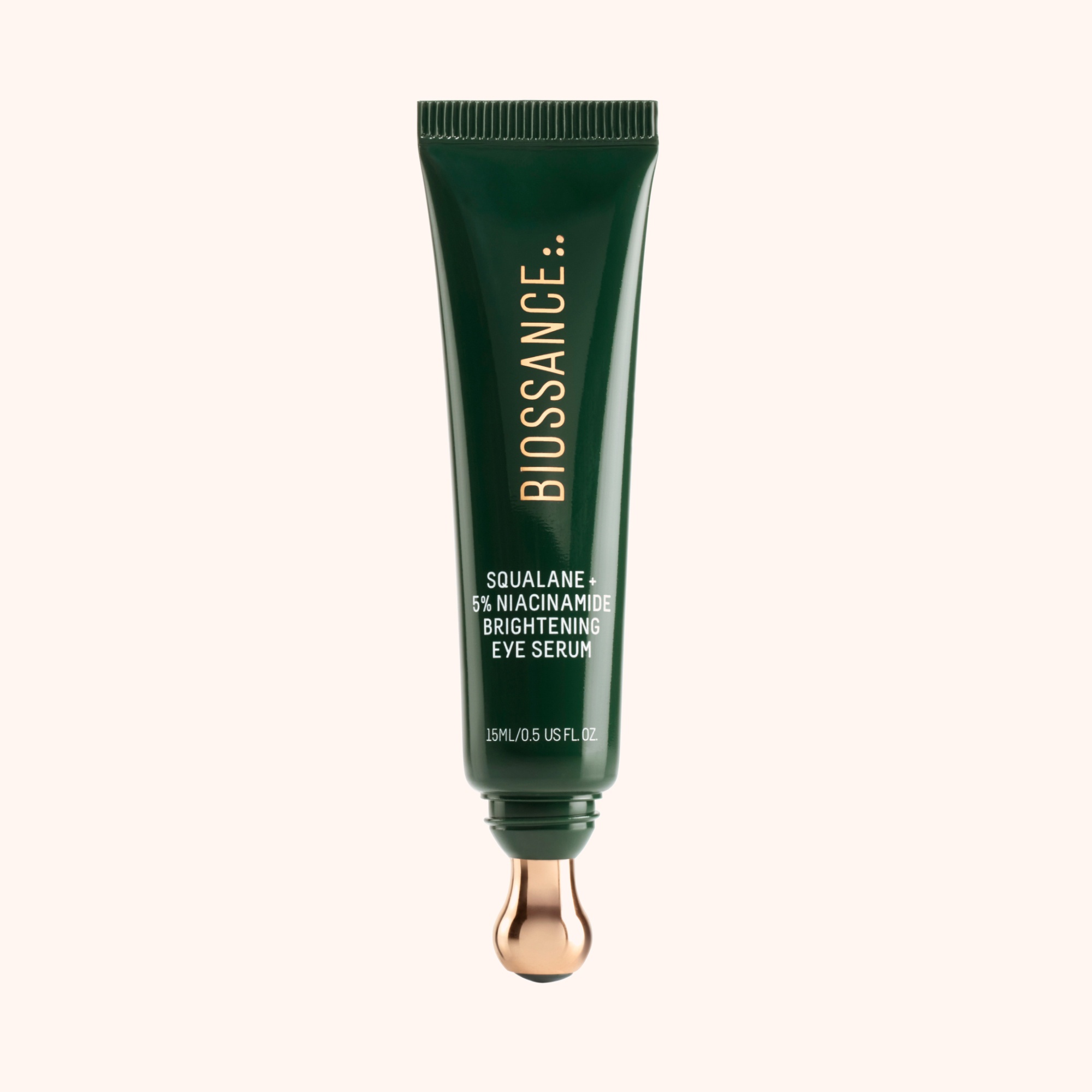
Squalane + 5% Niacinamide Brightening Eye Serum
Ingredients overview
Highlights
Key Ingredients
Skim through
BIOSSANCE Squalane + 5% Niacinamide Brightening Eye SerumIngredients explained
Good old water, aka H2O. The most common skincare ingredient of all. You can usually find it right in the very first spot of the ingredient list, meaning it’s the biggest thing out of all the stuff that makes up the product.
It’s mainly a solvent for ingredients that do not like to dissolve in oils but rather in water.
Once inside the skin, it hydrates, but not from the outside - putting pure water on the skin (hello long baths!) is drying.
One more thing: the water used in cosmetics is purified and deionized (it means that almost all of the mineral ions inside it is removed). Like this, the products can stay more stable over time.
- A multi-functional skincare superstar with several proven benefits for the skin
- Great anti-aging, wrinkle smoothing ingredient used at 4-5% concentration
- Fades brown spots alone or in combination with amino sugar, acetyl glucosamine
- Increases ceramide synthesis that results in a stronger, healthier skin barrier and better skin hydration
- Can help to improve several skin conditions including acne, rosacea, and atopic dermatitis
It seems to us that squalane is in fashion and there is a reason for it. Chemically speaking, it is a saturated (no double bonds) hydrocarbon (a molecule consisting only of carbon and hydrogen), meaning that it's a nice and stable oily liquid with a long shelf life.
It occurs naturally in certain fish and plant oils (e.g. olive), and in the sebum (the oily stuff our skin produces) of the human skin. As f.c. puts it in his awesome blog post, squalane's main things are "emolliency, surface occlusion, and TEWL prevention all with extreme cosmetic elegance". In other words, it's a superb moisturizer that makes your skin nice and smooth, without being heavy or greasy.
Another advantage of squalane is that it is pretty much compatible with all skin types and skin conditions. It is excellent for acne-prone skin and safe to use even if you have fungi-related skin issues, like seborrhea or fungal acne.
The unsaturated (with double bonds) and hence less stable version of Squalane is Squalene, you can read about it here >>
- A natural moisturizer that’s also in our skin
- A super common, safe, effective and cheap molecule used for more than 50 years
- Not only a simple moisturizer but knows much more: keeps the skin lipids between our skin cells in a healthy (liquid crystal) state, protects against irritation, helps to restore barrier
- Effective from as low as 3% with even more benefits for dry skin at higher concentrations up to 20-40%
- High-glycerin moisturizers are awesome for treating severely dry skin
An odorless and colorless emollient ester (cetyl alcohol + ethylhexanoic acid) that gives a velvety and silky feel to the skin. It has great spreadability and a non-oily feel. It's a popular ingredient in makeup removers.
A big molecule from repeated subunits that is used to form gel-like textures and create a film on the skin.
It’s pretty much the current IT-preservative. It’s safe and gentle, but even more importantly, it’s not a feared-by-everyone-mostly-without-scientific-reason paraben.
It’s not something new: it was introduced around 1950 and today it can be used up to 1% worldwide. It can be found in nature - in green tea - but the version used in cosmetics is synthetic.
Other than having a good safety profile and being quite gentle to the skin it has some other advantages too. It can be used in many types of formulations as it has great thermal stability (can be heated up to 85°C) and works on a wide range of pH levels (ph 3-10).
It’s often used together with ethylhexylglycerin as it nicely improves the preservative activity of phenoxyethanol.
Hello, our favorite molecule that helps us wake up in the morning and then keeps us going through the day. As a super well-known stimulant from coffee, tea and plenty of other soft drinks, Caffeine needs no introduction. So we will skip right to the part where we talk about what the hell it does in so-so many cosmetic products.
Looking at the research, we were surprised to find how versatile Caffeine is. It is a small, water-loving molecule with pretty good skin penetration abilties. Once in the skin, it has nice antioxidant properties, meaning that it reduces the formation of evil free radicals and it might even be useful in preventing UV-induced skin cancers.
A well-known thing about Caffeine is that it improves the microcirculation of the blood vessels. Though conventional wisdom and anecdotal evidence says that this property is helpful for dark under-eye circles and puffy eyes, we have to mention that the double-blind research we have found about a 3% caffeine gel concluded that "the overall efficacy of the selected caffeine gel in reducing puffy eyes was not significantly different from that of its gel base." But you know, the proof is in the pudding.
Another thing Caffeine is used for in body care products is its anti-cellulite effects. In theory, it can speed up the lipolysis process (the "fat burning" by our cells) and stimulate the draining lymph system that might lead to the improvement of cellulite. But here again, the evidence that it actually makes a measurable, let alone visible, improvement on actual human beings is limited (we could find only some animal skin studies or caffeine being combined with other actives).
Last, but not least, we have to write about caffeine and hair growth. The theory is that it can inhibit the activity of the 5-α-reductase enzyme that plays an important role in hair loss and allows a renewed growth phase of the hair. We have found some recent and promising research to back this up. A 2017 study compared a 0.2% caffeine liquid with a 5% Minoxidil (an FDA approved active to treat baldness) solution and found that "a caffeine-based topical liquid should be considered as not inferior to minoxidil 5% solution in men with androgenetic alopecia", or English translation means that the caffeine liquid was pretty much as good as the FDA-approved Minoxidil stuff. Not bad!
Overall, we think that caffeine is a very versatile and biologically active ingredient. Even though some of its effects are more hyped up than backed up, it is still a nice to have on many ingredient lists.
Tetrahexyldecyl Ascorbate is a stable, oil-soluble form of skincare big shot Vitamin C. If you do not know, why Vitamin C is such a big deal in skincare, click here and read all about it. We are massive vitamin C fans and have written about it in excruciating detail.
So now, you know that Vitamin C is great and all, but it's really unstable and gives cosmetics companies many headaches. To solve this problem they came up with vitamin C derivatives, and one of them is Tetrahexyldecyl Ascorbate (let's call it THDA in short).
It's a really promising candidate (see below), but while reading all the goodness about it in a minute, do not forget that derivatives not only have to be absorbed into the skin but also have to be converted to pure vitamin C (ascorbic acid or AA) and the efficacy of the conversion is often unknown. In addition, vitamin C's three magic properties (antioxidant, collagen booster, skin brightener) are all properly proven in-vivo (on real people), but for the derivatives, it's mostly in-vitro studies or in the case of THDA, it's in-vitro and done by an ingredient supplier.
With this context in mind let's see what THDA might be able to do. First, it is stable (if pH < 5), easy to formulate, and a joy to work with for a cosmetic chemist.
Second, because it's oil-soluble, its skin penetration abilities seem to be great. So great in fact, that it surpasses the penetration of pure vitamin C threefold at the same concentration and it penetrates successfully into the deeper layers of the skin (that is usually important to do some anti-aging work). There is also in-vitro data showing that it converts to AA in the skin.
Third, THDA seems to have all three magic abilities of pure vitamin C: it gives antioxidant protection from both UVB and UVA rays, it increases collagen synthesis (even more than AA) and it has a skin brightening effect by reducing melanogenesis by more than 80% in human melanoma cell cultures.
So this all sounds really great, but these are only in-vitro results at this point. We could find Tetrahexyldecyl Ascorbate mentioned only in one published in-vivo study that examined the anti-aging properties of a silicone formula containing 10% AA and 7% THDA. The authors theorized that the 10% AA is released slowly from the silicon delivery system and probably stays in the upper layer of the skin to give antioxidant benefits, while THDA penetrates more rapidly and deeply and gives some wrinkle-reducing benefits. The study was a small (10 patients), double-blind experiment, and the formula did show some measurable anti-aging results. However, it is hard to know how much pure vitamin C or THDA can be thanked.
Bottom line: a really promising, but not well-proven vitamin C derivative that can be worth a try especially if you like experimenting (but if you like the tried and true, pure vitamin C will be your best bet).
A very common ingredient that can be found in all cell membranes. In cosmetics it's quite the multi-tasker: it's an emollient and water-binding ingredient but it's also an emulsifier and can be used for stabilization purposes. It's also often used to create liposomes.
Synthetic Fluorphlogopite is the synthetic version of the super commonly used mineral, Mica. The advantage of being synthetic is that it has a more consistent quality, fewer impurities and an even lower heavy metal content than Mica (not that Mica's heavy metal content is high). It is also more transparent and has improved light reflection.
The two main use cases for Synthetic Fluorphlogopite is being used neat as a superior "filler" or skin tone enhancer or it can also serve as a base for multi-layered, composite pigments such as pearl effect pigments where it is coated with one or more layers of metal oxide, most commonly titanium dioxide.
 We don't have description for this ingredient yet.
If you ever wondered what those little Listerine breath strips were made of, you found your answer! Pullulan is a polysaccharide polymer, which basically means that it’s a big molecule made up of smaller sugar molecule units.
It dissolves in water and can make a thin, elastic, and moisture-absorbing film when spread on the skin that can cause an instant tightening effect. It can also be used as a thickener to get a silicone-like feel and can be used in peel-off masks. Btw, it's made from fungus via fermentation.
If you have spotted ethylhexylglycerin on the ingredient list, most probably you will see there also the current IT-preservative, phenoxyethanol. They are good friends because ethylhexylglycerin can boost the effectiveness of phenoxyethanol (and other preservatives) and as an added bonus it feels nice on the skin too.
Also, it's an effective deodorant and a medium spreading emollient.
The oil coming from the pulp of the sea buckthorn berry. It has a pretty unique fatty acid composition: 65% is a combination of the rare Omega-7, aka palmitoleic acid and the more common palmitic acid. Fatty acids give the oil nice moisturizing and skin-protecting abilities.
But that's not all the goodness of sea buckthorn oil. It contains antioxidant superstar, Vitamin E (in multiple forms), antioxidant (and orange color giving) pigments beta-carotene and lycopene, as well as skin-soothing and replenishing beta-sitosterol.
Btw, used undiluted, it will make your skin orange.
All in all, a goodie emollient plant oil.
The neutralized form of gluconic acid. It's a great ingredient to neutralize metal (especially iron and copper) ions in a cosmetic product. This helps to prevent discoloration of the formula over time or rancidity of cosmetic oils. It can also be a pH regulator and a humectant (helps skin to cling onto water).
It's also used in oral care products where it reduces the bitterness of other ingredients. And it's natural, both Ecocert and Cosmos approved. (source: manufacturer info)
A mild, corn-sugar derived, oil-loving emulsifier that helps oil and water to mix nicely together. It is safe for sensitive skin or eye-care formulations and gives a light, satiny after-feel. It is often used together with its water-loving buddy Peg-20 Methyl Glucose Sesquistearate.
It’s a handy multi-tasking ingredient that gives the skin a nice, soft feel. At the same time, it also boosts the effectiveness of other preservatives, such as the nowadays super commonly used phenoxyethanol.
The blend of these two (caprylyl glycol + phenoxyethanol) is called Optiphen, which not only helps to keep your cosmetics free from nasty things for a long time but also gives a good feel to the finished product. It's a popular duo.
Far from the tin cans you find in the supermarket, Tin Oxide is mostly used when dealing with so-called effect pigments, tricky composite pigments that can do color travel (change color depending on the viewing angle) or give multiple color effect.
It's often found alongside Mica (as a base material) and Titanium Dioxide (as a coating) to give a glossy, pearlescent effect. Together, they make up a trademarked technology called RonaFlair Blanace from the German manufacturer Merck. According to their info, this combination can balance out undesirable tones in the skin, making it a popular choice for brightening products and highlighters.
Other than that, CosIng (the official EU INCI database) lists its uses as being a bulking agent (to increase the volume of products), as well as a physical exfoliant or an opacifying agent, but being part of composite effect pigments is a much more common use case.
If you see a cosmetic product that claims that it has "Botox-like effect" then two things are almost certain: one, the product overpromises and two, it contains Argireline.
So this one is the famous peptide that's marketed by its manufacturer as the "Botox in a jar". The basis for this claim is that it targets the same wrinkle forming mechanism (wrinkles caused by facial muscle movement) as Botox, but the way it works is very different. In addition, the extent to which it can prevent muscles from contracting (and to smooth wrinkles) is very different (otherwise why would anyone use still Botox?).
The manufacturer did several studies to prove that Argireline really works and it does (just not as well as Botox). In-vivo (made on real people) tests showed that using 10% Argireline solution around the eyes for 15 days decreased wrinkles depth by 17%, while a 5% Argireline formula applied for 28 days did almost the same with a decrease in wrinkle depth by 16.26%. A Spanish University also did some research and found that Argireline increased the level of skin moisturization and decreased both the depth and width of wrinkles "significantly".
This means, Acetyl Hexapeptide-8 does have some ability to smooth wrinkles (but not as well as Botox - sorry, if we sound like a broken record). Also, we have to agree with TruthInAging, that it's not a collagen builder and not a preventer of structural aging (think vitamin C, AHAs or retinol); it's just a quick fix. If you are looking for one, this could be your thing. If you are more of a "let's treat this aging thing properly" type, then it's probably not your thing.
A four amino acid peptide that is claimed to improve puffy eye bags via its anti-oedema and anti-glycation effects.
To back this claim up, the manufacturer created an in-vivo study with 20 volunteers using 10% of EYESERYL (that comes down to 0.01% (!) of the pure peptide) and found that by day 15, 70% of the volunteers improved, while 95% of the volunteers improved by the end of the study (60 days). About third of them improved only slightly, third of them showed an ok improvement and third showed a good improvement. They also have pretty convincing before and after photos, so we can tell you that for the lucky ones, the improvement can be real and visible.
But, the thing is that puffiness around the eyes can have multiple reasons and one of the major ones is fat accumulation that might happen as we age. No miracle cream or ingredient can do much about that, however, another common reason is water accumulation. If the reason behind your eye bags is this latter one, trying an eye cream with Acetyl Tetrapeptide-5 can be a good idea and might bring nice improvements.
Ci 77891 is the color code of titanium dioxide. It's a white pigment with great color consistency and dispersibility.
You may also want to take a look at...
| what‑it‑does | solvent |
| what‑it‑does | cell-communicating ingredient | skin brightening | anti-acne | moisturizer/humectant |
| what‑it‑does | skin-identical ingredient | emollient |
| irritancy, com. | 0, 1 |
| what‑it‑does | skin-identical ingredient | moisturizer/humectant |
| irritancy, com. | 0, 0 |
| what‑it‑does | emollient |
| what‑it‑does | viscosity controlling |
| what‑it‑does | preservative |
| what‑it‑does | antioxidant | perfuming |
| what‑it‑does | antioxidant | skin brightening |
| what‑it‑does | emollient | emulsifying |
| what‑it‑does | viscosity controlling |
| what‑it‑does | emulsifying |
| what‑it‑does | preservative |
| what‑it‑does | antioxidant | emollient |
| what‑it‑does | chelating | moisturizer/humectant |
| what‑it‑does | emollient | emulsifying |
| what‑it‑does | moisturizer/humectant | emollient |
| what‑it‑does | colorant | abrasive/scrub | viscosity controlling |
| what‑it‑does | cell-communicating ingredient | moisturizer/humectant |
| what‑it‑does | cell-communicating ingredient | moisturizer/humectant |
| what‑it‑does | colorant |
| irritancy, com. | 0, 0 |