





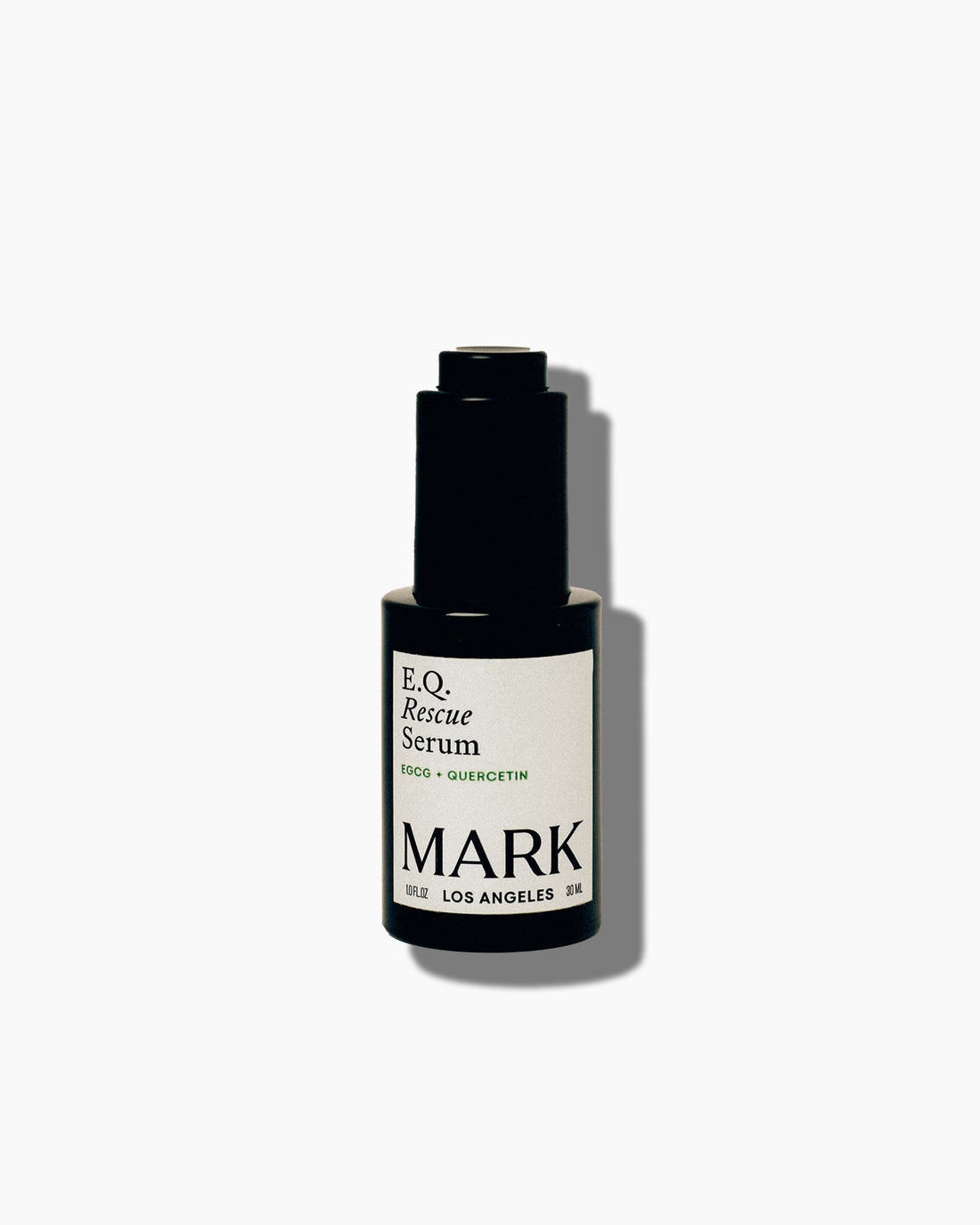

Highlights
Key Ingredients
Other Ingredients
Skim through
| Ingredient name | what-it-does | irr., com. | ID-Rating |
|---|---|---|---|
| Water (Aqua) | solvent | ||
| Hamamelis Virginiana (Witch Hazel) Water | soothing | goodie | |
| Alcohol | antimicrobial/antibacterial, solvent, viscosity controlling | icky | |
| PEG-40 Hydrogenated Castor Oil | emulsifying, surfactant/cleansing | ||
| Ethoxydiglycol | solvent, moisturizer/humectant, perfuming | 0, 0 | |
| Caprylyl Glycol | moisturizer/humectant, emollient | ||
| Glyceryl Laurate | emollient, emulsifying | ||
| Glyceryl Undecylenate | emollient, emulsifying | ||
| Epigallocatechin Gallate | antioxidant, soothing | superstar | |
| Xanthan Gum | viscosity controlling | ||
| Phenoxyethanol | preservative | ||
| Quercetin | antioxidant, soothing | goodie |
Mark LA Eq SerumIngredients explained
Good old water, aka H2O. The most common skincare ingredient of all. You can usually find it right in the very first spot of the ingredient list, meaning it’s the biggest thing out of all the stuff that makes up the product.
It’s mainly a solvent for ingredients that do not like to dissolve in oils but rather in water.
Once inside the skin, it hydrates, but not from the outside - putting pure water on the skin (hello long baths!) is drying.
One more thing: the water used in cosmetics is purified and deionized (it means that almost all of the mineral ions inside it is removed). Like this, the products can stay more stable over time.
The distillate created from different parts of the hazelnut-bush-like magic tree, commonly called Witch Hazel. Hamamelis Virginiana Water is a bit of a sloppy ingredient name as the leaves, the twigs and the bark can be used to create extracts or distillates and the different parts contain different amounts of biologically active components. But what you are getting is probably a nice water with astringent, soothing, antioxidant and antibacterial magic properties.
We went into great detail about Witch Hazel in cosmetics here, detailing the main biologically active components and how they are different in different parts of the plant. Click here and read more >>
Simply alcohol refers to ethanol and it's a pretty controversial ingredient. It has many instant benefits: it's a great solvent, penetration enhancer, creates cosmetically elegant, light formulas, great astringent and antimicrobial. No wonder it's popular in toners and oily skin formulas.
The downside is that it can be very drying if it's in the first few ingredients on an ingredient list.
Some experts even think that regular exposure to alcohol damages skin barrier and causes inflammation though it's a debated opinion. If you wanna know more, we wrote a more detailed explanation about what's the deal with alcohol in skincare products at alcohol denat. (it's also alcohol, but with some additives to make sure no one drinks it).
A mildly viscous, amber-colored liquid with fatty odor, made from Castor Oil and polyethylene glycol (PEG).
If it were a person, we’d say, it’s agile, diligent & multifunctional. It’s mostly used as an emulsifier and surfactant but most often it is used to solubilize fragrances into water-based formulas.
A nice odorless liquid used mainly as a superior solubilizer and efficacy booster for cosmetic active ingredients such as skincare bigshot vitamin C, self-tanning active DHA or the anti-acne gold standard, benzoyl peroxide.
Other than that it can also be used in hair care products where it gives a longer-lasting and more uniform coloring. According to a manufacturer, it might even prevent the formation of split ends.
It’s a handy multi-tasking ingredient that gives the skin a nice, soft feel. At the same time, it also boosts the effectiveness of other preservatives, such as the nowadays super commonly used phenoxyethanol.
The blend of these two (caprylyl glycol + phenoxyethanol) is called Optiphen, which not only helps to keep your cosmetics free from nasty things for a long time but also gives a good feel to the finished product. It's a popular duo.
A glycerin and lauric acid derived multi-functional ingredient that works as a co-emulsifier (helps water and oil to mix together next to other emulsifiers), emollient (makes skin nice and smooth) and anti-microbial agent (preservative booster). It also has some thickening and refatting properties in cleansing formulas.
 We don't have description for this ingredient yet.
If EGCG does not tell you anything, green tea sure does. We have written about green tea in excruciating details, so if you wanna become an expert in the "green tea in skincare" topic, click here and read it.
So now you know that EGCG is the magic ingredient in green tea. It's the most active polyphenol that green tea owes most of its magic properties to. It's a fantastic antioxidant, anti-inflammatory and anticarcinogenic agent. Be happy, if you spot it on the ingredient list.
It's one of the most commonly used thickeners and emulsion stabilizers. If the product is too runny, a little xanthan gum will make it more gel-like. Used alone, it can make the formula sticky and it is a good team player so it is usually combined with other thickeners and so-called rheology modifiers (helper ingredients that adjust the flow and thus the feel of the formula). The typical use level of Xantha Gum is below 1%, it is usually in the 0.1-0.5% range.
Btw, Xanthan gum is all natural, a chain of sugar molecules (polysaccharide) produced from individual sugar molecules (glucose and sucrose) via fermentation. It’s approved by Ecocert and also used in the food industry (E415).
It’s pretty much the current IT-preservative. It’s safe and gentle, but even more importantly, it’s not a feared-by-everyone-mostly-without-scientific-reason paraben.
It’s not something new: it was introduced around 1950 and today it can be used up to 1% worldwide. It can be found in nature - in green tea - but the version used in cosmetics is synthetic.
Other than having a good safety profile and being quite gentle to the skin it has some other advantages too. It can be used in many types of formulations as it has great thermal stability (can be heated up to 85°C) and works on a wide range of pH levels (ph 3-10).
It’s often used together with ethylhexylglycerin as it nicely improves the preservative activity of phenoxyethanol.
Quercetin is a polyphenol flavonoid found in lots of plants, such as red onions, broccoli, and blueberries. The reason it is in cosmetics is that - similar to other polyphenols - it is a strong antioxidant and has anti-inflammatory properties.
Other than that, a study also showed that adding quercetin to sunscreens helped to stabilize the otherwise not very stable chemical UV filters avobenzone and octinoxate against degradation -- and it did better than traditional stabilizers like octocrylene and vitamin E!
There are also some studies into the use of quercetin as a skin whitening agent, but after some conflicting results, the conclusion is that "quercetin is not effective in cosmetic applications as a whitening ingredient". It also shows minor cytotoxicity when compared to some of its polyphenol derivatives (such as rutin), so quercetin is a good example where more is not better.
You may also want to take a look at...
| what‑it‑does | solvent |
| what‑it‑does | soothing |
| what‑it‑does | antimicrobial/antibacterial | solvent | viscosity controlling |
| what‑it‑does | emulsifying | surfactant/cleansing |
| what‑it‑does | solvent | moisturizer/humectant | perfuming |
| irritancy, com. | 0, 0 |
| what‑it‑does | moisturizer/humectant | emollient |
| what‑it‑does | emollient | emulsifying |
| what‑it‑does | emollient | emulsifying |
| what‑it‑does | antioxidant | soothing |
| what‑it‑does | viscosity controlling |
| what‑it‑does | preservative |
| what‑it‑does | antioxidant | soothing |