





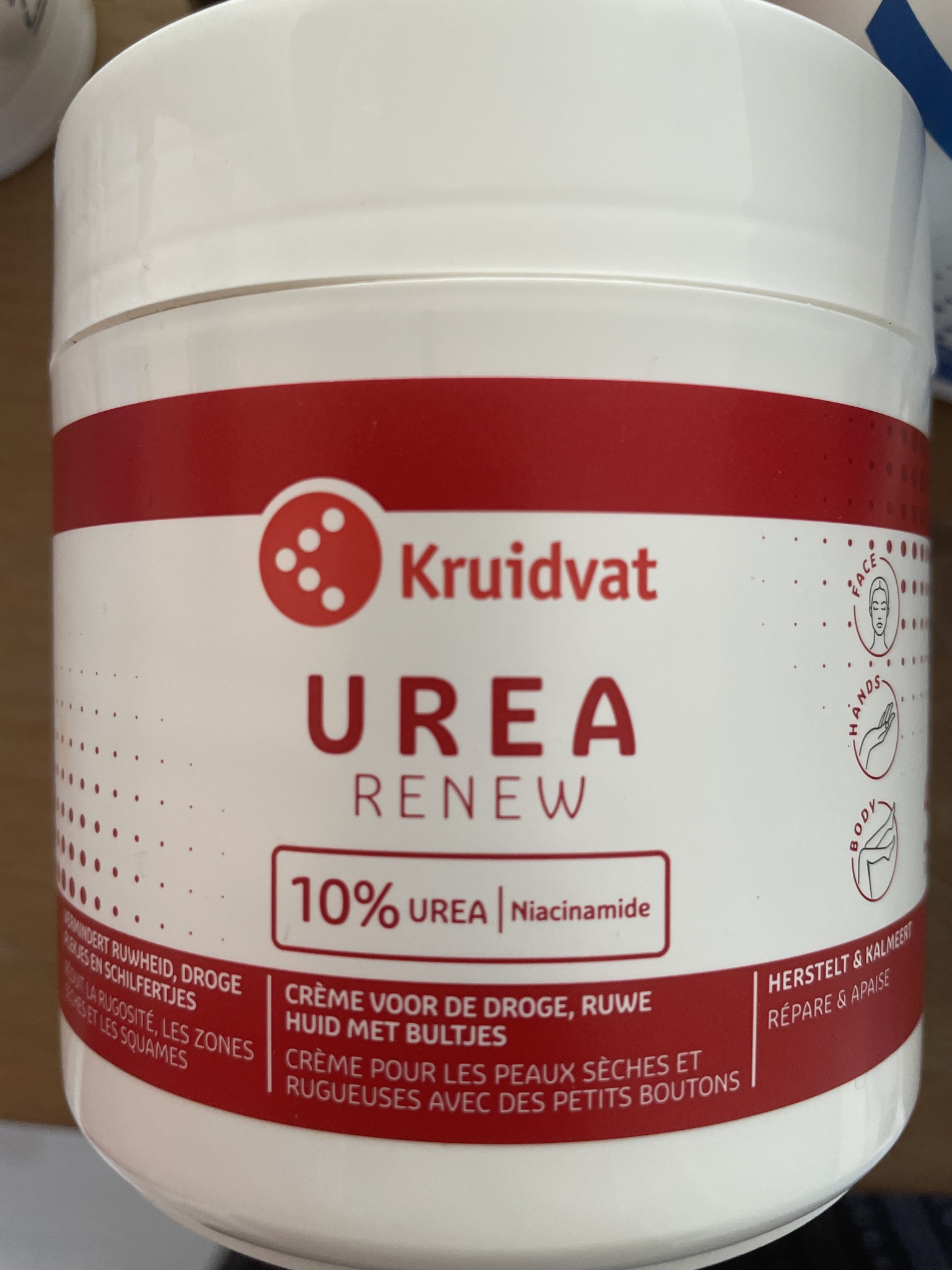
Ingredients overview
 INCI photo pending approval
Highlights
Key Ingredients
Skim through
Kruidvat Urea RenewIngredients explained
Good old water, aka H2O. The most common skincare ingredient of all. You can usually find it right in the very first spot of the ingredient list, meaning it’s the biggest thing out of all the stuff that makes up the product.
It’s mainly a solvent for ingredients that do not like to dissolve in oils but rather in water.
Once inside the skin, it hydrates, but not from the outside - putting pure water on the skin (hello long baths!) is drying.
One more thing: the water used in cosmetics is purified and deionized (it means that almost all of the mineral ions inside it is removed). Like this, the products can stay more stable over time.
- A natural moisturizer that’s also in our skin
- A super common, safe, effective and cheap molecule used for more than 50 years
- Not only a simple moisturizer but knows much more: keeps the skin lipids between our skin cells in a healthy (liquid crystal) state, protects against irritation, helps to restore barrier
- Effective from as low as 3% with even more benefits for dry skin at higher concentrations up to 20-40%
- High-glycerin moisturizers are awesome for treating severely dry skin
Yes, it's the thing that can be found naturally in pee. And in the skin. It is an awesome natural moisturizing factor, aka NMF. NMFs are important components that help the skin to hold onto water and keep it plump, elastic and hydrated. Urea makes up about 7% of NMFs next to other things such as amino acids (40%), PCA (12%) or Lactate (12%).
What makes urea special, is that it is not only a simple moisturizer, but it is thought to be a "small-molecule regulator of epidermal structure and function" meaning that it has a bunch of extra biological activities. It acts as a mild keratolytic agent (some of its moisturizing action is thought to come from urea's ability to break down bonds in the protein called filaggrin and thus freeing up amino acids in the skin), enhances antimicrobial peptide expression and improves skin barrier function.
Being a mild keratolytic agent and strong moisturizer means that high-percentage (10-40%) urea treatments are found effective in a bunch of skin disorders connected to excessive dryness and malfunctioning skin barrier such as ichthyosis, xerosis, psoriasis, eczema and seborrheic dermatitis.
Overall, just like glycerin, urea is a real oldie but a goodie, a nice ingredient in any moisturizer.
An extremely common multitasker ingredient that gives your skin a nice soft feel (emollient) and gives body to creams and lotions. It also helps to stabilize oil-water mixes (emulsions), though it does not function as an emulsifier in itself. Its typical use level in most cream type formulas is 2-3%.
It’s a so-called fatty alcohol, a mix of cetyl and stearyl alcohol, other two emollient fatty alcohols. Though chemically speaking, it is alcohol (as in, it has an -OH group in its molecule), its properties are totally different from the properties of low molecular weight or drying alcohols such as denat. alcohol. Fatty alcohols have a long oil-soluble (and thus emollient) tail part that makes them absolutely non-drying and non-irritating and are totally ok for the skin.
A clear, almost colorless (or slightly yellowish) oily liquid (an ester to be precise) that's used as a medium spreading emollient. It gives skin a nice and smooth after-feel and it's very good at reducing oiliness or greasiness coming from other heavier oils in the formula.
The emollient plant oil coming from the soybean. It is considered to be a nice, cost-effective base oil with moisturizing properties. As for its fatty acid profile, it contains 48-59% barrier-repairing linoleic acid, 17-30% nourishing oleic acid and also some (4.5-11%) potentially anti-inflammatory linolenic acid.
Glyceryl stearate citrate is similar to the super common skincare ingredient glyceryl stearate, and is similarly used to help combine waters and oils (emulsifier) and to make your skin feel nice and soft (emollient).
The main difference between glyceryl stearate citrate and its cousin glyceryl stearate is that this one has a citric acid molecule also attached to its glycerin. This makes it what chemists call a diacylglycerol, which is a fancy word for two acids (in this case, citric acid and stearic acid) attached together with a glycerin bridge. But when it comes to cosmetics, all you need to know is that both glyceryl stearate citrate and glyceryl stearate are safe, tried and true emulsifiers. Expect to see them in formulas with both water-based and oil-based ingredients (think moisturizers and lotions).
A triterpene ester-rich extract that comes from the shea butter. It is claimed to have barrier strengthening and anti-inflammatory properties. It is typically used at 0.5-1% in formulas.
A super common emollient that makes your skin feel nice and smooth. It comes from coconut oil and glycerin, it’s light-textured, clear, odorless and non-greasy. It’s a nice ingredient that just feels good on the skin, is super well tolerated by every skin type and easy to formulate with. No wonder it’s popular.
A little helper ingredient that is used to adjust the pH of the product. It also helps to keep products stay nice longer by neutralizing the metal ions in the formula (they usually come from water).
If you have spotted ethylhexylglycerin on the ingredient list, most probably you will see there also the current IT-preservative, phenoxyethanol. They are good friends because ethylhexylglycerin can boost the effectiveness of phenoxyethanol (and other preservatives) and as an added bonus it feels nice on the skin too.
Also, it's an effective deodorant and a medium spreading emollient.
It’s pretty much the current IT-preservative. It’s safe and gentle, but even more importantly, it’s not a feared-by-everyone-mostly-without-scientific-reason paraben.
It’s not something new: it was introduced around 1950 and today it can be used up to 1% worldwide. It can be found in nature - in green tea - but the version used in cosmetics is synthetic.
Other than having a good safety profile and being quite gentle to the skin it has some other advantages too. It can be used in many types of formulations as it has great thermal stability (can be heated up to 85°C) and works on a wide range of pH levels (ph 3-10).
It’s often used together with ethylhexylglycerin as it nicely improves the preservative activity of phenoxyethanol.
Exactly what it sounds: nice smelling stuff put into cosmetic products so that the end product also smells nice. Fragrance in the US and parfum in the EU is a generic term on the ingredient list that is made up of 30 to 50 chemicals on average (but it can have as much as 200 components!).
If you are someone who likes to know what you put on your face then fragrance is not your best friend - there's no way to know what’s really in it.
Also, if your skin is sensitive, fragrance is again not your best friend. It’s the number one cause of contact allergy to cosmetics. It’s definitely a smart thing to avoid with sensitive skin (and fragrance of any type - natural is just as allergic as synthetic, if not worse!).
 We don't have description for this ingredient yet.
A fatty acid that can be found naturally in the skin. In fact, it's the most common saturated fatty acid found in animals and plants.
As for skincare, it can make the skin feel nice and smooth in moisturizers (emollient) or it can act as a foam building cleansing agent in cleansers. It's also a very popular ingredient in shaving foams.
A common multi-tasker fatty acid. It makes your skin feel nice and smooth (emollient), gives body to cream type products and helps to stabilize water and oil mixes (aka emulsions).
- A multi-functional skincare superstar with several proven benefits for the skin
- Great anti-aging, wrinkle smoothing ingredient used at 4-5% concentration
- Fades brown spots alone or in combination with amino sugar, acetyl glucosamine
- Increases ceramide synthesis that results in a stronger, healthier skin barrier and better skin hydration
- Can help to improve several skin conditions including acne, rosacea, and atopic dermatitis
A 100% natural and plant-derived moisturizer that mimics the natural carbohydrate fraction found in the upper layer of the skin. Its special magic power is to bind to the skin stronger and longer than other moisturizer ingredients do so it can keep the skin hydrated longer than usual.
It's one of the most commonly used thickeners and emulsion stabilizers. If the product is too runny, a little xanthan gum will make it more gel-like. Used alone, it can make the formula sticky and it is a good team player so it is usually combined with other thickeners and so-called rheology modifiers (helper ingredients that adjust the flow and thus the feel of the formula). The typical use level of Xantha Gum is below 1%, it is usually in the 0.1-0.5% range.
Btw, Xanthan gum is all natural, a chain of sugar molecules (polysaccharide) produced from individual sugar molecules (glucose and sucrose) via fermentation. It’s approved by Ecocert and also used in the food industry (E415).
Citric acid comes from citrus fruits and is an AHA. If these magic three letters don’t tell you anything, click here and read our detailed description on glycolic acid, the most famous AHA.
So citric acid is an exfoliant, that can - just like other AHAs - gently lift off the dead skin cells of your skin and make it more smooth and fresh.
There is also some research showing that citric acid with regular use (think three months and 20% concentration) can help sun-damaged skin, increase skin thickness and some nice hydrating things called glycosaminoglycans in the skin.
But according to a comparative study done in 1995, citric acid has less skin improving magic properties than glycolic or lactic acid. Probably that’s why citric acid is usually not used as an exfoliant but more as a helper ingredient in small amounts to adjust the pH of a formulation.
You may also want to take a look at...
| what‑it‑does | solvent |
| what‑it‑does | skin-identical ingredient | moisturizer/humectant |
| irritancy, com. | 0, 0 |
| what‑it‑does | skin-identical ingredient | moisturizer/humectant |
| what‑it‑does | emollient | viscosity controlling | emulsifying | surfactant/cleansing |
| irritancy, com. | 1, 2 |
| what‑it‑does | emollient |
| what‑it‑does | emollient | perfuming |
| irritancy, com. | 0, 3 |
| what‑it‑does | emollient | emulsifying |
| what‑it‑does | emollient | soothing |
| what‑it‑does | emollient |
| what‑it‑does | chelating | buffering |
| what‑it‑does | preservative |
| what‑it‑does | preservative |
| what‑it‑does | perfuming |
| what‑it‑does | perfuming |
| what‑it‑does | skin-identical ingredient | emollient | emulsifying |
| irritancy, com. | 0, 2 |
| what‑it‑does | emollient | viscosity controlling |
| irritancy, com. | 0, 2-3 |
| what‑it‑does | cell-communicating ingredient | skin brightening | anti-acne | moisturizer/humectant |
| what‑it‑does | moisturizer/humectant |
| what‑it‑does | viscosity controlling |
| what‑it‑does | buffering |