





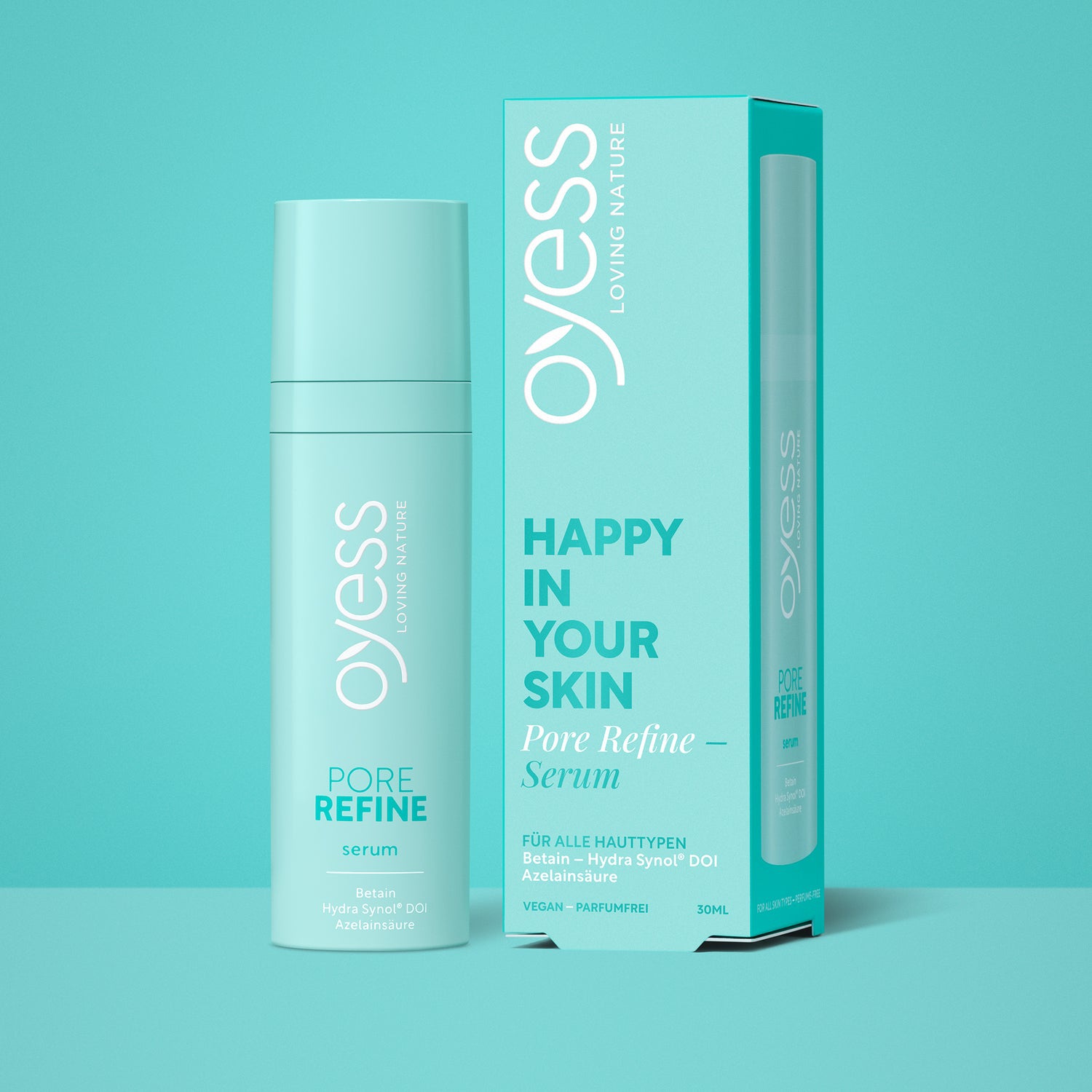
Pore Refine Serum
Ingredients overview
Highlights
Key Ingredients
Other Ingredients
Skim through
Oyess Pore Refine SerumIngredients explained
Good old water, aka H2O. The most common skincare ingredient of all. You can usually find it right in the very first spot of the ingredient list, meaning it’s the biggest thing out of all the stuff that makes up the product.
It’s mainly a solvent for ingredients that do not like to dissolve in oils but rather in water.
Once inside the skin, it hydrates, but not from the outside - putting pure water on the skin (hello long baths!) is drying.
One more thing: the water used in cosmetics is purified and deionized (it means that almost all of the mineral ions inside it is removed). Like this, the products can stay more stable over time.
A clear, colorless and odorless oily liquid that works as a fast-spreading emollient with a dry skin feel.
A multi-functional, silky feeling helper ingredient that can do quite many things. It's used as an emulsion stabilizer, solvent and a broad spectrum antimicrobial. According to manufacturer info, it's also a moisturizer and helps to make the product feel great on the skin. It works synergistically with preservatives and helps to improve water-resistance of sunscreens.
Butylene glycol, or let’s just call it BG, is a multi-tasking colorless, syrupy liquid. It’s a great pick for creating a nice feeling product.
BG’s main job is usually to be a solvent for the other ingredients. Other tasks include helping the product to absorb faster and deeper into the skin (penetration enhancer), making the product spread nicely over the skin (slip agent), and attracting water (humectant) into the skin.
It’s an ingredient whose safety hasn’t been questioned so far by anyone (at least not that we know about). BG is approved by Ecocert and is also used enthusiastically in natural products. BTW, it’s also a food additive.
- Superstar ingredient with antibacterial, skin cell regulating, anti-inflammatory and skin-lightening magic properties
- It is especially useful for acne-prone or rosacea-prone skin types (in concentration 10% and up)
- It is a prescription drug in the US but can be freely purchased in the EU in an up to 10% concentration
A coconut or palm kernel oil derived, fast spreading emollient liquid that makes your skin feel nice and smooth. It is mild for sensitive skin, leaves a light and dry skin feel and is readily biodegradable.
- A natural moisturizer that’s also in our skin
- A super common, safe, effective and cheap molecule used for more than 50 years
- Not only a simple moisturizer but knows much more: keeps the skin lipids between our skin cells in a healthy (liquid crystal) state, protects against irritation, helps to restore barrier
- Effective from as low as 3% with even more benefits for dry skin at higher concentrations up to 20-40%
- High-glycerin moisturizers are awesome for treating severely dry skin
Isosorbide Dicaprylate (IDC) is a smart, oil-loving skin hydrator and barrier builder molecule. It works synergistically with glycerin as it up-regulates Aquaporin 3 (AQP3), an important transmembrane protein that transports our beloved friend glycerin, along with its’ hydrating groupie water molecules that surround it, into the cell. To put it more simply - AQP3 makes sure that glycerin and water are well distributed in the outer layer of the skin and thus the skin is well-hydrated.
IDC is also claimed to upregulate the expression of CD44 (a hyaluronic acid binding receptor), ceramide synthase (an enzyme required for ceramide synthesis), and decrease transepidermal water loss (TEWL).
The clinical study done by the manufacturer showed that a direct comparison between 2% IDC versus 2% glycerin lotions revealed a three-fold advantage of IDC in giving skin hydration. Severely dry skin treated with 2% IDC + 2% glycerin showed 133% improvement, whereas 35% improvement was observed with moderately dry skin.
A sugar beet-derived amino acid derivative with nice skin protection and moisturization properties. Betaine's special thing is being an osmolyte, a molecule that helps to control cell-water balance. It is also a natural osmoprotectant, meaning that it attracts water away from the protein surface and thus protects them from denaturation and increases their thermodynamic stability.
It also gives sensorial benefits to the formula and when used in cleansers, it helps to make them milder and gentler.
- It's one of the gold standard ingredients for treating problem skin
- It can exfoliate skin both on the surface and in the pores
- It's a potent anti-inflammatory agent
- It's more effective for treating blackheads than acne
- For acne combine it with antibacterial agents like benzoyl peroxide or azelaic acid
It's one of the most commonly used thickeners and emulsion stabilizers. If the product is too runny, a little xanthan gum will make it more gel-like. Used alone, it can make the formula sticky and it is a good team player so it is usually combined with other thickeners and so-called rheology modifiers (helper ingredients that adjust the flow and thus the feel of the formula). The typical use level of Xantha Gum is below 1%, it is usually in the 0.1-0.5% range.
Btw, Xanthan gum is all natural, a chain of sugar molecules (polysaccharide) produced from individual sugar molecules (glucose and sucrose) via fermentation. It’s approved by Ecocert and also used in the food industry (E415).
Glyceryl stearate citrate is similar to the super common skincare ingredient glyceryl stearate, and is similarly used to help combine waters and oils (emulsifier) and to make your skin feel nice and soft (emollient).
The main difference between glyceryl stearate citrate and its cousin glyceryl stearate is that this one has a citric acid molecule also attached to its glycerin. This makes it what chemists call a diacylglycerol, which is a fancy word for two acids (in this case, citric acid and stearic acid) attached together with a glycerin bridge. But when it comes to cosmetics, all you need to know is that both glyceryl stearate citrate and glyceryl stearate are safe, tried and true emulsifiers. Expect to see them in formulas with both water-based and oil-based ingredients (think moisturizers and lotions).
 We don't have description for this ingredient yet.
A little helper ingredient that is used to adjust the pH of the product. It also helps to keep products stay nice longer by neutralizing the metal ions in the formula (they usually come from water).
If you have oily, acne-prone skin, Zinc PCA is one of the actives to put on your "TO TRY" list.
It's a synergistic association of two great things: Zinc and L-PCA. The Zinc part is there to help normalize sebum production and limit the proliferation of evil acne-causing bacteria. L-PCA stands for pyrrolidone carboxylic acid and it's a key molecule in the skin that helps with processes of hydration and energy (it's actually an NMF, a natural moisturizing factor).
L-PCA is not only there to hydrate the skin, but it also helps to increase the efficacy and bioavailability of zinc. An in-vivo (done on real people) test done by the manufacturer shows that Zinc PCA reduces sebum production statistically significantly after 28 days of application (1% was used in the test), and in-vitro (made in the lab) measurements show that Zinc PCA has strong anti-microbial activity against P. acnes (between 0.1-0.25%) and other bacterial strains.
If that would not be enough there is also a 2011 research paper saying that based on in-vitro (made in the lab, not on real people) findings Zinc PCA might be a promising anti-aging active that helps with the production of type I collagen (and we all know more collagen = firmer skin).
All in all, definitely a goodie for oily, acne-prone skin.
An extremely common multitasker ingredient that gives your skin a nice soft feel (emollient) and gives body to creams and lotions. It also helps to stabilize oil-water mixes (emulsions), though it does not function as an emulsifier in itself. Its typical use level in most cream type formulas is 2-3%.
It’s a so-called fatty alcohol, a mix of cetyl and stearyl alcohol, other two emollient fatty alcohols. Though chemically speaking, it is alcohol (as in, it has an -OH group in its molecule), its properties are totally different from the properties of low molecular weight or drying alcohols such as denat. alcohol. Fatty alcohols have a long oil-soluble (and thus emollient) tail part that makes them absolutely non-drying and non-irritating and are totally ok for the skin.
- Primary fat-soluble antioxidant in our skin
- Significant photoprotection against UVB rays
- Vit C + Vit E work in synergy and provide great photoprotection
- Has emollient properties
- Easy to formulate, stable and relatively inexpensive
Cellulose is an important component of the cell walls of green plants and it's the most abundant natural polymer (big molecule from repeated subunits) on Earth. If the polymer structure is not too big (less than 200 repeated units), cellulose becomes microcrystalline cellulose.
In skin care, it comes as a fine or less fine white powder. The less fine (bigger particle size) version is used as a gentle scrubbing agent (a nice natural, biodegradable alternative to now banned plastic polyethylene) and the ultra fine version is used as a helper ingredient that gives a super-silky, soft touch, reduces tackiness or greasiness and can also be used as a mattifying agent.
Combined with Cellulose Gum, it also works as a nice gelling agent.
We don't have description for this ingredient yet.
Sunflower does not need a big intro as you probably use it in the kitchen as cooking oil, or you munch on the seeds as a healthy snack or you adore its big, beautiful yellow flower during the summer - or you do all of these and probably even more. And by even more we mean putting it all over your face as sunflower oil is one of the most commonly used plant oils in skincare.
It’s a real oldie: expressed directly from the seeds, the oil is used not for hundreds but thousands of years. According to The National Sunflower Association, there is evidence that both the plant and its oil were used by American Indians in the area of Arizona and New Mexico about 3000 BC. Do the math: it's more than 5000 years – definitely an oldie.
Our intro did get pretty big after all (sorry for that), so let's get to the point finally: sunflower oil - similar to other plant oils - is a great emollient that makes the skin smooth and nice and helps to keep it hydrated. It also protects the surface of the skin and enhances the damaged or irritated skin barrier. Leslie Bauman notes in Cosmetic Dermatology that one application of sunflower oil significantly speeds up the recovery of the skin barrier within an hour and sustains the results 5 hours after using it.
It's also loaded with fatty acids (mostly linoleic (50-74%) and oleic (14-35%)). The unrefined version (be sure to use that on your skin!) is especially high in linoleic acid that is great even for acne-prone skin. Its comedogen index is 0, meaning that it's pretty much an all skin-type oil.
Truth be told, there are many great plant oils and sunflower oil is definitely one of them.
A polysaccharide (a big sugar molecule) coming from the edible fruit bodies of the Silver Ear mushroom in China. Legend has it, imperial Concubine Yang Kuei-fei - the most beautiful woman in Chinese history - used it for her facial care.
So Tremella Extract is a big molecule (more than 1M Da molecular weight) with sugar constituents of Mannose, Xylose, and Glucuronic acid (20%). The last one is the most important one, as Glucuronic acid is also a major component in hyaluronic acid (HA). Thanks to this, Tremella is claimed to be an awesome moisturizer with slightly greater water-holding capacities than HA itself. This is quite a big deal as HA is known for its crazy water-holding capacity (up to 1000 times its own weight).
Not only that but Tremella also seems to have some antioxidant effect, it's not sticky (humectants do tend to be sticky) and it leaves skin moist and smooth. No wonder, Concubine Yang Kuei-fei liked this mushroom.
Though its name says acid, it's not really an exfoliant. It's a plant extract with some antioxidant properties. Its main thing in cosmetic products is to neutralize the metal ions in the formula (that usually get into there from water) that would otherwise cause some not so nice changes. It's a natural alternative to sometimes bad-mouthed chelating agents, EDTAs.
An amino acid-based emulsifier that helps water and oil to mix and stay that way. It is considered as natural, environmentally friendly, and hypoallergenic.
A semi-essential (infants cannot synthesize it, but adults can) amino acid that is one of the primary building blocks of hair keratin and skin collagen. It's a natural moisturizing factor, a skin hydrator and might also help to speed up wound healing.
Arginine usually has a positive charge (cationic) that makes it substantive to skin and hair (those are more negatively charged surfaces) and an excellent film former. Thanks to the positive charge, it also creates a complex with AHAs (AHAs like to lose a hydrogen ion and be negatively charged, so the positive and the negative ions attract each other) that causes a "time-release AHA effect" and reduces the irritation associated with AHAs.
We don't have description for this ingredient yet.
You may also want to take a look at...
| what‑it‑does | solvent |
| what‑it‑does | emollient | solvent |
| what‑it‑does | solvent | moisturizer/humectant |
| what‑it‑does | moisturizer/humectant | solvent |
| irritancy, com. | 0, 1 |
| what‑it‑does | anti-acne | soothing | buffering |
| what‑it‑does | emollient |
| what‑it‑does | skin-identical ingredient | moisturizer/humectant |
| irritancy, com. | 0, 0 |
| what‑it‑does | cell-communicating ingredient | moisturizer/humectant |
| what‑it‑does | moisturizer/humectant |
| what‑it‑does | exfoliant | anti-acne | soothing | preservative |
| what‑it‑does | viscosity controlling |
| what‑it‑does | emollient | emulsifying |
| what‑it‑does | chelating | buffering |
| what‑it‑does | anti-acne | moisturizer/humectant |
| what‑it‑does | emollient | viscosity controlling | emulsifying | surfactant/cleansing |
| irritancy, com. | 1, 2 |
| what‑it‑does | antioxidant |
| irritancy, com. | 0-3, 0-3 |
| what‑it‑does | viscosity controlling |
| what‑it‑does | emollient |
| irritancy, com. | 0, 0 |
| what‑it‑does | antioxidant | moisturizer/humectant |
| what‑it‑does | chelating |
| what‑it‑does | emulsifying | surfactant/cleansing |
| what‑it‑does | skin-identical ingredient |