





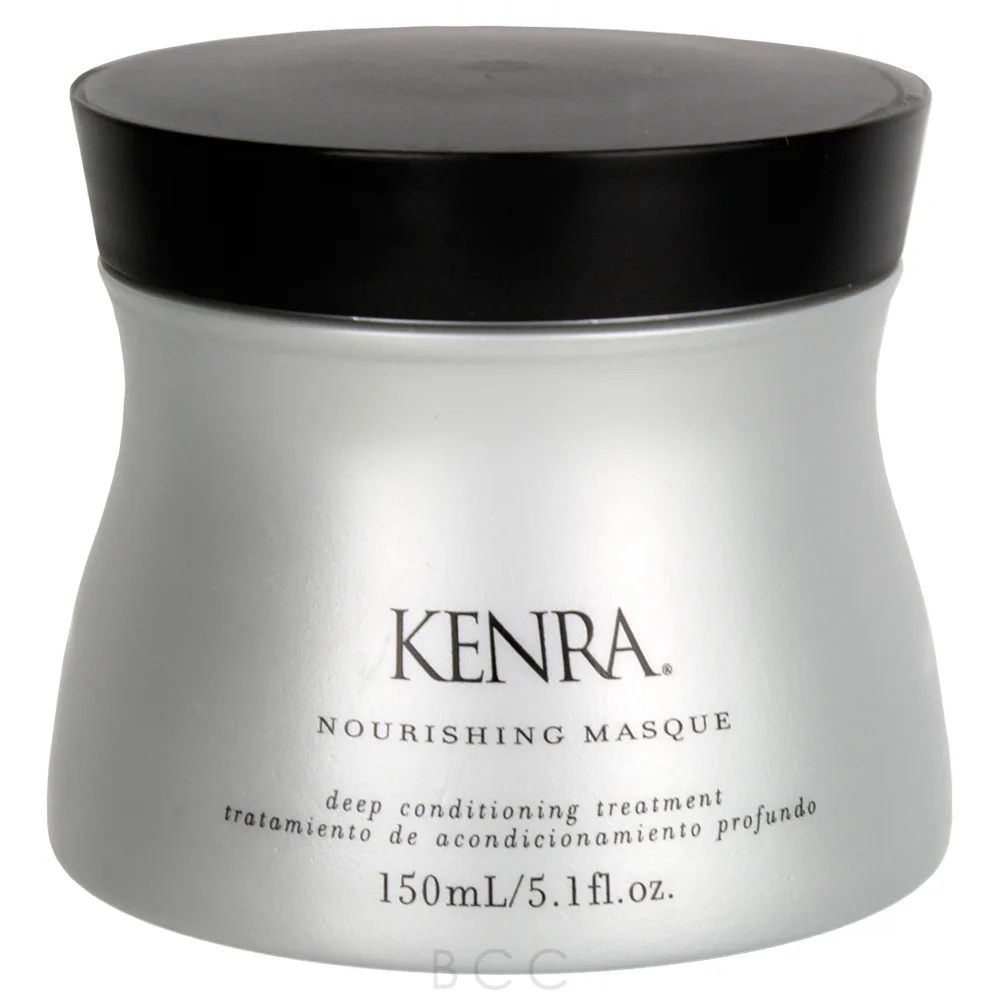
Nourishing Masque
Ingredients overview
Highlights
Key Ingredients
Other Ingredients
Skim through
Kenra Professional Nourishing MasqueIngredients explained
Good old water, aka H2O. The most common skincare ingredient of all. You can usually find it right in the very first spot of the ingredient list, meaning it’s the biggest thing out of all the stuff that makes up the product.
It’s mainly a solvent for ingredients that do not like to dissolve in oils but rather in water.
Once inside the skin, it hydrates, but not from the outside - putting pure water on the skin (hello long baths!) is drying.
One more thing: the water used in cosmetics is purified and deionized (it means that almost all of the mineral ions inside it is removed). Like this, the products can stay more stable over time.
A so-called fatty (the good, non-drying kind of) alcohol that does all kinds of things in a skincare product: it makes your skin feel smooth and nice (emollient), helps to thicken up products and also helps water and oil to blend (emulsifier). Can be derived from coconut or palm kernel oil.
- A natural moisturizer that’s also in our skin
- A super common, safe, effective and cheap molecule used for more than 50 years
- Not only a simple moisturizer but knows much more: keeps the skin lipids between our skin cells in a healthy (liquid crystal) state, protects against irritation, helps to restore barrier
- Effective from as low as 3% with even more benefits for dry skin at higher concentrations up to 20-40%
- High-glycerin moisturizers are awesome for treating severely dry skin
In itself, it's an antistatic (stops your hair from flying around because of electricity), hair conditioning and softening ingredient used mainly in haircare products.
Coupled with Cetearyl Alcohol, they form an easy to handle, super stable emulsifier duo that has exceptional spreadability and gives a pleasant final touch to the products.
A modified dimethicone-type silicone molecule that also contains amino-groups. Having amino-groups means that Amodimethicone also has Nitrogen in its molecule that likes to have a positive charge. Positively charged (or quaternised) molecules are substantive to skin and hair as those are negatively charged surfaces and are excellent film formers. Amodiemthcone is no exception and it is especially recommended for hair-care products for its long-lasting hair conditioning benefits.
 We don't have description for this ingredient yet.
An easy-to-formulate, commonly used, nice to have ingredient that’s also called pro-vitamin B5. As you might guess from the “pro” part, it’s a precursor to vitamin B5 (whose fancy name is pantothenic acid).
Its main job in skincare products is to moisturise the skin. It’s a humectant meaning that it can help the skin to attract water and then hold onto it. There is also research showing that panthenol can help our skin to produce more lovely lipids that are important for a strong and healthy skin barrier.
Another great thing about panthenol is that it has anti-inflammatory and skin protecting abilities. A study shows that it can reduce the irritation caused by less-nice other ingredients (e.g. fragrance, preservatives or chemical sunscreens) in the product.
Research also shows that it might be useful for wound healing as it promotes fibroblast (nice type of cells in our skin that produce skin-firming collagen) proliferation.
If that wasn’t enough panthenol is also useful in nail and hair care products. A study shows that a nail treatment liquide with 2% panthenol could effectively get into the nail and significantly increase the hydration of it.
As for the hair the hydration effect is also true there. Panthenol might make your hair softer, more elastic and helps to comb your hair more easily.
As you may guess, if something is only recommended in products that you rinse off (cleansers and shampoos), then it’s probably not the best ingredient for the skin.
Methylisothiazolinone (MI) is a preservative that' super efficient against bacteria at surprisingly low concentrations. The problem with it though is that it can also sensitize and irritate the skin quite easily when it comes in leave-on formulas.
Currently, some countries are considering to ban it entirely (like Denmark) and the permitted use level is very low (under 0.01%). Luckily there are plenty of products on the market with other preservative options so if you are a better safe than sorry type it's probably best to avoid it.
A water-soluble, chemical sunscreen agent that is a secondary UVB absorber with some activity in the short UVA range as well. Being a secondary UV absorber means that its protection is weak and it has to be combined with other sunscreen filters for proper sun protection.
More often than not, Benzophenone-4 is not used as a sunscreen agent but as a photoprotectant to extend product shelf life, or as a color-protectant for products in clear packages.
A Contact Dermatitis article from 2007 names BP-4 as an emerging allergen, as it was the most frequently positive chemical UV filter and third most frequently positive ingredient overall among the 35 substances patch tested in the study (13 positives of 1693 people tested).
A clear, oil-soluble, "cosmetically-elegant" liquid that is the most commonly used chemical sunscreen. It absorbs UVB radiation (at wavelengths: 280-320 nm) with a peak protection at 310nm.
It only protects against UVB and not UVA rays (the 320-400 nm range) – so always choose products that contain other sunscreens too. It is not very stable either, when exposed to sunlight, it kind of breaks down and loses its effectiveness (not instantly, but over time - it loses 10% of its SPF protection ability within 35 mins). To make it more stable it can be - and should be - combined with other sunscreen agents to give stable and broad-spectrum protection (the new generation sunscreen agent, Tinosorb S is a particularly good one for that).
Regarding safety, there are also some concerns around Octinoxate. In vitro (made in the lab not on real people) and animal studies have shown that it may produce hormonal (estrogen-like) effects. Do not panic, the studies were not conducted under real life conditions on real human people, so it is probably over-cautious to avoid Octinoxate altogether. However, if you are pregnant or a small child (under 2 yrs. old), choose a physical (zinc oxide/titanium dioxide) or new-generation Tinosorb based sunscreen, just to be on the super-safe side. :)
Overall, Ethylhexyl Methoxycinnamate is an old-school chemical sunscreen agent. There are plenty of better options for sun protection today, but it is considered "safe as used" (and sunscreens are pretty well regulated) and it is available worldwide (can be used up to 10% in the EU and up to 7.5% in the US).
Probably the most common silicone of all. It is a polymer (created from repeating subunits) molecule and has different molecular weight and thus different viscosity versions from water-light to thick liquid.
As for skincare, it makes the skin silky smooth, creates a subtle gloss and forms a protective barrier (aka occlusive). Also, works well to fill in fine lines and wrinkles and give skin a plump look (of course that is only temporary, but still, it's nice). There are also scar treatment gels out there using dimethicone as their base ingredient. It helps to soften scars and increase their elasticity.
As for hair care, it is a non-volatile silicone meaning that it stays on the hair rather than evaporates from it and smoothes the hair like no other thing. Depending on your hair type, it can be a bit difficult to wash out and might cause some build-up (btw, this is not true to all silicones, only the non-volatile types).
Pentaerythrityl Tetra-Di-T-Butyl Hydroxyhydrocinnamate is an antioxidant molecule used in small amounts (less than 0.8%) to help products stay nice longer. More specifically, it is great at preventing discoloration or other types of oxidative degradation. It is a trendy alternative to often bad-mouthed synthetic antioxidant and stabilizer, BHT.
We don't have description for this ingredient yet.
It’s the most commonly used version of pure vitamin E in cosmetics. You can read all about the pure form here. This one is the so-called esterified version.
According to famous dermatologist, Leslie Baumann while tocopheryl acetate is more stable and has a longer shelf life, it’s also more poorly absorbed by the skin and may not have the same awesome photoprotective effects as pure Vit E.
Sunflower does not need a big intro as you probably use it in the kitchen as cooking oil, or you munch on the seeds as a healthy snack or you adore its big, beautiful yellow flower during the summer - or you do all of these and probably even more. And by even more we mean putting it all over your face as sunflower oil is one of the most commonly used plant oils in skincare.
It’s a real oldie: expressed directly from the seeds, the oil is used not for hundreds but thousands of years. According to The National Sunflower Association, there is evidence that both the plant and its oil were used by American Indians in the area of Arizona and New Mexico about 3000 BC. Do the math: it's more than 5000 years – definitely an oldie.
Our intro did get pretty big after all (sorry for that), so let's get to the point finally: sunflower oil - similar to other plant oils - is a great emollient that makes the skin smooth and nice and helps to keep it hydrated. It also protects the surface of the skin and enhances the damaged or irritated skin barrier. Leslie Bauman notes in Cosmetic Dermatology that one application of sunflower oil significantly speeds up the recovery of the skin barrier within an hour and sustains the results 5 hours after using it.
It's also loaded with fatty acids (mostly linoleic (50-74%) and oleic (14-35%)). The unrefined version (be sure to use that on your skin!) is especially high in linoleic acid that is great even for acne-prone skin. Its comedogen index is 0, meaning that it's pretty much an all skin-type oil.
Truth be told, there are many great plant oils and sunflower oil is definitely one of them.
The emollient plant oil that comes from almonds. Similar to other plant oils, it is loaded with skin-nourishing fatty acids (oleic acid - 55-86% and linoleic acid 7-35%) and contains several other skin goodies such as antioxidant vitamin E and vitamin B versions.
It's a nice, basic oil that is often used due to its great smoothing, softening and moisturizing properties. It's also particularly good at treating dry brittle nails (source).
Exactly what it sounds: nice smelling stuff put into cosmetic products so that the end product also smells nice. Fragrance in the US and parfum in the EU is a generic term on the ingredient list that is made up of 30 to 50 chemicals on average (but it can have as much as 200 components!).
If you are someone who likes to know what you put on your face then fragrance is not your best friend - there's no way to know what’s really in it.
Also, if your skin is sensitive, fragrance is again not your best friend. It’s the number one cause of contact allergy to cosmetics. It’s definitely a smart thing to avoid with sensitive skin (and fragrance of any type - natural is just as allergic as synthetic, if not worse!).
We don't have description for this ingredient yet.
Jojoba-derived emollient wax esters (fatty acid + fatty alcohol) that make your skin feel nice and smooth. Chemically speaking, pure jojoba oil is also a wax ester (read our shiny explanation here), however, the ingredients called jojoba esters on the ingredient lists are made from jojoba oil and/or hydrogenated jojoba oil via interesterification.
They have multiple versions with variable fatty acid chain length and the ingredient can have a liquid, a creamy, a soft or firm paste, or even a hard wax consistency. The common thing between all versions is, that unlike most normal triglyceride oils, jojoba esters have superior stability, provide non-greasy emolliency and are readily absorbed into the skin.
We don't have description for this ingredient yet.
The most common type of feared-by-everyone-mostly-without-scientific-reason parabens. It's a cheap, effective and well-tolerated ingredient to make sure the cosmetic formula does not go wrong too soon.
Apart from the general controversy around parabens (we wrote about it more here), there is a 2006 in-vitro (made in the lab not on real people) research about methylparaben (MP) showing that when exposed to sunlight, MP treated skin cells suffered more harm than non-MP treated skin cells. The study was not done with real people on real skin but still - using a good sunscreen next to MP containing products is a good idea. (Well, in fact using a sunscreen is always a good idea. :))
We don't have description for this ingredient yet.
PCA stands for Pyrrolidone Carboxylic Acid and though it might not sound like it, it is a thing that can be found naturally in our skin. The sodium salt form of PCA is an important skin-identical ingredient and great natural moisturizer that helps the skin to hold onto water and stay nicely hydrated.
- It's a helper ingredient that improves the freeze-thaw stability of products
- It's also a solvent, humectant and to some extent a penetration enhancer
- It has a bad reputation among natural cosmetics advocates but cosmetic scientists and toxicology experts do not agree (read more in the geeky details section)
We don't have description for this ingredient yet.
You may also want to take a look at...
| what‑it‑does | solvent |
| what‑it‑does | emollient | viscosity controlling |
| irritancy, com. | 2, 2 |
| what‑it‑does | skin-identical ingredient | moisturizer/humectant |
| irritancy, com. | 0, 0 |
| what‑it‑does | surfactant/cleansing |
| what‑it‑does | emollient |
| what‑it‑does | antimicrobial/antibacterial | emulsifying | preservative | surfactant/cleansing |
| what‑it‑does | soothing | moisturizer/humectant |
| irritancy, com. | 0, 0 |
| what‑it‑does | preservative |
| what‑it‑does | sunscreen |
| what‑it‑does | sunscreen |
| irritancy, com. | 0, 0 |
| what‑it‑does | emollient |
| irritancy, com. | 0, 1 |
| what‑it‑does | antioxidant | preservative |
| what‑it‑does | moisturizer/humectant |
| what‑it‑does | antioxidant |
| irritancy, com. | 0, 0 |
| what‑it‑does | emollient |
| irritancy, com. | 0, 0 |
| what‑it‑does | emollient |
| irritancy, com. | 0, 1-3 |
| what‑it‑does | perfuming |
| what‑it‑does | soothing | emollient | moisturizer/humectant |
| what‑it‑does | soothing | emollient | moisturizer/humectant |
| what‑it‑does | solvent | viscosity controlling | perfuming |
| irritancy, com. | 0, 0 |
| what‑it‑does | preservative |
| irritancy, com. | 0, 0 |
| what‑it‑does | emulsifying | surfactant/cleansing |
| what‑it‑does | skin-identical ingredient | moisturizer/humectant |
| irritancy, com. | 0, 0 |
| what‑it‑does | moisturizer/humectant | solvent |
| irritancy, com. | 0, 0 |
| what‑it‑does | moisturizer/humectant |