





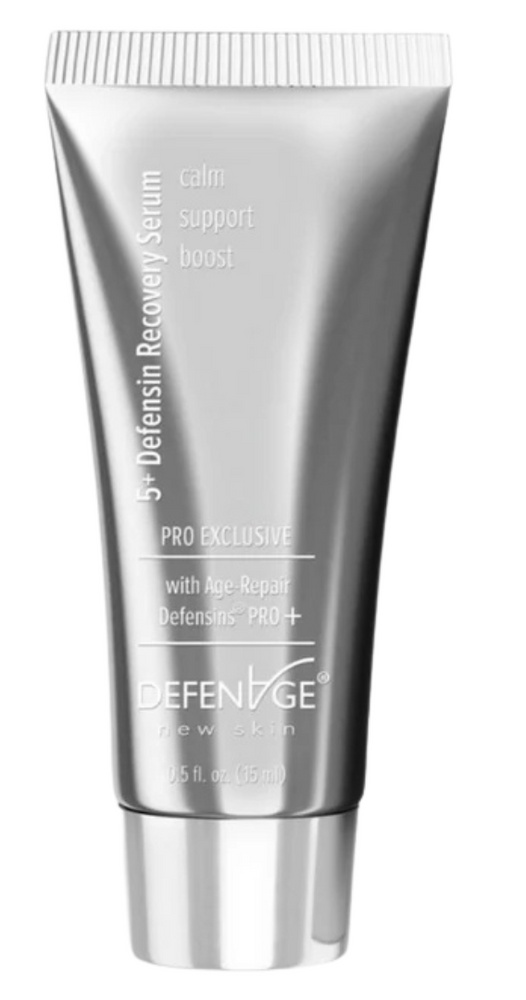
Ingredients overview
Highlights
Key Ingredients
Other Ingredients
Skim through
Defenage Pro 5Ingredients explained
Good old water, aka H2O. The most common skincare ingredient of all. You can usually find it right in the very first spot of the ingredient list, meaning it’s the biggest thing out of all the stuff that makes up the product.
It’s mainly a solvent for ingredients that do not like to dissolve in oils but rather in water.
Once inside the skin, it hydrates, but not from the outside - putting pure water on the skin (hello long baths!) is drying.
One more thing: the water used in cosmetics is purified and deionized (it means that almost all of the mineral ions inside it is removed). Like this, the products can stay more stable over time.
Aloe Vera is one of today’s magic plants. It does have some very nice properties indeed, though famous dermatologist Leslie Baumann warns us in her book that most of the evidence is anecdotal and the plant might be a bit overhyped.
What research does confirm about Aloe is that it’s a great moisturizer and has several anti-inflammatory (among others contains salicylates, polysaccharides, magnesium lactate and C-glucosyl chromone) as well as some antibacterial components. It also helps wound healing and skin regeneration in general. All in all definitely a goodie.
A superabsorbent polymer (big molecule from repeated subunits) that has crazy water binding abilities. Sometimes its referred to as "waterlock" and can absorb 100 to 1000 times its mass in water.
As for its use in cosmetic products, it is a handy multi-tasker that thickens up water-based formulas and also has some emulsifying and emulsion stabilizing properties.
A clear, slightly yellow, odorless oil that's a very common, medium-spreading emollient. It makes the skin feel nice and smooth and works in a wide range of formulas.
Propanediol is a natural alternative for the often used and often bad-mouthed propylene glycol. It's produced sustainably from corn sugar and it's Ecocert approved.
It's quite a multi-tasker: can be used to improve skin moisturization, as a solvent, to boost preservative efficacy or to influence the sensory properties of the end formula.
Apple needs no introduction as one of the most common fruits on planet Earth. It's not only a healthy fruit snack, it's also a goodie if you put in all over your face.
It's loaded with proteins, starch, sugars, acids, vitamins and salts. The sugars (mainly fructose, glucose, sucrose) give apple fruit extract nice moisturizing and smoothing properties, while the acids (mainly malic and gallic acid) give it mild exfoliant, skin brightening and antibacterial properties.
- A natural moisturizer that’s also in our skin
- A super common, safe, effective and cheap molecule used for more than 50 years
- Not only a simple moisturizer but knows much more: keeps the skin lipids between our skin cells in a healthy (liquid crystal) state, protects against irritation, helps to restore barrier
- Effective from as low as 3% with even more benefits for dry skin at higher concentrations up to 20-40%
- High-glycerin moisturizers are awesome for treating severely dry skin
Butylene glycol, or let’s just call it BG, is a multi-tasking colorless, syrupy liquid. It’s a great pick for creating a nice feeling product.
BG’s main job is usually to be a solvent for the other ingredients. Other tasks include helping the product to absorb faster and deeper into the skin (penetration enhancer), making the product spread nicely over the skin (slip agent), and attracting water (humectant) into the skin.
It’s an ingredient whose safety hasn’t been questioned so far by anyone (at least not that we know about). BG is approved by Ecocert and is also used enthusiastically in natural products. BTW, it’s also a food additive.
A type of lipid that's the major (about 75%) component of all cell membranes. As for skincare, it works as an emollient and skin-identical ingredient.
It has a water-loving head with two water-hating tails and this structure gives the molecule emulsifying properties. It is also often used to create liposomes, small spheres surrounded by phospholipid bi-layer designed to carry some active ingredient and help its absorption.
 We don't have description for this ingredient yet.
We don't have description for this ingredient yet.
It seems to us that squalane is in fashion and there is a reason for it. Chemically speaking, it is a saturated (no double bonds) hydrocarbon (a molecule consisting only of carbon and hydrogen), meaning that it's a nice and stable oily liquid with a long shelf life.
It occurs naturally in certain fish and plant oils (e.g. olive), and in the sebum (the oily stuff our skin produces) of the human skin. As f.c. puts it in his awesome blog post, squalane's main things are "emolliency, surface occlusion, and TEWL prevention all with extreme cosmetic elegance". In other words, it's a superb moisturizer that makes your skin nice and smooth, without being heavy or greasy.
Another advantage of squalane is that it is pretty much compatible with all skin types and skin conditions. It is excellent for acne-prone skin and safe to use even if you have fungi-related skin issues, like seborrhea or fungal acne.
The unsaturated (with double bonds) and hence less stable version of Squalane is Squalene, you can read about it here >>
It’s the - sodium form - cousin of the famous NMF, hyaluronic acid (HA). If HA does not tell you anything we have a super detailed, geeky explanation about it here. The TL; DR version of HA is that it's a huge polymer (big molecule from repeated subunits) found in the skin that acts as a sponge helping the skin to hold onto water, being plump and elastic. HA is famous for its crazy water holding capacity as it can bind up to 1000 times its own weight in water.
As far as skincare goes, sodium hyaluronate and hyaluronic acid are pretty much the same and the two names are used interchangeably. As cosmetic chemist kindofstephen writes on reddit "sodium hyaluronate disassociates into hyaluronic acid molecule and a sodium atom in solution".
In spite of this, if you search for "hyaluronic acid vs sodium hyaluronate" you will find on multiple places that sodium hyaluronate is smaller and can penetrate the skin better. Chemically, this is definitely not true, as the two forms are almost the same, both are polymers and the subunits can be repeated in both forms as much as you like. (We also checked Prospector for sodium hyaluronate versions actually used in cosmetic products and found that the most common molecular weight was 1.5-1.8 million Da that absolutely counts as high molecular weight).
What seems to be a true difference, though, is that the salt form is more stable, easier to formulate and cheaper so it pops up more often on the ingredient lists.
If you wanna become a real HA-and-the-skin expert you can read way more about the topic at hyaluronic acid (including penetration-questions, differences between high and low molecular weight versions and a bunch of references to scientific literature).
We don't have description for this ingredient yet.
The unsaponifiable part of sunflower oil. It's the small part of the oil that resists saponification, the chemical reaction that happens during soap making.
If you want to understand saponification more, here is a short explanation (if not, we understand, just skip this paragraph): Oils are mostly made up of triglyceride molecules (a glycerin + three fatty acids attached to it) and during the soap making process a strong base splits the triglyceride molecule up to become a separate glycerin and three soap molecules (sodium salts of fatty acids). The fantastic Labmuffin blog has a handy explanation with great drawings about the soap-making reaction.
So, the triglyceride molecules are the saponifiable part of the oil, and the rest is the unsaponifiable part. In the case of sunflower oil, it's about 1.5-2% of the oil and consists of skin nourishing molecules like free fatty acids (fatty acids not bound up in a triglyceride molecule, it contains mainly (48-74% according to its spec) barrier building linoleic acid), tocopherol (vitamin E) and sterols.
According to manufacturer's info, it's an oily ingredient that not only simply moisturizes the skin but also has great lipid-replenishing and soothing properties. The clinical study done by the manufacturer (on 20 people) found that a cream with 2% active increases skin moisturization by 48.6% after 1 hour, and 34.2% after 24 hours. Applied twice daily for 4 weeks, the study participants had a major improvement in skin dryness, roughness, and desquamation (skin peeling) parameters.
We don't have description for this ingredient yet.
We don't have description for this ingredient yet.
We don't have description for this ingredient yet.
It's a "bioengineered" version of superstar green tea polyphenol, EGCG (EGCG attached to a glucose molecule). According to the manufacturer, it's a highly water soluble, stabilized and purified form that's easier to formulate but it keeps the great antioxidant and anti-inflammatory benefits of regular EGCG. It's Ecocert approved.
An extract coming from red algae that's rich in milk sugar polysaccharide called galactan. According to the manufacturer, it can stimulate the telosomic protein expression thus limiting the shortening of telomeres.
Telomeres are like the plastic tips at the end of shoelaces: they give a protective ending to the DNA strands. The problem is that they get shorter and shorter with chromosome replication and after a while, they cannot protect the DNA strands anymore so DNA gets damaged and our cells cannot do their job. Based on this theory, it's believed that limiting the shortening of telomeres can maintain skin cell longevity and delay the skin aging process.
The in-vitro (in the lab) tests by the manufacturer showed that 0.5% Telesomyl on pre-senescence human fibroblasts reduced stress-induced telomeres shortening by 65%. The in-vivo (on people) tests showed that after 42 days, Telesomyl improved the appearance of the dermal matrix by 30.2%, smoothed the skin’s surface around the crow’s feet area, and improved the perceived age of the panellists by 3 years.
We don't have description for this ingredient yet.
We don't have description for this ingredient yet.
We don't have description for this ingredient yet.
Sunflower does not need a big intro as you probably use it in the kitchen as cooking oil, or you munch on the seeds as a healthy snack or you adore its big, beautiful yellow flower during the summer - or you do all of these and probably even more. And by even more we mean putting it all over your face as sunflower oil is one of the most commonly used plant oils in skincare.
It’s a real oldie: expressed directly from the seeds, the oil is used not for hundreds but thousands of years. According to The National Sunflower Association, there is evidence that both the plant and its oil were used by American Indians in the area of Arizona and New Mexico about 3000 BC. Do the math: it's more than 5000 years – definitely an oldie.
Our intro did get pretty big after all (sorry for that), so let's get to the point finally: sunflower oil - similar to other plant oils - is a great emollient that makes the skin smooth and nice and helps to keep it hydrated. It also protects the surface of the skin and enhances the damaged or irritated skin barrier. Leslie Bauman notes in Cosmetic Dermatology that one application of sunflower oil significantly speeds up the recovery of the skin barrier within an hour and sustains the results 5 hours after using it.
It's also loaded with fatty acids (mostly linoleic (50-74%) and oleic (14-35%)). The unrefined version (be sure to use that on your skin!) is especially high in linoleic acid that is great even for acne-prone skin. Its comedogen index is 0, meaning that it's pretty much an all skin-type oil.
Truth be told, there are many great plant oils and sunflower oil is definitely one of them.
Thanks to Nivea, Q10 is a pretty well-known ingredient and the fame and Beiersdorf's (the parent company of Nivea) obsession with it are not for no reason. It's an antioxidant found naturally in human cells where it plays a big role in energy production.
In fact, it's so important for energy production that if taken as an oral supplement it has a caffeine-like effect and if taken at night you will probably not sleep very well (so you should take it in the morning). Q10 supplementation is not a bad idea: it not only gives you energy but research also shows that oral Q10 increases the Q10 level of the skin (of course, it decreases with age like pretty much every good thing in the skin) and may help to reduce wrinkles. If you are not for supplements, dietary sources include fish, spinach, and nuts.
As for skincare, Q10 comes in the form of a yellow, oil-soluble powder that's shown to absorb into the upper layer of the skin and act there like an awesome antioxidant. It not only has preventative effects but might also be able to reduce the depth of wrinkles, though 0.3% Q10 was used in the study that counts as really high (products containing that much should be very yellow!).
A chelating agent that helps to preserve cosmetic products by neutralizing the metal ions (especially iron) in the formula (that usually get into there from water). Its special thing is that it also acts as a biostatic and fungistatic agent and remains active even at high pH.
It is often coupled with antimicrobial glycols (such as propanediol) to create a "preservative free preservative system" for cosmetic products.
We don't have description for this ingredient yet.
A very common ingredient that can be found in all cell membranes. In cosmetics it's quite the multi-tasker: it's an emollient and water-binding ingredient but it's also an emulsifier and can be used for stabilization purposes. It's also often used to create liposomes.
We don't have description for this ingredient yet.
- Primary fat-soluble antioxidant in our skin
- Significant photoprotection against UVB rays
- Vit C + Vit E work in synergy and provide great photoprotection
- Has emollient properties
- Easy to formulate, stable and relatively inexpensive
It’s the most commonly used version of pure vitamin E in cosmetics. You can read all about the pure form here. This one is the so-called esterified version.
According to famous dermatologist, Leslie Baumann while tocopheryl acetate is more stable and has a longer shelf life, it’s also more poorly absorbed by the skin and may not have the same awesome photoprotective effects as pure Vit E.
The extract coming from the lovely herb, rosemary. It contains lots of chemicals, including flavonoids, phenolic acids, and diterpenes. Its main active is rosmarinic acid, a potent antioxidant, and anti-inflammatory. It has also anti-bacterial, astringent and toning properties.
The leaves contain a small amount of essential oil (1-2%) with fragrant components, so if you are allergic to fragrance, it might be better to avoid it.
It's an alternative, natural preservative that comes from radishes fermented with Leuconostoc kimchii, a lactic acid bacteria that has been used to make traditional Korean dish, kimchi. During the fermentation process, a peptide is secreted from the bacteria that has significant antimicrobial properties.
It is one of the more promising natural preservatives that can be used even alone (recommended at 2-4%), but it's not as effective as more common alternatives, like parabens or phenoxyethanol.
A really multi-functional helper ingredient that can do several things in a skincare product: it can bring a soft and pleasant feel to the formula, it can act as a humectant and emollient, it can be a solvent for some other ingredients (for example it can help to stabilize perfumes in watery products) and it can also help to disperse pigments more evenly in makeup products. And that is still not all: it can also boost the antimicrobial activity of preservatives.
Sodium chloride is the fancy name of salt. Normal, everyday table salt.
If (similar to us) you are in the weird habit of reading the label on your shower gel while taking a shower, you might have noticed that sodium chloride is almost always on the ingredient list. The reason for this is that salt acts as a fantastic thickener in cleansing formulas created with ionic cleansing agents (aka surfactants) such as Sodium Laureth Sulfate. A couple of percents (typically 1-3%) turns a runny surfactant solution into a nice gel texture.
If you are into chemistry (if not, we understand, just skip this paragraph), the reason is that electrolytes (you know, the Na+ and Cl- ions) screen the electrostatic repulsion between the head groups of ionic surfactants and thus support the formation of long shaped micelles (instead of spherical ones) that entangle like spaghetti, and viola, a gel is formed. However, too much of it causes the phenomenon called "salting out", and the surfactant solution goes runny again.
Other than that, salt also works as an emulsion stabilizer in water-in-oil emulsions, that is when water droplets are dispersed in the outer oil (or silicone) phase. And last but not least, when salt is right at the first spot of the ingredient list (and is not dissolved), the product is usually a body scrub where salt is the physical exfoliating agent.
You may also want to take a look at...
| what‑it‑does | solvent |
| what‑it‑does | soothing | moisturizer/humectant |
| what‑it‑does | viscosity controlling |
| what‑it‑does | emollient | perfuming |
| what‑it‑does | solvent | moisturizer/humectant |
| what‑it‑does | moisturizer/humectant |
| what‑it‑does | skin-identical ingredient | moisturizer/humectant |
| irritancy, com. | 0, 0 |
| what‑it‑does | moisturizer/humectant | solvent |
| irritancy, com. | 0, 1 |
| what‑it‑does | skin-identical ingredient | emollient |
| what‑it‑does | skin-identical ingredient | emollient |
| irritancy, com. | 0, 1 |
| what‑it‑does | skin-identical ingredient | moisturizer/humectant |
| irritancy, com. | 0, 0 |
| what‑it‑does | emollient |
| what‑it‑does | soothing | skin-identical ingredient | emollient |
| what‑it‑does | antioxidant | soothing |
| what‑it‑does | cell-communicating ingredient |
| what‑it‑does | emollient |
| irritancy, com. | 0, 0 |
| what‑it‑does | antioxidant |
| what‑it‑does | chelating |
| what‑it‑does | emollient | emulsifying |
| what‑it‑does | moisturizer/humectant |
| what‑it‑does | antioxidant |
| irritancy, com. | 0-3, 0-3 |
| what‑it‑does | antioxidant |
| irritancy, com. | 0, 0 |
| what‑it‑does | antioxidant | soothing | antimicrobial/antibacterial |
| what‑it‑does | antimicrobial/antibacterial | preservative |
| what‑it‑does | solvent |
| what‑it‑does | viscosity controlling |