





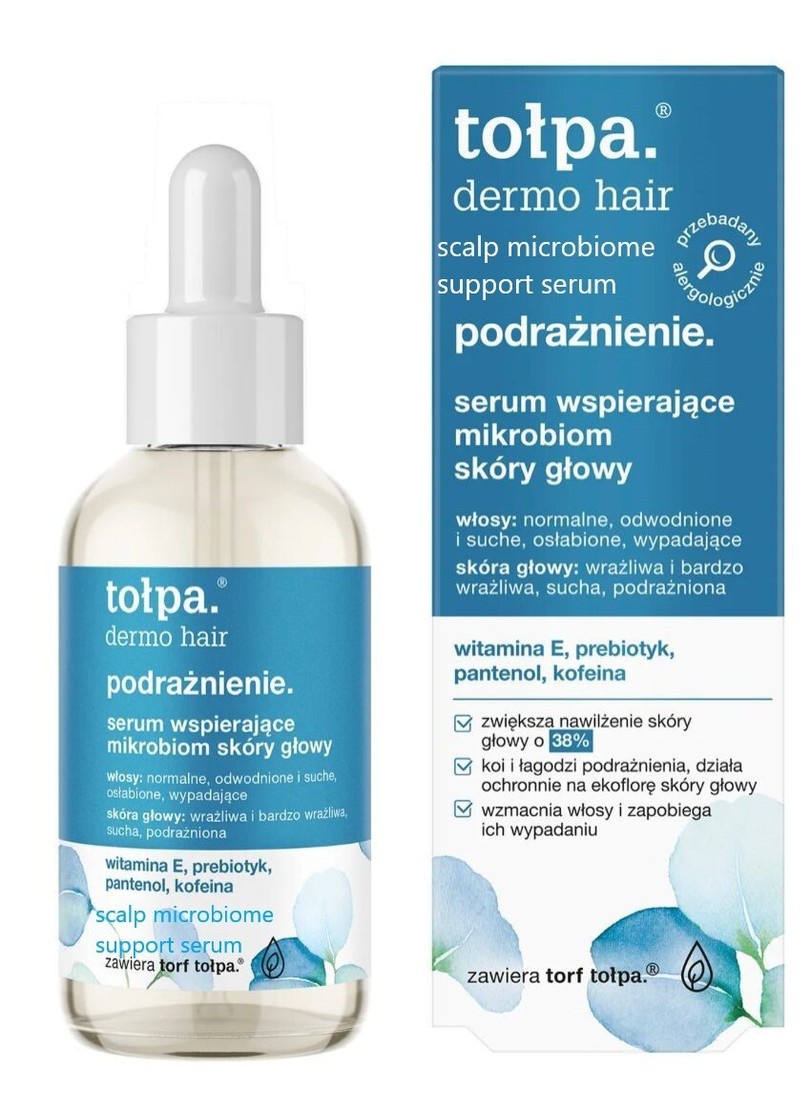
Dermo Hair Irritation Scalp Support Serum
Highlights
Key Ingredients
Other Ingredients
Skim through
| Ingredient name | what-it-does | irr., com. | ID-Rating |
|---|---|---|---|
| Aqua | solvent | ||
| Polysorbate 20 | emulsifying, surfactant/cleansing | 0, 0 | |
| Glycerin | skin-identical ingredient, moisturizer/humectant | 0, 0 | superstar |
| Pentylene Glycol | solvent, moisturizer/humectant | ||
| Sodium Ascorbyl Phosphate | antioxidant, anti-acne | goodie | |
| Panthenol | soothing, moisturizer/humectant | 0, 0 | goodie |
| Caffeine | antioxidant, perfuming | goodie | |
| Peat Extract | |||
| Tocopheryl Acetate | antioxidant | 0, 0 | |
| Inulin | goodie | ||
| Fructose | moisturizer/humectant | goodie | |
| Cinchona Succirubra Bark Extract | |||
| Menthol | soothing | icky | |
| Citric Acid | buffering | ||
| Potassium Sorbate | preservative | ||
| Sodium Benzoate | preservative | ||
| Parfum | perfuming | icky | |
| Methylpropanediol | solvent | ||
| Benzoic Acid | preservative | ||
| Caprylyl Glycol | moisturizer/humectant, emollient |
TOŁPA Dermo Hair Irritation Scalp Support SerumIngredients explained
Good old water, aka H2O. The most common skincare ingredient of all. You can usually find it right in the very first spot of the ingredient list, meaning it’s the biggest thing out of all the stuff that makes up the product.
It’s mainly a solvent for ingredients that do not like to dissolve in oils but rather in water.
Once inside the skin, it hydrates, but not from the outside - putting pure water on the skin (hello long baths!) is drying.
One more thing: the water used in cosmetics is purified and deionized (it means that almost all of the mineral ions inside it is removed). Like this, the products can stay more stable over time.
It's a common little helper ingredient that helps water and oil to mix together. Also, it can help to increase the solubility of some other ingredients in the formula.
- A natural moisturizer that’s also in our skin
- A super common, safe, effective and cheap molecule used for more than 50 years
- Not only a simple moisturizer but knows much more: keeps the skin lipids between our skin cells in a healthy (liquid crystal) state, protects against irritation, helps to restore barrier
- Effective from as low as 3% with even more benefits for dry skin at higher concentrations up to 20-40%
- High-glycerin moisturizers are awesome for treating severely dry skin
A multi-functional, silky feeling helper ingredient that can do quite many things. It's used as an emulsion stabilizer, solvent and a broad spectrum antimicrobial. According to manufacturer info, it's also a moisturizer and helps to make the product feel great on the skin. It works synergistically with preservatives and helps to improve water-resistance of sunscreens.
The sodium salt form of skincare superstar, vitamin C. If you do not know what the big fuss about vitamin C is, you are missing out and you have to click here and read all the geeky details about it.
Pure vitamin C (aka ascorbic acid, AA) is great and all, but its lack of stability is a big challenge for the cosmetics industry. One solution is to create stable derivatives that can be absorbed into the skin, convert there to AA and do all the magic AA is proven to do (which is being an antioxidant, a collagen booster, and a skin brightener).
SAP (the vit C derivative, not the enterprise software, obvs) is a promising derivative that has great stability up to pH 7. The challenge with it though is skin penetration. Unfortunately, it seems to be limited, or to quote a great article from the Journal of Cosmetic Dermatology "topically applied ascorbyl phosphate salts are, at very best, poorly absorbed in comparison with AA". Regarding conversion to AA, there seems to be no data about it, so we can neither deny nor confirm it.
We have better news regarding the three magic abilities of vitamin C: there is in-vivo (tested on real people) data showing that SAP does have photo-protective (aka antioxidant) properties, though less than pure AA. SAP might also aid collagen boosting; in-vitro (made in the lab) data shows that it works, but is less effective than another vitamin C derivative, called MAP (that seems to be as effective as pure AA). As for skin-brightening, there is a trade publication with in-vivo data showing that SAP can fade brown spots.
Another thing SAP might be able to do is to help with acne. A 2005 study showed in vitro (in test tubes) that 1% SAP has a strong antimicrobial activity on evil acne causing P. acnes and it also showed in vivo (on real people) that 5% SAP can strongly improve the inflammatory and non-inflammatory lesions of acne vulgaris. In fact, the results were comparable or even slightly better than with 5% benzoyl peroxide.
And there is even more regarding SAP and acne. A nice double-blind study from 2009 showed that 5% SAP reduced the inflammatory lesions by 20.14% and 48.82% within 4 and 8 weeks respectively and when combined with 0.2% retinol the results were even better. With this combination treatment, the improvement was 29.28% after 4 weeks and 63.10% after 8 weeks of application.
Aside from research studies, anecdotal evidence also supports SAP being a promising vitamin C derivative. One of the best-selling (vitamin C) serums in Sephora is the Ole Henriksen Truth Serum, while on Amazon it's the OzNaturals Vitamin C 20 Serum. Another popular choice is the Mad Hippie Vitamin C serum, and all of these contain vitamin C in the form of SAP.
Overall, we think SAP is a goody! In terms of anti-aging, it's probably not as effective as pure Ascorbic Acid, but it's totally worth a try. However, if your skin is acne-prone, SAP is your form of Vitamin C and it's a must-try.
An easy-to-formulate, commonly used, nice to have ingredient that’s also called pro-vitamin B5. As you might guess from the “pro” part, it’s a precursor to vitamin B5 (whose fancy name is pantothenic acid).
Its main job in skincare products is to moisturise the skin. It’s a humectant meaning that it can help the skin to attract water and then hold onto it. There is also research showing that panthenol can help our skin to produce more lovely lipids that are important for a strong and healthy skin barrier.
Another great thing about panthenol is that it has anti-inflammatory and skin protecting abilities. A study shows that it can reduce the irritation caused by less-nice other ingredients (e.g. fragrance, preservatives or chemical sunscreens) in the product.
Research also shows that it might be useful for wound healing as it promotes fibroblast (nice type of cells in our skin that produce skin-firming collagen) proliferation.
If that wasn’t enough panthenol is also useful in nail and hair care products. A study shows that a nail treatment liquide with 2% panthenol could effectively get into the nail and significantly increase the hydration of it.
As for the hair the hydration effect is also true there. Panthenol might make your hair softer, more elastic and helps to comb your hair more easily.
Hello, our favorite molecule that helps us wake up in the morning and then keeps us going through the day. As a super well-known stimulant from coffee, tea and plenty of other soft drinks, Caffeine needs no introduction. So we will skip right to the part where we talk about what the hell it does in so-so many cosmetic products.
Looking at the research, we were surprised to find how versatile Caffeine is. It is a small, water-loving molecule with pretty good skin penetration abilties. Once in the skin, it has nice antioxidant properties, meaning that it reduces the formation of evil free radicals and it might even be useful in preventing UV-induced skin cancers.
A well-known thing about Caffeine is that it improves the microcirculation of the blood vessels. Though conventional wisdom and anecdotal evidence says that this property is helpful for dark under-eye circles and puffy eyes, we have to mention that the double-blind research we have found about a 3% caffeine gel concluded that "the overall efficacy of the selected caffeine gel in reducing puffy eyes was not significantly different from that of its gel base." But you know, the proof is in the pudding.
Another thing Caffeine is used for in body care products is its anti-cellulite effects. In theory, it can speed up the lipolysis process (the "fat burning" by our cells) and stimulate the draining lymph system that might lead to the improvement of cellulite. But here again, the evidence that it actually makes a measurable, let alone visible, improvement on actual human beings is limited (we could find only some animal skin studies or caffeine being combined with other actives).
Last, but not least, we have to write about caffeine and hair growth. The theory is that it can inhibit the activity of the 5-α-reductase enzyme that plays an important role in hair loss and allows a renewed growth phase of the hair. We have found some recent and promising research to back this up. A 2017 study compared a 0.2% caffeine liquid with a 5% Minoxidil (an FDA approved active to treat baldness) solution and found that "a caffeine-based topical liquid should be considered as not inferior to minoxidil 5% solution in men with androgenetic alopecia", or English translation means that the caffeine liquid was pretty much as good as the FDA-approved Minoxidil stuff. Not bad!
Overall, we think that caffeine is a very versatile and biologically active ingredient. Even though some of its effects are more hyped up than backed up, it is still a nice to have on many ingredient lists.
 We don't have description for this ingredient yet.
It’s the most commonly used version of pure vitamin E in cosmetics. You can read all about the pure form here. This one is the so-called esterified version.
According to famous dermatologist, Leslie Baumann while tocopheryl acetate is more stable and has a longer shelf life, it’s also more poorly absorbed by the skin and may not have the same awesome photoprotective effects as pure Vit E.
A naturally occurring fructose polysaccharide found in the roots and rhizomes of several plants, for example, chicory. It is used in skincare for its prebiotic activity, meaning that it reduces the growth of bad bacteria in favor of friendly microorganisms naturally present on the skin.
Fancy name for fruit sugar. It has nice water-binding properties and helps to keep skin hydrated.
We don't have description for this ingredient yet.
Menthol needs no introduction: it's the thing that causes the cooling sensation so well-known both from cosmetic products as well as a bunch of other things like chocolate, chewing gum, toothpaste or cigarette. It's a natural compound that comes from the essential oil of Mentha species (peppermint oil contains 40-50% menthol) and it gives them their typical minty smell and flavor.
As for skincare, menthol seems to be a mixed bag. Apart from the cool cooling sensation (that might last up to 70 mins!), it also has painkilling, itch reducing, antibacterial, antifungal and even penetration enhancing properties. On the other hand, it also seems to act as a skin irritant that increases trans-epidermal water loss (the water that evaporates from the outer layer of the skin) and thus contributes to drying out the skin.
Citric acid comes from citrus fruits and is an AHA. If these magic three letters don’t tell you anything, click here and read our detailed description on glycolic acid, the most famous AHA.
So citric acid is an exfoliant, that can - just like other AHAs - gently lift off the dead skin cells of your skin and make it more smooth and fresh.
There is also some research showing that citric acid with regular use (think three months and 20% concentration) can help sun-damaged skin, increase skin thickness and some nice hydrating things called glycosaminoglycans in the skin.
But according to a comparative study done in 1995, citric acid has less skin improving magic properties than glycolic or lactic acid. Probably that’s why citric acid is usually not used as an exfoliant but more as a helper ingredient in small amounts to adjust the pH of a formulation.
It's one of those things that help your cosmetics not to go wrong too soon, aka a preservative. It’s not a strong one and doesn’t really work against bacteria, but more against mold and yeast. To do that it has to break down to its active form, sorbic acid. For that to happen, there has to be water in the product and the right pH value (pH 3-4).
But even if everything is right, it’s not enough on its own. If you see potassium sorbate you should see some other preservative next to it too.
BTW, it’s also a food preservative and even has an E number, E202.
A helper ingredient that helps to make the products stay nice longer, aka preservative. It works mainly against fungi.
It’s pH dependent and works best at acidic pH levels (3-5). It’s not strong enough to be used in itself so it’s always combined with something else, often with potassium sorbate.
Exactly what it sounds: nice smelling stuff put into cosmetic products so that the end product also smells nice. Fragrance in the US and parfum in the EU is a generic term on the ingredient list that is made up of 30 to 50 chemicals on average (but it can have as much as 200 components!).
If you are someone who likes to know what you put on your face then fragrance is not your best friend - there's no way to know what’s really in it.
Also, if your skin is sensitive, fragrance is again not your best friend. It’s the number one cause of contact allergy to cosmetics. It’s definitely a smart thing to avoid with sensitive skin (and fragrance of any type - natural is just as allergic as synthetic, if not worse!).
It's a type of glycol that - according to the manufacturer - is an extremely good replacement for other glycols like propylene or butylene glycol. Its main job is to be a solvent, but it has also very good antimicrobial properties and acts as a true preservative booster. Also helps with skin hydration without stickiness or tacky feel.
An Ecocert-approved, natural preservative that counts as gentle and non-irritating to the skin. Usually, it comes to the formula as part of a preservative blend as it's not enough on its own.
It’s a handy multi-tasking ingredient that gives the skin a nice, soft feel. At the same time, it also boosts the effectiveness of other preservatives, such as the nowadays super commonly used phenoxyethanol.
The blend of these two (caprylyl glycol + phenoxyethanol) is called Optiphen, which not only helps to keep your cosmetics free from nasty things for a long time but also gives a good feel to the finished product. It's a popular duo.
You may also want to take a look at...
| what‑it‑does | solvent |
| what‑it‑does | emulsifying | surfactant/cleansing |
| irritancy, com. | 0, 0 |
| what‑it‑does | skin-identical ingredient | moisturizer/humectant |
| irritancy, com. | 0, 0 |
| what‑it‑does | solvent | moisturizer/humectant |
| what‑it‑does | antioxidant | anti-acne |
| what‑it‑does | soothing | moisturizer/humectant |
| irritancy, com. | 0, 0 |
| what‑it‑does | antioxidant | perfuming |
| what‑it‑does | antioxidant |
| irritancy, com. | 0, 0 |
| what‑it‑does | moisturizer/humectant |
| what‑it‑does | soothing |
| what‑it‑does | buffering |
| what‑it‑does | preservative |
| what‑it‑does | preservative |
| what‑it‑does | perfuming |
| what‑it‑does | solvent |
| what‑it‑does | preservative |
| what‑it‑does | moisturizer/humectant | emollient |