





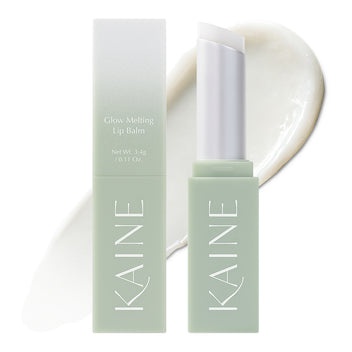
Glow Melting Lip Balm #pure
Ingredients overview
Highlights
Key Ingredients
Other Ingredients
Skim through
KAINE Glow Melting Lip Balm #pureIngredients explained
 We don't have description for this ingredient yet.
We don't have description for this ingredient yet.
We don't have description for this ingredient yet.
A thick, paste-like emollient ester that is touted as a vegetable-derived lanolin alternative. It has a smooth spreadability and touch, and it gives a substantive film to protect and moisturize the skin.
We don't have description for this ingredient yet.
A viscous, thick liquid emollient that gives lubricity and cushion at low use levels. It's great for night creams, eye area products, and skin treatment products due to the substantive film forming ability.
A clear, slightly yellow, odorless oil that's a very common, medium-spreading emollient. It makes the skin feel nice and smooth and works in a wide range of formulas.
We don't have description for this ingredient yet.
A handy helper ingredient that helps water and oil to mix nicely together, aka emulsifier. It is especially recommended for protective, baby care and general purpose emollient creams.
It also helps to disperse insoluble particles (think color pigments or zinc/titanium dioxide sunscreen) nice and even in cosmetic formulas.
A silicone emulsifier that helps water and silicone oils to mix nicely together.
We don't have description for this ingredient yet.
A really multi-functional helper ingredient that can do several things in a skincare product: it can bring a soft and pleasant feel to the formula, it can act as a humectant and emollient, it can be a solvent for some other ingredients (for example it can help to stabilize perfumes in watery products) and it can also help to disperse pigments more evenly in makeup products. And that is still not all: it can also boost the antimicrobial activity of preservatives.
An organic derivative of hectorite clay, Disteardimonium Hectorite is used as a viscosity controller - it thickens up formulations to make them less runny.
It’s most popular use in cosmetics is in sunscreens, under the trademarked name Bentone 38 from Elementis. According to the manufacturer info, it is a real multi-tasker, including the ability to prevent pigments settling during storage, stabilizing a formula for longer, creating a light and smooth skin feel and enhancing the water-resistance of sunscreen formulas.
Exactly what it sounds: nice smelling stuff put into cosmetic products so that the end product also smells nice. Fragrance in the US and parfum in the EU is a generic term on the ingredient list that is made up of 30 to 50 chemicals on average (but it can have as much as 200 components!).
If you are someone who likes to know what you put on your face then fragrance is not your best friend - there's no way to know what’s really in it.
Also, if your skin is sensitive, fragrance is again not your best friend. It’s the number one cause of contact allergy to cosmetics. It’s definitely a smart thing to avoid with sensitive skin (and fragrance of any type - natural is just as allergic as synthetic, if not worse!).
We don't have description for this ingredient yet.
We don't have description for this ingredient yet.
Jojoba is a drought resistant evergreen shrub native to South-western North America. It's known and grown for jojoba oil, the golden yellow liquid coming from the seeds (about 50% of the weight of the seeds will be oil).
At first glance, it seems like your average emollient plant oil: it looks like an oil and it's nourishing and moisturizing to the skin but if we dig a bit deeper, it turns out that jojoba oil is really special and unique: technically - or rather chemically - it's not an oil but a wax ester (and calling it an oil is kind of sloppy).
So what the heck is a wax ester and why is that important anyway? Well, to understand what a wax ester is, you first have to know that oils are chemically triglycerides: one glycerin + three fatty acids attached to it. The fatty acids attached to the glycerin vary and thus we have many kinds of oils, but they are all triglycerides. Mother Nature created triglycerides to be easily hydrolyzed (be broken down to a glycerin + 3 fatty acid molecules) and oxidized (the fatty acid is broken down into small parts) - this happens basically when we eat fats or oils and our body generates energy from it.
Mother Nature also created wax esters but for a totally different purpose. Chemically, a wax ester is a fatty acid + a fatty alcohol, one long molecule. Wax esters are on the outer surface of several plant leaves to give them environmental protection. 25-30% of human sebum is also wax esters to give us people environmental protection.
So being a wax ester results in a couple of unique properties: First, jojoba oil is extremely stable. Like crazy stable. Even if you heat it to 370 C (698 F) for 96 hours, it does not budge. (Many plant oils tend to go off pretty quickly). If you have some pure jojoba oil at home, you should be fine using it for years.
Second, jojoba oil is the most similar to human sebum (both being wax esters), and the two are completely miscible. Acne.org has this not fully proven theory that thanks to this, jojoba might be able to "trick" the skin into thinking it has already produced enough sebum, so it might have "skin balancing" properties for oily skin.
Third, jojoba oil moisturizes the skin through a unique dual action: on the one hand, it mixes with sebum and forms a thin, non-greasy, semi-occlusive layer; on the other hand, it absorbs into the skin through pores and hair follicles then diffuses into the intercellular spaces of the outer layer of the skin to make it soft and supple.
On balance, the point is this: in contrast to real plant oils, wax esters were designed by Mother Nature to stay on the surface and form a protective, moisturizing barrier and jojoba oil being a wax ester is uniquely excellent at doing that.
It seems to us that squalane is in fashion and there is a reason for it. Chemically speaking, it is a saturated (no double bonds) hydrocarbon (a molecule consisting only of carbon and hydrogen), meaning that it's a nice and stable oily liquid with a long shelf life.
It occurs naturally in certain fish and plant oils (e.g. olive), and in the sebum (the oily stuff our skin produces) of the human skin. As f.c. puts it in his awesome blog post, squalane's main things are "emolliency, surface occlusion, and TEWL prevention all with extreme cosmetic elegance". In other words, it's a superb moisturizer that makes your skin nice and smooth, without being heavy or greasy.
Another advantage of squalane is that it is pretty much compatible with all skin types and skin conditions. It is excellent for acne-prone skin and safe to use even if you have fungi-related skin issues, like seborrhea or fungal acne.
The unsaturated (with double bonds) and hence less stable version of Squalane is Squalene, you can read about it here >>
An easy-to-formulate, commonly used, nice to have ingredient that’s also called pro-vitamin B5. As you might guess from the “pro” part, it’s a precursor to vitamin B5 (whose fancy name is pantothenic acid).
Its main job in skincare products is to moisturise the skin. It’s a humectant meaning that it can help the skin to attract water and then hold onto it. There is also research showing that panthenol can help our skin to produce more lovely lipids that are important for a strong and healthy skin barrier.
Another great thing about panthenol is that it has anti-inflammatory and skin protecting abilities. A study shows that it can reduce the irritation caused by less-nice other ingredients (e.g. fragrance, preservatives or chemical sunscreens) in the product.
Research also shows that it might be useful for wound healing as it promotes fibroblast (nice type of cells in our skin that produce skin-firming collagen) proliferation.
If that wasn’t enough panthenol is also useful in nail and hair care products. A study shows that a nail treatment liquide with 2% panthenol could effectively get into the nail and significantly increase the hydration of it.
As for the hair the hydration effect is also true there. Panthenol might make your hair softer, more elastic and helps to comb your hair more easily.
The oil coming from the pulp of one of the most nutritious fruits in the world, the avocado. It's loaded with the nourishing and moisturizing fatty acid, oleic (70%) and contains some others including palmitic (10%) and linoleic acid (8%). It also contains a bunch of minerals and vitamins A, E and D.
Avocado oil has extraordinary skin penetration abilities and can nourish different skin layers. It's a very rich, highly moisturizing emollient oil that makes the skin smooth and nourished. Thanks to its vitamin E content it also has some antioxidant properties. As a high-oleic plant oil, it is recommended for dry skin.
- A natural moisturizer that’s also in our skin
- A super common, safe, effective and cheap molecule used for more than 50 years
- Not only a simple moisturizer but knows much more: keeps the skin lipids between our skin cells in a healthy (liquid crystal) state, protects against irritation, helps to restore barrier
- Effective from as low as 3% with even more benefits for dry skin at higher concentrations up to 20-40%
- High-glycerin moisturizers are awesome for treating severely dry skin
Unless you live under a rock you must have heard about shea butter. It's probably the most hyped up natural butter in skincare today. It comes from the seeds of African Shea or Karite Trees and used as a magic moisturizer and emollient.
But it's not only a simple emollient, it regenerates and soothes the skin, protects it from external factors (such as UV rays or wind) and is also rich in antioxidants (among others vitamin A, E, F, quercetin and epigallocatechin gallate). If you are looking for rich emollient benefits + more, shea is hard to beat.
Pentaerythrityl Tetra-Di-T-Butyl Hydroxyhydrocinnamate is an antioxidant molecule used in small amounts (less than 0.8%) to help products stay nice longer. More specifically, it is great at preventing discoloration or other types of oxidative degradation. It is a trendy alternative to often bad-mouthed synthetic antioxidant and stabilizer, BHT.
One of the many types of ceramides that can be found naturally in the upper layer of the skin. Ceramides make up about 50% of the goopy stuff that's between our skin cells and play a super important role in having a healthy skin barrier and keeping the skin hydrated. It works even better when combined with its pal, Ceramide 1.
We wrote way more about ceramides at ceramide 1, so click here to know more.
It's a type of lipid, a so-called sphingoid base that can be found naturally in the upper layer of the skin. It's found both in "free-form" and as part of famous skin lipids, ceramides.
There is emerging research about Phytosphingosine that shows that it has antimicrobial and cell-communicating properties and is considered part of the skin's natural defense system.
A 2007 study showed that Phytosphingosine even works against evil acne-causing bacteria, Propionibacterium acnes and shows promise as a complementing active ingredient in treating acne-prone skin thanks to its anti-inflammatory and antimicrobial activities.
A nice one to spot in the ingredient list. :)
Titanium Dioxide is one of the two members of the elite sunscreen group called physical sunscreens (or inorganic sunscreens if you’re a science geek and want to be precise).
Traditionally, UV-filters are categorized as either chemical or physical. The big difference is supposed to be that chemical agents absorb UV-light while physical agents reflect it like a bunch of mini umbrellas on top of the skin. While this categorization is easy and logical it turns out it's not true. A recent, 2016 study shows that inorganic sunscreens work mostly by absorption, just like chemical filters, and only a little bit by reflection (they do reflect the light in the visible spectrum, but mostly absorb in the UV spectrum).
Anyway, it doesn't matter if it reflects or absorbs, Titanium Dioxide is a pretty awesome sunscreen agent for two main reasons: it gives a nice broad spectrum coverage and it's highly stable. Its protection is very good between 290 - 350 nm (UVB and UVA II range), and less good at 350-400 nm (UVA I) range. Regular sized Titanium Dioxide also has a great safety profile, it's non-irritating and is pretty much free from any health concerns (like estrogenic effect worries with some chemical filters).
The disadvantage of Titanium Dioxide is that it's not cosmetically elegant, meaning it's a white, "unspreadable" mess. Sunscreens containing Titanium Dioxide are often hard to spread on the skin and they leave a disturbing whitish tint. The cosmetic industry is, of course, really trying to solve this problem and the best solution so far is using nanoparticles. The itsy-bitsy Nano-sized particles improve both spreadability and reduce the whitish tint a lot, but unfortunately, it also introduces new health concerns.
The main concern with nanoparticles is that they are so tiny that they are absorbed into the skin more than we want them (ideally sunscreen should remain on the surface of the skin). Once absorbed they might form unwanted complexes with proteins and they might promote the formation of evil free radicals. But do not panic, these are concerns under investigation. A 2009 review article about the safety of nanoparticles summarizes this, "to date, in-vivo and in-vitro studies have not demonstrated percutaneous penetration of nanosized particles in titanium dioxide and zinc oxide sunscreens". The English translation is, so far it looks like sunscreens with nanoparticles do stay on the surface of the skin where they should be.
All in all, Titanium Dioxide is a famous sunscreen agent and for good reason, it gives broad spectrum UV protection (best at UVB and UVA II), it's highly stable, and it has a good safety profile. It's definitely one of the best UV-filter agents we have today, especially in the US where new-generation Tinosorb filters are not (yet) approved.
You may also want to take a look at...
| what‑it‑does | emollient | surfactant/cleansing |
| what‑it‑does | emollient | viscosity controlling |
| what‑it‑does | emulsifying |
| what‑it‑does | emollient |
| what‑it‑does | viscosity controlling | perfuming |
| what‑it‑does | emollient |
| what‑it‑does | emollient | perfuming |
| what‑it‑does | viscosity controlling |
| what‑it‑does | emulsifying |
| irritancy, com. | 0, 1-2 |
| what‑it‑does | emulsifying | surfactant/cleansing |
| what‑it‑does | emollient | viscosity controlling |
| what‑it‑does | solvent |
| what‑it‑does | viscosity controlling |
| what‑it‑does | perfuming |
| what‑it‑does | abrasive/scrub |
| what‑it‑does | solvent | viscosity controlling |
| what‑it‑does | emollient |
| irritancy, com. | 0, 0-2 |
| what‑it‑does | skin-identical ingredient | emollient |
| irritancy, com. | 0, 1 |
| what‑it‑does | soothing | moisturizer/humectant |
| irritancy, com. | 0, 0 |
| what‑it‑does | antioxidant | emollient |
| irritancy, com. | 0, 0-3 |
| what‑it‑does | skin-identical ingredient | moisturizer/humectant |
| irritancy, com. | 0, 0 |
| what‑it‑does | emollient |
| what‑it‑does | antioxidant | preservative |
| what‑it‑does | skin-identical ingredient |
| what‑it‑does | skin-identical ingredient | cell-communicating ingredient | anti-acne | antimicrobial/antibacterial |
| what‑it‑does | sunscreen | colorant |