





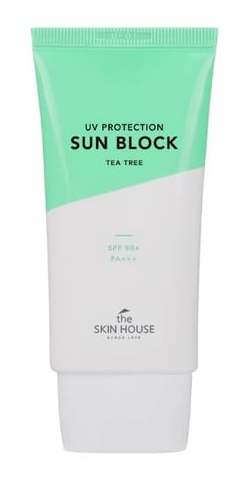
UV Protection Sun Block Tea Tree
Ingredients overview
Highlights
Key Ingredients
Skim through
The Skin House UV Protection Sun Block Tea TreeIngredients explained
Good old water, aka H2O. The most common skincare ingredient of all. You can usually find it right in the very first spot of the ingredient list, meaning it’s the biggest thing out of all the stuff that makes up the product.
It’s mainly a solvent for ingredients that do not like to dissolve in oils but rather in water.
Once inside the skin, it hydrates, but not from the outside - putting pure water on the skin (hello long baths!) is drying.
One more thing: the water used in cosmetics is purified and deionized (it means that almost all of the mineral ions inside it is removed). Like this, the products can stay more stable over time.
Titanium Dioxide is one of the two members of the elite sunscreen group called physical sunscreens (or inorganic sunscreens if you’re a science geek and want to be precise).
Traditionally, UV-filters are categorized as either chemical or physical. The big difference is supposed to be that chemical agents absorb UV-light while physical agents reflect it like a bunch of mini umbrellas on top of the skin. While this categorization is easy and logical it turns out it's not true. A recent, 2016 study shows that inorganic sunscreens work mostly by absorption, just like chemical filters, and only a little bit by reflection (they do reflect the light in the visible spectrum, but mostly absorb in the UV spectrum).
Anyway, it doesn't matter if it reflects or absorbs, Titanium Dioxide is a pretty awesome sunscreen agent for two main reasons: it gives a nice broad spectrum coverage and it's highly stable. Its protection is very good between 290 - 350 nm (UVB and UVA II range), and less good at 350-400 nm (UVA I) range. Regular sized Titanium Dioxide also has a great safety profile, it's non-irritating and is pretty much free from any health concerns (like estrogenic effect worries with some chemical filters).
The disadvantage of Titanium Dioxide is that it's not cosmetically elegant, meaning it's a white, "unspreadable" mess. Sunscreens containing Titanium Dioxide are often hard to spread on the skin and they leave a disturbing whitish tint. The cosmetic industry is, of course, really trying to solve this problem and the best solution so far is using nanoparticles. The itsy-bitsy Nano-sized particles improve both spreadability and reduce the whitish tint a lot, but unfortunately, it also introduces new health concerns.
The main concern with nanoparticles is that they are so tiny that they are absorbed into the skin more than we want them (ideally sunscreen should remain on the surface of the skin). Once absorbed they might form unwanted complexes with proteins and they might promote the formation of evil free radicals. But do not panic, these are concerns under investigation. A 2009 review article about the safety of nanoparticles summarizes this, "to date, in-vivo and in-vitro studies have not demonstrated percutaneous penetration of nanosized particles in titanium dioxide and zinc oxide sunscreens". The English translation is, so far it looks like sunscreens with nanoparticles do stay on the surface of the skin where they should be.
All in all, Titanium Dioxide is a famous sunscreen agent and for good reason, it gives broad spectrum UV protection (best at UVB and UVA II), it's highly stable, and it has a good safety profile. It's definitely one of the best UV-filter agents we have today, especially in the US where new-generation Tinosorb filters are not (yet) approved.
Officially, CosIng (the official EU ingredient database) lists Aluminum Hydroxide 's functions as opacifying (making the product white and non-transparent), as well as emollient and skin protectant.
However, with a little bit of digging, it turns out Aluminum Hyroxide often moonlights as a protective coating for UV filter superstar Titanium Dioxide. Specifically, it protects our skin from the harmful effects of nasty Reactive Oxygen Species (free radicals derived from oxygen such as Superoxide and Hydrogen Peroxide) generated when Titanium Dioxide is exposed to UV light. Btw, chlorine in swimming pool water depletes this protective coating, so one more reason to reapply your sunscreen after a dip in the pool on holiday.
Other than that, Aluminum Hydroxide also often shows up in composite pigment technologies where it is used the other way around (as the base material and not as the coating material) and helps to achieve higher color coverage with less pigment.
A common multi-tasker fatty acid. It makes your skin feel nice and smooth (emollient), gives body to cream type products and helps to stabilize water and oil mixes (aka emulsions).
Cyclomethicone is not one type of silicone, but a whole mixture of them: it's a mix of specific chain length (4 to 7) cyclic structured silicone molecules. (There seems to be a confusion on the internet whether Cyclomethicone and Cyclopentasiloxane are the same. They are not the same, but Cyclopentasiloxane is part of the mixture that makes up Cyclomethicone).
All the silicones in the Cyclomethicone mixture are volatile, meaning they evaporate from the skin or hair rather than stay on it. This means that Cyclomethicone has a light skin feel with none-to-minimal after-feel. It also makes the formulas easy to spread and has nice emollient properties.
A silicone emulsifier that helps water and silicone oils to mix nicely together. It can also be used together with plant oil + silicone oil mixtures.
A light, velvety, unique skin feel liquid that is a good solvent and also makes the skin feel nice and smooth (aka emollient). It's often used in makeup products mixed with silicones to give shine and slip to the product. It's also great for cleansing dirt and oil from the skin as well as for taking off make-up.
When it comes to sunscreen agents, Zinc Oxide is pretty much in a league of its own. It's a physical (or inorganic) sunscreen that has a lot in common with fellow inorganic sunscreen Titanium Dioxide (TiO2) but a couple of things make it superior even to TiO2.
If physical sunscreens don't tell you anything, go ahead and read about the basics here. Most of what we wrote about Titanium Dioxide is also true for Zinc Oxide so we will focus here on the differences.
The first main difference is that while TiO2 gives a nice broad spectrum protection, Zinc Oxide has an even nicer and even broader spectrum protection. It protects against UVB, UVA II, and UVA I almost uniformly, and is considered to be the broadest range sunscreen available today.
It's also highly stable and non-irritating. So much so that Zinc Oxide also counts as a skin protectant and anti-irritant. It's also often used to treat skin irritations such as diaper rash.
As for the disadvantages, Zinc Oxide is also not cosmetically elegant. It leaves a disturbing whitish tint on the skin, although, according to a 2000 research paper by Dr. Pinnell, it's slightly less white than TiO2. Still, it's white and disturbing enough to use Zinc Oxide nanoparticles more and more often.
We wrote more about nanoparticles and the concerns around them here, but the gist is that if nanoparticles were absorbed into the skin that would be a reason for legitimate health concerns. But luckily, so far research shows that sunscreen nanoparticles are not absorbed but remain on the surface of the skin or in the uppermost (dead) layer of the skin. This seems to be true even if the skin is damaged, for example, sunburnt.
All in all, if you've found a Zinc Oxide sunscreen that you are happy to use every single day, that's fantastic and we suggest you stick with it. It's definitely one of the best, or probably even the best option out there for sun protection available worldwide.
Bearing a close relationship to the famous Dimethicone, Methicone is the slightly trimmed down version missing the methyl (-CH3) groups on one side of the silicone chain. Like most silicones, it has nice emollient properties and improves the spreadability of products.
But Methicone's main thing in practice is not being an emollient but a silicone fluid for hydrophobization treatment of powders, i.e. making solid powders (mineral filters & color pigments) very water resistant and easily spreadable. Methicone does this by absorbing traces of water from the surface of pigments that is very useful for mineral sunscreens and makeup products.
A super commonly used 5 unit long, cyclic structured silicone that is water-thin and does not stay on the skin but evaporates from it (called volatile silicone). Similar to other silicones, it gives skin and hair a silky, smooth feel.
It's often combined with the non-volatile (i.e. stays on the skin) dimethicone as the two together form a water-resistant, breathable protective barrier on the skin without a negative tacky feel.
A clear, oil-soluble, "cosmetically-elegant" liquid that is the most commonly used chemical sunscreen. It absorbs UVB radiation (at wavelengths: 280-320 nm) with a peak protection at 310nm.
It only protects against UVB and not UVA rays (the 320-400 nm range) – so always choose products that contain other sunscreens too. It is not very stable either, when exposed to sunlight, it kind of breaks down and loses its effectiveness (not instantly, but over time - it loses 10% of its SPF protection ability within 35 mins). To make it more stable it can be - and should be - combined with other sunscreen agents to give stable and broad-spectrum protection (the new generation sunscreen agent, Tinosorb S is a particularly good one for that).
Regarding safety, there are also some concerns around Octinoxate. In vitro (made in the lab not on real people) and animal studies have shown that it may produce hormonal (estrogen-like) effects. Do not panic, the studies were not conducted under real life conditions on real human people, so it is probably over-cautious to avoid Octinoxate altogether. However, if you are pregnant or a small child (under 2 yrs. old), choose a physical (zinc oxide/titanium dioxide) or new-generation Tinosorb based sunscreen, just to be on the super-safe side. :)
Overall, Ethylhexyl Methoxycinnamate is an old-school chemical sunscreen agent. There are plenty of better options for sun protection today, but it is considered "safe as used" (and sunscreens are pretty well regulated) and it is available worldwide (can be used up to 10% in the EU and up to 7.5% in the US).
An emollient ester with a rich and creamy but non-greasy skin feel. It makes skin supple and protects dry skin.
An oil-soluble, chemical sunscreen agent that protects in the UVB (290-320 nm) range with a peak absorbance at 310 nm and with some additional protection in the UVA II (320-340nm) range. It is a newer generation UV filter that is approved up to 10% in the EU, but not (yet) available in the US due to impossible FDA regulations.
- A natural moisturizer that’s also in our skin
- A super common, safe, effective and cheap molecule used for more than 50 years
- Not only a simple moisturizer but knows much more: keeps the skin lipids between our skin cells in a healthy (liquid crystal) state, protects against irritation, helps to restore barrier
- Effective from as low as 3% with even more benefits for dry skin at higher concentrations up to 20-40%
- High-glycerin moisturizers are awesome for treating severely dry skin
4-Methylbenzylidene Camphor is a chemical sunscreen agent that protects in the UVB range (290-320 nm) with a peak absorbance at 301 nm. It is an oil-soluble powder that is slightly photo-unstable (it takes 65 minutes to lose 10% of its protecting power and 345 minutes to lose half of it), but it can still help to stabilize the famously unstable UVA filter, avobenzone.
Regarding its safety, we do not have the best news. Two possible concerns are that it absorbs into the body and might have some estrogenic activity there. But do not panic, the latter one was only shown in rats and is probably not the case in humans. Still, this is a UV filter that is currently being phased out of use. It is not approved in the US and Japan, and the EU also banned it starting in 2026 (however it is approved in Australia up to 4%).
It’s the - sodium form - cousin of the famous NMF, hyaluronic acid (HA). If HA does not tell you anything we have a super detailed, geeky explanation about it here. The TL; DR version of HA is that it's a huge polymer (big molecule from repeated subunits) found in the skin that acts as a sponge helping the skin to hold onto water, being plump and elastic. HA is famous for its crazy water holding capacity as it can bind up to 1000 times its own weight in water.
As far as skincare goes, sodium hyaluronate and hyaluronic acid are pretty much the same and the two names are used interchangeably. As cosmetic chemist kindofstephen writes on reddit "sodium hyaluronate disassociates into hyaluronic acid molecule and a sodium atom in solution".
In spite of this, if you search for "hyaluronic acid vs sodium hyaluronate" you will find on multiple places that sodium hyaluronate is smaller and can penetrate the skin better. Chemically, this is definitely not true, as the two forms are almost the same, both are polymers and the subunits can be repeated in both forms as much as you like. (We also checked Prospector for sodium hyaluronate versions actually used in cosmetic products and found that the most common molecular weight was 1.5-1.8 million Da that absolutely counts as high molecular weight).
What seems to be a true difference, though, is that the salt form is more stable, easier to formulate and cheaper so it pops up more often on the ingredient lists.
If you wanna become a real HA-and-the-skin expert you can read way more about the topic at hyaluronic acid (including penetration-questions, differences between high and low molecular weight versions and a bunch of references to scientific literature).
An organic derivative of hectorite clay, Disteardimonium Hectorite is used as a viscosity controller - it thickens up formulations to make them less runny.
It’s most popular use in cosmetics is in sunscreens, under the trademarked name Bentone 38 from Elementis. According to the manufacturer info, it is a real multi-tasker, including the ability to prevent pigments settling during storage, stabilizing a formula for longer, creating a light and smooth skin feel and enhancing the water-resistance of sunscreen formulas.
A silicone emulsifier that helps water and silicone oils to mix nicely together.
A helper ingredient that is used as a bulking and viscosity controlling agent. It is also an emulsion stabilizer in water-in-oil emulsions, where water droplets are dispersed in the continuous oil phase and not the other way round.
It can also be used as a heat generating agent in water-less formulas as it has an instant heat-generating chemical reaction with water.
It’s pretty much the current IT-preservative. It’s safe and gentle, but even more importantly, it’s not a feared-by-everyone-mostly-without-scientific-reason paraben.
It’s not something new: it was introduced around 1950 and today it can be used up to 1% worldwide. It can be found in nature - in green tea - but the version used in cosmetics is synthetic.
Other than having a good safety profile and being quite gentle to the skin it has some other advantages too. It can be used in many types of formulations as it has great thermal stability (can be heated up to 85°C) and works on a wide range of pH levels (ph 3-10).
It’s often used together with ethylhexylglycerin as it nicely improves the preservative activity of phenoxyethanol.
When it comes to Tea Tree, the essential oil is the one that steals the show with its well-documented antimicrobial and anti-acne effects. The extract is not very well defined, and it probably contains the active components of the oil in much-reduced concentrations. Manufacturers still mention soothing, antimicrobial, purifying and antiseptic properties for the tea tree extract.
Centella Asiatica - or sometimes also called Gotu Kola or Cica - has been used in folk medicine for hundreds of years. It’s traditionally used to improve small wounds, burns and scratches and it’s also a well known anti-inflammatory agent for eczema.
Recently science has taken an interest in Gotu Kola as well and it turns out it really has many active compounds with several benefits. Just for hard-core geeks, the main biologically active compounds are pentacyclic triterpenoid saponins called asiaticoside, madecassoside, asiatic and madecassic acid (also called centellosides).
One of the biological activities of the centellosides is to be able to stimulate GAGs (glycosaminoglycans - polysaccharides that are part of the liquidy stuff between our skin cells), and especially hyaluronic acid synthesis in our skin. This is probably one of the reasons why Centella Asiatica Extract has nice skin moisturizing properties that was confirmed by a 25 people, four weeks study along with Centella's anti-inflammatory effects.
Madecassoside can also help in burn wound healing through increasing antioxidant activity and enhancing collagen synthesis. Asiaticoside was shown to increase antioxidant levels on rats skin when applied at 0.2%.
Centella Asiatica also often shows up in products that try to treat cellulite or striae. Of course, it cannot make a miracle but it might have some effect via regulating microcirculation and normalizing the metabolism in the cells of connective tissues.
Bottom line: Gotu Kola is a great plant ingredient with proven wound healing, anti-inflammatory, and antioxidant properties. Nice to spot on any ingredient list.
- Green tea is one of the most researched natural ingredients
- The active parts are called polyphenols, or more precisely catechins (EGCG being the most abundant and most active catechin)
- There can be huge quality differences between green tea extracts. The good ones contain 50-90% catechins (and often make the product brown and give it a distinctive smell)
- Green tea is proven to be a great antioxidant, UV protectant, anti-inflammatory, anticarcinogenic and antimicrobial
- Because of these awesome properties green tea is a great choice for anti-aging and also for skin diseases including rosacea, acne and atopic dermatitis
 We don't have description for this ingredient yet.
The flower water coming from the flowers of the Damask Rose. In general, flower waters (also called hydrosols) are diluted versions of essential oils coming from the same plant. They contain the same components but in much-reduced concentrations.
Similar to its big sister, rose oil, rose water also has a lovely, relaxing scent. It contains some antioxidant and antimicrobial compounds, as well as some fragrant components.
If your skin is super sensitive, it is a good idea to choose products without fragrant floral waters.
We don't have description for this ingredient yet.
We don't have description for this ingredient yet.
We don't have description for this ingredient yet.
If you have spotted ethylhexylglycerin on the ingredient list, most probably you will see there also the current IT-preservative, phenoxyethanol. They are good friends because ethylhexylglycerin can boost the effectiveness of phenoxyethanol (and other preservatives) and as an added bonus it feels nice on the skin too.
Also, it's an effective deodorant and a medium spreading emollient.
It's the yellow, solid stuff that you probably know from beeswax candles. It's a natural material produced by honey bees to build their honeycomb.
As for skincare, it's used as an emollient and thickening agent. It's super common in lip balms and lipsticks.
A hydrocarbon wax consisting mainly of saturated straight chain hydrocarbons with C18-90+ carbon chain length. It has a high melting point (58-100 C) and it is used mainly in stick type products, such as lip balms to keep the product nice and solid.
You may also want to take a look at...
| what‑it‑does | solvent |
| what‑it‑does | sunscreen | colorant |
| what‑it‑does | emollient | moisturizer/humectant | viscosity controlling |
| what‑it‑does | emollient | viscosity controlling |
| irritancy, com. | 0, 2-3 |
| what‑it‑does | emollient |
| irritancy, com. | 0, 0 |
| what‑it‑does | emulsifying |
| what‑it‑does | emollient | solvent |
| what‑it‑does | sunscreen |
| irritancy, com. | 0, 1 |
| what‑it‑does | emollient |
| what‑it‑does | emollient | solvent |
| what‑it‑does | sunscreen |
| irritancy, com. | 0, 0 |
| what‑it‑does | emollient |
| what‑it‑does | sunscreen |
| what‑it‑does | skin-identical ingredient | moisturizer/humectant |
| irritancy, com. | 0, 0 |
| what‑it‑does | sunscreen |
| what‑it‑does | skin-identical ingredient | moisturizer/humectant |
| irritancy, com. | 0, 0 |
| what‑it‑does | viscosity controlling |
| what‑it‑does | emulsifying | surfactant/cleansing |
| what‑it‑does | viscosity controlling |
| what‑it‑does | preservative |
| what‑it‑does | antimicrobial/antibacterial | perfuming |
| what‑it‑does | soothing | antioxidant | moisturizer/humectant |
| what‑it‑does | antioxidant | soothing |
| what‑it‑does | antimicrobial/antibacterial | soothing |
| what‑it‑does | preservative |
| what‑it‑does | emollient | viscosity controlling | emulsifying | perfuming |
| irritancy, com. | 0, 0-2 |
| what‑it‑does | viscosity controlling |