





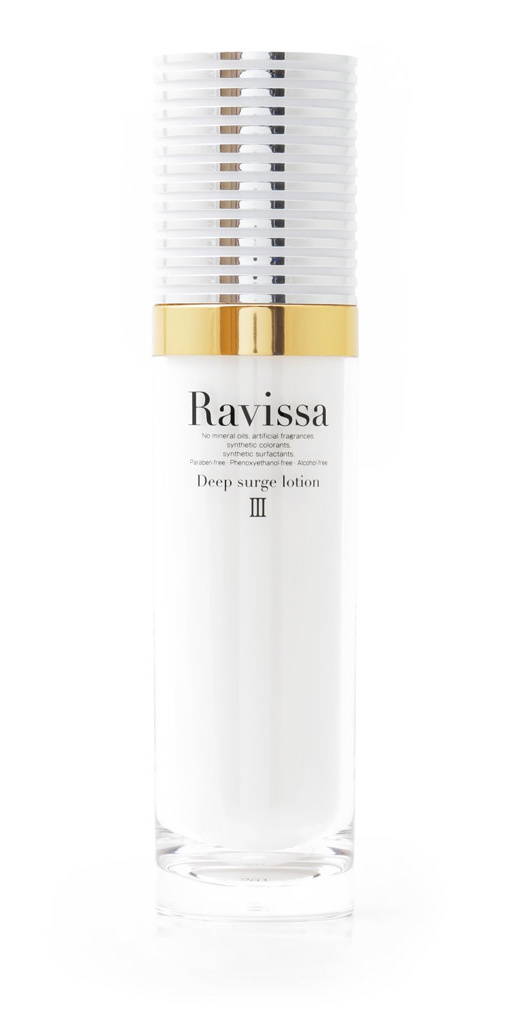
Ingredients overview
Highlights
Key Ingredients
Other Ingredients
Skim through
Ravissa Deep Surge LotionIngredients explained
Good old water, aka H2O. The most common skincare ingredient of all. You can usually find it right in the very first spot of the ingredient list, meaning it’s the biggest thing out of all the stuff that makes up the product.
It’s mainly a solvent for ingredients that do not like to dissolve in oils but rather in water.
Once inside the skin, it hydrates, but not from the outside - putting pure water on the skin (hello long baths!) is drying.
One more thing: the water used in cosmetics is purified and deionized (it means that almost all of the mineral ions inside it is removed). Like this, the products can stay more stable over time.
Propanediol is a natural alternative for the often used and often bad-mouthed propylene glycol. It's produced sustainably from corn sugar and it's Ecocert approved.
It's quite a multi-tasker: can be used to improve skin moisturization, as a solvent, to boost preservative efficacy or to influence the sensory properties of the end formula.
- A natural moisturizer that’s also in our skin
- A super common, safe, effective and cheap molecule used for more than 50 years
- Not only a simple moisturizer but knows much more: keeps the skin lipids between our skin cells in a healthy (liquid crystal) state, protects against irritation, helps to restore barrier
- Effective from as low as 3% with even more benefits for dry skin at higher concentrations up to 20-40%
- High-glycerin moisturizers are awesome for treating severely dry skin
The flower water coming from the flowers of the Damask Rose. In general, flower waters (also called hydrosols) are diluted versions of essential oils coming from the same plant. They contain the same components but in much-reduced concentrations.
Similar to its big sister, rose oil, rose water also has a lovely, relaxing scent. It contains some antioxidant and antimicrobial compounds, as well as some fragrant components.
If your skin is super sensitive, it is a good idea to choose products without fragrant floral waters.
 We don't have description for this ingredient yet.
We don't have description for this ingredient yet.
We don't have description for this ingredient yet.
We don't have description for this ingredient yet.
An interesting synthetic molecule that mimics two antioxidant skin enzymes superoxide dismutase (SOD) and catalase.
If you are wondering what the heck SOD and catalase are, here is a little background: they are two smart enzymes found in our bodies that speed up the conversion of the evil, cell damaging free radicals (such as superoxide radicals) into friendly and harmless things such as water and oxygen. We wrote some more about SOD here.
So this unpronounceable guy is actually a nice molecule that mimics the behavior of the natural enzymes in our skin. Estee Lauder likes this ingredient, uses it and has done some studies to prove that Ethylbisiminomethylguaiacol Manganese Chloride, aka EUK-134, can nicely protect the cells from UVB damage. They hypothesize that "EUK-134, via direct protection of the membrane from UVB-induced oxidative damage, reduces oxidative stress induced MAPK signaling and consequently lowers the level of p53 induction. The protection conferred by EUK-134 results in a significant increase in cell survival following UVB irradiation."
Another study (also by Estee Lauder) found that EUK-134 lowers hydroperoxide levels at the surface of UVA-exposed skin in vivo and concluded that this salen–manganese compound is a "unique cosmetic tool to protect the skin surface from accumulating oxidative damage".
Other than that, we found a study that examined a serum to manage skin redness in sensitive, pale skin types and contained EUK-134 along with a bunch of other ingredients. The formula examined did reduce facial redness so EUK-134 seems to be tolerated well even by redness-prone, sensitive skin types.
Hydrolyzed Hyaluronic Acid is a low molecular weight, chemically chopped up version of the naturally big molecule and current IT-moisturizer, Hyaluronic Acid (HA). The TL; DR version of HA is that it's a huge polymer (big molecule from repeated subunits) found in the skin that acts as a sponge helping the skin to retain water, making it plump and elastic. As HA is a polymer, the subunits can be repeated many times (as a high-molecular-weight version), or just a few times (as a low-molecular-weight version).
We wrote in detail at HA about how different molecular weight versions do different things both as a component of the skin and as a skincare ingredient, so click here and read about all the details. Hydrolyzed Hyaluronic Acid can also come in different molecular-weight versions with different properties:
- 100-300 kDa version: apart from moisturizing, this size might also help the skin to repair itself by increasing its self-defense. It is also claimed to boost the wound healing process and is especially helpful for sensitive skin types (acne, rosacea, inflammation-related skin diseases).
- 50k Da version: this is the size that is claimed to be able to absorb into the skin and plump up wrinkles, so it is used mainly as an "anti-aging ingredient"
- below 50k, around 10k Da version: there is a Japanese version trade named Hyalo-Oligo that has only a 10k molecular weight and is claimed to penetrate the skin very well, have a unique touch and give deep and long-lasting moisturization. Based on the Evonik-research and the natural role of LMW-HA in the body working as a pro-inflammatory signal molecule, this ultra-low molecular weight version is a controversial ingredient.
If you wanna become a real HA-and-the-skin expert, you can read much more about the topic at hyaluronic acid (including penetration-questions, differences between high and low molecular weight versions and a bunch of references to scientific literature).
We don't have description for this ingredient yet.
We don't have description for this ingredient yet.
Chamomile probably needs no introduction as it's one of the most widely used medicinal herbs. You probably drink it regularly as a nice, calming cup of tea and it's also a regular on skincare ingredient lists.
Cosmetic companies use it mainly for its anti-inflammatory properties. It contains the terpenoids chamazulene and bisabolol both of which show great anti-inflammatory action in animal studies. On top of that chamomile also has some antioxidant activity (thanks to some other active ingredients called matricine, apigenin and luteolin).
Though chamomile is usually a goodie for the skin, it's also not uncommon to have an allergic reaction to it.
A chemically chopped up version of normal yeast extract that works as a skin moisturizer.
It often comes to the formula as part of a moisturizing, skin smoothing complex trade named Optim Hyal. Combined with polyglucuronic acid and some helper ingredients the complex is obtained by bio-fermentation and - according to the manufacturer - it can stimulate the hyaluronic acid synthesis in the skin. (It does that by containing so-called Glycokines, specific signaling oligosaccharides that mimic the hyaluronic acid fragments in the skin.) And more hyaluronic acid means smoother, better moisturized and more supple skin.
We don't have description for this ingredient yet.
We don't have description for this ingredient yet.
This ingredient name is not according to the INCI-standard. :( What, why?!
It's the chemically chopped up version of normal lecithin. Most often it's used to create liposomes and to coat and stabilize other ingredients.
A very common ingredient that can be found in all cell membranes. In cosmetics it's quite the multi-tasker: it's an emollient and water-binding ingredient but it's also an emulsifier and can be used for stabilization purposes. It's also often used to create liposomes.
We don't have description for this ingredient yet.
We don't have description for this ingredient yet.
An oily liquid (ester) that is not oil-soluble (as most other esters), but water soluble. It has nice emollient and skin moisturizing properties, and an elegant skin-feel. It can also reduce the stickiness of glycerin and oils in the formula.
An amino acid-based emulsifier that helps water and oil to mix and stay that way. It is considered as natural, environmentally friendly, and hypoallergenic.
We don't have description for this ingredient yet.
A 100% plant derived, natural (Ecocert approved) multi-functional ingredient that has emollient and moisturizing properties, can work as a co-emulsifier (meaning that next to other emulsifiers it can help water and oil to mix) and even more importantly has a strong antimicrobial activity.
Thanks to this last thing, it allows a lower percentage of traditional preservative or it might even be able to completely replace them.
A sugar ester (sucrose + stearic acid) that works as a natural emulsifier (helps water and oil to mix). It's popular in oily gel cleansers as it improves the high-temperature stability of the formula.
We don't have description for this ingredient yet.
We don't have description for this ingredient yet.
It's one of the most commonly used thickeners and emulsion stabilizers. If the product is too runny, a little xanthan gum will make it more gel-like. Used alone, it can make the formula sticky and it is a good team player so it is usually combined with other thickeners and so-called rheology modifiers (helper ingredients that adjust the flow and thus the feel of the formula). The typical use level of Xantha Gum is below 1%, it is usually in the 0.1-0.5% range.
Btw, Xanthan gum is all natural, a chain of sugar molecules (polysaccharide) produced from individual sugar molecules (glucose and sucrose) via fermentation. It’s approved by Ecocert and also used in the food industry (E415).
Butylene glycol, or let’s just call it BG, is a multi-tasking colorless, syrupy liquid. It’s a great pick for creating a nice feeling product.
BG’s main job is usually to be a solvent for the other ingredients. Other tasks include helping the product to absorb faster and deeper into the skin (penetration enhancer), making the product spread nicely over the skin (slip agent), and attracting water (humectant) into the skin.
It’s an ingredient whose safety hasn’t been questioned so far by anyone (at least not that we know about). BG is approved by Ecocert and is also used enthusiastically in natural products. BTW, it’s also a food additive.
If you have spotted ethylhexylglycerin on the ingredient list, most probably you will see there also the current IT-preservative, phenoxyethanol. They are good friends because ethylhexylglycerin can boost the effectiveness of phenoxyethanol (and other preservatives) and as an added bonus it feels nice on the skin too.
Also, it's an effective deodorant and a medium spreading emollient.
Citric acid comes from citrus fruits and is an AHA. If these magic three letters don’t tell you anything, click here and read our detailed description on glycolic acid, the most famous AHA.
So citric acid is an exfoliant, that can - just like other AHAs - gently lift off the dead skin cells of your skin and make it more smooth and fresh.
There is also some research showing that citric acid with regular use (think three months and 20% concentration) can help sun-damaged skin, increase skin thickness and some nice hydrating things called glycosaminoglycans in the skin.
But according to a comparative study done in 1995, citric acid has less skin improving magic properties than glycolic or lactic acid. Probably that’s why citric acid is usually not used as an exfoliant but more as a helper ingredient in small amounts to adjust the pH of a formulation.
A little helper ingredient that is used to adjust the pH of the product. It also helps to keep products stay nice longer by neutralizing the metal ions in the formula (they usually come from water).
You may also want to take a look at...
| what‑it‑does | solvent |
| what‑it‑does | solvent | moisturizer/humectant |
| what‑it‑does | skin-identical ingredient | moisturizer/humectant |
| irritancy, com. | 0, 0 |
| what‑it‑does | cell-communicating ingredient |
| what‑it‑does | antioxidant |
| what‑it‑does | moisturizer/humectant |
| what‑it‑does | soothing | antioxidant |
| irritancy, com. | 0, 0 |
| what‑it‑does | moisturizer/humectant |
| what‑it‑does | emollient | emulsifying |
| what‑it‑does | emollient | emulsifying |
| what‑it‑does | moisturizer/humectant |
| what‑it‑does | moisturizer/humectant |
| what‑it‑does | emollient |
| what‑it‑does | solvent |
| what‑it‑does | emulsifying | surfactant/cleansing |
| what‑it‑does | emulsifying |
| what‑it‑does | preservative |
| what‑it‑does | emollient | emulsifying | surfactant/cleansing |
| irritancy, com. | 0, 0 |
| what‑it‑does | surfactant/cleansing | viscosity controlling |
| what‑it‑does | viscosity controlling |
| what‑it‑does | moisturizer/humectant | solvent |
| irritancy, com. | 0, 1 |
| what‑it‑does | preservative |
| what‑it‑does | buffering |
| what‑it‑does | chelating | buffering |