





Ingredients overview
Highlights
Key Ingredients
Other Ingredients
Skim through
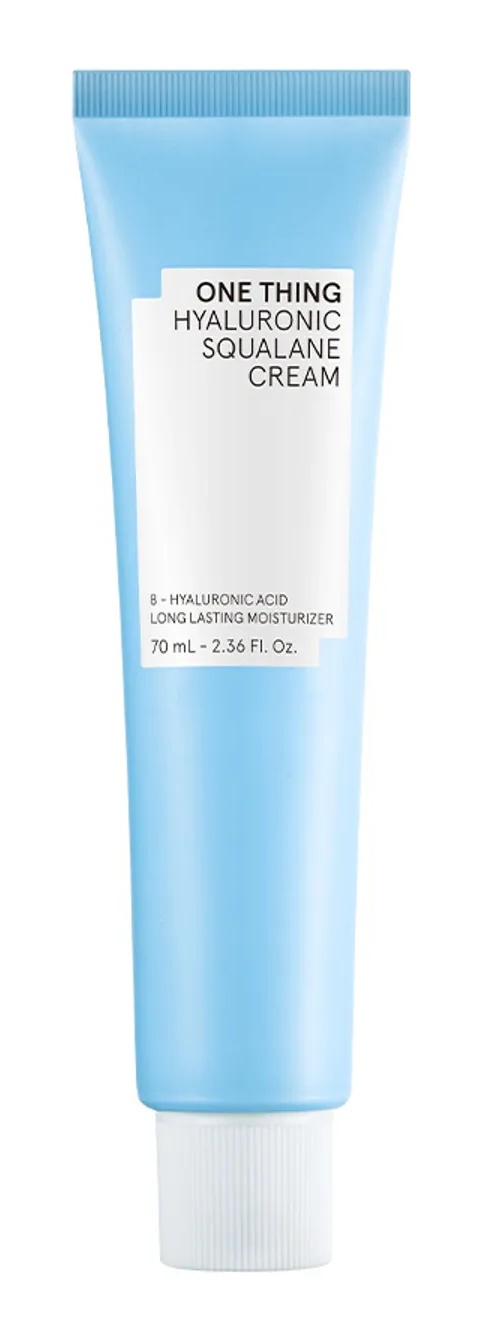
ONE THING Hyaluronic Squalane CreamIngredients explained
Good old water, aka H2O. The most common skincare ingredient of all. You can usually find it right in the very first spot of the ingredient list, meaning it’s the biggest thing out of all the stuff that makes up the product.
It’s mainly a solvent for ingredients that do not like to dissolve in oils but rather in water.
Once inside the skin, it hydrates, but not from the outside - putting pure water on the skin (hello long baths!) is drying.
One more thing: the water used in cosmetics is purified and deionized (it means that almost all of the mineral ions inside it is removed). Like this, the products can stay more stable over time.
Butylene glycol, or let’s just call it BG, is a multi-tasking colorless, syrupy liquid. It’s a great pick for creating a nice feeling product.
BG’s main job is usually to be a solvent for the other ingredients. Other tasks include helping the product to absorb faster and deeper into the skin (penetration enhancer), making the product spread nicely over the skin (slip agent), and attracting water (humectant) into the skin.
It’s an ingredient whose safety hasn’t been questioned so far by anyone (at least not that we know about). BG is approved by Ecocert and is also used enthusiastically in natural products. BTW, it’s also a food additive.
A really multi-functional helper ingredient that can do several things in a skincare product: it can bring a soft and pleasant feel to the formula, it can act as a humectant and emollient, it can be a solvent for some other ingredients (for example it can help to stabilize perfumes in watery products) and it can also help to disperse pigments more evenly in makeup products. And that is still not all: it can also boost the antimicrobial activity of preservatives.
A hydrocarbon-based emollient that can come in different viscosities from silky-light through satiny-smooth to luxurious, rich. It forms a non-occlusive film on the surface of the skin and brings gloss without greasiness to the formula. It's a very pure and hypoallergenic emollient that's also ideal for baby care products.
Propanediol is a natural alternative for the often used and often bad-mouthed propylene glycol. It's produced sustainably from corn sugar and it's Ecocert approved.
It's quite a multi-tasker: can be used to improve skin moisturization, as a solvent, to boost preservative efficacy or to influence the sensory properties of the end formula.
An ester that comes from Cetearyl alcohol and the fatty acids of olive oil. It often comes to the formula coupled with Sorbitan Olivate as the two together form the well-known, natural emulsifier trade named Olivem 1000.
Other than helping oil and water to blend, the main thing of Olivem 1000 is generating liquid crystal structures that are similar to the lipid structures of the stratum corneum (the outermost layer of the skin). Thanks to this, Olivem 1000 doubles as an active ingredient with significant moisturizing, barrier-repairing and soothing properties.
It also helps to deliver water-soluble actives such as caffeine more effectively, and can even boost SPF in sunscreen formulas. Its typical use level is 1-5% and has wide compatibility with other actives and oils.
Overall, a real multi-tasker with nice sensorial properties. No wonder it is so popular.
An ester coming from sorbitol and the fatty acids of olive oil. It is part of the popular emulsifier trade named Olivem 1000 that is well-known for generating biomimetic liquid crystal structures. We have more info on Olivem 1000 at Cetearyl Olivate >>
 We don't have description for this ingredient yet.
A kind of polymer (big molecule from repeated subunits) that helps to create beautiful gel-like textures. It's also a texturizer and thickener for oil-in-water emulsions. It gives products a good skin feel and does not make the formula tacky or sticky.
It works over a wide pH range and is used between 0.5-1.2%.
It seems to us that squalane is in fashion and there is a reason for it. Chemically speaking, it is a saturated (no double bonds) hydrocarbon (a molecule consisting only of carbon and hydrogen), meaning that it's a nice and stable oily liquid with a long shelf life.
It occurs naturally in certain fish and plant oils (e.g. olive), and in the sebum (the oily stuff our skin produces) of the human skin. As f.c. puts it in his awesome blog post, squalane's main things are "emolliency, surface occlusion, and TEWL prevention all with extreme cosmetic elegance". In other words, it's a superb moisturizer that makes your skin nice and smooth, without being heavy or greasy.
Another advantage of squalane is that it is pretty much compatible with all skin types and skin conditions. It is excellent for acne-prone skin and safe to use even if you have fungi-related skin issues, like seborrhea or fungal acne.
The unsaturated (with double bonds) and hence less stable version of Squalane is Squalene, you can read about it here >>
If you have spotted ethylhexylglycerin on the ingredient list, most probably you will see there also the current IT-preservative, phenoxyethanol. They are good friends because ethylhexylglycerin can boost the effectiveness of phenoxyethanol (and other preservatives) and as an added bonus it feels nice on the skin too.
Also, it's an effective deodorant and a medium spreading emollient.
We don't have description for this ingredient yet.
We don't have description for this ingredient yet.
We don't have description for this ingredient yet.
We don't have description for this ingredient yet.
Super common little helper ingredient that helps products to remain nice and stable for a longer time. It does so by neutralizing the metal ions in the formula (that usually get into there from water) that would otherwise cause some not so nice changes.
It is typically used in tiny amounts, around 0.1% or less.
We don't have description for this ingredient yet.
- It’s naturally in our skin and behaves there like a sponge
- It can bind up to 1000 times its own weight in water
- It is a big molecule from repeated subunits (polymer) so different molecular weight versions exist (unfortunately there is no way to determine MW from INCI list only)
- High-molecular-weight-HA (>500 kDa) is an excellent surface hydrator, skin protectant and can act as an osmotic pump helping water-soluble actives to penetrate deeper into the skin
- Low-molecular-weight-HA (< 500 kDa) can hydrate the skin somewhat deeper though it is still a big molecule and works mainly in the epidermis (outer layer of the skin)
- Low-molecular-weight-HA might also help the skin to repair itself by increasing its self-defense (~ 200kDa used in the study)
- Ultra-low-molecular-weight-HA (<50kDa) is a controversial ingredient and might work as a pro-inflammatory signal molecule
We don't have description for this ingredient yet.
We don't have description for this ingredient yet.
We don't have description for this ingredient yet.
We don't have description for this ingredient yet.
We don't have description for this ingredient yet.
A fancy name for sugar. Luckily when you put it on your skin it's good for you not like when you eat it. :) It has water-binding properties, which means that it helps to keep your skin nice and hydrated.
We don't have description for this ingredient yet.
Turmeric is the yellow spice you probably know from curry and Indian food. It's also a traditional herbal medicine used in Ayurveda for its bunch of anti-something magic abilities including being anti-inflammatory, antimicrobial, antioxidant and anticarcinogenic.
As for turmeric and skincare, we have good news: studies show that the root extract and its main biologically active component, curcumin can do multiple good things for the skin. Thanks to its anti-inflammatory and antimicrobial activity, it shows some promise for acne-prone skin and a small study from 2013 showed that it might be able to regulate sebum production.
It's also a potent antioxidant and skin-brightening agent so it often shows up in anti-aging and/or radiance-boosting products.
It's a super small, chemically chopped up version of sodium hyaluronate. Its trade name is miniHA, and its molecular weight is 10 kDa. This counts as really tiny given that "normal" HA has a molecular weight of 0.5-2 million Da.
To be honest, low molecular weight (LMW), and especially this ultra-low molecular weight HA is a controversial ingredient. On the upside, it can penetrate the skin better (though 10kDa still counts as big!) and might be able to moisturize the deeper layers of the skin where normal HA cannot get. Also, according to the manufacturer of miniHA, it has better antioxidant activity than a 1.6MDa version HA and it also has better sun protection and after-sun repair abilities than the higher MW versions. It also works in synergy with higher molecular weight versions, and the combination of 0.1% 1.45MDa-HA + 0.1% 380 kDa-HA + 0.1% miniHA hydrated the skin significantly better than 0.3% 1.45MDa-HA alone.
On the downside, the biological role of LMW-HA in the skin is being a pro-inflammatory signaling agent and there is a study by another manufacturer called Evonik showing that HA versions with smaller than 50kDa molecular weight might be pro-inflammatory when put on the skin. Granted, the study was only done on reconstituted human epidermis, so it might or might not be like this on real human skin.
If you wanna get confused and read much more about hyaluronic acid and what the different molecular weight versions might or might not do, click here and read our excruciatingly long description.
We don't have description for this ingredient yet.
We don't have description for this ingredient yet.
It's a special "cross-linked" from of IT-moisturizer, hyaluronic acid (HA). Cross-linked means that "normal" HA pieces (1-2 million Da molecular weight) are chemically bound togeather to create a big, "infinite" mesh.
The special HA mesh has a remarkable water-binding capacity, 5 times more than the already crazy water-binding capacity of "normal" HA. This water filled crosslinked HA gel forms a smooth film on the skin and continuously delivers the bound water, so it gives long-term moisturizing benefits.
Btw, crosslinking HA was developed for dermal fillers (as crosslinking helps their longevity), and this guy is the topical version of FDA approved dermal filler called Hylan B gel. Smearing crosslinked version all over ourselves is a newish thing, and incoming evidence so far suggests that it's a great idea, even better than normal HA.
A very recent, 2016 research article compared the topical moisturizing effect of crosslinked HA (not Hylan B gel specifically, but something called Resilient HA or RHA), HMW-HA and LMW-HA and found that "TEWL (that is trans-epidermal water loss, the water that evaporates from the skin) was reduced by 27.8% with RHA, and by 15.6% with HMW HA, but increased by 55.5% with LMW HA." (You can read much more about HMW and LMW HA here in the geeky details section.)
All in all, we think Sodium Hyaluronate Crosspolymer is an awesome version of HA, probably superior to traditional versions, so be happy to spot it on the ingredient list.
A multi-functional, silky feeling helper ingredient that can do quite many things. It's used as an emulsion stabilizer, solvent and a broad spectrum antimicrobial. According to manufacturer info, it's also a moisturizer and helps to make the product feel great on the skin. It works synergistically with preservatives and helps to improve water-resistance of sunscreens.
Sodium Acetylated Hyaluronate is a variation of current IT moisturizer, Hyaluronic acid, where some water-loving -OH groups are replaced by amphipathic (partly water-loving and partly water-hating) acetyl groups. The modified molecule is claimed to have even better moisture retention ability than normal HA and better affinity to the skin surface.
The better affinity comes from the acetyl groups that act as tiny "anchors" to attach the HA molecule to the skin. Staying on top of the skin better and longer means longer-lasting surface hydration and improved elasticity. It is also less sticky and more cosmetically elegant than normal HA, so no wonder the nickname of this molecule is super hyaluronic acid.
You may also want to take a look at...
| what‑it‑does | solvent |
| what‑it‑does | moisturizer/humectant | solvent |
| irritancy, com. | 0, 1 |
| what‑it‑does | solvent |
| what‑it‑does | emollient | perfuming | solvent |
| what‑it‑does | solvent | moisturizer/humectant |
| what‑it‑does | emulsifying |
| what‑it‑does | emulsifying |
| what‑it‑does | viscosity controlling |
| what‑it‑does | viscosity controlling |
| what‑it‑does | skin-identical ingredient | emollient |
| irritancy, com. | 0, 1 |
| what‑it‑does | preservative |
| what‑it‑does | antioxidant |
| what‑it‑does | chelating |
| what‑it‑does | skin-identical ingredient | moisturizer/humectant |
| what‑it‑does | emollient |
| what‑it‑does | moisturizer/humectant |
| what‑it‑does | antioxidant | soothing | skin brightening | perfuming |
| what‑it‑does | moisturizer/humectant |
| what‑it‑does | moisturizer/humectant |
| what‑it‑does | skin-identical ingredient | antioxidant | moisturizer/humectant |
| what‑it‑does | solvent | moisturizer/humectant |
| what‑it‑does | moisturizer/humectant |