





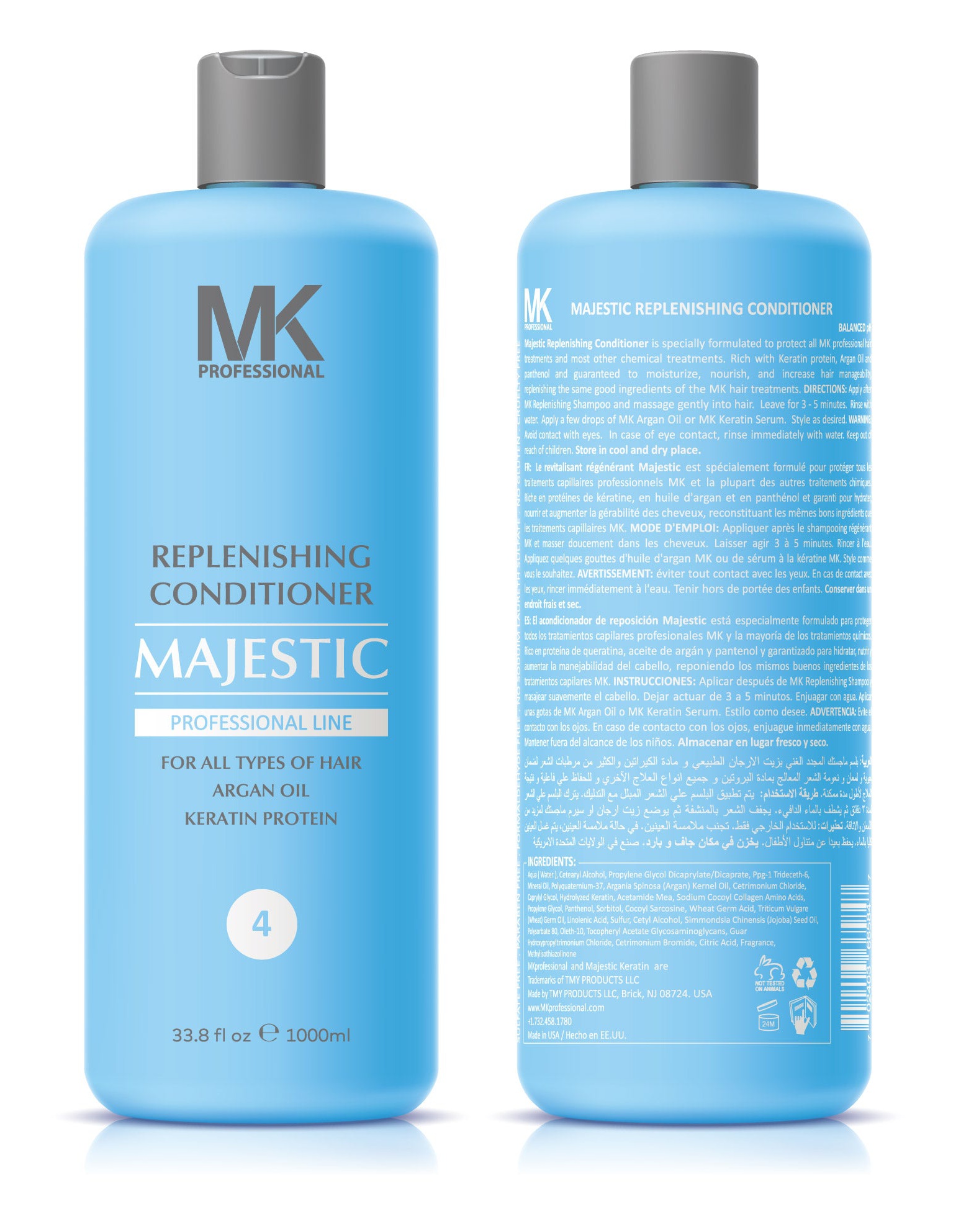
Replenishing Conditioner Majestic
Ingredients overview
Highlights
Key Ingredients
Other Ingredients
Skim through
MK Professional Replenishing Conditioner MajesticIngredients explained
Good old water, aka H2O. The most common skincare ingredient of all. You can usually find it right in the very first spot of the ingredient list, meaning it’s the biggest thing out of all the stuff that makes up the product.
It’s mainly a solvent for ingredients that do not like to dissolve in oils but rather in water.
Once inside the skin, it hydrates, but not from the outside - putting pure water on the skin (hello long baths!) is drying.
One more thing: the water used in cosmetics is purified and deionized (it means that almost all of the mineral ions inside it is removed). Like this, the products can stay more stable over time.
An extremely common multitasker ingredient that gives your skin a nice soft feel (emollient) and gives body to creams and lotions. It also helps to stabilize oil-water mixes (emulsions), though it does not function as an emulsifier in itself. Its typical use level in most cream type formulas is 2-3%.
It’s a so-called fatty alcohol, a mix of cetyl and stearyl alcohol, other two emollient fatty alcohols. Though chemically speaking, it is alcohol (as in, it has an -OH group in its molecule), its properties are totally different from the properties of low molecular weight or drying alcohols such as denat. alcohol. Fatty alcohols have a long oil-soluble (and thus emollient) tail part that makes them absolutely non-drying and non-irritating and are totally ok for the skin.
Propylene Glycol Dicaprylate/Dicaprate is an emollient that leaves a light, non-oily smooth and velvet skin sensation. According to manufacturer info it's also great at dispersing and dissolving pigments and sunscreen actives. Most often you will meet this guy in light moisturizers, sunscreens or makeup products.
 We don't have description for this ingredient yet.
The famous or maybe rather infamous mineral oil. The clear oily liquid that is the "cheap by-product" of refining crude oil and the one that gets a lot of heat for its poor provenance. It is a very controversial ingredient with pros and cons and plenty of myths around it. So let us see them:
The pros of mineral oil
Trust us, if something is used for more than 100 years in cosmetic products, it has advantages. Chemically speaking, cosmetic grade mineral oil is a complex mixture of highly refined saturated hydrocarbons with C15-50 chain length. It is not merely a "by-product" but rather a specifically isolated part of petroleum that is very pure and inert.
It is a great emollient and moisturizer working mainly by occlusivity. Occlusivity is one of the basic mechanisms of how moisturizers work and it means that mineral oil sits on top of the skin and hinders so-called trans-epidermal water loss, i.e water evaporating out of your skin. When compared to heavy-duty plant oil, extra virgin coconut oil, the two of them were equally efficient and safe as moisturizers in treating xerosis, a skin condition connected to very dry skin.
The other thing that mineral oil is really good at is being non-irritating to the skin. The chemical composition of plant oils is more complex with many more possible allergens or irritating components, while mineral oil is simple, pure and sensitivity to it is extremely rare. If you check out the classic French pharmacy brands and their moisturizers for the most sensitive, allergy prone skin, they usually contain mineral oil. This is no coincidence.
The cons of mineral oil
The pros of mineral oil can be interpreted as cons if we look at them from another perspective. Not penetrating the skin but mostly just sitting on top of it and not containing biologically active components, like nice fatty acids and vitamins mean that mineral oil does not "nourish" the skin in the way plant oils do. Mineral oil does not give the skin any extra goodness, it is simply a non-irritating moisturizer working mainly by occlusivity.
The myths around mineral oil
Badmouthing mineral oil is a favorite sport of many, it is a cheap material and being connected to petrolatum makes it fairly easy to demonize.
While it is true that industrial grade mineral oil contains carcinogenic components (so-called polycyclic compounds), these are completely removed from cosmetic and food grade mineral oil and there is no scientific data showing that the pure, cosmetic grade version is carcinogenic.
What is more, in terms of the general health effects of mineral oils used in cosmetics, a 2017 study reviewed the data on their skin penetration and concluded that "the cosmetic use of mineral oils and waxes does not present a risk to consumers due to a lack of systemic exposure."
Another super common myth surrounding mineral oil is that it is comedogenic. A 2005 study titled "Is mineral oil comedogenic?" examined this very question and guess what happened? The study concluded that "based on the animal and human data reported, along with the AAD recommendation, it would appear reasonable to conclude that mineral oil is noncomedogenic in humans."
Overall, we feel that the scaremongering around mineral oil is not justified. For dry and super-sensitive skin types it is a great option. However, if you do not like its origin or its heavy feeling or anything else about it, avoiding it has never been easier. Mineral oil has such a bad reputation nowadays that cosmetic companies hardly dare to use it anymore.
A cationic polymer molecule (a big molecule with repeated subunits and a positive charge) that acts both as a film-former and conditioning ingredient as well as a thickening agent.
When it comes to cosmetic oils and hype, argan oil is for sure leading the way. Dubbed as the "liquid gold of Morocco", we have to admit we have some trouble determining why this oil enjoys such a special miracle status. Not that it's not good, it is good, even great but reading the research about argan and a bunch of other plant oils we just do not see the big, unique differentiating factor (though that might be our fault not reading enough, obvs.)
So, argan oil comes from the kernel of the argan fruit that comes from the argan tree that grows only in Morocco. The tree is slow growing and getting the oil is a hard job. The traditional process is that the ripe argan fruits fall from the tree, then goats eat them up and poop out the seeds. The seeds are collected and smashed with a stone to get the kernels inside. This part is the hard one as the seeds have extremely hard shells. Once the kernels are obtained, the oil is pressed out from them (the kernels contain about 50% oil).
As for skincare, argan oil is loaded with lots of skin goodies (but so are many other plant oils): it contains 80% nourishing and moisturizing unsaturated fatty acids, mainly oleic (38-50%), linoleic (28-38%) and palmitic (10-18%). It also contains a relatively large amount of antioxidant vitamin E (600-900 mg/kg, about twice as much as olive), small amounts of antioxidant phenols (including caffeic acid, ferulic acid, and epicatechin), as well as some rare sterols with soothing and anti-inflammatory properties.
Thanks to all the above goodness in argan oil, it can greatly nourish and moisturize the skin and hair. It's also claimed to be able to neutralize collagen-damaging free radicals, help reduce scars, and revitalize and improve skin elasticity. You can even read that argan might help acne-prone skin, but being a high oleic oil, we would be careful with that.
All in all, argan oil is a real goodie but we do not fully understand the special miracle status it enjoys.
We don't have description for this ingredient yet.
It’s a handy multi-tasking ingredient that gives the skin a nice, soft feel. At the same time, it also boosts the effectiveness of other preservatives, such as the nowadays super commonly used phenoxyethanol.
The blend of these two (caprylyl glycol + phenoxyethanol) is called Optiphen, which not only helps to keep your cosmetics free from nasty things for a long time but also gives a good feel to the finished product. It's a popular duo.
We don't have description for this ingredient yet.
We don't have description for this ingredient yet.
We don't have description for this ingredient yet.
- It's a helper ingredient that improves the freeze-thaw stability of products
- It's also a solvent, humectant and to some extent a penetration enhancer
- It has a bad reputation among natural cosmetics advocates but cosmetic scientists and toxicology experts do not agree (read more in the geeky details section)
An easy-to-formulate, commonly used, nice to have ingredient that’s also called pro-vitamin B5. As you might guess from the “pro” part, it’s a precursor to vitamin B5 (whose fancy name is pantothenic acid).
Its main job in skincare products is to moisturise the skin. It’s a humectant meaning that it can help the skin to attract water and then hold onto it. There is also research showing that panthenol can help our skin to produce more lovely lipids that are important for a strong and healthy skin barrier.
Another great thing about panthenol is that it has anti-inflammatory and skin protecting abilities. A study shows that it can reduce the irritation caused by less-nice other ingredients (e.g. fragrance, preservatives or chemical sunscreens) in the product.
Research also shows that it might be useful for wound healing as it promotes fibroblast (nice type of cells in our skin that produce skin-firming collagen) proliferation.
If that wasn’t enough panthenol is also useful in nail and hair care products. A study shows that a nail treatment liquide with 2% panthenol could effectively get into the nail and significantly increase the hydration of it.
As for the hair the hydration effect is also true there. Panthenol might make your hair softer, more elastic and helps to comb your hair more easily.
It's a sweet tasting sugar substitute that helps your skin to hold onto water when used in cosmetic products. It also helps to thicken up products and give them a bit more slip.
We don't have description for this ingredient yet.
We don't have description for this ingredient yet.
We don't have description for this ingredient yet.
The famous omega-3 fatty acid, the mother of all ω-3 fatty acids in our body. Next to linoleic acid, it is the other essential fatty acid that our body cannot synthesize and we have to ingest it from our food. It is also a PUFA, aka polyunsaturated fatty acid with three double bonds, a kinky chemical structure and thus a liquid consistency.
While linoleic acid is abundant in the skin, this is not the case with alpha-linolenic acid (ALA). It is not entirely clear if it is meant to be like that or if this is a consequence of not eating enough Omega-3 with the typical Western diet.
Leafy green vegetables, walnuts, flax seeds and fish oils are rich sources of ALA and if you are not eating a lot from these, supplementing with fish oil is a pretty good idea backed by research. It is a good idea both in terms of general health benefits as well as potentially improving inflammation-related skin issues such as atopic dermatitis or acne.
As for using ALA topically, we have to say that its role and effects seem to be less direct than with LA. ALA's main role in the skin appears to be modulating the immune response of the epidermis. This is probably helpful for inflammatory skin diseases but most studies examine ALA as an oral supplement and not when applied topically. One exception, we could find, is a study that found that topically applied ALA has nice spot-fading abilities.
To be honest, it seems to us that oral supplementation of ALA is more important than smearing it all over your face. However, that is not to say that topical ALA is a bad thing, it is a good thing. It is a skin-identical ingredient, it is probably moisturizing and anti-inflammatory but its topical effects are less established than that of fellow omega fatty acid, linoleic acid.
A yellowish element that smells of rotten eggs and it might be familiar to you from the periodic table (has the symbol S in there). It has a long history of medicinal use thanks to its antifungal, antibacterial and keratolytic activity. It used to be a very common ingredient in the treatment of inflammation-related skin diseases such as acne, rosacea and seborrheic dermatitis, however, due to its malodorousness, it is less popular nowadays.
Sulfur's precise mechanism of action is not known, but we do know that its effectiveness depends on its direct interaction with the skin surface, meaning the smaller the particle size, the better the effect. The United States Pharmacopeia lists two types of sulfur, sublimed and precipitated. The latter one has a smaller particle size and counts as a superior version.
Sulfur is also a team-player and works well when combined with other anti-acne agents, such as salicylic acid or sodium sulfacetamide. In fact, the combination of 10% sodium sulfacetamide and 5% sulfur is the active ingredient duo of several Rx-only anti-acne products.
As for the disadvantages, there is the rotten egg smell. Also in higher concentrations, it might cause a mild burning sensation and dry skin. If you are new to sulfur, patch testing it first is a good idea.
A so-called fatty (the good, non-drying kind of) alcohol that does all kinds of things in a skincare product: it makes your skin feel smooth and nice (emollient), helps to thicken up products and also helps water and oil to blend (emulsifier). Can be derived from coconut or palm kernel oil.
Jojoba is a drought resistant evergreen shrub native to South-western North America. It's known and grown for jojoba oil, the golden yellow liquid coming from the seeds (about 50% of the weight of the seeds will be oil).
At first glance, it seems like your average emollient plant oil: it looks like an oil and it's nourishing and moisturizing to the skin but if we dig a bit deeper, it turns out that jojoba oil is really special and unique: technically - or rather chemically - it's not an oil but a wax ester (and calling it an oil is kind of sloppy).
So what the heck is a wax ester and why is that important anyway? Well, to understand what a wax ester is, you first have to know that oils are chemically triglycerides: one glycerin + three fatty acids attached to it. The fatty acids attached to the glycerin vary and thus we have many kinds of oils, but they are all triglycerides. Mother Nature created triglycerides to be easily hydrolyzed (be broken down to a glycerin + 3 fatty acid molecules) and oxidized (the fatty acid is broken down into small parts) - this happens basically when we eat fats or oils and our body generates energy from it.
Mother Nature also created wax esters but for a totally different purpose. Chemically, a wax ester is a fatty acid + a fatty alcohol, one long molecule. Wax esters are on the outer surface of several plant leaves to give them environmental protection. 25-30% of human sebum is also wax esters to give us people environmental protection.
So being a wax ester results in a couple of unique properties: First, jojoba oil is extremely stable. Like crazy stable. Even if you heat it to 370 C (698 F) for 96 hours, it does not budge. (Many plant oils tend to go off pretty quickly). If you have some pure jojoba oil at home, you should be fine using it for years.
Second, jojoba oil is the most similar to human sebum (both being wax esters), and the two are completely miscible. Acne.org has this not fully proven theory that thanks to this, jojoba might be able to "trick" the skin into thinking it has already produced enough sebum, so it might have "skin balancing" properties for oily skin.
Third, jojoba oil moisturizes the skin through a unique dual action: on the one hand, it mixes with sebum and forms a thin, non-greasy, semi-occlusive layer; on the other hand, it absorbs into the skin through pores and hair follicles then diffuses into the intercellular spaces of the outer layer of the skin to make it soft and supple.
On balance, the point is this: in contrast to real plant oils, wax esters were designed by Mother Nature to stay on the surface and form a protective, moisturizing barrier and jojoba oil being a wax ester is uniquely excellent at doing that.
A common little helper ingredient that helps water and oil to mix together, aka emulsifier.
The number at the end refers to the oil-loving part and the bigger the number the more emulsifying power it has. 20 is a weak emulsifier, rather called solubilizer used commonly in toners while 60 and 80 are more common in serums and creams.
A useful ingredient that helps water and oil to mix nicely together (emulsifier). It has a liquide-pasty texture and is recommended for skincare, haircare and shaving products.
It’s the most commonly used version of pure vitamin E in cosmetics. You can read all about the pure form here. This one is the so-called esterified version.
According to famous dermatologist, Leslie Baumann while tocopheryl acetate is more stable and has a longer shelf life, it’s also more poorly absorbed by the skin and may not have the same awesome photoprotective effects as pure Vit E.
We don't have description for this ingredient yet.
We don't have description for this ingredient yet.
Citric acid comes from citrus fruits and is an AHA. If these magic three letters don’t tell you anything, click here and read our detailed description on glycolic acid, the most famous AHA.
So citric acid is an exfoliant, that can - just like other AHAs - gently lift off the dead skin cells of your skin and make it more smooth and fresh.
There is also some research showing that citric acid with regular use (think three months and 20% concentration) can help sun-damaged skin, increase skin thickness and some nice hydrating things called glycosaminoglycans in the skin.
But according to a comparative study done in 1995, citric acid has less skin improving magic properties than glycolic or lactic acid. Probably that’s why citric acid is usually not used as an exfoliant but more as a helper ingredient in small amounts to adjust the pH of a formulation.
Exactly what it sounds: nice smelling stuff put into cosmetic products so that the end product also smells nice. Fragrance in the US and parfum in the EU is a generic term on the ingredient list that is made up of 30 to 50 chemicals on average (but it can have as much as 200 components!).
If you are someone who likes to know what you put on your face then fragrance is not your best friend - there's no way to know what’s really in it.
Also, if your skin is sensitive, fragrance is again not your best friend. It’s the number one cause of contact allergy to cosmetics. It’s definitely a smart thing to avoid with sensitive skin (and fragrance of any type - natural is just as allergic as synthetic, if not worse!).
As you may guess, if something is only recommended in products that you rinse off (cleansers and shampoos), then it’s probably not the best ingredient for the skin.
Methylisothiazolinone (MI) is a preservative that' super efficient against bacteria at surprisingly low concentrations. The problem with it though is that it can also sensitize and irritate the skin quite easily when it comes in leave-on formulas.
Currently, some countries are considering to ban it entirely (like Denmark) and the permitted use level is very low (under 0.01%). Luckily there are plenty of products on the market with other preservative options so if you are a better safe than sorry type it's probably best to avoid it.
You may also want to take a look at...
| what‑it‑does | solvent |
| what‑it‑does | emollient | viscosity controlling | emulsifying | surfactant/cleansing |
| irritancy, com. | 1, 2 |
| what‑it‑does | emollient |
| irritancy, com. | 0, 1 |
| what‑it‑does | surfactant/cleansing |
| what‑it‑does | emollient | solvent |
| irritancy, com. | 0, 0-2 |
| what‑it‑does | viscosity controlling |
| what‑it‑does | antioxidant | emollient |
| what‑it‑does | antimicrobial/antibacterial | emulsifying | preservative | surfactant/cleansing |
| what‑it‑does | moisturizer/humectant | emollient |
| what‑it‑does | moisturizer/humectant |
| what‑it‑does | moisturizer/humectant | surfactant/cleansing | viscosity controlling |
| what‑it‑does | moisturizer/humectant | solvent |
| irritancy, com. | 0, 0 |
| what‑it‑does | soothing | moisturizer/humectant |
| irritancy, com. | 0, 0 |
| what‑it‑does | moisturizer/humectant |
| irritancy, com. | 0, 0 |
| what‑it‑does | surfactant/cleansing |
| what‑it‑does | surfactant/cleansing | emollient | emulsifying |
| what‑it‑does | emollient | moisturizer/humectant |
| what‑it‑does | skin-identical ingredient | emollient | surfactant/cleansing | perfuming |
| what‑it‑does | anti-acne | antimicrobial/antibacterial |
| irritancy, com. | 0, 0-3 |
| what‑it‑does | emollient | viscosity controlling |
| irritancy, com. | 2, 2 |
| what‑it‑does | emollient |
| irritancy, com. | 0, 0-2 |
| what‑it‑does | emulsifying | surfactant/cleansing |
| irritancy, com. | 0, 0 |
| what‑it‑does | emulsifying | surfactant/cleansing |
| irritancy, com. | 1, 2 |
| what‑it‑does | antioxidant |
| irritancy, com. | 0, 0 |
| what‑it‑does | emollient |
| what‑it‑does | viscosity controlling |
| what‑it‑does | antimicrobial/antibacterial | emulsifying | preservative | surfactant/cleansing |
| what‑it‑does | buffering |
| what‑it‑does | perfuming |
| what‑it‑does | preservative |