





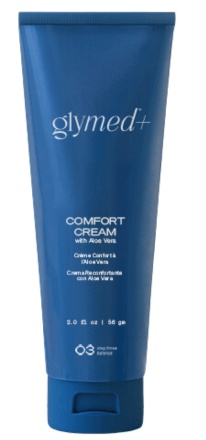
Comfort Cream (with Aloe Vera)
Ingredients overview
Highlights
Key Ingredients
Other Ingredients
Skim through
Glymed Plus Comfort Cream (with Aloe Vera)Ingredients explained
Aloe Vera is one of today’s magic plants. It does have some very nice properties indeed, though famous dermatologist Leslie Baumann warns us in her book that most of the evidence is anecdotal and the plant might be a bit overhyped.
What research does confirm about Aloe is that it’s a great moisturizer and has several anti-inflammatory (among others contains salicylates, polysaccharides, magnesium lactate and C-glucosyl chromone) as well as some antibacterial components. It also helps wound healing and skin regeneration in general. All in all definitely a goodie.
The famous Vaseline or Petroleum Jelly. Just like mineral oil, it is also a by-product of refining crude oil, aka petroleum, and it is also a mixture of hydrocarbons but with bigger (C18-90+) carbon chain length.
The unique thing about petrolatum is that it is the most effective occlusive agent known today. While the occlusivity of mineral oil is in the same league as the occlusivity of plant oils, petrolatum is in a league of its own. It sits on top of the skin and hinders so-called transepidermal water loss (TEWL) like nothing else.
This comes in handy healing cracked lips or severely dry skin patches, though overdoing it (i.e. reducing TEWL by more than 40%) is not good as it can create a nice moist place for fungi and bacteria to grow.
As for petrolatum and safety, we can write here pretty much the exact same thing as we have written at mineral oil. There is no evidence whatsoever that cosmetic, USP grade petrolatum is carcinogenic. It also does not absorb into the skin but sits on top of it and that in itself greatly minimises health risks. It also has a long history of safe use, as it was first used as a skincare product more than 100 years ago, in 1872 to be precise.
It is also non-comedogenic, though its pure form is very heavy and greasy so combination and oily skin types might want to avoid it anyway.
Overall, it is the gold-standard occlusive agent known today and a tub of Vaseline comes in handy in any household to heal cracked lips or other severely dry skin patches.
It seems to us that squalane is in fashion and there is a reason for it. Chemically speaking, it is a saturated (no double bonds) hydrocarbon (a molecule consisting only of carbon and hydrogen), meaning that it's a nice and stable oily liquid with a long shelf life.
It occurs naturally in certain fish and plant oils (e.g. olive), and in the sebum (the oily stuff our skin produces) of the human skin. As f.c. puts it in his awesome blog post, squalane's main things are "emolliency, surface occlusion, and TEWL prevention all with extreme cosmetic elegance". In other words, it's a superb moisturizer that makes your skin nice and smooth, without being heavy or greasy.
Another advantage of squalane is that it is pretty much compatible with all skin types and skin conditions. It is excellent for acne-prone skin and safe to use even if you have fungi-related skin issues, like seborrhea or fungal acne.
The unsaturated (with double bonds) and hence less stable version of Squalane is Squalene, you can read about it here >>
- A natural moisturizer that’s also in our skin
- A super common, safe, effective and cheap molecule used for more than 50 years
- Not only a simple moisturizer but knows much more: keeps the skin lipids between our skin cells in a healthy (liquid crystal) state, protects against irritation, helps to restore barrier
- Effective from as low as 3% with even more benefits for dry skin at higher concentrations up to 20-40%
- High-glycerin moisturizers are awesome for treating severely dry skin
Good old water, aka H2O. The most common skincare ingredient of all. You can usually find it right in the very first spot of the ingredient list, meaning it’s the biggest thing out of all the stuff that makes up the product.
It’s mainly a solvent for ingredients that do not like to dissolve in oils but rather in water.
Once inside the skin, it hydrates, but not from the outside - putting pure water on the skin (hello long baths!) is drying.
One more thing: the water used in cosmetics is purified and deionized (it means that almost all of the mineral ions inside it is removed). Like this, the products can stay more stable over time.
A so-called fatty (the good, non-drying kind of) alcohol that does all kinds of things in a skincare product: it makes your skin feel smooth and nice (emollient), helps to thicken up products and also helps water and oil to blend (emulsifier). Can be derived from coconut or palm kernel oil.
A super common, waxy, white, solid stuff that helps water and oil to mix together, gives body to creams and leaves the skin feeling soft and smooth.
Chemically speaking, it is the attachment of a glycerin molecule to the fatty acid called stearic acid. It can be produced from most vegetable oils (in oils three fatty acid molecules are attached to glycerin instead of just one like here) in a pretty simple, "green" process that is similar to soap making. It's readily biodegradable.
It also occurs naturally in our body and is used as a food additive. As cosmetic chemist Colins writes it, "its safety really is beyond any doubt".
A very common water-loving surfactant and emulsifier that helps to keep water and oil mixed nicely together.
It's often paired with glyceryl stearate - the two together form a super effective emulsifier duo that's salt and acid tolerant and works over a wide pH range. It also gives a "pleasing product aesthetics", so no wonder it's popular.
A pretty well-known and often used ingredient with the magic ability to fade brown spots. It's used traditionally in Japan and can be found naturally in a couple of plants, including the leaves of pear trees, wheat and bearberry.
Arbutin seems to work its magic and hinder the pigmentation process at the second step of it. An enzyme called tyrosinase is needed to create melanin (the pigment that causes the brown spots) and while several other skin lightening agents work to inhibit the synthesis of tyrosinase itself (like vitamin C or licorice), arbutin lets tyrosinase be and rather hinders the melanin-forming activity of the enzyme. (So it might be a good idea to combine arbutin with some direct tyrosinase inhibitors for more skin lightening effect.)
All in all, arbutin is one of the better-known skin brightening agents, that's probably worth a try if pigmentation is an issue for you.
It’s pretty much the current IT-preservative. It’s safe and gentle, but even more importantly, it’s not a feared-by-everyone-mostly-without-scientific-reason paraben.
It’s not something new: it was introduced around 1950 and today it can be used up to 1% worldwide. It can be found in nature - in green tea - but the version used in cosmetics is synthetic.
Other than having a good safety profile and being quite gentle to the skin it has some other advantages too. It can be used in many types of formulations as it has great thermal stability (can be heated up to 85°C) and works on a wide range of pH levels (ph 3-10).
It’s often used together with ethylhexylglycerin as it nicely improves the preservative activity of phenoxyethanol.
Super common soothing ingredient. It can be found naturally in the roots & leaves of the comfrey plant, but more often than not what's in the cosmetic products is produced synthetically.
It's not only soothing but it' also skin-softening and protecting and can promote wound healing.
A big molecule created from repeated subunits (a polymer of acrylic acid) that magically converts a liquid into a nice gel formula. It usually has to be neutralized with a base (such as sodium hydroxide) for the thickening to occur and it creates viscous, clear gels that also feel nice and non-tacky on the skin. No wonder, it is a very popular and common ingredient. Typically used at 1% or less in most formulations.
If you have spotted ethylhexylglycerin on the ingredient list, most probably you will see there also the current IT-preservative, phenoxyethanol. They are good friends because ethylhexylglycerin can boost the effectiveness of phenoxyethanol (and other preservatives) and as an added bonus it feels nice on the skin too.
Also, it's an effective deodorant and a medium spreading emollient.
It’s the - sodium form - cousin of the famous NMF, hyaluronic acid (HA). If HA does not tell you anything we have a super detailed, geeky explanation about it here. The TL; DR version of HA is that it's a huge polymer (big molecule from repeated subunits) found in the skin that acts as a sponge helping the skin to hold onto water, being plump and elastic. HA is famous for its crazy water holding capacity as it can bind up to 1000 times its own weight in water.
As far as skincare goes, sodium hyaluronate and hyaluronic acid are pretty much the same and the two names are used interchangeably. As cosmetic chemist kindofstephen writes on reddit "sodium hyaluronate disassociates into hyaluronic acid molecule and a sodium atom in solution".
In spite of this, if you search for "hyaluronic acid vs sodium hyaluronate" you will find on multiple places that sodium hyaluronate is smaller and can penetrate the skin better. Chemically, this is definitely not true, as the two forms are almost the same, both are polymers and the subunits can be repeated in both forms as much as you like. (We also checked Prospector for sodium hyaluronate versions actually used in cosmetic products and found that the most common molecular weight was 1.5-1.8 million Da that absolutely counts as high molecular weight).
What seems to be a true difference, though, is that the salt form is more stable, easier to formulate and cheaper so it pops up more often on the ingredient lists.
If you wanna become a real HA-and-the-skin expert you can read way more about the topic at hyaluronic acid (including penetration-questions, differences between high and low molecular weight versions and a bunch of references to scientific literature).
The unfancy name for it is lye. It’s a solid white stuff that’s very alkaline and used in small amounts to adjust the pH of the product and make it just right.
For example, in case of AHA or BHA exfoliants, the right pH is super-duper important, and pH adjusters like sodium hydroxide are needed.
BTW, lye is not something new. It was already used by ancient Egyptians to help oil and fat magically turn into something else. Can you guess what? Yes, it’s soap. It still often shows up in the ingredient list of soaps and other cleansers.
Sodium hydroxide in itself is a potent skin irritant, but once it's reacted (as it is usually in skin care products, like exfoliants) it is totally harmless.
It's one of those things that help your cosmetics not to go wrong too soon, aka a preservative. It can be naturally found in fruits and teas but can also be made synthetically.
No matter the origin, in small amounts (up to 1%) it’s a nice, gentle preservative. Has to be combined with some other nice preservatives, like potassium sorbate to be broad spectrum enough.
In high amounts, it can be a skin irritant, but don’t worry, it’s never used in high amounts.
You might know licorice as a sweet treat from your childhood, but it's actually a legume that grows around the Mediterranean Sea, the Middle East, central and southern Russia. It's sweet and yellow and not only used for licorice all sorts but it's also a skincare superstar thanks to two magic properties:
Nr. 1 magic property is that it has skin-lightening or to say it another way depigmenting properties. The most active part is called glabridin. The topical application (meaning when you put it on your face) of 0.5% glabridin was shown to inhibit UVB caused pigmentation of guinea pigs. Another study even suggested that licorice is more effective than the gold standard skin-lightening agent hydroquinone. All in all, licorice is considered to be one of the safest skin lightening agents with the fewest side effects.
There is just one catch regarding glabridin and licorice: the amount of glabridin in commercial licorice extracts can vary a lot. We have seen extracts with only 4% glabridin as well as 40% glabridin. The latter one is a very-very expensive ingredient, so if you are after the depigmenting properties try to choose a product that boasts its high-quality licorice extract.
Nr. 2 magic property is that licorice is a potent anti-inflammatory. Glabridin has also some soothing properties but the main active anti-inflammatory component is glycyrrhizin. It’s used to treat several skin diseases that are connected to inflammation including atopic dermatitis, rosacea or eczema.
Oh, and one more thing: glabridin seems to be also an antioxidant, which is just one more reason to be happy about licorice root extract on an ingredient list.
Bottom line: Licorice is a great skincare ingredient with significant depigmenting, anti-inflammatory and even some antioxidant properties. Be happy if it's on the ingredient list. :)
It's a "bioengineered" version of superstar green tea polyphenol, EGCG (EGCG attached to a glucose molecule). According to the manufacturer, it's a highly water soluble, stabilized and purified form that's easier to formulate but it keeps the great antioxidant and anti-inflammatory benefits of regular EGCG. It's Ecocert approved.
Gallyl Glucoside is a glycosylated form of gallic acid (i.e. attaching the sugar molecule, glucose to gallic acid) coming from oak leaves. It is known for its antioxidant and soothing properties and usually comes to the formula combined with other plant-derived glucosides.
 We don't have description for this ingredient yet.
There are two primary types of Chamomile, the German and the Roman. Both has soothing properties, but the German one contains more anti-inflammatory actives (like chamazulene). The anti-inflammatory action of the Roman Chamomile is due to phenolic compounds and - according to manufacturer info- it also has some nice skin toning properties.
The extract coming from the popular garden plant Calendula or Marigold. It's used traditionally as a skin-repairing and soothing plant extract.
Click here to read more at the calendula flower extract.
The extract coming from the popular garden plant Calendula or Marigold. According to manufacturer info, it's used for many centuries for its exceptional healing powers and is particularly remarkable in the treatment of wounds. It contains flavonoids that give the plant anti-inflammatory and antioxidant properties.
A standardized powdered extract from the roots of the Curcuma longa (Turmeric) plant (together with this and this). The trio is called Tetrahydrocurcuminoids (THC) and has skin-brightening, anti-inflammatory and antioxidant magic properties.
Other turmeric extracts have brilliant yellow color that makes them difficult to use but this one is color-free.
A helper ingredient that helps to make the products stay nice longer, aka preservative. It works mainly against fungi and has only milder effect against bacteria.
It is Ecocert and Cosmos approved, works quite well at low concentrations (0.1-0.6%) and is popular in natural products.
You may also want to take a look at...
| what‑it‑does | soothing | moisturizer/humectant |
| what‑it‑does | emollient |
| what‑it‑does | skin-identical ingredient | emollient |
| irritancy, com. | 0, 1 |
| what‑it‑does | skin-identical ingredient | moisturizer/humectant |
| irritancy, com. | 0, 0 |
| what‑it‑does | solvent |
| what‑it‑does | emollient | viscosity controlling |
| irritancy, com. | 2, 2 |
| what‑it‑does | emollient | emulsifying |
| irritancy, com. | 0, 1 |
| what‑it‑does | surfactant/cleansing | emulsifying |
| irritancy, com. | 0, 0 |
| what‑it‑does | antioxidant | skin brightening |
| what‑it‑does | preservative |
| what‑it‑does | soothing |
| irritancy, com. | 0, 0 |
| what‑it‑does | viscosity controlling |
| irritancy, com. | 0, 1 |
| what‑it‑does | preservative |
| what‑it‑does | skin-identical ingredient | moisturizer/humectant |
| irritancy, com. | 0, 0 |
| what‑it‑does | buffering |
| what‑it‑does | preservative | perfuming | solvent | viscosity controlling |
| what‑it‑does | soothing | skin brightening |
| what‑it‑does | antioxidant | soothing |
| what‑it‑does | antioxidant | soothing |
| what‑it‑does | antioxidant | perfuming |
| what‑it‑does | soothing | perfuming |
| what‑it‑does | soothing | antioxidant |
| what‑it‑does | soothing | antioxidant | perfuming |
| what‑it‑does | antioxidant | skin brightening | soothing |
| what‑it‑does | preservative |