





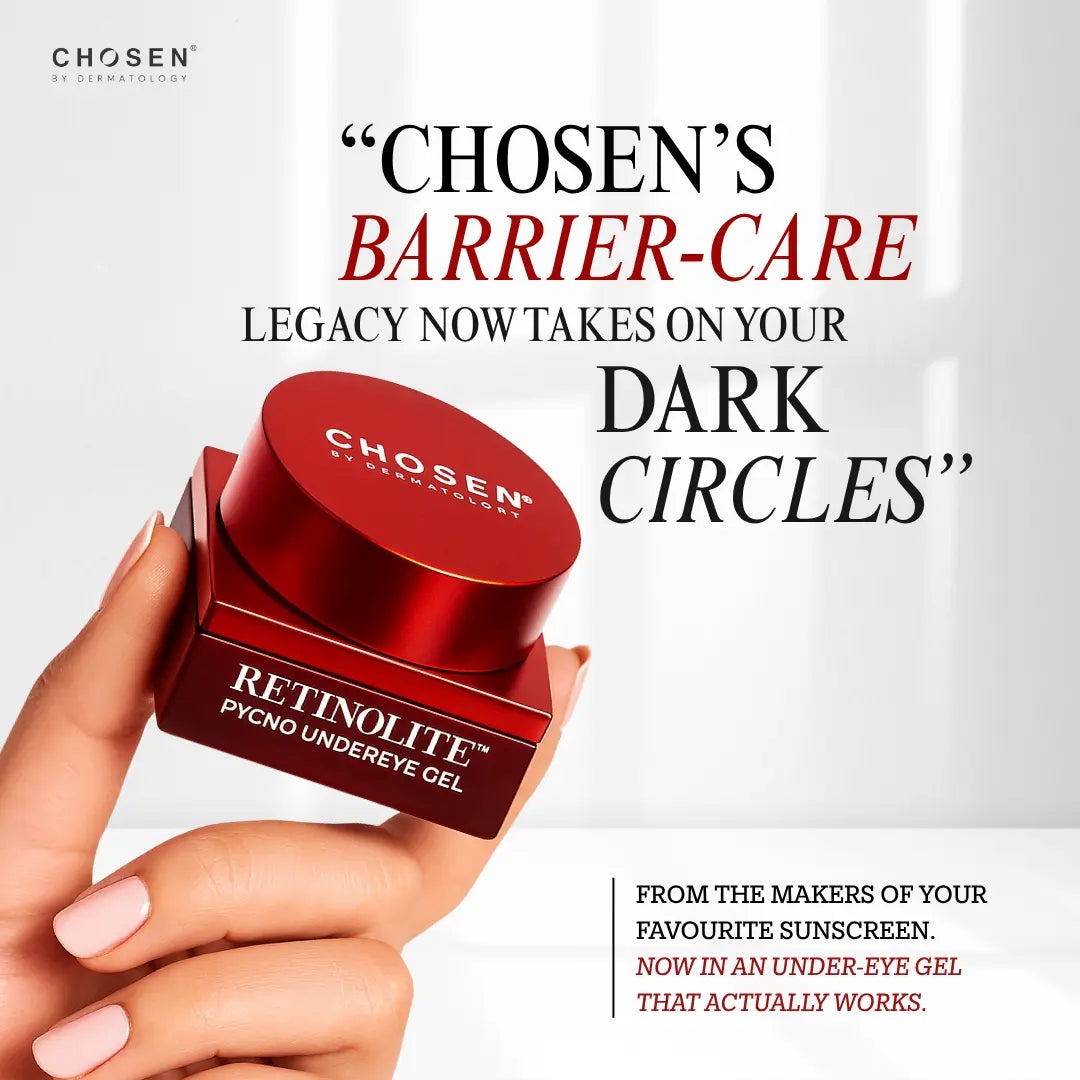
Retinolite™ Pycno Undereye Gel
Ingredients overview
 INCI photo pending approval
Highlights
Key Ingredients
Skim through
CHOSEN by Dermatology Retinolite™ Pycno Undereye GelIngredients explained
Good old water, aka H2O. The most common skincare ingredient of all. You can usually find it right in the very first spot of the ingredient list, meaning it’s the biggest thing out of all the stuff that makes up the product.
It’s mainly a solvent for ingredients that do not like to dissolve in oils but rather in water.
Once inside the skin, it hydrates, but not from the outside - putting pure water on the skin (hello long baths!) is drying.
One more thing: the water used in cosmetics is purified and deionized (it means that almost all of the mineral ions inside it is removed). Like this, the products can stay more stable over time.
- A natural moisturizer that’s also in our skin
- A super common, safe, effective and cheap molecule used for more than 50 years
- Not only a simple moisturizer but knows much more: keeps the skin lipids between our skin cells in a healthy (liquid crystal) state, protects against irritation, helps to restore barrier
- Effective from as low as 3% with even more benefits for dry skin at higher concentrations up to 20-40%
- High-glycerin moisturizers are awesome for treating severely dry skin
Propanediol is a natural alternative for the often used and often bad-mouthed propylene glycol. It's produced sustainably from corn sugar and it's Ecocert approved.
It's quite a multi-tasker: can be used to improve skin moisturization, as a solvent, to boost preservative efficacy or to influence the sensory properties of the end formula.
A copolymer is a big molecule that consists not of one but of two repeating subunits. This particular copolymer is a handy helper ingredient to form nice gel textures.
It usually comes to the formula combined with emollients (such as C13-14 Isoparaffin, Isohexadecane, Isononyl Isononanoate or Squalane) and can be used as an emulsifier and/or thickener to produce milky gel emulsions with a soft and non-tacky skin feel.
A light, velvety, unique skin feel liquid that is a good solvent and also makes the skin feel nice and smooth (aka emollient). It's often used in makeup products mixed with silicones to give shine and slip to the product. It's also great for cleansing dirt and oil from the skin as well as for taking off make-up.
 We don't have description for this ingredient yet.
Beetroot is a beautifully colored vegetable that you probably know from the kitchen. As for skincare - according to manufacturer info - it works as a natural moisturizer that might be able to increase the concentration of NMFs (natural moisturizing factors) in the upper layer of the skin giving skin both immediate and longer term hydration.
According to Paula's Choice, it's also a colorant and a source of antioxidants.
We don't have description for this ingredient yet.
It seems to us that squalane is in fashion and there is a reason for it. Chemically speaking, it is a saturated (no double bonds) hydrocarbon (a molecule consisting only of carbon and hydrogen), meaning that it's a nice and stable oily liquid with a long shelf life.
It occurs naturally in certain fish and plant oils (e.g. olive), and in the sebum (the oily stuff our skin produces) of the human skin. As f.c. puts it in his awesome blog post, squalane's main things are "emolliency, surface occlusion, and TEWL prevention all with extreme cosmetic elegance". In other words, it's a superb moisturizer that makes your skin nice and smooth, without being heavy or greasy.
Another advantage of squalane is that it is pretty much compatible with all skin types and skin conditions. It is excellent for acne-prone skin and safe to use even if you have fungi-related skin issues, like seborrhea or fungal acne.
The unsaturated (with double bonds) and hence less stable version of Squalane is Squalene, you can read about it here >>
It’s pretty much the current IT-preservative. It’s safe and gentle, but even more importantly, it’s not a feared-by-everyone-mostly-without-scientific-reason paraben.
It’s not something new: it was introduced around 1950 and today it can be used up to 1% worldwide. It can be found in nature - in green tea - but the version used in cosmetics is synthetic.
Other than having a good safety profile and being quite gentle to the skin it has some other advantages too. It can be used in many types of formulations as it has great thermal stability (can be heated up to 85°C) and works on a wide range of pH levels (ph 3-10).
It’s often used together with ethylhexylglycerin as it nicely improves the preservative activity of phenoxyethanol.
If you have spotted ethylhexylglycerin on the ingredient list, most probably you will see there also the current IT-preservative, phenoxyethanol. They are good friends because ethylhexylglycerin can boost the effectiveness of phenoxyethanol (and other preservatives) and as an added bonus it feels nice on the skin too.
Also, it's an effective deodorant and a medium spreading emollient.
- Primary fat-soluble antioxidant in our skin
- Significant photoprotection against UVB rays
- Vit C + Vit E work in synergy and provide great photoprotection
- Has emollient properties
- Easy to formulate, stable and relatively inexpensive
It's one of the most commonly used thickeners and emulsion stabilizers. If the product is too runny, a little xanthan gum will make it more gel-like. Used alone, it can make the formula sticky and it is a good team player so it is usually combined with other thickeners and so-called rheology modifiers (helper ingredients that adjust the flow and thus the feel of the formula). The typical use level of Xantha Gum is below 1%, it is usually in the 0.1-0.5% range.
Btw, Xanthan gum is all natural, a chain of sugar molecules (polysaccharide) produced from individual sugar molecules (glucose and sucrose) via fermentation. It’s approved by Ecocert and also used in the food industry (E415).
A natural plant extract coming from the bark of the maritime pine that grows along the coast of southwest France. The extract contains potent antioxidant molecules, mainly procyanidins and phenolic acids. Horphag Research trademarked the name 'Pycnogenol', which refers to a standardized, high-active content version of the pine bark extract.
Pycnogenol is a very well researched ingredient with more than 370 published studies and review articles. Most of these are in-vitro (made in the lab, not on real people) or analyse Pycnogenol when taken orally. It's clear from them that Pycnogenol has a load of health benefits including antioxidant, anti-inflammatory, and anticarcinogenic magical properties (and a bunch of other things such as improving cognitive function, relieving premenstrual symptoms, or enhancing microcirculation).
Regarding Pycnogenol and the skin, we found a study from 2012 that examined its effect on the skin when taken as a supplement. After 12 weeks, Pycnogenol supplements resulted in increased skin hydration and elasticity. The researchers thought this was due to the increased synthesis of extracellular matrix molecules such as hyaluronic acid and perhaps collagen.
As for topical application, the studies are also promising. A 2003 research paper, conducted on mice, showed that topical Pycnogenol (used at 0.05-0.2%) has the potential to provide photoprotection for humans in a complementary role to sunscreens. Meanwhile, a 2004 study concluded, "pine bark extract is readily absorbed by human skin and can be used for topical application".
Overall, Pycnogenol, or Pinus Pinaster Bark Extract, as it will be listed on the product label, is a well-researched and potent antioxidant that is a welcome addition to any ingredient list.
- Retinol (pure Vitamin A) is probably the most proven anti-aging ingredient available OTC
- It has to be converted in the skin to retinoic acid to work its magic
- Once converted, it has the same effect as all-trans-retinoic acid, aka tretinoin
- A generally accepted ballpark number is that retinol is 10-to-20 times less potent than retinoic acid
- It makes skin less wrinkled, smoother, firmer and tighter
- It might also be helpful for acne prone skin as it normalizes keratinization and makes the pores produce less sebum
- Possible side effects and irritation are also much less than with retinoic acid
- Do not use whilst pregnant
A type of bucket or donut-shaped molecule with a water-loving outer side and an oil-loving inner side that is used mostly to encapsulate other actives in cosmetics.
You may also want to take a look at...
| what‑it‑does | solvent |
| what‑it‑does | skin-identical ingredient | moisturizer/humectant |
| irritancy, com. | 0, 0 |
| what‑it‑does | solvent | moisturizer/humectant |
| what‑it‑does | viscosity controlling |
| what‑it‑does | emollient | solvent |
| what‑it‑does | moisturizer/humectant |
| what‑it‑does | antioxidant | moisturizer/humectant |
| what‑it‑does | emollient |
| what‑it‑does | skin-identical ingredient | emollient |
| irritancy, com. | 0, 1 |
| what‑it‑does | preservative |
| what‑it‑does | preservative |
| what‑it‑does | antioxidant |
| irritancy, com. | 0-3, 0-3 |
| what‑it‑does | viscosity controlling |
| what‑it‑does | antioxidant |
| what‑it‑does | cell-communicating ingredient |