





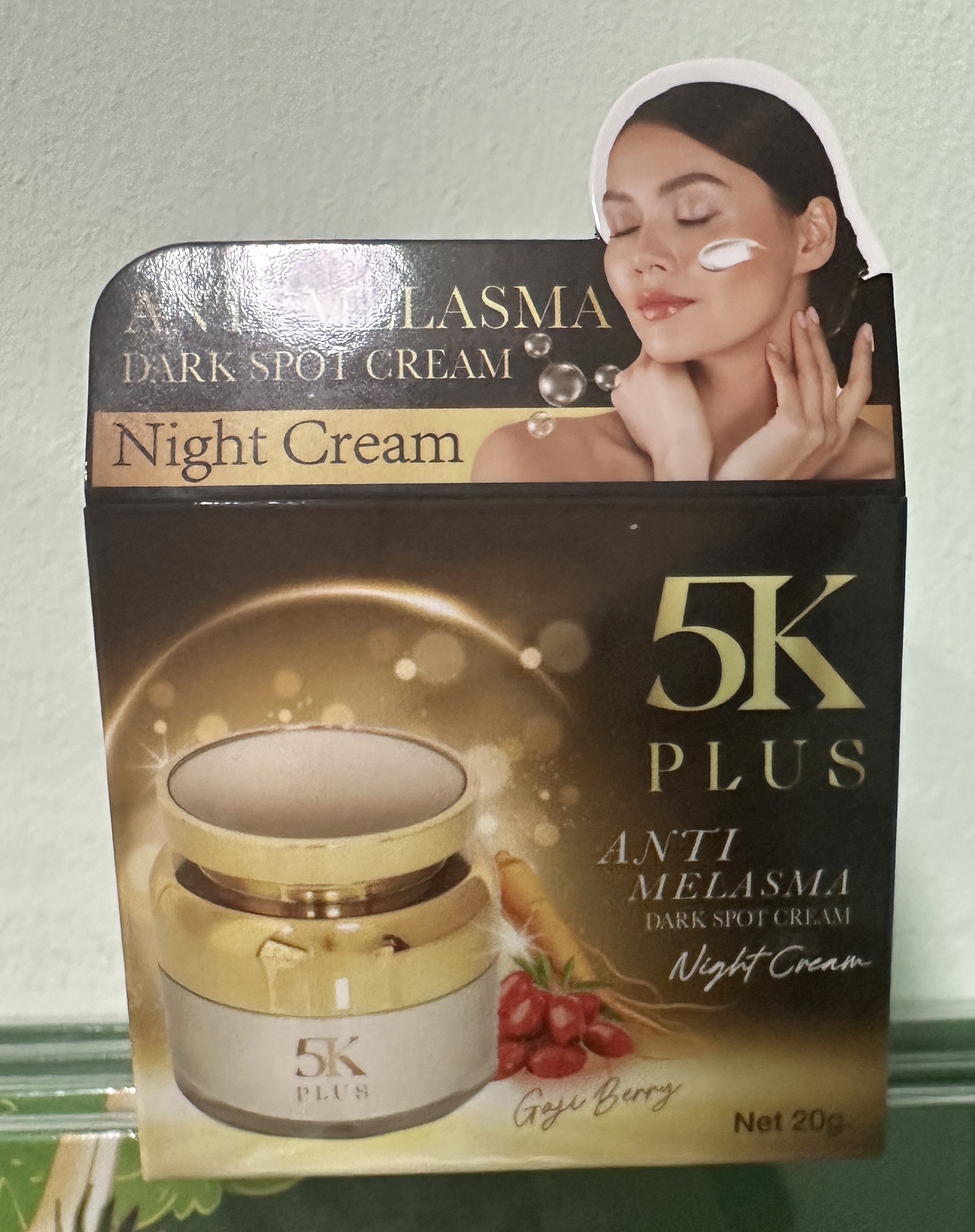
Anti Melasma Dark Spot Night Cream
Ingredients overview
Highlights
Key Ingredients
Skim through
5K Plus Anti Melasma Dark Spot Night CreamIngredients explained
Good old water, aka H2O. The most common skincare ingredient of all. You can usually find it right in the very first spot of the ingredient list, meaning it’s the biggest thing out of all the stuff that makes up the product.
It’s mainly a solvent for ingredients that do not like to dissolve in oils but rather in water.
Once inside the skin, it hydrates, but not from the outside - putting pure water on the skin (hello long baths!) is drying.
One more thing: the water used in cosmetics is purified and deionized (it means that almost all of the mineral ions inside it is removed). Like this, the products can stay more stable over time.
The distillate created from different parts of the hazelnut-bush-like magic tree, commonly called Witch Hazel. Hamamelis Virginiana Water is a bit of a sloppy ingredient name as the leaves, the twigs and the bark can be used to create extracts or distillates and the different parts contain different amounts of biologically active components. But what you are getting is probably a nice water with astringent, soothing, antioxidant and antibacterial magic properties.
We went into great detail about Witch Hazel in cosmetics here, detailing the main biologically active components and how they are different in different parts of the plant. Click here and read more >>
- A multi-functional skincare superstar with several proven benefits for the skin
- Great anti-aging, wrinkle smoothing ingredient used at 4-5% concentration
- Fades brown spots alone or in combination with amino sugar, acetyl glucosamine
- Increases ceramide synthesis that results in a stronger, healthier skin barrier and better skin hydration
- Can help to improve several skin conditions including acne, rosacea, and atopic dermatitis
Butylene glycol, or let’s just call it BG, is a multi-tasking colorless, syrupy liquid. It’s a great pick for creating a nice feeling product.
BG’s main job is usually to be a solvent for the other ingredients. Other tasks include helping the product to absorb faster and deeper into the skin (penetration enhancer), making the product spread nicely over the skin (slip agent), and attracting water (humectant) into the skin.
It’s an ingredient whose safety hasn’t been questioned so far by anyone (at least not that we know about). BG is approved by Ecocert and is also used enthusiastically in natural products. BTW, it’s also a food additive.
Propanediol is a natural alternative for the often used and often bad-mouthed propylene glycol. It's produced sustainably from corn sugar and it's Ecocert approved.
It's quite a multi-tasker: can be used to improve skin moisturization, as a solvent, to boost preservative efficacy or to influence the sensory properties of the end formula.
- It's a helper ingredient that improves the freeze-thaw stability of products
- It's also a solvent, humectant and to some extent a penetration enhancer
- It has a bad reputation among natural cosmetics advocates but cosmetic scientists and toxicology experts do not agree (read more in the geeky details section)
A mildly viscous, amber-colored liquid with fatty odor, made from Castor Oil and polyethylene glycol (PEG).
If it were a person, we’d say, it’s agile, diligent & multifunctional. It’s mostly used as an emulsifier and surfactant but most often it is used to solubilize fragrances into water-based formulas.
The chemically chopped up version of the big protein molecule, collagen. It is often derived from fish or bovine sources and works as a nice moisturizer and humectant that helps the skin to hold onto water.
To understand a bit more what Hydrolyzed Collagen is, you have to know that proteins are large chains of amino acids connected with so-called peptide bonds. These bonds can be broken up when a water molecule is added and the resulting thing is a mix of shorter length amino acids, also called peptides. So Hydrolyzed Collagen is not really collagen, it is rather an undefined and varying mix of largish peptides. Based on a manufacturer's data, the whole, soluble collagen has an average molecular weight of 300 000 Da, while this chopped up mixture has an average MW of 12 000 Da (still pretty big).
The main thing of these largish peptides is to act as water-binding agents, and to make the skin nice and smooth (aka emollient). Hydrolyzed Collagen is also often used in cleansers as it can make harsh surfactants milder and in hair conditioners as it improves the flexibility and manageability of hair.
If you wanna know more about collagen in cosmetics, we have a shiny explanation about soluble collagen here >>
 We don't have description for this ingredient yet.
It’s a little helper ingredient that helps to set the pH of a cosmetic formulation to be just right. It’s very alkaline (you know the opposite of being very acidic): a 1% solution has a pH of around 10.
It does not have the very best safety reputation but in general, you do not have to worry about it.
What is true is that if a product contains so-called N-nitrogenating agents (e.g.: preservatives like 2-Bromo-2-Nitropropane-1,3-Diol, 5-Bromo-5-Nitro- 1,3-Dioxane or sodium nitrate - so look out for things with nitro, nitra in the name) that together with TEA can form some not nice carcinogenic stuff (that is called nitrosamines). But with proper formulation that does not happen, TEA in itself is not a bad guy.
But let’s assume a bad combination of ingredients were used and the nitrosamines formed. :( Even in that case you are probably fine because as far as we know it cannot penetrate the skin.
But to be on the safe side, if you see Triethanolamine in an INCI and also something with nitra, nitro in the name of it just skip the product, that cannot hurt.
A big molecule created from repeated subunits (a polymer of acrylic acid) that magically converts a liquid into a nice gel formula. It usually has to be neutralized with a base (such as sodium hydroxide) for the thickening to occur and it creates viscous, clear gels that also feel nice and non-tacky on the skin. No wonder, it is a very popular and common ingredient. Typically used at 1% or less in most formulations.
Super common little helper ingredient that helps products to remain nice and stable for a longer time. It does so by neutralizing the metal ions in the formula (that usually get into there from water) that would otherwise cause some not so nice changes.
It is typically used in tiny amounts, around 0.1% or less.
If you have spotted ethylhexylglycerin on the ingredient list, most probably you will see there also the current IT-preservative, phenoxyethanol. They are good friends because ethylhexylglycerin can boost the effectiveness of phenoxyethanol (and other preservatives) and as an added bonus it feels nice on the skin too.
Also, it's an effective deodorant and a medium spreading emollient.
A nice little helper ingredient that can thicken up cosmetic products and create beautiful gel formulas. It's derived from cellulose, the major component of the cell wall of green plants. It is compatible with most co-ingredients and gives a very good slip to the formulas.
A smallish polymer molecule (created from repeated units of Polyethylene glycol, aka PEG) that's used as a solubilizer and viscosity control agent.
It is a clear, colorless liquid that is water-soluble and water-binding (aka humectant) and can help to solubilize sparingly-water soluble things (e.g. vanilla, perfumes) into water-based formulas. Thanks to its water-binding ability, it also prevents the drying out of formulas, especially when combined with the fellow hygroscopic agent, sorbitol.
Exactly what it sounds: nice smelling stuff put into cosmetic products so that the end product also smells nice. Fragrance in the US and parfum in the EU is a generic term on the ingredient list that is made up of 30 to 50 chemicals on average (but it can have as much as 200 components!).
If you are someone who likes to know what you put on your face then fragrance is not your best friend - there's no way to know what’s really in it.
Also, if your skin is sensitive, fragrance is again not your best friend. It’s the number one cause of contact allergy to cosmetics. It’s definitely a smart thing to avoid with sensitive skin (and fragrance of any type - natural is just as allergic as synthetic, if not worse!).
We don't have description for this ingredient yet.
A famous water-like, yeast-derived ingredient that the whole SKII brand is built on. As legend has it, SKII scientists in the 1970's discovered by chance that aged Japanese sake brewers have amazingly soft and youthful hands in contrast to their aged and wrinkled faces. They concluded that the secret must lie in the yeast that the brewers’ hands were in constant contact with during the sake fermentation process.
So Pitera - obtained by a fermentation process of a certain yeast belonging to the genus Galactomyces - was discovered as an anti-aging, skin-nourishing magic liquid. The company claims that the clear, water-like liquid is loaded with good-for-the-skin stuff and is rich in vitamins, amino acids, minerals and organic acids.
As for the science behind Pitera, SKII parent company P&G did an in-vitro (made in the lab) study that confirmed that Pitera-containing moisturizers do indeed help to protect the skin against damage. More specifically, they found that Pitera has antioxidant effects and increases hyaluronan production in epidermal cells. And more hyaluronic acid in the skin means better hydrated, plumper, healthier skin.
If that would not be enough, there is also a 2014 study showing that Pitera might be able to help with skin pigmentation and a 2015 study finding that Galactomyces Ferment Filtrate can activate aryl hydrocarbon receptor (AhR) that's important in epidermal homeostasis by upregulating epidermal barrier proteins. English translation equals: Pitera might be able to help with a healthy skin barrier.
All in all, both anecdotal and scientific evidence show that Pitera is a skin goodie so if you are into essences and yeast-derived fermentations, it's definitely worth a try.
It’s the - sodium form - cousin of the famous NMF, hyaluronic acid (HA). If HA does not tell you anything we have a super detailed, geeky explanation about it here. The TL; DR version of HA is that it's a huge polymer (big molecule from repeated subunits) found in the skin that acts as a sponge helping the skin to hold onto water, being plump and elastic. HA is famous for its crazy water holding capacity as it can bind up to 1000 times its own weight in water.
As far as skincare goes, sodium hyaluronate and hyaluronic acid are pretty much the same and the two names are used interchangeably. As cosmetic chemist kindofstephen writes on reddit "sodium hyaluronate disassociates into hyaluronic acid molecule and a sodium atom in solution".
In spite of this, if you search for "hyaluronic acid vs sodium hyaluronate" you will find on multiple places that sodium hyaluronate is smaller and can penetrate the skin better. Chemically, this is definitely not true, as the two forms are almost the same, both are polymers and the subunits can be repeated in both forms as much as you like. (We also checked Prospector for sodium hyaluronate versions actually used in cosmetic products and found that the most common molecular weight was 1.5-1.8 million Da that absolutely counts as high molecular weight).
What seems to be a true difference, though, is that the salt form is more stable, easier to formulate and cheaper so it pops up more often on the ingredient lists.
If you wanna become a real HA-and-the-skin expert you can read way more about the topic at hyaluronic acid (including penetration-questions, differences between high and low molecular weight versions and a bunch of references to scientific literature).
We don't have description for this ingredient yet.
CI 42090 or Blue 1 is a super common synthetic colorant in beauty & food. Used alone, it adds a brilliant smurf-like blue color, combined with Tartrazine, it gives the fifty shades of green.
A subtropical plant that thrives in flooded environments and is claimed to give excellent long-term moisturizing effects. Its hydrating ability is due to the chemical composition of the rhizomes that contain natural osmoprotective compounds such as 3-dimethylsulfoniopropionate (DMSP), potassium, starches, and sugars.
Osmoprotective compounds are interesting, skincare-wise, as they are thought to be able to increase intracellular osmosis, meaning water is drawn into the skin cells. According to the efficacy data from the manufacturer, 2% of ABS Imperata Cylindrica Extract (the trade name of the diluted version of the root extract) is able to increase the level of skin moisturization by almost 45%, which is 88% more effective than the untreated control.
This all sounds great, however, in terms of comparative effectiveness, Imperata Cylindrica came up somewhat short in the study published in the Journal of cosmetic dermatology. They compared four hydrogels with different moisturizer actives and although all the formulas did hydrate the skin, the one with Imperata Cylindrica extract performed less well than the same formula with urea or sugar-based hydrating trio, called Aquaxyl.
Still, it is a skin goodie with nice moisturizing properties, so if you are after skin hydration, it is a good one to spot on the INCI list.
You may also want to take a look at...
| what‑it‑does | solvent |
| what‑it‑does | soothing |
| what‑it‑does | cell-communicating ingredient | skin brightening | anti-acne | moisturizer/humectant |
| what‑it‑does | moisturizer/humectant | solvent |
| irritancy, com. | 0, 1 |
| what‑it‑does | solvent | moisturizer/humectant |
| what‑it‑does | moisturizer/humectant | solvent |
| irritancy, com. | 0, 0 |
| what‑it‑does | emulsifying | surfactant/cleansing |
| what‑it‑does | emollient | moisturizer/humectant |
| what‑it‑does | antioxidant | moisturizer/humectant |
| what‑it‑does | buffering |
| irritancy, com. | 0, 2 |
| what‑it‑does | viscosity controlling |
| irritancy, com. | 0, 1 |
| what‑it‑does | chelating |
| what‑it‑does | preservative |
| what‑it‑does | viscosity controlling |
| what‑it‑does | moisturizer/humectant | solvent |
| what‑it‑does | perfuming |
| what‑it‑does | moisturizer/humectant |
| what‑it‑does | skin-identical ingredient | moisturizer/humectant |
| irritancy, com. | 0, 0 |
| what‑it‑does | antimicrobial/antibacterial |
| what‑it‑does | colorant |
| what‑it‑does | moisturizer/humectant |