





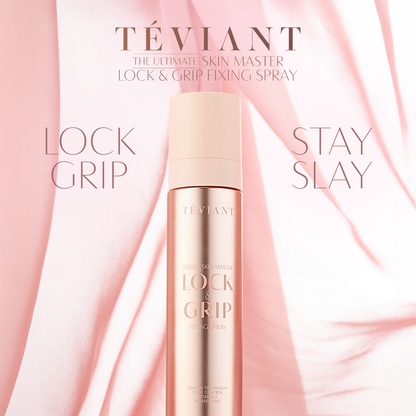
The Ultimate Skin Master Lock & Grip Fixing Spray

Highlights
Other Ingredients
Skim through
| Ingredient name | what-it-does | irr., com. | ID-Rating |
|---|---|---|---|
| Aqua | solvent | ||
| Dimethicone/Vinyl Dimethicone Crosspolymer | viscosity controlling | ||
| PVP | viscosity controlling | 0, 0 | |
| Phenoxyethanol | preservative | ||
| Silica | viscosity controlling | ||
| Allantoin | soothing | 0, 0 | goodie |
| Fragrance | perfuming | icky | |
| Butylene Glycol | moisturizer/humectant, solvent | 0, 1 | |
| Triethylene Glycol | perfuming, viscosity controlling | ||
| Isoceteth-10 | emulsifying, surfactant/cleansing | ||
| Tocopheryl Acetate | antioxidant | 0, 0 |
Teviant The Ultimate Skin Master Lock & Grip Fixing SprayIngredients explained
Good old water, aka H2O. The most common skincare ingredient of all. You can usually find it right in the very first spot of the ingredient list, meaning it’s the biggest thing out of all the stuff that makes up the product.
It’s mainly a solvent for ingredients that do not like to dissolve in oils but rather in water.
Once inside the skin, it hydrates, but not from the outside - putting pure water on the skin (hello long baths!) is drying.
One more thing: the water used in cosmetics is purified and deionized (it means that almost all of the mineral ions inside it is removed). Like this, the products can stay more stable over time.
A white, elastomeric silicone powder that gives a nice silky and powdery feel to the products. It also has some oil and sebum absorption capabilities.
These three letters stand for Poly Vinyl Pyrollidone, a big molecule created from repeated units of Vinyl Pyrrolidone, aka VP. Its main thing is being an important film former. It was the first synthetic polymer introduced as a hair fixative in the 1950s instead of insect-derived Shellac.
So PVP likes to attach itself to surfaces such as the hair and the skin and forms a nice, thin, even film there. The film is useful for holding a hairstyle or extending the wear of color cosmetics and sunscreens. The disadvantage of PVP is that the film is a bit brittle and that PVP loves water (hygroscopic) that tends to destroy the film. This is the reason why hair styled with a PVP based product loses its style in high humidity. To fix this problem, there are now several versions of VP containing film formers that are less sensitive to humidity, for example, the molecule called VP/VA Copolymer.
It’s pretty much the current IT-preservative. It’s safe and gentle, but even more importantly, it’s not a feared-by-everyone-mostly-without-scientific-reason paraben.
It’s not something new: it was introduced around 1950 and today it can be used up to 1% worldwide. It can be found in nature - in green tea - but the version used in cosmetics is synthetic.
Other than having a good safety profile and being quite gentle to the skin it has some other advantages too. It can be used in many types of formulations as it has great thermal stability (can be heated up to 85°C) and works on a wide range of pH levels (ph 3-10).
It’s often used together with ethylhexylglycerin as it nicely improves the preservative activity of phenoxyethanol.
A white powdery thing that's the major component of glass and sand. In cosmetics, it’s often in products that are supposed to keep your skin matte as it has great oil-absorbing abilities. It’s also used as a helper ingredient to thicken up products or suspend insoluble particles.
Super common soothing ingredient. It can be found naturally in the roots & leaves of the comfrey plant, but more often than not what's in the cosmetic products is produced synthetically.
It's not only soothing but it' also skin-softening and protecting and can promote wound healing.
Exactly what it sounds: nice smelling stuff put into cosmetic products so that the end product also smells nice. Fragrance in the US and parfum in the EU is a generic term on the ingredient list that is made up of 30 to 50 chemicals on average (but it can have as much as 200 components!).
If you are someone who likes to know what you put on your face then fragrance is not your best friend - there's no way to know what’s really in it.
Also, if your skin is sensitive, fragrance is again not your best friend. It’s the number one cause of contact allergy to cosmetics. It’s definitely a smart thing to avoid with sensitive skin (and fragrance of any type - natural is just as allergic as synthetic, if not worse!).
Butylene glycol, or let’s just call it BG, is a multi-tasking colorless, syrupy liquid. It’s a great pick for creating a nice feeling product.
BG’s main job is usually to be a solvent for the other ingredients. Other tasks include helping the product to absorb faster and deeper into the skin (penetration enhancer), making the product spread nicely over the skin (slip agent), and attracting water (humectant) into the skin.
It’s an ingredient whose safety hasn’t been questioned so far by anyone (at least not that we know about). BG is approved by Ecocert and is also used enthusiastically in natural products. BTW, it’s also a food additive.
 We don't have description for this ingredient yet.
We don't have description for this ingredient yet.
It’s the most commonly used version of pure vitamin E in cosmetics. You can read all about the pure form here. This one is the so-called esterified version.
According to famous dermatologist, Leslie Baumann while tocopheryl acetate is more stable and has a longer shelf life, it’s also more poorly absorbed by the skin and may not have the same awesome photoprotective effects as pure Vit E.
You may also want to take a look at...
| what‑it‑does | solvent |
| what‑it‑does | viscosity controlling |
| what‑it‑does | viscosity controlling |
| irritancy, com. | 0, 0 |
| what‑it‑does | preservative |
| what‑it‑does | viscosity controlling |
| what‑it‑does | soothing |
| irritancy, com. | 0, 0 |
| what‑it‑does | perfuming |
| what‑it‑does | moisturizer/humectant | solvent |
| irritancy, com. | 0, 1 |
| what‑it‑does | perfuming | viscosity controlling |
| what‑it‑does | emulsifying | surfactant/cleansing |
| what‑it‑does | antioxidant |
| irritancy, com. | 0, 0 |