





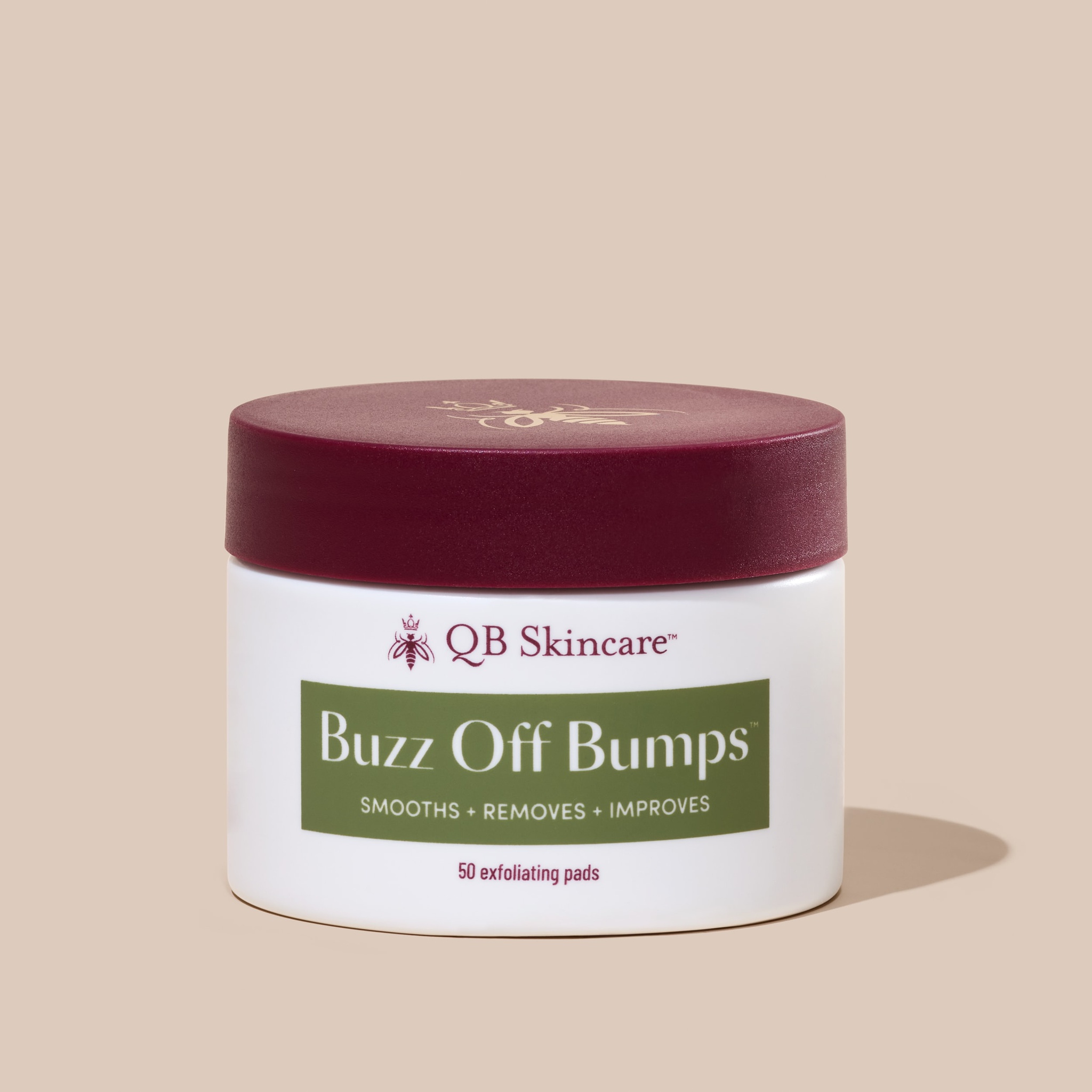
Buzz Off Bumps
Ingredients overview
Highlights
Key Ingredients
Other Ingredients
Skim through
| Ingredient name | what-it-does | irr., com. | ID-Rating |
|---|---|---|---|
| Aqua | solvent | ||
| Alcohol Denat | antimicrobial/antibacterial, solvent, viscosity controlling | icky | |
| Salicylic Acid | exfoliant, anti-acne, soothing, preservative | superstar | |
| Aloe Barbadensis Leaf Extract | soothing, emollient, moisturizer/humectant | goodie | |
| Propanediol | solvent, moisturizer/humectant | ||
| Caprylyl Glycol | moisturizer/humectant, emollient | ||
| Glycolic Acid | exfoliant, buffering | superstar | |
| Sodium Hydroxide | buffering | ||
| Caprylyl/Capryl Glucoside | surfactant/cleansing | ||
| Hamamelis Virginiana (Witch Hazel) Water | soothing | goodie | |
| Menthol | soothing | icky | |
| Eucalyptus Globulus Leaf Oil | perfuming, antimicrobial/antibacterial | icky | |
| Allantoin | soothing | 0, 0 | goodie |
| Althaea Officinalis (Mallow) Root Extract | |||
| Avena Sativa (Oat) Kernel Extract | antioxidant, soothing, emollient, abrasive/scrub | goodie | |
| Chamomilla Recutita (Matricaria) Flower Extract | soothing, antioxidant | 0, 0 | goodie |
QB Skincare Buzz Off BumpsIngredients explained
Good old water, aka H2O. The most common skincare ingredient of all. You can usually find it right in the very first spot of the ingredient list, meaning it’s the biggest thing out of all the stuff that makes up the product.
It’s mainly a solvent for ingredients that do not like to dissolve in oils but rather in water.
Once inside the skin, it hydrates, but not from the outside - putting pure water on the skin (hello long baths!) is drying.
One more thing: the water used in cosmetics is purified and deionized (it means that almost all of the mineral ions inside it is removed). Like this, the products can stay more stable over time.
- It's a super common and super debated skincare ingredient
- It has several benefits: great solvent, penetration enhancer, creates cosmetically elegant, light formulas, great astringent and antimicrobial
- It can be very drying if it's in the first few ingredients on an ingredient list
- Some experts even think that regular exposure to alcohol damages skin barrier and causes inflammation though it's a debated opinion (read more in geeky details tab)
- It's one of the gold standard ingredients for treating problem skin
- It can exfoliate skin both on the surface and in the pores
- It's a potent anti-inflammatory agent
- It's more effective for treating blackheads than acne
- For acne combine it with antibacterial agents like benzoyl peroxide or azelaic acid
The extract coming from the juice containing leaves of the Aloe vera plant. It's usually a hydroglycolic extract (though oil extract for the lipid parts also exists) that has similar moisturizing, emollient and anti-inflammatory properties as the juice itself. We have written some more about aloe here.
Propanediol is a natural alternative for the often used and often bad-mouthed propylene glycol. It's produced sustainably from corn sugar and it's Ecocert approved.
It's quite a multi-tasker: can be used to improve skin moisturization, as a solvent, to boost preservative efficacy or to influence the sensory properties of the end formula.
It’s a handy multi-tasking ingredient that gives the skin a nice, soft feel. At the same time, it also boosts the effectiveness of other preservatives, such as the nowadays super commonly used phenoxyethanol.
The blend of these two (caprylyl glycol + phenoxyethanol) is called Optiphen, which not only helps to keep your cosmetics free from nasty things for a long time but also gives a good feel to the finished product. It's a popular duo.
- It’s the most researched AHA with the most proven skin benefits
- It gently lifts off dead skin cells to reveal newer, fresher, smoother skin
- It can help skin’s own collagen production that results in firmer, younger skin
- It can fade brown spots caused by sun damage or PIH
- Choose a product where you know the concentration and pH value because these two greatly influence effectiveness
- Don’t forget to use your sunscreen (in any case but especially so next to an AHA product)
- Slight stinging or burning with a stronger AHA product is normal
- If your skin is very sensitive, rosacea prone choose rather a BHA or PHA product
The unfancy name for it is lye. It’s a solid white stuff that’s very alkaline and used in small amounts to adjust the pH of the product and make it just right.
For example, in case of AHA or BHA exfoliants, the right pH is super-duper important, and pH adjusters like sodium hydroxide are needed.
BTW, lye is not something new. It was already used by ancient Egyptians to help oil and fat magically turn into something else. Can you guess what? Yes, it’s soap. It still often shows up in the ingredient list of soaps and other cleansers.
Sodium hydroxide in itself is a potent skin irritant, but once it's reacted (as it is usually in skin care products, like exfoliants) it is totally harmless.
 We don't have description for this ingredient yet.
The distillate created from different parts of the hazelnut-bush-like magic tree, commonly called Witch Hazel. Hamamelis Virginiana Water is a bit of a sloppy ingredient name as the leaves, the twigs and the bark can be used to create extracts or distillates and the different parts contain different amounts of biologically active components. But what you are getting is probably a nice water with astringent, soothing, antioxidant and antibacterial magic properties.
We went into great detail about Witch Hazel in cosmetics here, detailing the main biologically active components and how they are different in different parts of the plant. Click here and read more >>
Menthol needs no introduction: it's the thing that causes the cooling sensation so well-known both from cosmetic products as well as a bunch of other things like chocolate, chewing gum, toothpaste or cigarette. It's a natural compound that comes from the essential oil of Mentha species (peppermint oil contains 40-50% menthol) and it gives them their typical minty smell and flavor.
As for skincare, menthol seems to be a mixed bag. Apart from the cool cooling sensation (that might last up to 70 mins!), it also has painkilling, itch reducing, antibacterial, antifungal and even penetration enhancing properties. On the other hand, it also seems to act as a skin irritant that increases trans-epidermal water loss (the water that evaporates from the outer layer of the skin) and thus contributes to drying out the skin.
The essential oil created by steam distilling the leaves of the Eucalyptus tree. It's a colorless, pale yellow oil with a camphoraceous aroma used traditionally in vapor rubs to treat coughs. Its name-giving main component is eucalyptol (also called 1,8-cineole, 80-91%) that has significant antibacterial and expectorant properties.
Among essential oils, Eucalyptus Globulus counts as rather non-sensitising with an EU sensitizer total of 5% (due to limonene). However, if your skin is super-sensitive or you are allergic to fragrances, it is still better to avoid it.
Super common soothing ingredient. It can be found naturally in the roots & leaves of the comfrey plant, but more often than not what's in the cosmetic products is produced synthetically.
It's not only soothing but it' also skin-softening and protecting and can promote wound healing.
We don't have description for this ingredient yet.
When you hear oatmeal, you probably think of breakfast, but the finely ground version of whole oat kernels, aka colloidal oatmeal, can do good things for your skin, especially if it's dry, itchy or prone to skin-rashes or eczema.
Oat is loaded with compounds good for the body, inside or outside, such as soothing agent beta-glucan (5%), lipids (3-11%) including barrier repairing omega-3 and 6 fatty acids or phenolic antioxidant and anti-inflammatory agents (avenanthramides).
The soothing, antioxidant and skin-protecting abilities of oat are so well-established that it is an active natural ingredient covered by the FDA OTC Skin Protectant monograph in the US, meaning that colloidal oatmeal can be claimed as an active ingredient on the INCI list and Aveeno is a mass-market brand built around oat-containing products.
If your skin is dry, irritated, inflamed or eczema-prone, colloidal oatmeal is something to try.
Chamomile probably needs no introduction as it's one of the most widely used medicinal herbs. You probably drink it regularly as a nice, calming cup of tea and it's also a regular on skincare ingredient lists.
Cosmetic companies use it mainly for its anti-inflammatory properties. It contains the terpenoids chamazulene and bisabolol both of which show great anti-inflammatory action in animal studies. On top of that chamomile also has some antioxidant activity (thanks to some other active ingredients called matricine, apigenin and luteolin).
Though chamomile is usually a goodie for the skin, it's also not uncommon to have an allergic reaction to it.
You may also want to take a look at...
| what‑it‑does | solvent |
| what‑it‑does | antimicrobial/antibacterial | solvent | viscosity controlling |
| what‑it‑does | exfoliant | anti-acne | soothing | preservative |
| what‑it‑does | soothing | emollient | moisturizer/humectant |
| what‑it‑does | solvent | moisturizer/humectant |
| what‑it‑does | moisturizer/humectant | emollient |
| what‑it‑does | exfoliant | buffering |
| what‑it‑does | buffering |
| what‑it‑does | surfactant/cleansing |
| what‑it‑does | soothing |
| what‑it‑does | soothing |
| what‑it‑does | perfuming | antimicrobial/antibacterial |
| what‑it‑does | soothing |
| irritancy, com. | 0, 0 |
| what‑it‑does | antioxidant | soothing | emollient | abrasive/scrub |
| what‑it‑does | soothing | antioxidant |
| irritancy, com. | 0, 0 |