





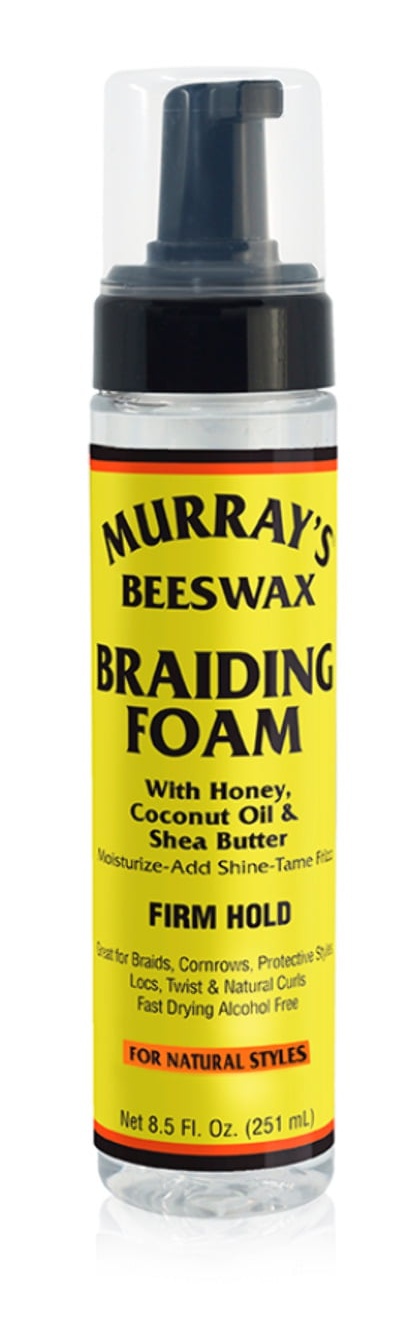
Beeswax Braiding Foam
Ingredients overview
Highlights
Skim through
| Ingredient name | what-it-does | irr., com. | ID-Rating |
|---|---|---|---|
| Water (Aqua, Eau) | solvent | ||
| Polysorbate 20 | emulsifying, surfactant/cleansing | 0, 0 | |
| Methyl Gluceth-20 | moisturizer/humectant | goodie | |
| Cocamidopropyl Betaine | surfactant/cleansing | ||
| Fragrance (Parfum) | perfuming | icky | |
| Polyquaternium-55 | |||
| Beeswax | emollient, viscosity controlling, emulsifying, perfuming | 0, 0-2 | |
| Honey (Mel) | soothing, moisturizer/humectant, antimicrobial/antibacterial | goodie | |
| Oleth-20 | surfactant/cleansing | 0, 1 | |
| Keratin Amino Acids | |||
| Panthenol | soothing, moisturizer/humectant | 0, 0 | goodie |
| Argania Spinosa Kernel Oil | antioxidant, emollient | goodie | |
| Cocos Nucifera (Coconut) Oil | emollient, perfuming | 0, 4 | goodie |
| Sesamum Indicum (Sesame) Seed Oil | emollient | 0, 1-3 | goodie |
| Hydrogenated Lecithin | emollient, emulsifying | goodie | |
| Caprylyl Glycol | moisturizer/humectant, emollient | ||
| Phenoxyethanol | preservative | ||
| Citric Acid | buffering | ||
| Hexylene Glycol | solvent, emulsifying, perfuming, surfactant/cleansing | 0-1, 0-2 | |
| Sodium Hydroxide | buffering |
Murray’s Beeswax Braiding FoamIngredients explained
Good old water, aka H2O. The most common skincare ingredient of all. You can usually find it right in the very first spot of the ingredient list, meaning it’s the biggest thing out of all the stuff that makes up the product.
It’s mainly a solvent for ingredients that do not like to dissolve in oils but rather in water.
Once inside the skin, it hydrates, but not from the outside - putting pure water on the skin (hello long baths!) is drying.
One more thing: the water used in cosmetics is purified and deionized (it means that almost all of the mineral ions inside it is removed). Like this, the products can stay more stable over time.
It's a common little helper ingredient that helps water and oil to mix together. Also, it can help to increase the solubility of some other ingredients in the formula.
A corn sugar derived, water-soluble, pale yellow syrup, that nicely moisturizes the skin. It has a light and smooth skin feel, it is non-tacky, and it can improve the after-feel of the formula. It is also mild and gentle, popular in sensitive skin formulas.
Super common ingredient in all kinds of cleansing products: face and body washes, shampoos and foam baths.
Number one reason for its popularity has to do with bubbles. Everyone loves bubbles. And cocamidopropyl betaine is great at stabilizing them.
The other reason is that it’s mild and works very well combined with other cleansing agents and surfactants. The art of cleansing is usually to balance between properly cleansing but not over-cleansing and cocamidopropyl betaine is helpful in pulling off this balance right.
Oh, and one more nice thing: even though it’s synthetic it’s highly biodegradable.
More info on CAPB on Collins Beaty Pages.
Exactly what it sounds: nice smelling stuff put into cosmetic products so that the end product also smells nice. Fragrance in the US and parfum in the EU is a generic term on the ingredient list that is made up of 30 to 50 chemicals on average (but it can have as much as 200 components!).
If you are someone who likes to know what you put on your face then fragrance is not your best friend - there's no way to know what’s really in it.
Also, if your skin is sensitive, fragrance is again not your best friend. It’s the number one cause of contact allergy to cosmetics. It’s definitely a smart thing to avoid with sensitive skin (and fragrance of any type - natural is just as allergic as synthetic, if not worse!).
 We don't have description for this ingredient yet.
It's the yellow, solid stuff that you probably know from beeswax candles. It's a natural material produced by honey bees to build their honeycomb.
As for skincare, it's used as an emollient and thickening agent. It's super common in lip balms and lipsticks.
We all know honey as the sweet, gooey stuff that is lovely to sweeten a good cup of tea and we have good news about putting honey all over our skin. It is just as lovely on the skin as it is in the tea.
The great review article about honey in the Journal of Cosmetic Dermatology writes that it is arguably the oldest skincare ingredient and evidence from around 4500 BC mentions honey in some eye cream recipes. Chemically speaking, it is a bee-derived, supersaturated sugar solution. About 95% of honey dry weight is sugar and the other 5% consists of a great number of other minor components including proteins, amino acids, vitamins, enzymes, and minerals.
This unique and complex chemical composition gives honey a bunch of nice skin care properties: it is very moisturizing, has soothing and antioxidant abilities as well as significant antibacterial and antifungal magic powers. There is also a lot of empirical evidence with emerging scientific backup that honey dressing promotes the healing of wounds and burns.
One tricky thing about honey though, is that it can have lots of different floral sources and different types of honey have a somewhat different composition and thus somewhat different properties. For example, the darker the honey the richer it is in antioxidant phenolic compounds. Two special types of honey are acacia and manuka. The former is unique and popular because of its higher than usual fructose content that makes it more water-soluble and easier to stabilize in cosmetic formulas. The latter comes from the Leptospermum Scoparium tree native to New Zeland and its special thing is its extra strong antibacterial power due to a unique component called methylglyoxal.
Overall, honey is a real skin-goodie in pretty much every shape and form, and it is a nice one to spot on the ingredient list.
We don't have description for this ingredient yet.
We don't have description for this ingredient yet.
An easy-to-formulate, commonly used, nice to have ingredient that’s also called pro-vitamin B5. As you might guess from the “pro” part, it’s a precursor to vitamin B5 (whose fancy name is pantothenic acid).
Its main job in skincare products is to moisturise the skin. It’s a humectant meaning that it can help the skin to attract water and then hold onto it. There is also research showing that panthenol can help our skin to produce more lovely lipids that are important for a strong and healthy skin barrier.
Another great thing about panthenol is that it has anti-inflammatory and skin protecting abilities. A study shows that it can reduce the irritation caused by less-nice other ingredients (e.g. fragrance, preservatives or chemical sunscreens) in the product.
Research also shows that it might be useful for wound healing as it promotes fibroblast (nice type of cells in our skin that produce skin-firming collagen) proliferation.
If that wasn’t enough panthenol is also useful in nail and hair care products. A study shows that a nail treatment liquide with 2% panthenol could effectively get into the nail and significantly increase the hydration of it.
As for the hair the hydration effect is also true there. Panthenol might make your hair softer, more elastic and helps to comb your hair more easily.
When it comes to cosmetic oils and hype, argan oil is for sure leading the way. Dubbed as the "liquid gold of Morocco", we have to admit we have some trouble determining why this oil enjoys such a special miracle status. Not that it's not good, it is good, even great but reading the research about argan and a bunch of other plant oils we just do not see the big, unique differentiating factor (though that might be our fault not reading enough, obvs.)
So, argan oil comes from the kernel of the argan fruit that comes from the argan tree that grows only in Morocco. The tree is slow growing and getting the oil is a hard job. The traditional process is that the ripe argan fruits fall from the tree, then goats eat them up and poop out the seeds. The seeds are collected and smashed with a stone to get the kernels inside. This part is the hard one as the seeds have extremely hard shells. Once the kernels are obtained, the oil is pressed out from them (the kernels contain about 50% oil).
As for skincare, argan oil is loaded with lots of skin goodies (but so are many other plant oils): it contains 80% nourishing and moisturizing unsaturated fatty acids, mainly oleic (38-50%), linoleic (28-38%) and palmitic (10-18%). It also contains a relatively large amount of antioxidant vitamin E (600-900 mg/kg, about twice as much as olive), small amounts of antioxidant phenols (including caffeic acid, ferulic acid, and epicatechin), as well as some rare sterols with soothing and anti-inflammatory properties.
Thanks to all the above goodness in argan oil, it can greatly nourish and moisturize the skin and hair. It's also claimed to be able to neutralize collagen-damaging free radicals, help reduce scars, and revitalize and improve skin elasticity. You can even read that argan might help acne-prone skin, but being a high oleic oil, we would be careful with that.
All in all, argan oil is a real goodie but we do not fully understand the special miracle status it enjoys.
There is definitely some craze going on for coconut oil both in the healthy eating space (often claimed to be the healthiest oil to cook with but this is a topic for another site) and in the skin and hair care space.
We will talk here about the latter two and see why we might want to smear it all over ourselves. Chemically speaking, coconut oil has a unique fatty acid profile. Unlike many plant oils that mostly contain unsaturated fatty acids (fatty acids with double bonds and kinky structure such as linoleic or oleic), coconut oil is mostly saturated (fatty acids with single bonds only) and its most important fatty acid is Lauric Acid (about 50%). Saturated fatty acids have a linear structure that can stack nice and tight and hence they are normally solid at room temperature. Coconut oil melts around 25 °C so it is solid in the tub but melts on contact with the skin.
The saturated nature of coconut oil also means that it is a heavy-duty-oil ideal for dry skin types. A double-blind research confirmed that extra virgin coconut oil is as effective in treating xerosis (aka very dry skin) as mineral oil. Another study found that coconut oil is more effective than mineral oil in treating mild to moderate atopic dermatitis (aka eczema) in children.
So when it comes to dry skin, coconut oil is a goodie, no question there. The question is if it is good or bad for acne-prone skin. Its main fatty acid, Lauric Acid has some research showing that it is a promising ingredient against evil acne-causing bacteria, P. acnes but at the same time, both Lauric Acid and coconut oil have a very high comedogenic rating (4 out of 5). Though comedogenic ratings are not very reliable, anecdotal evidence (i.e. people commenting in forums) shows that people have mixed experiences. While some claim that it worked wonders on their acne others say that it gave them serious blackheads and zits. Try it at your own risk.
As for hair care, coconut oil has pretty solid research showing that it can penetrate into the hair very well (better than mineral oil and sunflower oil) and it can prevent hair protein loss as well as combing damage. If you have problems with damaged hair, split ends, coconut oil is worth trying as a pre- or/and post-wash treatment. Labmuffin has an awesome blogpost explaining in more detail why coconut oil is good for your hair.
A couple of other things worth mentioning: coconut oil might help with wound healing (promising animal study), it has some antifungal activity (against dermatophytes that cause the thing known as ringworm) and it also works as an insect repellent against black flies.
Overall, coconut oil is definitely a goodie for the hair and dry skin. If that warrants for the magic oil status it enjoys, we don't know.
A goldish to dark yellow emollient plant oil coming from Sesame seeds. Similar to many other plant oils, it contains high amounts of nourishing and moisturizing fatty acids (about 38% of oleic and 48% of linoleic acid) and is a nice oil to repair and regenerate dry skin. It is rapidly absorbed and gives the skin a soft and gentle feel.
It's the chemically chopped up version of normal lecithin. Most often it's used to create liposomes and to coat and stabilize other ingredients.
It’s a handy multi-tasking ingredient that gives the skin a nice, soft feel. At the same time, it also boosts the effectiveness of other preservatives, such as the nowadays super commonly used phenoxyethanol.
The blend of these two (caprylyl glycol + phenoxyethanol) is called Optiphen, which not only helps to keep your cosmetics free from nasty things for a long time but also gives a good feel to the finished product. It's a popular duo.
It’s pretty much the current IT-preservative. It’s safe and gentle, but even more importantly, it’s not a feared-by-everyone-mostly-without-scientific-reason paraben.
It’s not something new: it was introduced around 1950 and today it can be used up to 1% worldwide. It can be found in nature - in green tea - but the version used in cosmetics is synthetic.
Other than having a good safety profile and being quite gentle to the skin it has some other advantages too. It can be used in many types of formulations as it has great thermal stability (can be heated up to 85°C) and works on a wide range of pH levels (ph 3-10).
It’s often used together with ethylhexylglycerin as it nicely improves the preservative activity of phenoxyethanol.
Citric acid comes from citrus fruits and is an AHA. If these magic three letters don’t tell you anything, click here and read our detailed description on glycolic acid, the most famous AHA.
So citric acid is an exfoliant, that can - just like other AHAs - gently lift off the dead skin cells of your skin and make it more smooth and fresh.
There is also some research showing that citric acid with regular use (think three months and 20% concentration) can help sun-damaged skin, increase skin thickness and some nice hydrating things called glycosaminoglycans in the skin.
But according to a comparative study done in 1995, citric acid has less skin improving magic properties than glycolic or lactic acid. Probably that’s why citric acid is usually not used as an exfoliant but more as a helper ingredient in small amounts to adjust the pH of a formulation.
Similar to other glycols, it's a helper ingredient used as a solvent, or to thin out thick formulas and make them more nicely spreadable.
Hexylene Glycol is also part a preservative blend named Lexgard® HPO, where it helps the effectiveness of current IT-preservative, phenoxyethanol.
The unfancy name for it is lye. It’s a solid white stuff that’s very alkaline and used in small amounts to adjust the pH of the product and make it just right.
For example, in case of AHA or BHA exfoliants, the right pH is super-duper important, and pH adjusters like sodium hydroxide are needed.
BTW, lye is not something new. It was already used by ancient Egyptians to help oil and fat magically turn into something else. Can you guess what? Yes, it’s soap. It still often shows up in the ingredient list of soaps and other cleansers.
Sodium hydroxide in itself is a potent skin irritant, but once it's reacted (as it is usually in skin care products, like exfoliants) it is totally harmless.
You may also want to take a look at...
| what‑it‑does | solvent |
| what‑it‑does | emulsifying | surfactant/cleansing |
| irritancy, com. | 0, 0 |
| what‑it‑does | moisturizer/humectant |
| what‑it‑does | surfactant/cleansing |
| what‑it‑does | perfuming |
| what‑it‑does | emollient | viscosity controlling | emulsifying | perfuming |
| irritancy, com. | 0, 0-2 |
| what‑it‑does | soothing | moisturizer/humectant | antimicrobial/antibacterial |
| what‑it‑does | surfactant/cleansing |
| irritancy, com. | 0, 1 |
| what‑it‑does | soothing | moisturizer/humectant |
| irritancy, com. | 0, 0 |
| what‑it‑does | antioxidant | emollient |
| what‑it‑does | emollient | perfuming |
| irritancy, com. | 0, 4 |
| what‑it‑does | emollient |
| irritancy, com. | 0, 1-3 |
| what‑it‑does | emollient | emulsifying |
| what‑it‑does | moisturizer/humectant | emollient |
| what‑it‑does | preservative |
| what‑it‑does | buffering |
| what‑it‑does | solvent | emulsifying | perfuming | surfactant/cleansing |
| irritancy, com. | 0-1, 0-2 |
| what‑it‑does | buffering |