





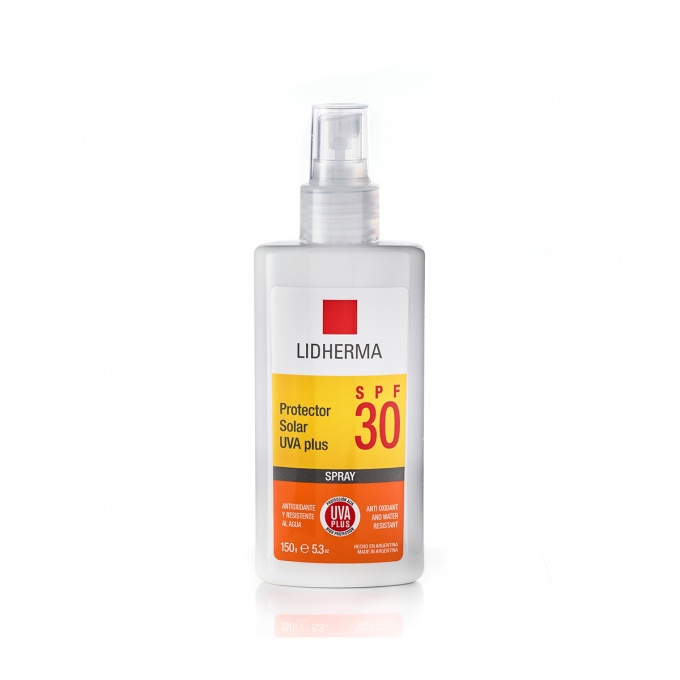
Ingredients overview
 INCI photo pending approval
Highlights
Key Ingredients
Skim through
Lidherma Protector Solar UVA PlusIngredients explained
Good old water, aka H2O. The most common skincare ingredient of all. You can usually find it right in the very first spot of the ingredient list, meaning it’s the biggest thing out of all the stuff that makes up the product.
It’s mainly a solvent for ingredients that do not like to dissolve in oils but rather in water.
Once inside the skin, it hydrates, but not from the outside - putting pure water on the skin (hello long baths!) is drying.
One more thing: the water used in cosmetics is purified and deionized (it means that almost all of the mineral ions inside it is removed). Like this, the products can stay more stable over time.
A clear, oil-soluble, "cosmetically-elegant" liquid that is the most commonly used chemical sunscreen. It absorbs UVB radiation (at wavelengths: 280-320 nm) with a peak protection at 310nm.
It only protects against UVB and not UVA rays (the 320-400 nm range) – so always choose products that contain other sunscreens too. It is not very stable either, when exposed to sunlight, it kind of breaks down and loses its effectiveness (not instantly, but over time - it loses 10% of its SPF protection ability within 35 mins). To make it more stable it can be - and should be - combined with other sunscreen agents to give stable and broad-spectrum protection (the new generation sunscreen agent, Tinosorb S is a particularly good one for that).
Regarding safety, there are also some concerns around Octinoxate. In vitro (made in the lab not on real people) and animal studies have shown that it may produce hormonal (estrogen-like) effects. Do not panic, the studies were not conducted under real life conditions on real human people, so it is probably over-cautious to avoid Octinoxate altogether. However, if you are pregnant or a small child (under 2 yrs. old), choose a physical (zinc oxide/titanium dioxide) or new-generation Tinosorb based sunscreen, just to be on the super-safe side. :)
Overall, Ethylhexyl Methoxycinnamate is an old-school chemical sunscreen agent. There are plenty of better options for sun protection today, but it is considered "safe as used" (and sunscreens are pretty well regulated) and it is available worldwide (can be used up to 10% in the EU and up to 7.5% in the US).
Diethylamino Hydroxybenzoyl Hexyl Benzoate is a new generation, chemical sunscreen agent (not available in the US due to impossible FDA regulations) that's designed for high UVA protection and high photostability. It gives sun protection in the whole UVA range (320-400 nm) with peak protection at 354nm. It can be used up to 10% worldwide except for the US and Canada.
Ethylhexyl Triazone is a new generation, chemical sunscreen (not available in the US due to impossible FDA regulations) that gives the highest photo-stable absorption of all available UVB filters today. It protects in the UVB range (280-320nm) with a peak protection of 314nm. It is an oil soluble, odorless, colorless powder that works well in fragrance-free formulas. It can be used up to 5% worldwide except for the US and Canada.
- A natural moisturizer that’s also in our skin
- A super common, safe, effective and cheap molecule used for more than 50 years
- Not only a simple moisturizer but knows much more: keeps the skin lipids between our skin cells in a healthy (liquid crystal) state, protects against irritation, helps to restore barrier
- Effective from as low as 3% with even more benefits for dry skin at higher concentrations up to 20-40%
- High-glycerin moisturizers are awesome for treating severely dry skin
An often used emollient with a light and silky feel. It's very mild to both skin and eyes and spreads nicely and easily. It's often used in sunscreens as it's also an excellent solvent for sunscreen agents.
 We don't have description for this ingredient yet.
We don't have description for this ingredient yet.
A super common emollient that makes your skin feel nice and smooth. It comes from coconut oil and glycerin, it’s light-textured, clear, odorless and non-greasy. It’s a nice ingredient that just feels good on the skin, is super well tolerated by every skin type and easy to formulate with. No wonder it’s popular.
A white to beige powder that is described as the golden standard emulsifier for emulsions (oil+water mixtures) that are difficult to stabilize. It is especially popular in sunscreens as it can boost SPF protection and increase the water-resistance of the formula.
It’s pretty much the current IT-preservative. It’s safe and gentle, but even more importantly, it’s not a feared-by-everyone-mostly-without-scientific-reason paraben.
It’s not something new: it was introduced around 1950 and today it can be used up to 1% worldwide. It can be found in nature - in green tea - but the version used in cosmetics is synthetic.
Other than having a good safety profile and being quite gentle to the skin it has some other advantages too. It can be used in many types of formulations as it has great thermal stability (can be heated up to 85°C) and works on a wide range of pH levels (ph 3-10).
It’s often used together with ethylhexylglycerin as it nicely improves the preservative activity of phenoxyethanol.
If you have spotted ethylhexylglycerin on the ingredient list, most probably you will see there also the current IT-preservative, phenoxyethanol. They are good friends because ethylhexylglycerin can boost the effectiveness of phenoxyethanol (and other preservatives) and as an added bonus it feels nice on the skin too.
Also, it's an effective deodorant and a medium spreading emollient.
A super common, waxy, white, solid stuff that helps water and oil to mix together, gives body to creams and leaves the skin feeling soft and smooth.
Chemically speaking, it is the attachment of a glycerin molecule to the fatty acid called stearic acid. It can be produced from most vegetable oils (in oils three fatty acid molecules are attached to glycerin instead of just one like here) in a pretty simple, "green" process that is similar to soap making. It's readily biodegradable.
It also occurs naturally in our body and is used as a food additive. As cosmetic chemist Colins writes it, "its safety really is beyond any doubt".
Exactly what it sounds: nice smelling stuff put into cosmetic products so that the end product also smells nice. Fragrance in the US and parfum in the EU is a generic term on the ingredient list that is made up of 30 to 50 chemicals on average (but it can have as much as 200 components!).
If you are someone who likes to know what you put on your face then fragrance is not your best friend - there's no way to know what’s really in it.
Also, if your skin is sensitive, fragrance is again not your best friend. It’s the number one cause of contact allergy to cosmetics. It’s definitely a smart thing to avoid with sensitive skin (and fragrance of any type - natural is just as allergic as synthetic, if not worse!).
A common fragrance ingredient that smells like jasmine. It is one of the “EU 26 fragrances” that has to be labelled separately because of allergen potential. Best to avoid if your skin is sensitive.
A common fragrance ingredient that has a nice floral scent and also goes by the name Lilial. It is a known fragrance allergen and as of 1st of March 2022, it has been banned in the EU due to animal studies showing a possible link to infertility (in rats - so no need to panic even if you used a product before with Butylphenyl Methylpropional).
Linalool is a super common fragrance ingredient. It’s kind of everywhere - both in plants and in cosmetic products. It’s part of 200 natural oils including lavender, ylang-ylang, bergamot, jasmine, geranium and it can be found in 90-95% of prestige perfumes on the market.
The problem with linalool is, that just like limonene it oxidises on air exposure and becomes allergenic. That’s why a product containing linalool that has been opened for several months is more likely to be allergenic than a fresh one.
A study made in the UK with 483 people tested the allergic reaction to 3% oxidised linalool and 2.3% had positive test results.
A white waxy solid that helps water and oil to mix nicely together (emulsifier). It is derived from the fatty alcohol lauryl alcohol by ethoxylating it and thus making the molecule a lot more water-soluble. In fact, Laureth-23 is mostly water-soluble acting as a solubilizer for dissolving small amounts of oily things into water-based formulas.
A clear, colorless, low viscosity, volatile (does not absorb into the skin but rather evaporates from it) silicone fluid that has excellent spreadability and leaves a light, silky and smooth feel on the skin.
According to manufacturer info, its big advantage is that it's compatible both with other silicones and with natural plant oils, so it's a great ingredient to formulate products with good-sounding, consumer-pleasing vegetable oils but still maintain a cosmetically elegant, non-greasy and non-tacky feel.
It’s a little helper ingredient that helps to set the pH of a cosmetic formulation to be just right. It’s very alkaline (you know the opposite of being very acidic): a 1% solution has a pH of around 10.
It does not have the very best safety reputation but in general, you do not have to worry about it.
What is true is that if a product contains so-called N-nitrogenating agents (e.g.: preservatives like 2-Bromo-2-Nitropropane-1,3-Diol, 5-Bromo-5-Nitro- 1,3-Dioxane or sodium nitrate - so look out for things with nitro, nitra in the name) that together with TEA can form some not nice carcinogenic stuff (that is called nitrosamines). But with proper formulation that does not happen, TEA in itself is not a bad guy.
But let’s assume a bad combination of ingredients were used and the nitrosamines formed. :( Even in that case you are probably fine because as far as we know it cannot penetrate the skin.
But to be on the safe side, if you see Triethanolamine in an INCI and also something with nitra, nitro in the name of it just skip the product, that cannot hurt.
When it comes to cosmetic oils and hype, argan oil is for sure leading the way. Dubbed as the "liquid gold of Morocco", we have to admit we have some trouble determining why this oil enjoys such a special miracle status. Not that it's not good, it is good, even great but reading the research about argan and a bunch of other plant oils we just do not see the big, unique differentiating factor (though that might be our fault not reading enough, obvs.)
So, argan oil comes from the kernel of the argan fruit that comes from the argan tree that grows only in Morocco. The tree is slow growing and getting the oil is a hard job. The traditional process is that the ripe argan fruits fall from the tree, then goats eat them up and poop out the seeds. The seeds are collected and smashed with a stone to get the kernels inside. This part is the hard one as the seeds have extremely hard shells. Once the kernels are obtained, the oil is pressed out from them (the kernels contain about 50% oil).
As for skincare, argan oil is loaded with lots of skin goodies (but so are many other plant oils): it contains 80% nourishing and moisturizing unsaturated fatty acids, mainly oleic (38-50%), linoleic (28-38%) and palmitic (10-18%). It also contains a relatively large amount of antioxidant vitamin E (600-900 mg/kg, about twice as much as olive), small amounts of antioxidant phenols (including caffeic acid, ferulic acid, and epicatechin), as well as some rare sterols with soothing and anti-inflammatory properties.
Thanks to all the above goodness in argan oil, it can greatly nourish and moisturize the skin and hair. It's also claimed to be able to neutralize collagen-damaging free radicals, help reduce scars, and revitalize and improve skin elasticity. You can even read that argan might help acne-prone skin, but being a high oleic oil, we would be careful with that.
All in all, argan oil is a real goodie but we do not fully understand the special miracle status it enjoys.
You may also want to take a look at...
| what‑it‑does | solvent |
| what‑it‑does | sunscreen |
| irritancy, com. | 0, 0 |
| what‑it‑does | sunscreen |
| what‑it‑does | sunscreen |
| what‑it‑does | skin-identical ingredient | moisturizer/humectant |
| irritancy, com. | 0, 0 |
| what‑it‑does | emollient | antimicrobial/antibacterial |
| what‑it‑does | viscosity controlling |
| what‑it‑does | emollient |
| irritancy, com. | 3, 0 |
| what‑it‑does | emollient |
| what‑it‑does | emulsifying | surfactant/cleansing |
| what‑it‑does | preservative |
| what‑it‑does | preservative |
| what‑it‑does | emollient | emulsifying |
| irritancy, com. | 0, 1 |
| what‑it‑does | perfuming |
| what‑it‑does | perfuming |
| what‑it‑does | perfuming |
| what‑it‑does | perfuming |
| what‑it‑does | perfuming |
| what‑it‑does | emulsifying | surfactant/cleansing |
| irritancy, com. | 0, 3 |
| what‑it‑does | emollient |
| what‑it‑does | buffering |
| irritancy, com. | 0, 2 |
| what‑it‑does | antioxidant | emollient |