





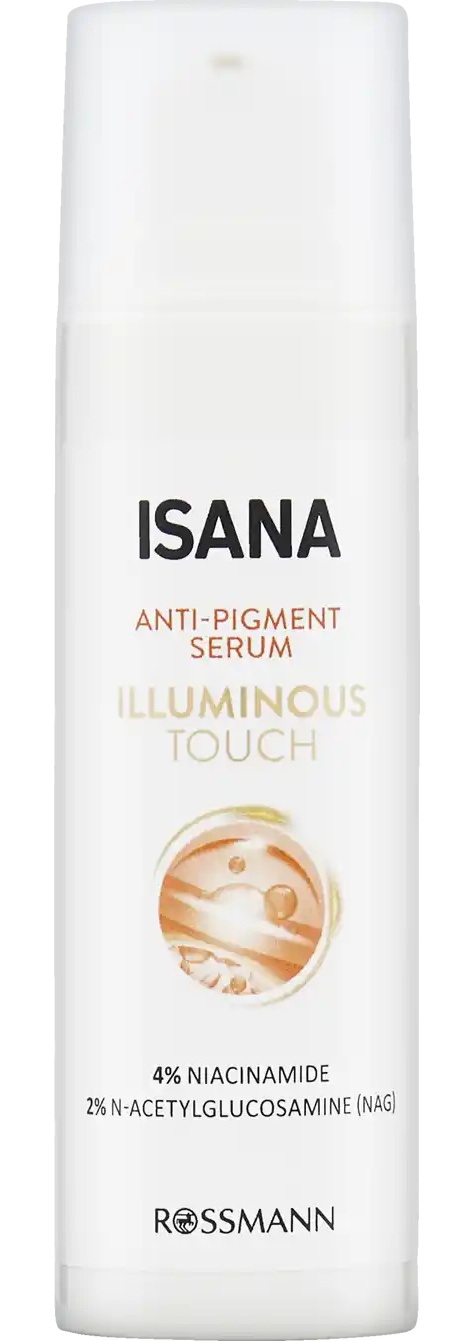
Illuminous Touch Anti-Pigment Serum
Ingredients overview
Highlights
Key Ingredients
Other Ingredients
Skim through
Isana Illuminous Touch Anti-Pigment SerumIngredients explained
Good old water, aka H2O. The most common skincare ingredient of all. You can usually find it right in the very first spot of the ingredient list, meaning it’s the biggest thing out of all the stuff that makes up the product.
It’s mainly a solvent for ingredients that do not like to dissolve in oils but rather in water.
Once inside the skin, it hydrates, but not from the outside - putting pure water on the skin (hello long baths!) is drying.
One more thing: the water used in cosmetics is purified and deionized (it means that almost all of the mineral ions inside it is removed). Like this, the products can stay more stable over time.
- A natural moisturizer that’s also in our skin
- A super common, safe, effective and cheap molecule used for more than 50 years
- Not only a simple moisturizer but knows much more: keeps the skin lipids between our skin cells in a healthy (liquid crystal) state, protects against irritation, helps to restore barrier
- Effective from as low as 3% with even more benefits for dry skin at higher concentrations up to 20-40%
- High-glycerin moisturizers are awesome for treating severely dry skin
- A multi-functional skincare superstar with several proven benefits for the skin
- Great anti-aging, wrinkle smoothing ingredient used at 4-5% concentration
- Fades brown spots alone or in combination with amino sugar, acetyl glucosamine
- Increases ceramide synthesis that results in a stronger, healthier skin barrier and better skin hydration
- Can help to improve several skin conditions including acne, rosacea, and atopic dermatitis
The emollient plant oil that comes from almonds. Similar to other plant oils, it is loaded with skin-nourishing fatty acids (oleic acid - 55-86% and linoleic acid 7-35%) and contains several other skin goodies such as antioxidant vitamin E and vitamin B versions.
It's a nice, basic oil that is often used due to its great smoothing, softening and moisturizing properties. It's also particularly good at treating dry brittle nails (source).
An amino acid sugar that can be found in the skin and does there good and important things. One of them is that it's a precursor for the biosynthesis of superstar moisturizer, hyaluronic acid. So acetyl glucosamine itself is also an important skin-identical ingredient and natural moisturizing factor.
But that is not all, acetyl glucosamine has two other great properties proved by double-blind clinical trials. First, it's a promising ingredient against wrinkles: 2% can improve wrinkles, particularly in the eye area.
Second, the same amount can also fade - always stubborn - brown spots. (Do not expect magic, though - the photos from the study show the difference after 8 weeks of daily use. The difference is visible, but not that big. It's always good to have realistic expectations. :)) Combined with skincare superstar niacinamide the duo is synergistic and is more effective at improving hyperpigmentation, so if you are after the skin-lightening benefit look out for products that contain both.
A nice-feeling, light emollient that makes the skin soft and smooth. It gives a fresh and gliding sensation with a powdery or soft after-feel depending on the exact grade used. It is a popular alternative to replace silicones.
Chemically speaking, it is an alkane (stable, non-reacting hydrocarbon) that used to be produced from petrochemicals, but today's versions are typically vegetable based. It is readily biodegradable.
A 100% vegetable origin emulsifier that usually comes to the formula with its buddy called C12-20 Alkyl Glucoside. The duo is trade-named Montanov L and works as an effective oil in water emulsifier. It creates ultra-soft, light texture, has excellent dermo-compatibility and is readily biodegradable.
Chemically speaking, it is a mixture of fatty alcohols with 14 to 22 carbon atoms in their fatty chains.
A so-called fatty (the good, non-drying kind of) alcohol that does all kinds of things in a skincare product: it makes your skin feel smooth and nice (emollient), helps to thicken up products and also helps water and oil to blend (emulsifier). Can be derived from coconut or palm kernel oil.
A vegetable origin (coconut/palm kernel oil, glucose) cleansing agent that gives moderate to high stable foam. It's also biodegradable and mild to the skin.
A molecule that is naturally present in the bran of rye and other cereals. It has been used for a long time in the food industry as an "anti-browning agent" for fresh-cut fruits or shrimps.
It turns out that Hexylresorcinol works as an "anti-browning agent" also in cosmetic products. It is a pretty well-researched molecule with significant tyrosinase (the famous enzyme needed to produce melanin) inhibiting abilities. The clinical study of the manufacturer showed that 0.5% Hexylresorcinol has a comparable skin-lightening effect to gold-standard, 2% Hydroquinone.
Even better, a 12-weeks, double-blind, placebo-controlled study with 65 volunteers confirmed the effectiveness of our skin-lightening molecule and it measured an average of 88% skin-lightening improvement. The study also included before and after photos (always a good sign!) and the skin-lightening was indeed visible and significant (though the pigmentation spots did not completely disappear, just so you have realistic expectations).
Our molecule is also a good team player and seems to work in synergy with skincare-do-it-all Niacinamide. A 2022 study compared 3% Niacinamide on its own and a combination of 0.4% Hexylresorcinol + 3% Niacinamide and found that the combo delivered superior skin tone and anti-ageing benefits significantly better than Niacinamide alone.
A white to beige powder that is described as the golden standard emulsifier for emulsions (oil+water mixtures) that are difficult to stabilize. It is especially popular in sunscreens as it can boost SPF protection and increase the water-resistance of the formula.
A 100% vegetable origin emulsifier that usually comes to the formula with its buddy called C14-22 Alcohols. The duo is called Montanov L and two together help to create ultra-soft light formulas.
Exactly what it sounds: nice smelling stuff put into cosmetic products so that the end product also smells nice. Fragrance in the US and parfum in the EU is a generic term on the ingredient list that is made up of 30 to 50 chemicals on average (but it can have as much as 200 components!).
If you are someone who likes to know what you put on your face then fragrance is not your best friend - there's no way to know what’s really in it.
Also, if your skin is sensitive, fragrance is again not your best friend. It’s the number one cause of contact allergy to cosmetics. It’s definitely a smart thing to avoid with sensitive skin (and fragrance of any type - natural is just as allergic as synthetic, if not worse!).
 We don't have description for this ingredient yet.
It’s the most commonly used version of pure vitamin E in cosmetics. You can read all about the pure form here. This one is the so-called esterified version.
According to famous dermatologist, Leslie Baumann while tocopheryl acetate is more stable and has a longer shelf life, it’s also more poorly absorbed by the skin and may not have the same awesome photoprotective effects as pure Vit E.
We don't have description for this ingredient yet.
We don't have description for this ingredient yet.
A natural polymer (big molecules from repeated subunits) that is harvested from the Acacia tree in the sub-Saharan region in Africa. It's a great thickening and binding agent. Often coupled with xanthan gum, as it helps to reduce its unpleasant stickiness.
It's one of the most commonly used thickeners and emulsion stabilizers. If the product is too runny, a little xanthan gum will make it more gel-like. Used alone, it can make the formula sticky and it is a good team player so it is usually combined with other thickeners and so-called rheology modifiers (helper ingredients that adjust the flow and thus the feel of the formula). The typical use level of Xantha Gum is below 1%, it is usually in the 0.1-0.5% range.
Btw, Xanthan gum is all natural, a chain of sugar molecules (polysaccharide) produced from individual sugar molecules (glucose and sucrose) via fermentation. It’s approved by Ecocert and also used in the food industry (E415).
You may also want to take a look at...
| what‑it‑does | solvent |
| what‑it‑does | skin-identical ingredient | moisturizer/humectant |
| irritancy, com. | 0, 0 |
| what‑it‑does | cell-communicating ingredient | skin brightening | anti-acne | moisturizer/humectant |
| what‑it‑does | emollient |
| irritancy, com. | 0, 1-3 |
| what‑it‑does | skin-identical ingredient | skin brightening |
| what‑it‑does | emollient |
| what‑it‑does | emollient | viscosity controlling |
| irritancy, com. | 2, 2 |
| what‑it‑does | surfactant/cleansing |
| what‑it‑does | perfuming |
| what‑it‑does | skin brightening | antimicrobial/antibacterial |
| what‑it‑does | emulsifying | surfactant/cleansing |
| what‑it‑does | emulsifying | surfactant/cleansing |
| what‑it‑does | perfuming |
| what‑it‑does | antimicrobial/antibacterial |
| what‑it‑does | antioxidant |
| irritancy, com. | 0, 0 |
| what‑it‑does | emollient | emulsifying | surfactant/cleansing | viscosity controlling |
| what‑it‑does | viscosity controlling |