





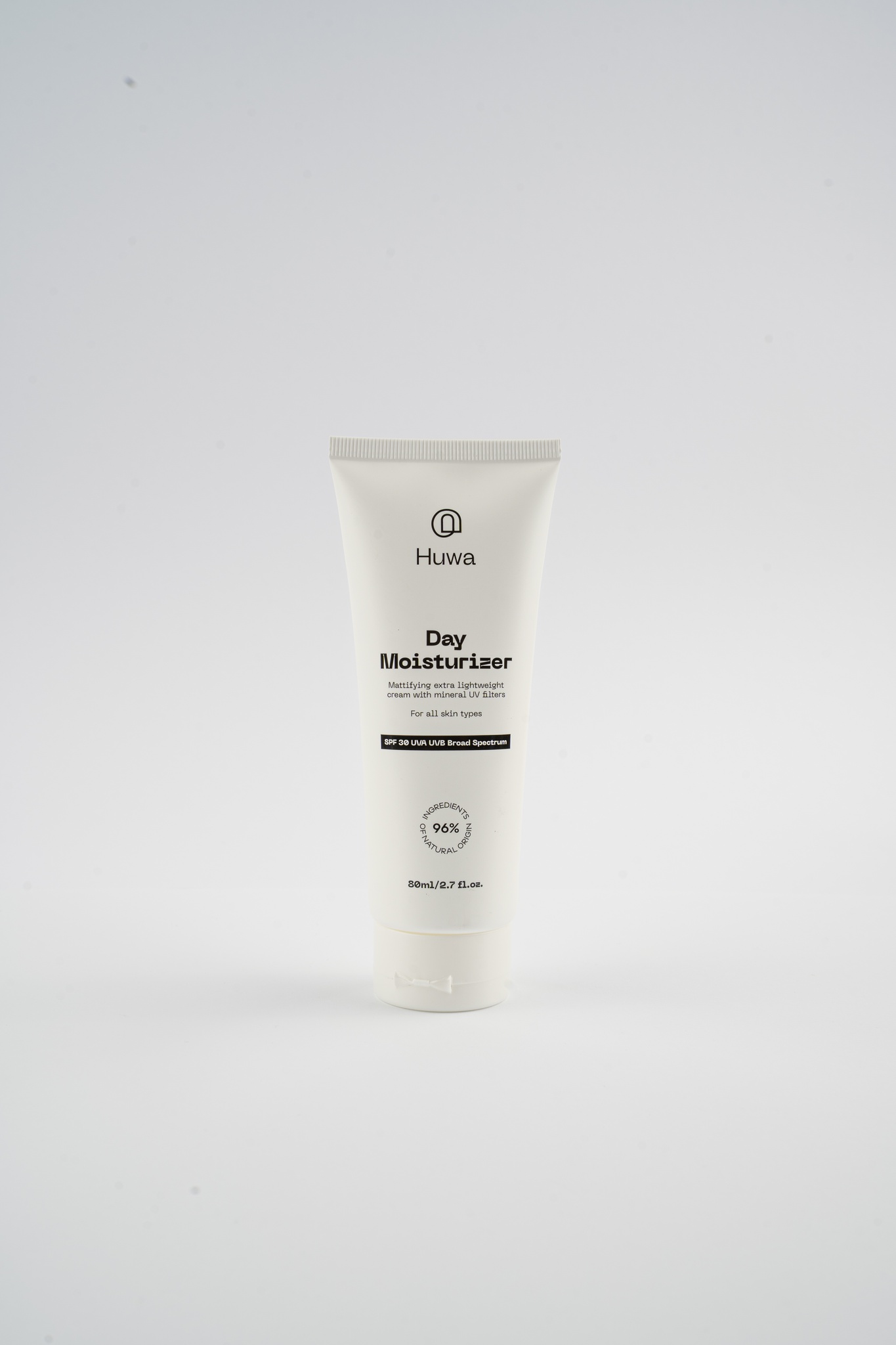
Huwa Day Moisturizer with SPF 30
Ingredients overview
Highlights
Key Ingredients
Skim through
| Ingredient name | what-it-does | irr., com. | ID-Rating |
|---|---|---|---|
| Aloe Barbadensis Leaf Extract | soothing, emollient, moisturizer/humectant | goodie | |
| Aqua | solvent | ||
| Zinc Oxide | sunscreen | 0, 1 | goodie |
| Glycerin | skin-identical ingredient, moisturizer/humectant | 0, 0 | superstar |
| Caprylic/Capric Triglyceride | emollient | ||
| Polyglyceryl-10 Myristate | |||
| Polyglyceryl-10 Stearate | emulsifying | ||
| Helianthus Annuus (Sunflower) Seed Oil | emollient | 0, 0 | goodie |
| Citric Acid | buffering | ||
| Silica | viscosity controlling | ||
| 2,3-Butanediol | moisturizer/humectant, solvent | ||
| Glyceryl Isostearate | emollient, emulsifying | ||
| Tocopherol | antioxidant | 0-3, 0-3 | goodie |
| Polyhydroxystearic Acid | emulsifying | ||
| Xanthan Gum | viscosity controlling | ||
| Sodium Hydroxide | buffering | ||
| Salicylic Acid | exfoliant, anti-acne, soothing, preservative | superstar | |
| Arginine | skin-identical ingredient | goodie |
Huwa Skincare Huwa Day Moisturizer with SPF 30Ingredients explained
The extract coming from the juice containing leaves of the Aloe vera plant. It's usually a hydroglycolic extract (though oil extract for the lipid parts also exists) that has similar moisturizing, emollient and anti-inflammatory properties as the juice itself. We have written some more about aloe here.
Good old water, aka H2O. The most common skincare ingredient of all. You can usually find it right in the very first spot of the ingredient list, meaning it’s the biggest thing out of all the stuff that makes up the product.
It’s mainly a solvent for ingredients that do not like to dissolve in oils but rather in water.
Once inside the skin, it hydrates, but not from the outside - putting pure water on the skin (hello long baths!) is drying.
One more thing: the water used in cosmetics is purified and deionized (it means that almost all of the mineral ions inside it is removed). Like this, the products can stay more stable over time.
When it comes to sunscreen agents, Zinc Oxide is pretty much in a league of its own. It's a physical (or inorganic) sunscreen that has a lot in common with fellow inorganic sunscreen Titanium Dioxide (TiO2) but a couple of things make it superior even to TiO2.
If physical sunscreens don't tell you anything, go ahead and read about the basics here. Most of what we wrote about Titanium Dioxide is also true for Zinc Oxide so we will focus here on the differences.
The first main difference is that while TiO2 gives a nice broad spectrum protection, Zinc Oxide has an even nicer and even broader spectrum protection. It protects against UVB, UVA II, and UVA I almost uniformly, and is considered to be the broadest range sunscreen available today.
It's also highly stable and non-irritating. So much so that Zinc Oxide also counts as a skin protectant and anti-irritant. It's also often used to treat skin irritations such as diaper rash.
As for the disadvantages, Zinc Oxide is also not cosmetically elegant. It leaves a disturbing whitish tint on the skin, although, according to a 2000 research paper by Dr. Pinnell, it's slightly less white than TiO2. Still, it's white and disturbing enough to use Zinc Oxide nanoparticles more and more often.
We wrote more about nanoparticles and the concerns around them here, but the gist is that if nanoparticles were absorbed into the skin that would be a reason for legitimate health concerns. But luckily, so far research shows that sunscreen nanoparticles are not absorbed but remain on the surface of the skin or in the uppermost (dead) layer of the skin. This seems to be true even if the skin is damaged, for example, sunburnt.
All in all, if you've found a Zinc Oxide sunscreen that you are happy to use every single day, that's fantastic and we suggest you stick with it. It's definitely one of the best, or probably even the best option out there for sun protection available worldwide.
- A natural moisturizer that’s also in our skin
- A super common, safe, effective and cheap molecule used for more than 50 years
- Not only a simple moisturizer but knows much more: keeps the skin lipids between our skin cells in a healthy (liquid crystal) state, protects against irritation, helps to restore barrier
- Effective from as low as 3% with even more benefits for dry skin at higher concentrations up to 20-40%
- High-glycerin moisturizers are awesome for treating severely dry skin
A super common emollient that makes your skin feel nice and smooth. It comes from coconut oil and glycerin, it’s light-textured, clear, odorless and non-greasy. It’s a nice ingredient that just feels good on the skin, is super well tolerated by every skin type and easy to formulate with. No wonder it’s popular.
 We don't have description for this ingredient yet.
A vegetable-based, PEG-free ingredient whose job is to help water and oil to mix nicely together (emulsifier). It is created by attaching ten water-loving glycerin molecules with the oil-loving fatty acid, stearic acid. The result is a partly water- and partly oil-loving molecule that creates stable and smooth emulsions that are also cosmetically elegant. It also has some moisturizing and softening benefits for skin and hair.
Sunflower does not need a big intro as you probably use it in the kitchen as cooking oil, or you munch on the seeds as a healthy snack or you adore its big, beautiful yellow flower during the summer - or you do all of these and probably even more. And by even more we mean putting it all over your face as sunflower oil is one of the most commonly used plant oils in skincare.
It’s a real oldie: expressed directly from the seeds, the oil is used not for hundreds but thousands of years. According to The National Sunflower Association, there is evidence that both the plant and its oil were used by American Indians in the area of Arizona and New Mexico about 3000 BC. Do the math: it's more than 5000 years – definitely an oldie.
Our intro did get pretty big after all (sorry for that), so let's get to the point finally: sunflower oil - similar to other plant oils - is a great emollient that makes the skin smooth and nice and helps to keep it hydrated. It also protects the surface of the skin and enhances the damaged or irritated skin barrier. Leslie Bauman notes in Cosmetic Dermatology that one application of sunflower oil significantly speeds up the recovery of the skin barrier within an hour and sustains the results 5 hours after using it.
It's also loaded with fatty acids (mostly linoleic (50-74%) and oleic (14-35%)). The unrefined version (be sure to use that on your skin!) is especially high in linoleic acid that is great even for acne-prone skin. Its comedogen index is 0, meaning that it's pretty much an all skin-type oil.
Truth be told, there are many great plant oils and sunflower oil is definitely one of them.
Citric acid comes from citrus fruits and is an AHA. If these magic three letters don’t tell you anything, click here and read our detailed description on glycolic acid, the most famous AHA.
So citric acid is an exfoliant, that can - just like other AHAs - gently lift off the dead skin cells of your skin and make it more smooth and fresh.
There is also some research showing that citric acid with regular use (think three months and 20% concentration) can help sun-damaged skin, increase skin thickness and some nice hydrating things called glycosaminoglycans in the skin.
But according to a comparative study done in 1995, citric acid has less skin improving magic properties than glycolic or lactic acid. Probably that’s why citric acid is usually not used as an exfoliant but more as a helper ingredient in small amounts to adjust the pH of a formulation.
A white powdery thing that's the major component of glass and sand. In cosmetics, it’s often in products that are supposed to keep your skin matte as it has great oil-absorbing abilities. It’s also used as a helper ingredient to thicken up products or suspend insoluble particles.
We don't have description for this ingredient yet.
We don't have description for this ingredient yet.
- Primary fat-soluble antioxidant in our skin
- Significant photoprotection against UVB rays
- Vit C + Vit E work in synergy and provide great photoprotection
- Has emollient properties
- Easy to formulate, stable and relatively inexpensive
A so-called dispersant or dispersing agent that's used in inorganic (titanium dioxide/zinc oxide based) sunscreens or in make-up products to help to distribute the pigments nicely and evenly on the skin. It's also claimed to increase the UV absorption of the sunscreen formula as well as to reduce the annoying white cast left behind by inorganic sunscreens.
It's one of the most commonly used thickeners and emulsion stabilizers. If the product is too runny, a little xanthan gum will make it more gel-like. Used alone, it can make the formula sticky and it is a good team player so it is usually combined with other thickeners and so-called rheology modifiers (helper ingredients that adjust the flow and thus the feel of the formula). The typical use level of Xantha Gum is below 1%, it is usually in the 0.1-0.5% range.
Btw, Xanthan gum is all natural, a chain of sugar molecules (polysaccharide) produced from individual sugar molecules (glucose and sucrose) via fermentation. It’s approved by Ecocert and also used in the food industry (E415).
The unfancy name for it is lye. It’s a solid white stuff that’s very alkaline and used in small amounts to adjust the pH of the product and make it just right.
For example, in case of AHA or BHA exfoliants, the right pH is super-duper important, and pH adjusters like sodium hydroxide are needed.
BTW, lye is not something new. It was already used by ancient Egyptians to help oil and fat magically turn into something else. Can you guess what? Yes, it’s soap. It still often shows up in the ingredient list of soaps and other cleansers.
Sodium hydroxide in itself is a potent skin irritant, but once it's reacted (as it is usually in skin care products, like exfoliants) it is totally harmless.
- It's one of the gold standard ingredients for treating problem skin
- It can exfoliate skin both on the surface and in the pores
- It's a potent anti-inflammatory agent
- It's more effective for treating blackheads than acne
- For acne combine it with antibacterial agents like benzoyl peroxide or azelaic acid
A semi-essential (infants cannot synthesize it, but adults can) amino acid that is one of the primary building blocks of hair keratin and skin collagen. It's a natural moisturizing factor, a skin hydrator and might also help to speed up wound healing.
Arginine usually has a positive charge (cationic) that makes it substantive to skin and hair (those are more negatively charged surfaces) and an excellent film former. Thanks to the positive charge, it also creates a complex with AHAs (AHAs like to lose a hydrogen ion and be negatively charged, so the positive and the negative ions attract each other) that causes a "time-release AHA effect" and reduces the irritation associated with AHAs.
You may also want to take a look at...
| what‑it‑does | soothing | emollient | moisturizer/humectant |
| what‑it‑does | solvent |
| what‑it‑does | sunscreen |
| irritancy, com. | 0, 1 |
| what‑it‑does | skin-identical ingredient | moisturizer/humectant |
| irritancy, com. | 0, 0 |
| what‑it‑does | emollient |
| what‑it‑does | emulsifying |
| what‑it‑does | emollient |
| irritancy, com. | 0, 0 |
| what‑it‑does | buffering |
| what‑it‑does | viscosity controlling |
| what‑it‑does | moisturizer/humectant | solvent |
| what‑it‑does | emollient | emulsifying |
| what‑it‑does | antioxidant |
| irritancy, com. | 0-3, 0-3 |
| what‑it‑does | emulsifying |
| what‑it‑does | viscosity controlling |
| what‑it‑does | buffering |
| what‑it‑does | exfoliant | anti-acne | soothing | preservative |
| what‑it‑does | skin-identical ingredient |