





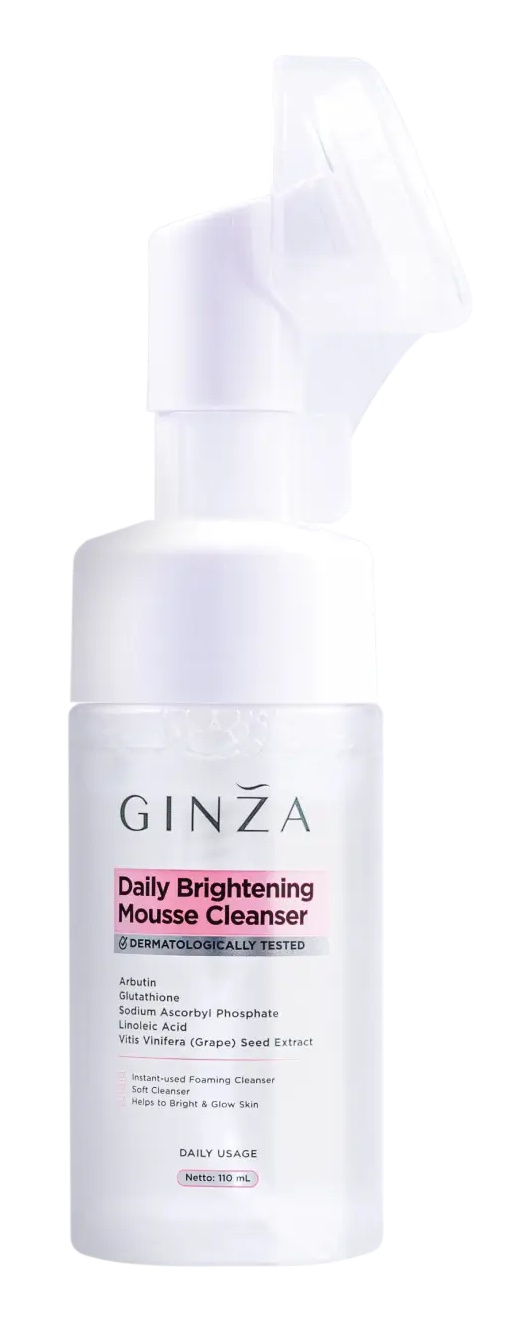
Highlights
Key Ingredients
Skim through
| Ingredient name | what-it-does | irr., com. | ID-Rating |
|---|---|---|---|
| Sodium Ascorbyl Phosphate (Vitamin C) | antioxidant, anti-acne | goodie | |
| Grape Seed Extract | antioxidant, antimicrobial/antibacterial | goodie | |
| Arbutin | antioxidant, skin brightening | goodie | |
| Glutathione | |||
| Vitamin E | antioxidant | 0-3, 0-3 | goodie |
| Vitamin F (Omega-6) | skin-identical ingredient, emollient, surfactant/cleansing | goodie | |
| Sodium Cocoamphoacetate | surfactant/cleansing | ||
| Maltooligosyl Glucoside | |||
| Hydrogenated Starch Hydrolysate | moisturizer/humectant |
Ginza Mousse CleanserIngredients explained
The sodium salt form of skincare superstar, vitamin C. If you do not know what the big fuss about vitamin C is, you are missing out and you have to click here and read all the geeky details about it.
Pure vitamin C (aka ascorbic acid, AA) is great and all, but its lack of stability is a big challenge for the cosmetics industry. One solution is to create stable derivatives that can be absorbed into the skin, convert there to AA and do all the magic AA is proven to do (which is being an antioxidant, a collagen booster, and a skin brightener).
SAP (the vit C derivative, not the enterprise software, obvs) is a promising derivative that has great stability up to pH 7. The challenge with it though is skin penetration. Unfortunately, it seems to be limited, or to quote a great article from the Journal of Cosmetic Dermatology "topically applied ascorbyl phosphate salts are, at very best, poorly absorbed in comparison with AA". Regarding conversion to AA, there seems to be no data about it, so we can neither deny nor confirm it.
We have better news regarding the three magic abilities of vitamin C: there is in-vivo (tested on real people) data showing that SAP does have photo-protective (aka antioxidant) properties, though less than pure AA. SAP might also aid collagen boosting; in-vitro (made in the lab) data shows that it works, but is less effective than another vitamin C derivative, called MAP (that seems to be as effective as pure AA). As for skin-brightening, there is a trade publication with in-vivo data showing that SAP can fade brown spots.
Another thing SAP might be able to do is to help with acne. A 2005 study showed in vitro (in test tubes) that 1% SAP has a strong antimicrobial activity on evil acne causing P. acnes and it also showed in vivo (on real people) that 5% SAP can strongly improve the inflammatory and non-inflammatory lesions of acne vulgaris. In fact, the results were comparable or even slightly better than with 5% benzoyl peroxide.
And there is even more regarding SAP and acne. A nice double-blind study from 2009 showed that 5% SAP reduced the inflammatory lesions by 20.14% and 48.82% within 4 and 8 weeks respectively and when combined with 0.2% retinol the results were even better. With this combination treatment, the improvement was 29.28% after 4 weeks and 63.10% after 8 weeks of application.
Aside from research studies, anecdotal evidence also supports SAP being a promising vitamin C derivative. One of the best-selling (vitamin C) serums in Sephora is the Ole Henriksen Truth Serum, while on Amazon it's the OzNaturals Vitamin C 20 Serum. Another popular choice is the Mad Hippie Vitamin C serum, and all of these contain vitamin C in the form of SAP.
Overall, we think SAP is a goody! In terms of anti-aging, it's probably not as effective as pure Ascorbic Acid, but it's totally worth a try. However, if your skin is acne-prone, SAP is your form of Vitamin C and it's a must-try.
We wholeheartedly support the rise of seedless grapes as fruit snacks, but when it comes to skincare, we are big fans of the seeds.
They contain the majority of the skin goodies that - similar to green tea - are mostly polyphenols (but not the same ones as in tea). The most abundant ones in grape are called proanthocyanidins, and 60-70% of them are found in the seeds (it's also often abbreviated as GSP - grape seed proanthocyanidins). In general, the darker the fruit, the more GSPs and other flavonoids it contains.
So what's so special about GSPs? Well, they are super-potent antioxidants, much stronger than Vitamin C or Vitamin E. And if that's not enough, GSPs and other flavonoids in grape also show UV protecting and anti-cancer properties.
It's definitely a goodie to spot on the INCI list.
A pretty well-known and often used ingredient with the magic ability to fade brown spots. It's used traditionally in Japan and can be found naturally in a couple of plants, including the leaves of pear trees, wheat and bearberry.
Arbutin seems to work its magic and hinder the pigmentation process at the second step of it. An enzyme called tyrosinase is needed to create melanin (the pigment that causes the brown spots) and while several other skin lightening agents work to inhibit the synthesis of tyrosinase itself (like vitamin C or licorice), arbutin lets tyrosinase be and rather hinders the melanin-forming activity of the enzyme. (So it might be a good idea to combine arbutin with some direct tyrosinase inhibitors for more skin lightening effect.)
All in all, arbutin is one of the better-known skin brightening agents, that's probably worth a try if pigmentation is an issue for you.
 We don't have description for this ingredient yet.
- Primary fat-soluble antioxidant in our skin
- Significant photoprotection against UVB rays
- Vit C + Vit E work in synergy and provide great photoprotection
- Has emollient properties
- Easy to formulate, stable and relatively inexpensive
The famous omega-6 fatty acid, the mother of all ω-6 fatty acids in our body. It is a so-called polyunsaturated fatty acid meaning it has more than one (in this case two) double bonds and a somewhat kinky structure that makes LA and LA-rich oils a thin liquid.
It is also an essential fatty acid meaning our body cannot synthesize it and has to take it from food. This is not hard at all as plenty of nuts (such as flax, poppy or sesame seeds) and vegetable oils (such as sunflower or safflower) are rich in LA. The hard thing seems to be eating enough omega-3-s, more specifically eating a healthy ratio of omega-6 to omega-3, but that is a topic for a what-is-good-to-eat-site and not for us.
As for linoleic acid and the skin, LA is a really important little guy found naturally in our skin. It is the most abundant fatty acid in the epidermis and it serves as a structural precursor for important skin lipids called ceramides. Knowing this, it will not come as a surprise that Linoleic acid has a central role in the structure and function of stratum corneum permeability, aka healthy skin barrier. LA deficiency leads to an impaired more permeable skin barrier and the topical application of LA-rich sunflower oil can fix this issue rapidly (while oleic-rich olive oil did not have the same barrier repairing effect).
LA is not only important for dry, barrier damaged skin types but also for acne-prone skin. Research shows that problem skin has lower levels of linoleic acid (and higher levels of oleic acid) than normal skin. So LA-deficiency in the skin seems to be connected not only to an impaired skin barrier but also to acne and smearing LA all over your face might help with your problem skin. A double-blind study using a 2.5% LA gel for 4 weeks found a 25% reduction in the size of microcomedones, the tiny blocked pores that can later lead to acne.
If that was not enough, we have one more thing to report about LA. It lightens hyperpigmentation (aka UVB caused sun spots) both by blocking the melanin production of melanocytes (the skin cells that make the pigment melanin) and by enhancing the desquamation of melanin pigment from the upper layers of the skin.
Overall, linoleic acid is a multi-functional skin goodie with barrier repairing, acne-reducing, and skin-lightening magic abilities. It's a nice one to spot on the ingredient list pretty much for any skin type.
A clear, yellowish liquid that works as a cleansing agent. It has so-called amphoteric structure meaning that its head contains both a positively and a negatively charged part (surfactants are most commonly anionic meaning their head has a negative charge). Its structure makes Sodium Cocoamphoacetate very mild with great foaming properties. It's popular in baby products.
We don't have description for this ingredient yet.
We don't have description for this ingredient yet.
You may also want to take a look at...
| what‑it‑does | antioxidant | anti-acne |
| what‑it‑does | antioxidant | antimicrobial/antibacterial |
| what‑it‑does | antioxidant | skin brightening |
| what‑it‑does | antioxidant |
| irritancy, com. | 0-3, 0-3 |
| what‑it‑does | skin-identical ingredient | emollient | surfactant/cleansing |
| what‑it‑does | surfactant/cleansing |
| what‑it‑does | moisturizer/humectant |