





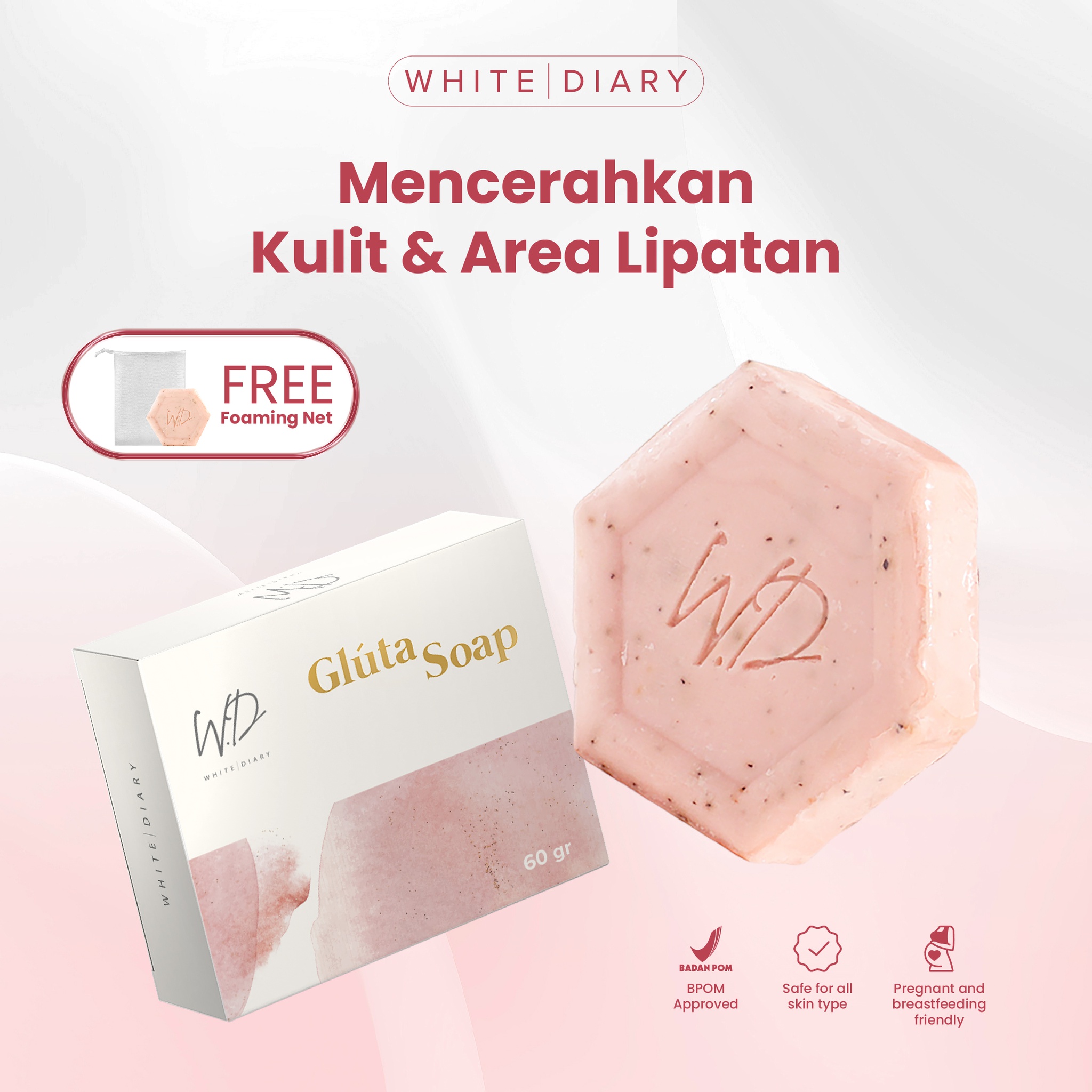

Highlights
Key Ingredients
Skim through
| Ingredient name | what-it-does | irr., com. | ID-Rating |
|---|---|---|---|
| Coconut (Cocos Nucifera) Oil | emollient, perfuming | 0, 4 | goodie |
| Aqua | solvent | ||
| Sodium Hydroxide | buffering | ||
| Parfum | perfuming | icky | |
| Swiftlet Nest Extract | |||
| Titanium Dioxide | sunscreen, colorant | goodie | |
| Goat Milk | |||
| Camellia Sinensis Powder | |||
| Soluble Collagen | moisturizer/humectant | goodie | |
| Glutathione | |||
| Alpha-Arbutin | antioxidant, skin brightening | goodie | |
| Kojic Acid | antioxidant, skin brightening | goodie | |
| Mentha Piperita Oil | perfuming | icky | |
| Ci 45430 | colorant |
White diary Gluta SoapIngredients explained
There is definitely some craze going on for coconut oil both in the healthy eating space (often claimed to be the healthiest oil to cook with but this is a topic for another site) and in the skin and hair care space.
We will talk here about the latter two and see why we might want to smear it all over ourselves. Chemically speaking, coconut oil has a unique fatty acid profile. Unlike many plant oils that mostly contain unsaturated fatty acids (fatty acids with double bonds and kinky structure such as linoleic or oleic), coconut oil is mostly saturated (fatty acids with single bonds only) and its most important fatty acid is Lauric Acid (about 50%). Saturated fatty acids have a linear structure that can stack nice and tight and hence they are normally solid at room temperature. Coconut oil melts around 25 °C so it is solid in the tub but melts on contact with the skin.
The saturated nature of coconut oil also means that it is a heavy-duty-oil ideal for dry skin types. A double-blind research confirmed that extra virgin coconut oil is as effective in treating xerosis (aka very dry skin) as mineral oil. Another study found that coconut oil is more effective than mineral oil in treating mild to moderate atopic dermatitis (aka eczema) in children.
So when it comes to dry skin, coconut oil is a goodie, no question there. The question is if it is good or bad for acne-prone skin. Its main fatty acid, Lauric Acid has some research showing that it is a promising ingredient against evil acne-causing bacteria, P. acnes but at the same time, both Lauric Acid and coconut oil have a very high comedogenic rating (4 out of 5). Though comedogenic ratings are not very reliable, anecdotal evidence (i.e. people commenting in forums) shows that people have mixed experiences. While some claim that it worked wonders on their acne others say that it gave them serious blackheads and zits. Try it at your own risk.
As for hair care, coconut oil has pretty solid research showing that it can penetrate into the hair very well (better than mineral oil and sunflower oil) and it can prevent hair protein loss as well as combing damage. If you have problems with damaged hair, split ends, coconut oil is worth trying as a pre- or/and post-wash treatment. Labmuffin has an awesome blogpost explaining in more detail why coconut oil is good for your hair.
A couple of other things worth mentioning: coconut oil might help with wound healing (promising animal study), it has some antifungal activity (against dermatophytes that cause the thing known as ringworm) and it also works as an insect repellent against black flies.
Overall, coconut oil is definitely a goodie for the hair and dry skin. If that warrants for the magic oil status it enjoys, we don't know.
Good old water, aka H2O. The most common skincare ingredient of all. You can usually find it right in the very first spot of the ingredient list, meaning it’s the biggest thing out of all the stuff that makes up the product.
It’s mainly a solvent for ingredients that do not like to dissolve in oils but rather in water.
Once inside the skin, it hydrates, but not from the outside - putting pure water on the skin (hello long baths!) is drying.
One more thing: the water used in cosmetics is purified and deionized (it means that almost all of the mineral ions inside it is removed). Like this, the products can stay more stable over time.
The unfancy name for it is lye. It’s a solid white stuff that’s very alkaline and used in small amounts to adjust the pH of the product and make it just right.
For example, in case of AHA or BHA exfoliants, the right pH is super-duper important, and pH adjusters like sodium hydroxide are needed.
BTW, lye is not something new. It was already used by ancient Egyptians to help oil and fat magically turn into something else. Can you guess what? Yes, it’s soap. It still often shows up in the ingredient list of soaps and other cleansers.
Sodium hydroxide in itself is a potent skin irritant, but once it's reacted (as it is usually in skin care products, like exfoliants) it is totally harmless.
Exactly what it sounds: nice smelling stuff put into cosmetic products so that the end product also smells nice. Fragrance in the US and parfum in the EU is a generic term on the ingredient list that is made up of 30 to 50 chemicals on average (but it can have as much as 200 components!).
If you are someone who likes to know what you put on your face then fragrance is not your best friend - there's no way to know what’s really in it.
Also, if your skin is sensitive, fragrance is again not your best friend. It’s the number one cause of contact allergy to cosmetics. It’s definitely a smart thing to avoid with sensitive skin (and fragrance of any type - natural is just as allergic as synthetic, if not worse!).
 We don't have description for this ingredient yet.
Titanium Dioxide is one of the two members of the elite sunscreen group called physical sunscreens (or inorganic sunscreens if you’re a science geek and want to be precise).
Traditionally, UV-filters are categorized as either chemical or physical. The big difference is supposed to be that chemical agents absorb UV-light while physical agents reflect it like a bunch of mini umbrellas on top of the skin. While this categorization is easy and logical it turns out it's not true. A recent, 2016 study shows that inorganic sunscreens work mostly by absorption, just like chemical filters, and only a little bit by reflection (they do reflect the light in the visible spectrum, but mostly absorb in the UV spectrum).
Anyway, it doesn't matter if it reflects or absorbs, Titanium Dioxide is a pretty awesome sunscreen agent for two main reasons: it gives a nice broad spectrum coverage and it's highly stable. Its protection is very good between 290 - 350 nm (UVB and UVA II range), and less good at 350-400 nm (UVA I) range. Regular sized Titanium Dioxide also has a great safety profile, it's non-irritating and is pretty much free from any health concerns (like estrogenic effect worries with some chemical filters).
The disadvantage of Titanium Dioxide is that it's not cosmetically elegant, meaning it's a white, "unspreadable" mess. Sunscreens containing Titanium Dioxide are often hard to spread on the skin and they leave a disturbing whitish tint. The cosmetic industry is, of course, really trying to solve this problem and the best solution so far is using nanoparticles. The itsy-bitsy Nano-sized particles improve both spreadability and reduce the whitish tint a lot, but unfortunately, it also introduces new health concerns.
The main concern with nanoparticles is that they are so tiny that they are absorbed into the skin more than we want them (ideally sunscreen should remain on the surface of the skin). Once absorbed they might form unwanted complexes with proteins and they might promote the formation of evil free radicals. But do not panic, these are concerns under investigation. A 2009 review article about the safety of nanoparticles summarizes this, "to date, in-vivo and in-vitro studies have not demonstrated percutaneous penetration of nanosized particles in titanium dioxide and zinc oxide sunscreens". The English translation is, so far it looks like sunscreens with nanoparticles do stay on the surface of the skin where they should be.
All in all, Titanium Dioxide is a famous sunscreen agent and for good reason, it gives broad spectrum UV protection (best at UVB and UVA II), it's highly stable, and it has a good safety profile. It's definitely one of the best UV-filter agents we have today, especially in the US where new-generation Tinosorb filters are not (yet) approved.
We don't have description for this ingredient yet.
We don't have description for this ingredient yet.
Soluble Collagen refers to the big, natural collagen molecules mostly extracted from fish or bovine skin. Spotting collagen on the ingredient list, you might think that, aha, this must be there to supplement the collagen content of our own skin, but you have to know that collagen is a huge-huge molecule that cannot absorb to the middle layer of the skin where collagen is and even if it could, it cannot just magically go the right places to become part of the skin's own collagen network. Putting collagen on your skin for anti-aging purposes is like throwing tent poles onto a ramshackle tent and expecting the tent to magically become nice and firm again.
The strong point of collagen is being a large molecule with tremendous water binding capacity, i.e. an amazing humectant and moisturizer. It produces a water-rich film on the skin giving the stratum corneum (the uppermost layer of the skin) great hydration, making it nice and smooth and reducing trans-epidermal-water loss (the process of water evaporating out of your skin).
It is also so gentle and non-irritant that it can actually be used in cleansers to reduce the irritating potential of harsh surfactants, aka cleansing agents.
If you are fine with animal-derived ingredients and know that collagen in a jar has nothing to do with wrinkles but everything to do with skin hydration, Soluble Collagen is a nice ingredient.
We don't have description for this ingredient yet.
An optical isomer of naturally occurring arbutin (or beta-arbutin). Just like its sibling, alpha-arbutin is also a skin-brightening, depigmenting agent.
Researching the difference between the two kinds of arbutin, you can read in multiple places on the internet that alpha-arbutin is stronger in effect. Unfortunately, it's never backed up with a credible source. :( Our own research resulted in conflicting results: a study from 1995 found that alpha-arbutin is 10x as effective on mouse melanoma as beta-arbutin. On the other hand, a more recent study from 2015 found that beta-arbutin is more effective both on mouse melanoma cells and on human melanoma cells (btw, kojic acid was the most effective on human melanoma cells).
None of the studies we could find is in-vivo (made on real people) anyways, so who knows. We think you cannot go wrong with trying both beta- and alpha-arbutin and see if one works better for you than the other.
We don't have description for this ingredient yet.
The essential oil coming from steam distillation of freshly harvested, flowering peppermint sprigs. Its major component is menthol that gives the oil its well-known refreshing and cooling properties. Peppermint oil is traditionally used as an inhalant for cold and coughs and there is also some clinical data validating its use against headaches by rubbing a peppermint oil cream on the forehead.
As for skincare, other than the nice grassy-minty smell and the refreshing sensations, we cannot write good things. It can be a skin irritant, so much so that it is a well-known counterirritant for muscle pains creating mild surface irritation to make things better in the deeper layers. But for everyday skincare, counterirritation is not something you wanna do, so we think that peppermint oil is better to avoid, especially if your skin is sensitive.
You may also want to take a look at...
| what‑it‑does | emollient | perfuming |
| irritancy, com. | 0, 4 |
| what‑it‑does | solvent |
| what‑it‑does | buffering |
| what‑it‑does | perfuming |
| what‑it‑does | sunscreen | colorant |
| what‑it‑does | moisturizer/humectant |
| what‑it‑does | antioxidant | skin brightening |
| what‑it‑does | antioxidant | skin brightening |
| what‑it‑does | perfuming |
| what‑it‑does | colorant |