





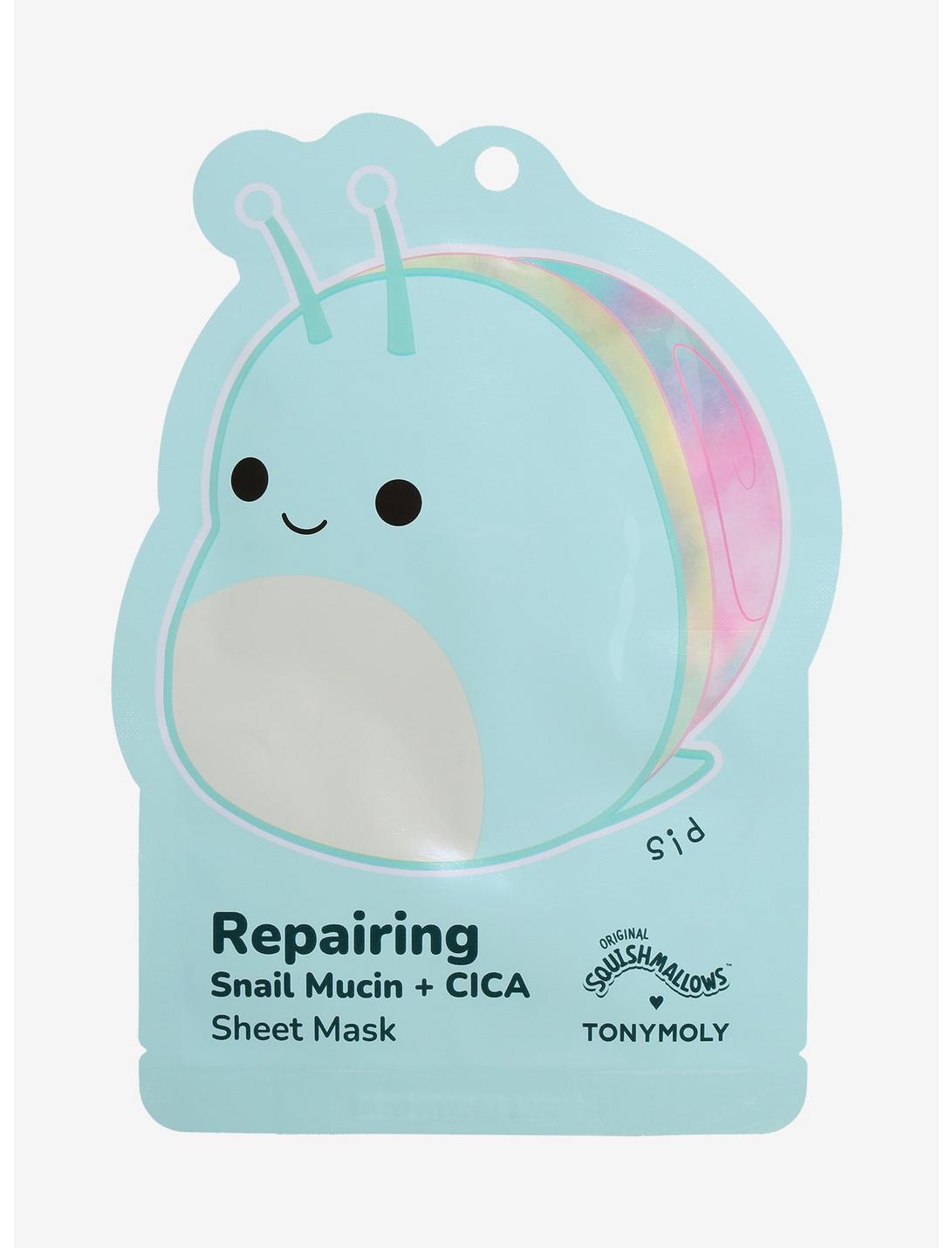
Sid Repairing Sheet Mask
Highlights
Key Ingredients
Other Ingredients
Skim through
| Ingredient name | what-it-does | irr., com. | ID-Rating |
|---|---|---|---|
| Water | solvent | ||
| Methylpropanediol | solvent | ||
| Glycerin | skin-identical ingredient, moisturizer/humectant | 0, 0 | superstar |
| 1,2-Hexanediol | solvent | ||
| Polysorbate 60 | emulsifying, surfactant/cleansing | ||
| Hydroxyacetophenone | antioxidant, preservative | ||
| Cetyl Ethylhexanoate | emollient | ||
| Allantoin | soothing | 0, 0 | goodie |
| Carbomer | viscosity controlling | 0, 1 | |
| Tromethamine | buffering | ||
| Xanthan Gum | viscosity controlling | ||
| Fragrance | perfuming | icky | |
| Butylene Glycol | moisturizer/humectant, solvent | 0, 1 | |
| Snail Secretion Filtrate | antioxidant, moisturizer/humectant | goodie | |
| Centella Asiatica Extract | soothing, antioxidant, moisturizer/humectant | goodie |
TonyMoly Sid Repairing Sheet MaskIngredients explained
Good old water, aka H2O. The most common skincare ingredient of all. You can usually find it right in the very first spot of the ingredient list, meaning it’s the biggest thing out of all the stuff that makes up the product.
It’s mainly a solvent for ingredients that do not like to dissolve in oils but rather in water.
Once inside the skin, it hydrates, but not from the outside - putting pure water on the skin (hello long baths!) is drying.
One more thing: the water used in cosmetics is purified and deionized (it means that almost all of the mineral ions inside it is removed). Like this, the products can stay more stable over time.
It's a type of glycol that - according to the manufacturer - is an extremely good replacement for other glycols like propylene or butylene glycol. Its main job is to be a solvent, but it has also very good antimicrobial properties and acts as a true preservative booster. Also helps with skin hydration without stickiness or tacky feel.
- A natural moisturizer that’s also in our skin
- A super common, safe, effective and cheap molecule used for more than 50 years
- Not only a simple moisturizer but knows much more: keeps the skin lipids between our skin cells in a healthy (liquid crystal) state, protects against irritation, helps to restore barrier
- Effective from as low as 3% with even more benefits for dry skin at higher concentrations up to 20-40%
- High-glycerin moisturizers are awesome for treating severely dry skin
A really multi-functional helper ingredient that can do several things in a skincare product: it can bring a soft and pleasant feel to the formula, it can act as a humectant and emollient, it can be a solvent for some other ingredients (for example it can help to stabilize perfumes in watery products) and it can also help to disperse pigments more evenly in makeup products. And that is still not all: it can also boost the antimicrobial activity of preservatives.
A common little helper ingredient that helps water and oil to mix together, aka emulsifier.
A handy multifunctional ingredient that works as a preservative booster, as well as an antioxidant and soothing agent.
An odorless and colorless emollient ester (cetyl alcohol + ethylhexanoic acid) that gives a velvety and silky feel to the skin. It has great spreadability and a non-oily feel. It's a popular ingredient in makeup removers.
Super common soothing ingredient. It can be found naturally in the roots & leaves of the comfrey plant, but more often than not what's in the cosmetic products is produced synthetically.
It's not only soothing but it' also skin-softening and protecting and can promote wound healing.
A big molecule created from repeated subunits (a polymer of acrylic acid) that magically converts a liquid into a nice gel formula. It usually has to be neutralized with a base (such as sodium hydroxide) for the thickening to occur and it creates viscous, clear gels that also feel nice and non-tacky on the skin. No wonder, it is a very popular and common ingredient. Typically used at 1% or less in most formulations.
It's a little helper ingredient that helps to set the pH of the products to be right. It has an alkaline pH and can neutralize acidic ingredients.
It's one of the most commonly used thickeners and emulsion stabilizers. If the product is too runny, a little xanthan gum will make it more gel-like. Used alone, it can make the formula sticky and it is a good team player so it is usually combined with other thickeners and so-called rheology modifiers (helper ingredients that adjust the flow and thus the feel of the formula). The typical use level of Xantha Gum is below 1%, it is usually in the 0.1-0.5% range.
Btw, Xanthan gum is all natural, a chain of sugar molecules (polysaccharide) produced from individual sugar molecules (glucose and sucrose) via fermentation. It’s approved by Ecocert and also used in the food industry (E415).
Exactly what it sounds: nice smelling stuff put into cosmetic products so that the end product also smells nice. Fragrance in the US and parfum in the EU is a generic term on the ingredient list that is made up of 30 to 50 chemicals on average (but it can have as much as 200 components!).
If you are someone who likes to know what you put on your face then fragrance is not your best friend - there's no way to know what’s really in it.
Also, if your skin is sensitive, fragrance is again not your best friend. It’s the number one cause of contact allergy to cosmetics. It’s definitely a smart thing to avoid with sensitive skin (and fragrance of any type - natural is just as allergic as synthetic, if not worse!).
Butylene glycol, or let’s just call it BG, is a multi-tasking colorless, syrupy liquid. It’s a great pick for creating a nice feeling product.
BG’s main job is usually to be a solvent for the other ingredients. Other tasks include helping the product to absorb faster and deeper into the skin (penetration enhancer), making the product spread nicely over the skin (slip agent), and attracting water (humectant) into the skin.
It’s an ingredient whose safety hasn’t been questioned so far by anyone (at least not that we know about). BG is approved by Ecocert and is also used enthusiastically in natural products. BTW, it’s also a food additive.
If you are into the K-Beauty trend, you must have bumped into snail slime like a thousand times. Korean brands love the ingredient and tout it for its miraculous repair and hydration properties. It's claimed to be able to repair everything from dry patches, acne breakouts to signs of aging and we are happy to say that it might be just true.
So snail slime is the yucky stuff that snails (in cosmetics the secretion of Cornu Aspersum, the garden snail is used) produce when they are in stress (it's not the same as the one they secret to be able to move nicely and smoothly). As the cosmetic chemists at the Beauty Brains blog write, "chemically speaking, snail slime is a complex mixture of proteoglycans, glycosaminoglycans, glycoprotein enzymes, hyaluronic acid, copper peptides, antimicrobial peptides and trace elements including copper, zinc, and iron." English translation equals it's loaded with a bunch of good-for-the-skin stuff.
As for scientific proof that snail slime does something for the skin, we did find a couple of studies to go by. A Spanish radiation oncologist, Rafael Abad Iglesias MD discovered for the first time that snail mucin can be used to treat radiation dermatitis (skin irritation caused by radiotherapy, a form of cancer treatment). He did a clinical study with 100 patients and reported a "statistically significant clinical improvement in erythema, itching and burning pain" in the group treated with snail slime.
A 2007 study examined the molecular basis for the great regeneration properties of the ingredient. It found that snail slime (SS) indeed does a bunch of positive things that could be the reason for its great repair abilities. First, it has serious antioxidant properties thanks to two great antioxidant enzymes, superoxide dismutase and glutathione s-transferase. Second, SS induces fibroblast proliferation, that's particularly important during wound healing. Third SS was also found to downregulate MMP, an evil enzyme that's out there to destroy skin-firming collagen. These properties add up to give SS not only wound healing and regenerative properties but also serious anti-aging potential.
Regarding anti-aging, a 2013 study in the Journal of Drugs in Dermatology examined the effect of SS on photoaged skin. The 14-week, double-blind, 25 participant study found that "there was a significant degree of improvement in fines lines", though the participants did not report a significant difference in the quality of their skin.
All in all, we think that snail slime definitely deserves the skin goodie status it already enjoys in the K-beauty space. If you have no problem with somewhat strange, yucky things or animal derived ingredients in your products, it's worth a try.
Centella Asiatica - or sometimes also called Gotu Kola or Cica - has been used in folk medicine for hundreds of years. It’s traditionally used to improve small wounds, burns and scratches and it’s also a well known anti-inflammatory agent for eczema.
Recently science has taken an interest in Gotu Kola as well and it turns out it really has many active compounds with several benefits. Just for hard-core geeks, the main biologically active compounds are pentacyclic triterpenoid saponins called asiaticoside, madecassoside, asiatic and madecassic acid (also called centellosides).
One of the biological activities of the centellosides is to be able to stimulate GAGs (glycosaminoglycans - polysaccharides that are part of the liquidy stuff between our skin cells), and especially hyaluronic acid synthesis in our skin. This is probably one of the reasons why Centella Asiatica Extract has nice skin moisturizing properties that was confirmed by a 25 people, four weeks study along with Centella's anti-inflammatory effects.
Madecassoside can also help in burn wound healing through increasing antioxidant activity and enhancing collagen synthesis. Asiaticoside was shown to increase antioxidant levels on rats skin when applied at 0.2%.
Centella Asiatica also often shows up in products that try to treat cellulite or striae. Of course, it cannot make a miracle but it might have some effect via regulating microcirculation and normalizing the metabolism in the cells of connective tissues.
Bottom line: Gotu Kola is a great plant ingredient with proven wound healing, anti-inflammatory, and antioxidant properties. Nice to spot on any ingredient list.
You may also want to take a look at...
| what‑it‑does | solvent |
| what‑it‑does | solvent |
| what‑it‑does | skin-identical ingredient | moisturizer/humectant |
| irritancy, com. | 0, 0 |
| what‑it‑does | solvent |
| what‑it‑does | emulsifying | surfactant/cleansing |
| what‑it‑does | antioxidant | preservative |
| what‑it‑does | emollient |
| what‑it‑does | soothing |
| irritancy, com. | 0, 0 |
| what‑it‑does | viscosity controlling |
| irritancy, com. | 0, 1 |
| what‑it‑does | buffering |
| what‑it‑does | viscosity controlling |
| what‑it‑does | perfuming |
| what‑it‑does | moisturizer/humectant | solvent |
| irritancy, com. | 0, 1 |
| what‑it‑does | antioxidant | moisturizer/humectant |
| what‑it‑does | soothing | antioxidant | moisturizer/humectant |