





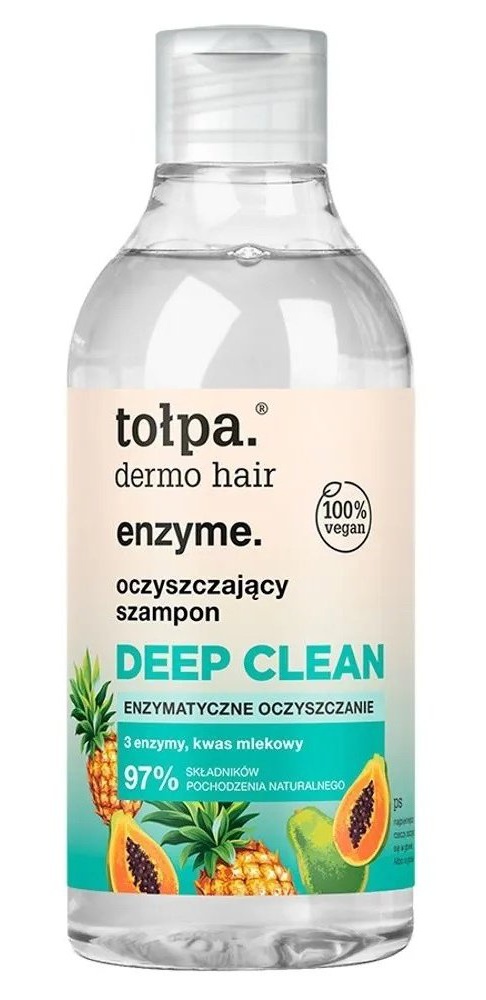
Dermo Hair Enzyme Deep Clean Shampoo
Ingredients overview
Highlights
Key Ingredients
Other Ingredients
Skim through
TOŁPA Dermo Hair Enzyme Deep Clean ShampooIngredients explained
Good old water, aka H2O. The most common skincare ingredient of all. You can usually find it right in the very first spot of the ingredient list, meaning it’s the biggest thing out of all the stuff that makes up the product.
It’s mainly a solvent for ingredients that do not like to dissolve in oils but rather in water.
Once inside the skin, it hydrates, but not from the outside - putting pure water on the skin (hello long baths!) is drying.
One more thing: the water used in cosmetics is purified and deionized (it means that almost all of the mineral ions inside it is removed). Like this, the products can stay more stable over time.
A 100% vegetable origin, biodegradable, mild cleansing agent that gives moderate to high amount of foam. It's happy to work together with other surfactants (in general, that helps to create milder formulas).
 We don't have description for this ingredient yet.
- A natural moisturizer that’s also in our skin
- A super common, safe, effective and cheap molecule used for more than 50 years
- Not only a simple moisturizer but knows much more: keeps the skin lipids between our skin cells in a healthy (liquid crystal) state, protects against irritation, helps to restore barrier
- Effective from as low as 3% with even more benefits for dry skin at higher concentrations up to 20-40%
- High-glycerin moisturizers are awesome for treating severely dry skin
A water-loving emollient that is used as a solubilizer in water-based, toner-like formulas. Solubilizers are handy helper ingredients to dissolve small amounts of oil-loving materials (such as essential oils or fragrances) into watery liquids. Polyglyceryl-4 Caprate also has some emollient properties, making the skin feel nice and smooth.
We don't have description for this ingredient yet.
We don't have description for this ingredient yet.
A sugar beet-derived amino acid derivative with nice skin protection and moisturization properties. Betaine's special thing is being an osmolyte, a molecule that helps to control cell-water balance. It is also a natural osmoprotectant, meaning that it attracts water away from the protein surface and thus protects them from denaturation and increases their thermodynamic stability.
It also gives sensorial benefits to the formula and when used in cleansers, it helps to make them milder and gentler.
We don't have description for this ingredient yet.
We don't have description for this ingredient yet.
It's the fancy name for pomegranate enzyme that's obtained by fermenting the pomegranate fruit with Lactobacillus lactis. The fermentation process makes the desired phytochemicals readily available and selective filtration techniques are used to isolate the proteolytic fractions.
The end result is the enzyme that increases cell renewal and can be an alternative to acid exfoliation (though it is not as effective as glycolic acid even according to the manufacturer's measurements not to speak about the other benefits of glycolic acid).
It's an alternative, natural preservative that comes from radishes fermented with Leuconostoc kimchii, a lactic acid bacteria that has been used to make traditional Korean dish, kimchi. During the fermentation process, a peptide is secreted from the bacteria that has significant antimicrobial properties.
It is one of the more promising natural preservatives that can be used even alone (recommended at 2-4%), but it's not as effective as more common alternatives, like parabens or phenoxyethanol.
We don't have description for this ingredient yet.
It’s one of those little helper ingredients that makes sure the product stays the same over time. No color change or anything like that. It does so by neutralizing the metal ions in the formula (that usually get into there from water) that would otherwise cause some not so nice changes.
- It’s the second most researched AHA after glycolic acid
- It gently lifts off dead skin cells to reveal newer, fresher, smoother skin
- It also has amazing skin hydrating properties
- In higher concentration (10% and up) it improves skin firmness, thickness and wrinkles
- Choose a product where you know the concentration and pH value because these two greatly influence effectiveness
- Don’t forget to use your sunscreen (in any case but especially so next to an AHA product)
Exactly what it sounds: nice smelling stuff put into cosmetic products so that the end product also smells nice. Fragrance in the US and parfum in the EU is a generic term on the ingredient list that is made up of 30 to 50 chemicals on average (but it can have as much as 200 components!).
If you are someone who likes to know what you put on your face then fragrance is not your best friend - there's no way to know what’s really in it.
Also, if your skin is sensitive, fragrance is again not your best friend. It’s the number one cause of contact allergy to cosmetics. It’s definitely a smart thing to avoid with sensitive skin (and fragrance of any type - natural is just as allergic as synthetic, if not worse!).
It's a type of glycol that - according to the manufacturer - is an extremely good replacement for other glycols like propylene or butylene glycol. Its main job is to be a solvent, but it has also very good antimicrobial properties and acts as a true preservative booster. Also helps with skin hydration without stickiness or tacky feel.
An Ecocert-approved, natural preservative that counts as gentle and non-irritating to the skin. Usually, it comes to the formula as part of a preservative blend as it's not enough on its own.
It’s a handy multi-tasking ingredient that gives the skin a nice, soft feel. At the same time, it also boosts the effectiveness of other preservatives, such as the nowadays super commonly used phenoxyethanol.
The blend of these two (caprylyl glycol + phenoxyethanol) is called Optiphen, which not only helps to keep your cosmetics free from nasty things for a long time but also gives a good feel to the finished product. It's a popular duo.
You may also want to take a look at...
| what‑it‑does | solvent |
| what‑it‑does | surfactant/cleansing |
| what‑it‑does | surfactant/cleansing | emulsifying |
| what‑it‑does | skin-identical ingredient | moisturizer/humectant |
| irritancy, com. | 0, 0 |
| what‑it‑does | emulsifying |
| what‑it‑does | emollient |
| what‑it‑does | emollient |
| irritancy, com. | 0, 1 |
| what‑it‑does | moisturizer/humectant |
| irritancy, com. | 0, 0 |
| what‑it‑does | exfoliant |
| what‑it‑does | antimicrobial/antibacterial | preservative |
| what‑it‑does | chelating |
| what‑it‑does | exfoliant | moisturizer/humectant | buffering |
| what‑it‑does | perfuming |
| what‑it‑does | solvent |
| what‑it‑does | preservative |
| what‑it‑does | moisturizer/humectant | emollient |