





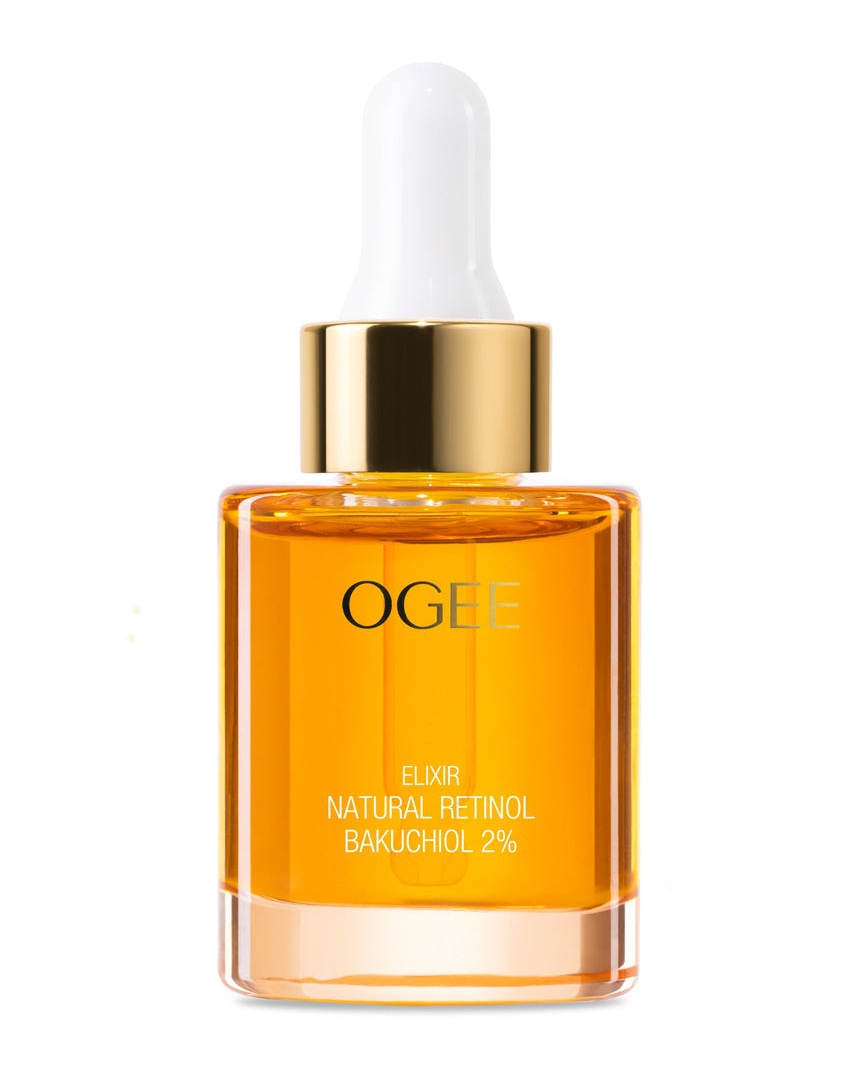
Retinol Alternative Bakuchiol 2% Elixir
Ingredients overview
Highlights
Key Ingredients
Skim through
| Ingredient name | what-it-does | irr., com. | ID-Rating |
|---|---|---|---|
| Caprylic/Capric Triglyceride | emollient | ||
| Organic Simmondsia Chinensis (Jojoba) Seed Oil | emollient | 0, 0-2 | goodie |
| Organic Mauritia Flexuosa (Buriti) Fruit Oil | |||
| Sambucus Nigra (Elderberry) Fruit Extract | |||
| Bakuchiol | cell-communicating ingredient, antioxidant, antimicrobial/antibacterial | goodie | |
| Helianthus Annuus (Sunflower) Seed Oil | emollient | 0, 0 | goodie |
| Boswellia Serrata (Frankincense) Resin Extract | |||
| Rosmarinus Officinalis (Rosemary) Leaf Extract | antioxidant, soothing, antimicrobial/antibacterial | goodie | |
| Tocopherol | antioxidant | 0-3, 0-3 | goodie |
Ogee Retinol Alternative Bakuchiol 2% ElixirIngredients explained
A super common emollient that makes your skin feel nice and smooth. It comes from coconut oil and glycerin, it’s light-textured, clear, odorless and non-greasy. It’s a nice ingredient that just feels good on the skin, is super well tolerated by every skin type and easy to formulate with. No wonder it’s popular.
Jojoba is a drought resistant evergreen shrub native to South-western North America. It's known and grown for jojoba oil, the golden yellow liquid coming from the seeds (about 50% of the weight of the seeds will be oil).
At first glance, it seems like your average emollient plant oil: it looks like an oil and it's nourishing and moisturizing to the skin but if we dig a bit deeper, it turns out that jojoba oil is really special and unique: technically - or rather chemically - it's not an oil but a wax ester (and calling it an oil is kind of sloppy).
So what the heck is a wax ester and why is that important anyway? Well, to understand what a wax ester is, you first have to know that oils are chemically triglycerides: one glycerin + three fatty acids attached to it. The fatty acids attached to the glycerin vary and thus we have many kinds of oils, but they are all triglycerides. Mother Nature created triglycerides to be easily hydrolyzed (be broken down to a glycerin + 3 fatty acid molecules) and oxidized (the fatty acid is broken down into small parts) - this happens basically when we eat fats or oils and our body generates energy from it.
Mother Nature also created wax esters but for a totally different purpose. Chemically, a wax ester is a fatty acid + a fatty alcohol, one long molecule. Wax esters are on the outer surface of several plant leaves to give them environmental protection. 25-30% of human sebum is also wax esters to give us people environmental protection.
So being a wax ester results in a couple of unique properties: First, jojoba oil is extremely stable. Like crazy stable. Even if you heat it to 370 C (698 F) for 96 hours, it does not budge. (Many plant oils tend to go off pretty quickly). If you have some pure jojoba oil at home, you should be fine using it for years.
Second, jojoba oil is the most similar to human sebum (both being wax esters), and the two are completely miscible. Acne.org has this not fully proven theory that thanks to this, jojoba might be able to "trick" the skin into thinking it has already produced enough sebum, so it might have "skin balancing" properties for oily skin.
Third, jojoba oil moisturizes the skin through a unique dual action: on the one hand, it mixes with sebum and forms a thin, non-greasy, semi-occlusive layer; on the other hand, it absorbs into the skin through pores and hair follicles then diffuses into the intercellular spaces of the outer layer of the skin to make it soft and supple.
On balance, the point is this: in contrast to real plant oils, wax esters were designed by Mother Nature to stay on the surface and form a protective, moisturizing barrier and jojoba oil being a wax ester is uniquely excellent at doing that.
 We don't have description for this ingredient yet.
We don't have description for this ingredient yet.
At first glance, you could think that Bakuchiol is your average plant extract. It is derived from the seeds of Psoralea Corylifolia, aka Babchi, a plant important in Indian and Chinese medicine. The molecule was first isolated in 1973 and several anti-something properties are known about it: it has anti-inflammatory, antioxidant, anti-tumor, anti-bacterial and hepatoprotective magical abilities like plenty of other Ayurvedic plant extracts.
What makes Bakuchiol a special snowflake is the recent discovery that it behaves on the skin in a way very similar to well-known skincare superstar, retinol. While chemically, it has nothing to do with the vitamin-A family, aka retinoids, comparative gene expression profiling (a fancy way of saying that they compared how retinol and bakuchiol modify the way skin cells behave and produce important skin proteins such as collagen) shows that retinol and bakuchiol regulate skin cell behavior in a similar way.
To be more specific, both Bakuchiol and retinol upregulate collagen I, III and IV production and downregulate MMP, the evil collagen attacking enzyme in our skin. This means more collagen stays in our skin and we all know that more collagen equals firmer, more wrinkle-free skin. A 12-week clinical study using a 0.5% Bakuchiol formula with 17 people using it twice a day confirmed a significant improvement in lines and wrinkles, elasticity, firmness and an overall reduction in photo-damage. Also, the test formula was very well tolerated, without any retinol-like side effects.
What's more, a 2018 double-blind study with 44 people compared 0.5% Bakuchiol with 0.5% retinol cream and found that "bakuchiol is comparable to retinol in its ability to improve photoaging and is better tolerated than retinol". A super promising result after 12 weeks.
If you are not a daredevil-type who doesn't want to stop using a super well-proven retinol for a newbie like Bakuchiol, we have good news. The two also work very nicely together and Bakuchiol can actually help to stabilize the otherwise unstable and hard to formulate retinol.
And we are still not done, as Bakuchiol shows not only anti-aging properties but also nice anti-acne effects. 1% Bakuchiol seems to be very effective in itself (57% reduction in acne after 6 weeks treatment) and even better when combined with 2% salicylic acid (67% reduction in acne after 6 weeks). We like that Bakuchiol is such a good team player! The molecule works against acne in multiple ways: It downregulates 5α-reductase (a sebum-controlling enzyme), it is antibacterial (including P. acnes), anti-inflammatory and it inhibits lipid-peroxidation, an evil oxidative process that is recently thought to be a very early trigger in the acne process.
We feel that this description is becoming very long so we will just mention that Bakuchiol also seems to positively regulate hydration-related genes such as Aquaporin 3 and also shows some melanin-inhibiting properties.
Overall, we think Bakuchiol is an awesome molecule with lots of promise both for anti-aging and anti-acne. But the proof compared to the well-established superstars is far from solid, so in a skincare routine, we would rather add Bakuchiol next to retinol than straight up replace it. Unless you are a gimme-the-newest-shiny-thing-under-the-sun-type.
Sunflower does not need a big intro as you probably use it in the kitchen as cooking oil, or you munch on the seeds as a healthy snack or you adore its big, beautiful yellow flower during the summer - or you do all of these and probably even more. And by even more we mean putting it all over your face as sunflower oil is one of the most commonly used plant oils in skincare.
It’s a real oldie: expressed directly from the seeds, the oil is used not for hundreds but thousands of years. According to The National Sunflower Association, there is evidence that both the plant and its oil were used by American Indians in the area of Arizona and New Mexico about 3000 BC. Do the math: it's more than 5000 years – definitely an oldie.
Our intro did get pretty big after all (sorry for that), so let's get to the point finally: sunflower oil - similar to other plant oils - is a great emollient that makes the skin smooth and nice and helps to keep it hydrated. It also protects the surface of the skin and enhances the damaged or irritated skin barrier. Leslie Bauman notes in Cosmetic Dermatology that one application of sunflower oil significantly speeds up the recovery of the skin barrier within an hour and sustains the results 5 hours after using it.
It's also loaded with fatty acids (mostly linoleic (50-74%) and oleic (14-35%)). The unrefined version (be sure to use that on your skin!) is especially high in linoleic acid that is great even for acne-prone skin. Its comedogen index is 0, meaning that it's pretty much an all skin-type oil.
Truth be told, there are many great plant oils and sunflower oil is definitely one of them.
We don't have description for this ingredient yet.
The extract coming from the lovely herb, rosemary. It contains lots of chemicals, including flavonoids, phenolic acids, and diterpenes. Its main active is rosmarinic acid, a potent antioxidant, and anti-inflammatory. It has also anti-bacterial, astringent and toning properties.
The leaves contain a small amount of essential oil (1-2%) with fragrant components, so if you are allergic to fragrance, it might be better to avoid it.
- Primary fat-soluble antioxidant in our skin
- Significant photoprotection against UVB rays
- Vit C + Vit E work in synergy and provide great photoprotection
- Has emollient properties
- Easy to formulate, stable and relatively inexpensive
You may also want to take a look at...
| what‑it‑does | emollient |
| what‑it‑does | emollient |
| irritancy, com. | 0, 0-2 |
| what‑it‑does | cell-communicating ingredient | antioxidant | antimicrobial/antibacterial |
| what‑it‑does | emollient |
| irritancy, com. | 0, 0 |
| what‑it‑does | antioxidant | soothing | antimicrobial/antibacterial |
| what‑it‑does | antioxidant |
| irritancy, com. | 0-3, 0-3 |