





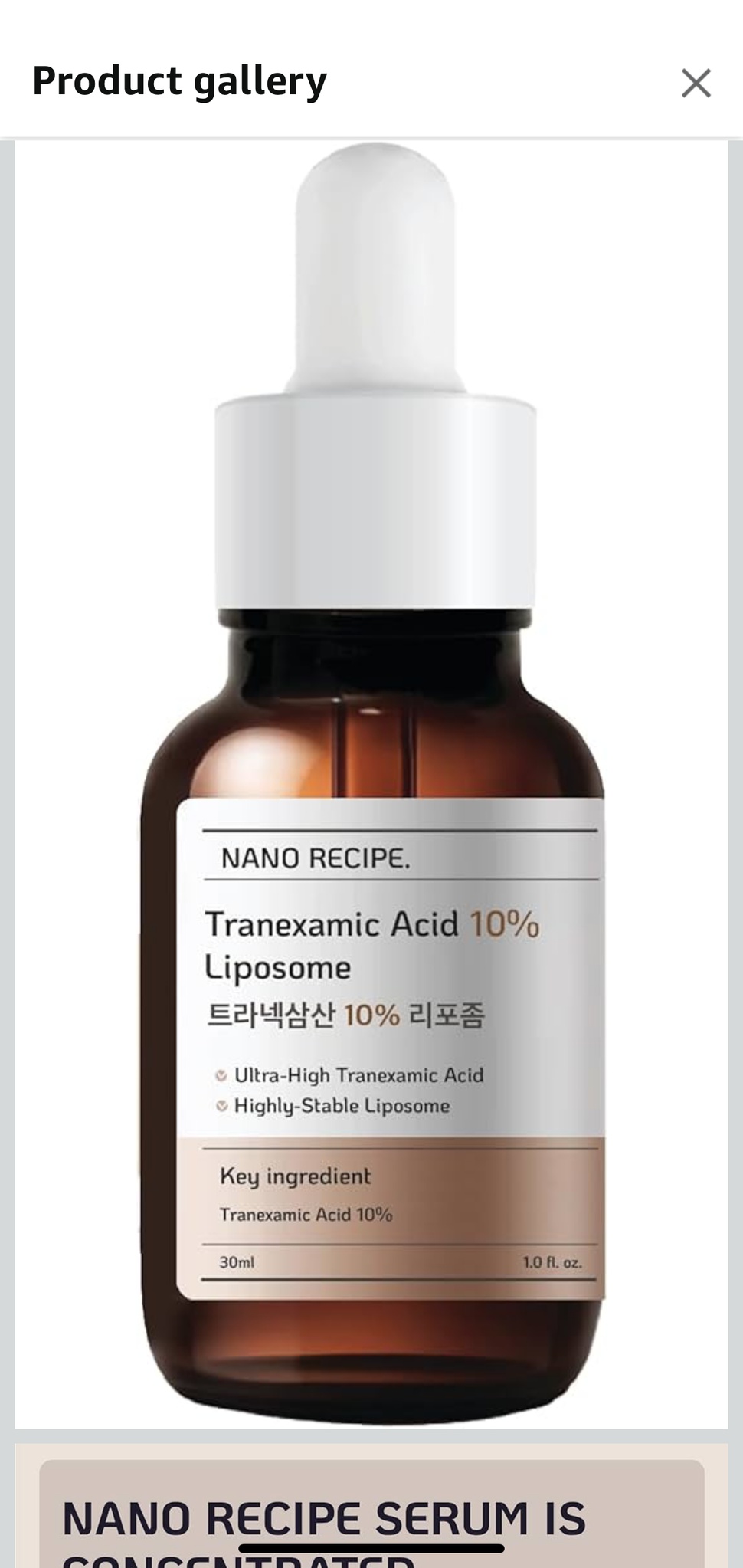
Tranexamic Acid 10% Concentrate
Ingredients overview
 INCI photo pending approval
Highlights
Key Ingredients
Skim through
| Ingredient name | what-it-does | irr., com. | ID-Rating |
|---|---|---|---|
| Tranexamic Acid (10%) | skin brightening, soothing | goodie | |
| Glycerin | skin-identical ingredient, moisturizer/humectant | 0, 0 | superstar |
| Caprylic/Capric Triglyceride | emollient | ||
| Dipropylene Glycol | solvent | ||
| Water | solvent | ||
| Polyglyceryl-10 Stearate | emulsifying | ||
| Polyglyceryl-10 Oleate | |||
| Polyglyceryl-2 Stearate | emulsifying | ||
| Hydrogenated Lecithin | emollient, emulsifying | goodie | |
| Glyceryl Stearate | emollient, emulsifying | 0, 1 | |
| Stearyl Alcohol | emollient, viscosity controlling, emulsifying, surfactant/cleansing | 2, 2 | |
| Hydroxyacetophenone | antioxidant, preservative | ||
| Caprylyl Glycol | moisturizer/humectant, emollient |
Nano Recipe Tranexamic Acid 10% ConcentrateIngredients explained
 We don't have description for this ingredient yet.
- A natural moisturizer that’s also in our skin
- A super common, safe, effective and cheap molecule used for more than 50 years
- Not only a simple moisturizer but knows much more: keeps the skin lipids between our skin cells in a healthy (liquid crystal) state, protects against irritation, helps to restore barrier
- Effective from as low as 3% with even more benefits for dry skin at higher concentrations up to 20-40%
- High-glycerin moisturizers are awesome for treating severely dry skin
A super common emollient that makes your skin feel nice and smooth. It comes from coconut oil and glycerin, it’s light-textured, clear, odorless and non-greasy. It’s a nice ingredient that just feels good on the skin, is super well tolerated by every skin type and easy to formulate with. No wonder it’s popular.
A clear, colorless liquid that works as a solvent and viscosity decreasing ingredient. It also has great skin-moisturizing abilities.
Good old water, aka H2O. The most common skincare ingredient of all. You can usually find it right in the very first spot of the ingredient list, meaning it’s the biggest thing out of all the stuff that makes up the product.
It’s mainly a solvent for ingredients that do not like to dissolve in oils but rather in water.
Once inside the skin, it hydrates, but not from the outside - putting pure water on the skin (hello long baths!) is drying.
One more thing: the water used in cosmetics is purified and deionized (it means that almost all of the mineral ions inside it is removed). Like this, the products can stay more stable over time.
A vegetable-based, PEG-free ingredient whose job is to help water and oil to mix nicely together (emulsifier). It is created by attaching ten water-loving glycerin molecules with the oil-loving fatty acid, stearic acid. The result is a partly water- and partly oil-loving molecule that creates stable and smooth emulsions that are also cosmetically elegant. It also has some moisturizing and softening benefits for skin and hair.
We don't have description for this ingredient yet.
We don't have description for this ingredient yet.
It's the chemically chopped up version of normal lecithin. Most often it's used to create liposomes and to coat and stabilize other ingredients.
A super common, waxy, white, solid stuff that helps water and oil to mix together, gives body to creams and leaves the skin feeling soft and smooth.
Chemically speaking, it is the attachment of a glycerin molecule to the fatty acid called stearic acid. It can be produced from most vegetable oils (in oils three fatty acid molecules are attached to glycerin instead of just one like here) in a pretty simple, "green" process that is similar to soap making. It's readily biodegradable.
It also occurs naturally in our body and is used as a food additive. As cosmetic chemist Colins writes it, "its safety really is beyond any doubt".
A handy multi-tasker, white to light yellowish oil-loving wax that works very well in oil-in-water emulsions. It makes your skin feel nice and smooth (emollient), stabilizes oil-water mixes and gives body to them.
Oh, and one more thing: it's a so-called fatty alcohol - the good, emollient type of alcohol that is non-drying and non-irritating. It is often mixed with fellow fatty alcohol, Cetyl Alcohol, and the mixture is called Cetearyl Alcohol in the ingredient list.
A handy multifunctional ingredient that works as a preservative booster, as well as an antioxidant and soothing agent.
It’s a handy multi-tasking ingredient that gives the skin a nice, soft feel. At the same time, it also boosts the effectiveness of other preservatives, such as the nowadays super commonly used phenoxyethanol.
The blend of these two (caprylyl glycol + phenoxyethanol) is called Optiphen, which not only helps to keep your cosmetics free from nasty things for a long time but also gives a good feel to the finished product. It's a popular duo.
You may also want to take a look at...
| what‑it‑does | skin brightening | soothing |
| what‑it‑does | skin-identical ingredient | moisturizer/humectant |
| irritancy, com. | 0, 0 |
| what‑it‑does | emollient |
| what‑it‑does | solvent |
| what‑it‑does | solvent |
| what‑it‑does | emulsifying |
| what‑it‑does | emulsifying |
| what‑it‑does | emollient | emulsifying |
| what‑it‑does | emollient | emulsifying |
| irritancy, com. | 0, 1 |
| what‑it‑does | emollient | viscosity controlling | emulsifying | surfactant/cleansing |
| irritancy, com. | 2, 2 |
| what‑it‑does | antioxidant | preservative |
| what‑it‑does | moisturizer/humectant | emollient |