





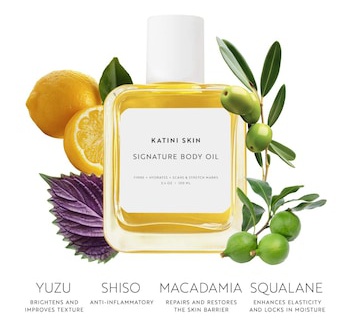
Signature Firming And Hydrating Body Oil For Scars And Stretch Marks
Ingredients overview
Highlights
Key Ingredients
Skim through
Katini Skin Signature Firming And Hydrating Body Oil For Scars And Stretch MarksIngredients explained
It seems to us that squalane is in fashion and there is a reason for it. Chemically speaking, it is a saturated (no double bonds) hydrocarbon (a molecule consisting only of carbon and hydrogen), meaning that it's a nice and stable oily liquid with a long shelf life.
It occurs naturally in certain fish and plant oils (e.g. olive), and in the sebum (the oily stuff our skin produces) of the human skin. As f.c. puts it in his awesome blog post, squalane's main things are "emolliency, surface occlusion, and TEWL prevention all with extreme cosmetic elegance". In other words, it's a superb moisturizer that makes your skin nice and smooth, without being heavy or greasy.
Another advantage of squalane is that it is pretty much compatible with all skin types and skin conditions. It is excellent for acne-prone skin and safe to use even if you have fungi-related skin issues, like seborrhea or fungal acne.
The unsaturated (with double bonds) and hence less stable version of Squalane is Squalene, you can read about it here >>
When it comes to cosmetic oils and hype, argan oil is for sure leading the way. Dubbed as the "liquid gold of Morocco", we have to admit we have some trouble determining why this oil enjoys such a special miracle status. Not that it's not good, it is good, even great but reading the research about argan and a bunch of other plant oils we just do not see the big, unique differentiating factor (though that might be our fault not reading enough, obvs.)
So, argan oil comes from the kernel of the argan fruit that comes from the argan tree that grows only in Morocco. The tree is slow growing and getting the oil is a hard job. The traditional process is that the ripe argan fruits fall from the tree, then goats eat them up and poop out the seeds. The seeds are collected and smashed with a stone to get the kernels inside. This part is the hard one as the seeds have extremely hard shells. Once the kernels are obtained, the oil is pressed out from them (the kernels contain about 50% oil).
As for skincare, argan oil is loaded with lots of skin goodies (but so are many other plant oils): it contains 80% nourishing and moisturizing unsaturated fatty acids, mainly oleic (38-50%), linoleic (28-38%) and palmitic (10-18%). It also contains a relatively large amount of antioxidant vitamin E (600-900 mg/kg, about twice as much as olive), small amounts of antioxidant phenols (including caffeic acid, ferulic acid, and epicatechin), as well as some rare sterols with soothing and anti-inflammatory properties.
Thanks to all the above goodness in argan oil, it can greatly nourish and moisturize the skin and hair. It's also claimed to be able to neutralize collagen-damaging free radicals, help reduce scars, and revitalize and improve skin elasticity. You can even read that argan might help acne-prone skin, but being a high oleic oil, we would be careful with that.
All in all, argan oil is a real goodie but we do not fully understand the special miracle status it enjoys.
The golden yellow oil coming from the Macadamia nut, a native Australian nut. Similar to other plant oils, it's loaded with emollient and nourishing fatty acids. It's a high oleic acid oil (50-67% oleic acid and only 0-5% linoleic acid) that makes it very emollient and ideal for dry skin types (and less ideal for acne-prone skin).
Its unique property is that it contains high amounts of a rare fatty acid called palmitoleic acid (12-25%) that give Macadamia oil a "cushiony" feel. It's also easily absorbed and makes the skin soft and supple.
The oil coming from the seeds of dog-rose, a wild rose species native to Europe, northwest Africa and western Asia. It's a nice emollient, moisturizing plant oil loaded with skin-nourishing fatty acids (linoleic acid - 51%, linolenic acid - 19% and oleic acid - 20%).
If you start to dig a bit deeper into the rosehip oil topic, you will soon see that there are lots of species of rose, and it's all a bit confusing to know what the differences and similarities between the oils of the different roses are. As far as our research can tell, here is the gist.
In skincare two major types of rosehip oil are used:
1. Rosa Rubiginosa that is a synonym for Rosa Eglanteria and for Rosa Mosqueta. We will call it RR from now on.
2. Rosa Canina, or RC
The oil content and composition of RR and RC is similar, but there are some differences: RR contains 8% of oil, while RC contains a bit more, 10%. However, the quality of RR oil seems to be a bit better: it contains 78% essential unsaturated fatty acids while RC contains only 71%. Also, the linoleic-oleic ratio of RR is better (3.3 vs 2.5) that might be important if your skin is acne-prone (as linoleic acid is good for acne and oleic is not).
There is one more important thing to mention: RR oil is famous for containing the miracle active, tretinoin. Though Wikipedia puts RR and RC oil under the same article called as Rose hip seed oil, the referenced research about tretinoin content examines only Rosa Rubiginosa. We looked for a research paper explicitly stating that Rosa Canina also contains tretinoin, but could not find one, so we can neither deny nor confirm it. What we could find is a paper mentioning the tocopherols (vitamin E) and carotenoids (pro-vitamin A) content of Rosa Canina oil that gives it some nice antioxidant properties.
All in all, it is a great emollient plant oil with great fatty acids beneficial for any skin type.
The oil coming from the seeds of the Moringa tree, a big white-flowered tree native to India. It's a yellow oil similar to olive oil. It's rich in nourishing and moisturizing fatty acid, oleic (75%) and also contains behenic acid (up to 8%) that makes moringa very stable and gives the oil a long shelf life.
It blends easily with essential oils and can also help to stabilize scents so it's a popular oil in the perfume industry.
 We don't have description for this ingredient yet.
We don't have description for this ingredient yet.
We don't have description for this ingredient yet.
- Primary fat-soluble antioxidant in our skin
- Significant photoprotection against UVB rays
- Vit C + Vit E work in synergy and provide great photoprotection
- Has emollient properties
- Easy to formulate, stable and relatively inexpensive
We don't have description for this ingredient yet.
We don't have description for this ingredient yet.
A super common emollient that makes your skin feel nice and smooth. It comes from coconut oil and glycerin, it’s light-textured, clear, odorless and non-greasy. It’s a nice ingredient that just feels good on the skin, is super well tolerated by every skin type and easy to formulate with. No wonder it’s popular.
The essential oil coming from the peel of the bergamot orange. It's a common top note in perfumes and contains (among others) fragrant compounds limonene (37%), linalyl acetate (30%) and linalool (8.8%).
Fragrant compounds smell nice but are common allergens and can be a problem for sensitive skin types. The bigger problem with bergamot oil though, is that it also contains furanocoumarins (more specifically, bergapten and bergamottin) that have well-documented phototoxic effects. A phototoxic reaction is a not nice one causing red, edematous lesions on the affected area. We think it is a good idea to avoid bergamot oil but if you have a product that you love, make sure to use it at night only.
Nowadays, furanocoumarin-free versions of bergamot oil are also available and more and more common, and they usually go by the INCI name Bergamot Fruit Oil.
The essential oil coming from the flowers of bitter orange (which is the sister of the sweet orange we all know and eat). It contains several fragrance components including linalool (around 30%) and limonene (around 10%) and has a lovely sweet smell.
As it's an essential oil with lots of fragrant components, be careful with it if your skin is sensitive.
We don't have description for this ingredient yet.
This ingredient name is not according to the INCI-standard. :( What, why?!
You may also want to take a look at...
| what‑it‑does | skin-identical ingredient | emollient |
| irritancy, com. | 0, 1 |
| what‑it‑does | antioxidant | emollient |
| what‑it‑does | emollient |
| what‑it‑does | emollient |
| what‑it‑does | emollient |
| what‑it‑does | emollient | moisturizer/humectant |
| what‑it‑does | antioxidant |
| irritancy, com. | 0-3, 0-3 |
| what‑it‑does | emollient |
| what‑it‑does | perfuming |