





Ingredients overview
Highlights
Key Ingredients
Other Ingredients
Skim through
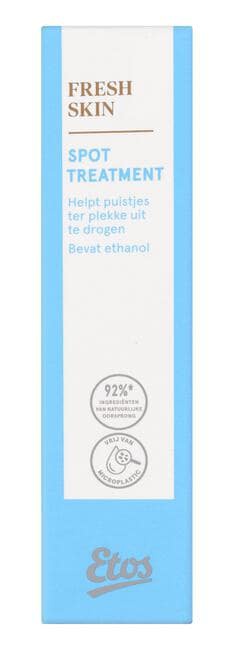
Etos Fresh Skin Spot TreatmentIngredients explained
Good old water, aka H2O. The most common skincare ingredient of all. You can usually find it right in the very first spot of the ingredient list, meaning it’s the biggest thing out of all the stuff that makes up the product.
It’s mainly a solvent for ingredients that do not like to dissolve in oils but rather in water.
Once inside the skin, it hydrates, but not from the outside - putting pure water on the skin (hello long baths!) is drying.
One more thing: the water used in cosmetics is purified and deionized (it means that almost all of the mineral ions inside it is removed). Like this, the products can stay more stable over time.
- It's a super common and super debated skincare ingredient
- It has several benefits: great solvent, penetration enhancer, creates cosmetically elegant, light formulas, great astringent and antimicrobial
- It can be very drying if it's in the first few ingredients on an ingredient list
- Some experts even think that regular exposure to alcohol damages skin barrier and causes inflammation though it's a debated opinion (read more in geeky details tab)
It's one of the most commonly used thickeners and emulsion stabilizers. If the product is too runny, a little xanthan gum will make it more gel-like. Used alone, it can make the formula sticky and it is a good team player so it is usually combined with other thickeners and so-called rheology modifiers (helper ingredients that adjust the flow and thus the feel of the formula). The typical use level of Xantha Gum is below 1%, it is usually in the 0.1-0.5% range.
Btw, Xanthan gum is all natural, a chain of sugar molecules (polysaccharide) produced from individual sugar molecules (glucose and sucrose) via fermentation. It’s approved by Ecocert and also used in the food industry (E415).
 We don't have description for this ingredient yet.
- It's a helper ingredient that improves the freeze-thaw stability of products
- It's also a solvent, humectant and to some extent a penetration enhancer
- It has a bad reputation among natural cosmetics advocates but cosmetic scientists and toxicology experts do not agree (read more in the geeky details section)
It’s pretty much the current IT-preservative. It’s safe and gentle, but even more importantly, it’s not a feared-by-everyone-mostly-without-scientific-reason paraben.
It’s not something new: it was introduced around 1950 and today it can be used up to 1% worldwide. It can be found in nature - in green tea - but the version used in cosmetics is synthetic.
Other than having a good safety profile and being quite gentle to the skin it has some other advantages too. It can be used in many types of formulations as it has great thermal stability (can be heated up to 85°C) and works on a wide range of pH levels (ph 3-10).
It’s often used together with ethylhexylglycerin as it nicely improves the preservative activity of phenoxyethanol.
- It's one of the gold standard ingredients for treating problem skin
- It can exfoliate skin both on the surface and in the pores
- It's a potent anti-inflammatory agent
- It's more effective for treating blackheads than acne
- For acne combine it with antibacterial agents like benzoyl peroxide or azelaic acid
If you have oily, acne-prone skin, Zinc PCA is one of the actives to put on your "TO TRY" list.
It's a synergistic association of two great things: Zinc and L-PCA. The Zinc part is there to help normalize sebum production and limit the proliferation of evil acne-causing bacteria. L-PCA stands for pyrrolidone carboxylic acid and it's a key molecule in the skin that helps with processes of hydration and energy (it's actually an NMF, a natural moisturizing factor).
L-PCA is not only there to hydrate the skin, but it also helps to increase the efficacy and bioavailability of zinc. An in-vivo (done on real people) test done by the manufacturer shows that Zinc PCA reduces sebum production statistically significantly after 28 days of application (1% was used in the test), and in-vitro (made in the lab) measurements show that Zinc PCA has strong anti-microbial activity against P. acnes (between 0.1-0.25%) and other bacterial strains.
If that would not be enough there is also a 2011 research paper saying that based on in-vitro (made in the lab, not on real people) findings Zinc PCA might be a promising anti-aging active that helps with the production of type I collagen (and we all know more collagen = firmer skin).
All in all, definitely a goodie for oily, acne-prone skin.
The distillate created from different parts of the hazelnut-bush-like magic tree, commonly called Witch Hazel. Hamamelis Virginiana Water is a bit of a sloppy ingredient name as the leaves, the twigs and the bark can be used to create extracts or distillates and the different parts contain different amounts of biologically active components. But what you are getting is probably a nice water with astringent, soothing, antioxidant and antibacterial magic properties.
We went into great detail about Witch Hazel in cosmetics here, detailing the main biologically active components and how they are different in different parts of the plant. Click here and read more >>
The unfancy name for it is lye. It’s a solid white stuff that’s very alkaline and used in small amounts to adjust the pH of the product and make it just right.
For example, in case of AHA or BHA exfoliants, the right pH is super-duper important, and pH adjusters like sodium hydroxide are needed.
BTW, lye is not something new. It was already used by ancient Egyptians to help oil and fat magically turn into something else. Can you guess what? Yes, it’s soap. It still often shows up in the ingredient list of soaps and other cleansers.
Sodium hydroxide in itself is a potent skin irritant, but once it's reacted (as it is usually in skin care products, like exfoliants) it is totally harmless.
If you have spotted ethylhexylglycerin on the ingredient list, most probably you will see there also the current IT-preservative, phenoxyethanol. They are good friends because ethylhexylglycerin can boost the effectiveness of phenoxyethanol (and other preservatives) and as an added bonus it feels nice on the skin too.
Also, it's an effective deodorant and a medium spreading emollient.
Aloe Vera is one of today’s magic plants. It does have some very nice properties indeed, though famous dermatologist Leslie Baumann warns us in her book that most of the evidence is anecdotal and the plant might be a bit overhyped.
What research does confirm about Aloe is that it’s a great moisturizer and has several anti-inflammatory (among others contains salicylates, polysaccharides, magnesium lactate and C-glucosyl chromone) as well as some antibacterial components. It also helps wound healing and skin regeneration in general. All in all definitely a goodie.
The famous tea tree oil. One of the best known essential oils which comes from Australia where it has been used for almost 100 years for its antiseptic and anti-inflammatory actions. Legend has it that the medicinal benefits of the oil were considered so important that Australian soldiers were supplied with some tea tree oil in their World War II military kit.
Similar to other essential oils, tea tree oil is a very complex chemical mixture consisting of about 100 components, the major ones being terpinen-4-ol (40%), γ-Terpinene (23%) and α-Terpinene (10%). Terpinen-4-ol is considered to be the main active component but as a great article in Clinical Microbiology Reviews states "while some TTO components may be considered less active, none can be considered inactive" and most components contribute to TTO's strong antibacterial, antiviral and antifungal effects.
Regarding skincare and tea tree oil, its most well-known effect is probably being a well established anti-acne ingredient. Multiple studies confirm that TTO is effective against the evil acne-causing bacteria called P. acnes and the effectiveness of 5% TTO gel is comparable to the gold standard anti-acne treatment, 5% Benzoyl Peroxide lotion. You need to be a bit more patient with TTO, though, as its effects come slower but also with fewer side effects.
Regarding TTO and sensitive skin, we say that you should be careful. Even if your skin is not sensitive you should never put undiluted TTO on your skin. Luckily, it contains only very small amounts of the common allergens (such as limonene), but irritant and allergic reactions still happen, especially by oxidation products that occur in older or not properly stored oil. So if you have some pure TTO at home, know that storage matters, keep it in a cool, dry, dark place and use it up in a reasonable amount of time.
Overall, we do not often give a goodie status to essential oils, but we feel that TTO's unique antibacterial and anti-acne properties with its minimal allergen content warrant an exception. If your skin is acne-prone, TTO is something to experiment with.
Simply alcohol refers to ethanol and it's a pretty controversial ingredient. It has many instant benefits: it's a great solvent, penetration enhancer, creates cosmetically elegant, light formulas, great astringent and antimicrobial. No wonder it's popular in toners and oily skin formulas.
The downside is that it can be very drying if it's in the first few ingredients on an ingredient list.
Some experts even think that regular exposure to alcohol damages skin barrier and causes inflammation though it's a debated opinion. If you wanna know more, we wrote a more detailed explanation about what's the deal with alcohol in skincare products at alcohol denat. (it's also alcohol, but with some additives to make sure no one drinks it).
We don't have description for this ingredient yet.
We don't have description for this ingredient yet.
A helper ingredient that helps to make the products stay nice longer, aka preservative. It works mainly against fungi.
It’s pH dependent and works best at acidic pH levels (3-5). It’s not strong enough to be used in itself so it’s always combined with something else, often with potassium sorbate.
A super common and cheap fragrance ingredient. It's in many plants, e.g. rosemary, eucalyptus, lavender, lemongrass, peppermint and it's the main component (about 50-90%) of the peel oil of citrus fruits.
It does smell nice but the problem is that it oxidizes on air exposure and the resulting stuff is not good for the skin. Oxidized limonene can cause allergic contact dermatitis and counts as a frequent skin sensitizer.
Limonene's nr1 function is definitely being a fragrance component, but there are several studies showing that it's also a penetration enhancer, mainly for oil-loving components.
All in all, limonene has some pros and cons, but - especially if your skin is sensitive - the cons probably outweigh the pros.
You may also want to take a look at...
| what‑it‑does | solvent |
| what‑it‑does | antimicrobial/antibacterial | solvent | viscosity controlling |
| what‑it‑does | viscosity controlling |
| what‑it‑does | surfactant/cleansing |
| what‑it‑does | moisturizer/humectant | solvent |
| irritancy, com. | 0, 0 |
| what‑it‑does | preservative |
| what‑it‑does | exfoliant | anti-acne | soothing | preservative |
| what‑it‑does | anti-acne | moisturizer/humectant |
| what‑it‑does | soothing |
| what‑it‑does | buffering |
| what‑it‑does | preservative |
| what‑it‑does | soothing | moisturizer/humectant |
| what‑it‑does | soothing | anti-acne | antioxidant | antimicrobial/antibacterial | perfuming |
| what‑it‑does | antimicrobial/antibacterial | solvent | viscosity controlling |
| what‑it‑does | antioxidant | soothing |
| what‑it‑does | preservative |
| what‑it‑does | perfuming | solvent |