





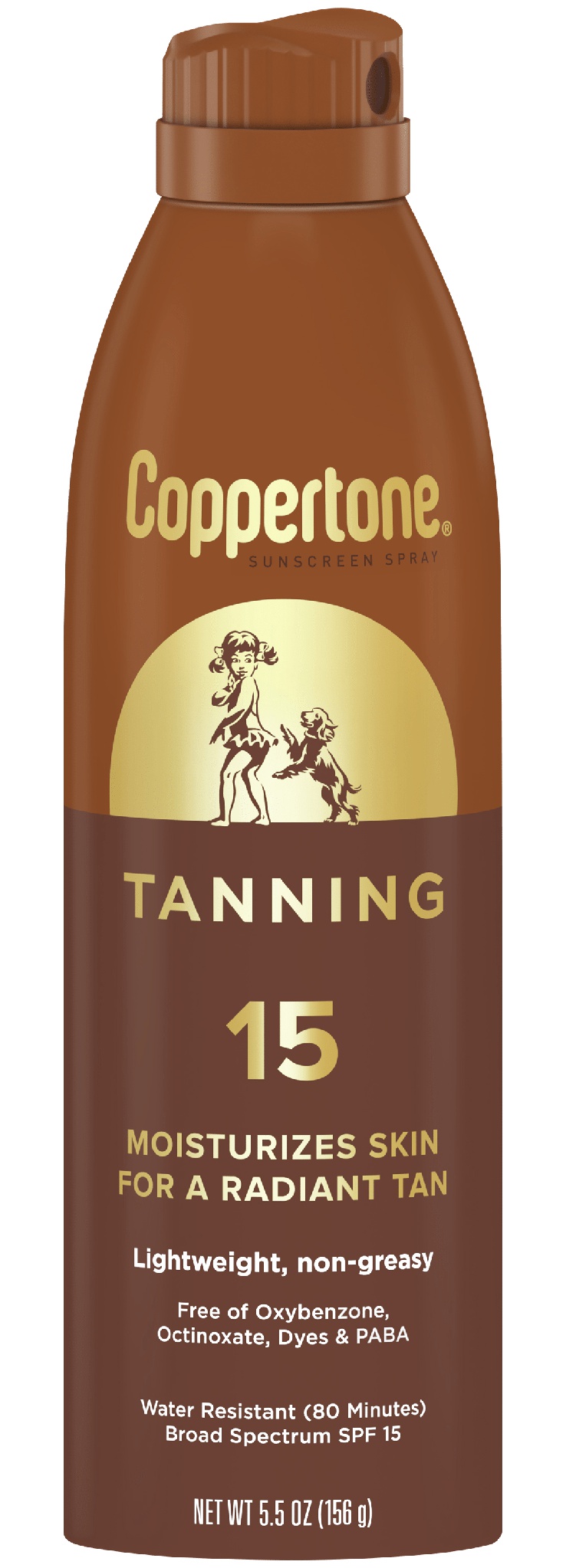
Tanning SPF 15
Ingredients overview
Highlights
Key Ingredients
Skim through
| Ingredient name | what-it-does | irr., com. | ID-Rating |
|---|---|---|---|
| Avobenzone (2%) | sunscreen | goodie | |
| Octisalate (4.5%) | sunscreen | 0, 0 | |
| Octocrylene (7%) | sunscreen | ||
| Sd Alcohol 40-B (49.3% V/V) | solvent, viscosity controlling | icky | |
| Isobutane | |||
| Neopentyl Glycol Diheptanoate | emollient | ||
| Polyester-27 | |||
| Fragrance | perfuming | icky |
Coppertone Tanning SPF 15Ingredients explained
The famous Avobenzone. It is a special snowflake as it is the only globally available chemical sunscreen agent that provides proper UVA protection (in the US, new generation sunscreen agents are not approved because of impossible FDA regulations). It is the global gold standard of UVA protection and is the most used UVA sunscreen in the world.
It gives very good protection across the whole UVA range (310-400 nm that is both UVA1 and UVA2) with a peak protection at 360 nm. The problem with it, though, is that it is not photostable and degrades in the sunlight. Wikipedia says that avobenzone loses 36% of its UV-absorption capacity after just one hour of sunlight (yep, this is one of the reasons why sunscreens have to be reapplied after a few hours).
The cosmetic's industry is trying to solve the problem by combining avobenzone with other UV filters that enhance its stability (like octocrylene, Tinosorb S or Ensulizole) or by encapsulating it and while both solutions help, neither is perfect. Interestingly, the combination of avobenzone with mineral sunscreens (that is titanium dioxide and zinc oxide) is not a good idea. In the US, it is flat out prohibited as avobenzone becomes unstable when combined with mineral sunscreens.
As for safety, avobenzone has a pretty good safety profile. It counts as non-irritating, and unlike some other chemical sunscreens, it shows no estrogenic effect. The maximum concentration of avobenzone permitted is 5% in the EU and 3% in the US.
A colorless to light yellowish oily liquid that works as a UVB (280-320nm) sunscreen filter with a peak absorbance at 306 nm. It's not a strong filter in itself, it's always used in combination with other sunscreen agents to further enhance the SPF and to solubilize other solid UV filters.
It has a good safety profile and is allowed to be used at a max concentration of 5% both in the US and in Europe (10% is allowed in Japan).
An oil-soluble chemical sunscreen agent that protects skin in the UVB and somewhat in the UVA II range with a peak absorption of 304 nm. Its protection is not strong enough on its own but it is quite photostable (loses 10% of SPF protection in 95 mins) and is often used to stabilize other photo-unstable UV-filters, for example, Avobenzone. It is also often used to improve the water resistance of the products.
Octocrylene's safety profile is generally quite good, though a review study in Contact Dermatitis reports an "increasing number of patients with photo contact allergy to octocrylene." Mainly adults with ketoprofen-sensitivity and children with sensitive skin are affected, so if you have a small kid, it is probably better to use octocrylene-free sunscreens.
SD-Alcohol and some numer+letter refers to alcohol (or ethanol) being denaturated with different kind of additives. These additives make sure that the alcohol is poisonous and bad tasting so that nobody drinks their alcohol-loaded toner. 40-B specifically means the additives are denatonium benzoate and t-butyl alcohol.
As for Alcohol Denat in skincare, it's a controversial ingredient. It's a great solvent and makes cosmetically elegant, light formulas but at best it's skin-drying, at worst it's skin-barrier damaging. We have written about alcohol way more here.
A colorless gas used as a propellant in cosmetic products that come in a spray form. Chemically, it is an isomer of butane (same number of C and H atoms), but while butane has a straight chain structure, isobutane is branched.
A clear, odorless, very light emollient ester that helps to achieve light textures. It has great spreadability, a good slip, and a silky skin feel. It's ideal to solubilize sunscreen agents and fragrances. It's also touted as a volatile (evaporates from the skin rather than absorbs into it) silicone alternative, especially to replace Cyclomethicone mixes.
 We don't have description for this ingredient yet.
Exactly what it sounds: nice smelling stuff put into cosmetic products so that the end product also smells nice. Fragrance in the US and parfum in the EU is a generic term on the ingredient list that is made up of 30 to 50 chemicals on average (but it can have as much as 200 components!).
If you are someone who likes to know what you put on your face then fragrance is not your best friend - there's no way to know what’s really in it.
Also, if your skin is sensitive, fragrance is again not your best friend. It’s the number one cause of contact allergy to cosmetics. It’s definitely a smart thing to avoid with sensitive skin (and fragrance of any type - natural is just as allergic as synthetic, if not worse!).
You may also want to take a look at...
| what‑it‑does | sunscreen |
| what‑it‑does | sunscreen |
| irritancy, com. | 0, 0 |
| what‑it‑does | sunscreen |
| what‑it‑does | solvent | viscosity controlling |
| what‑it‑does | emollient |
| what‑it‑does | perfuming |