





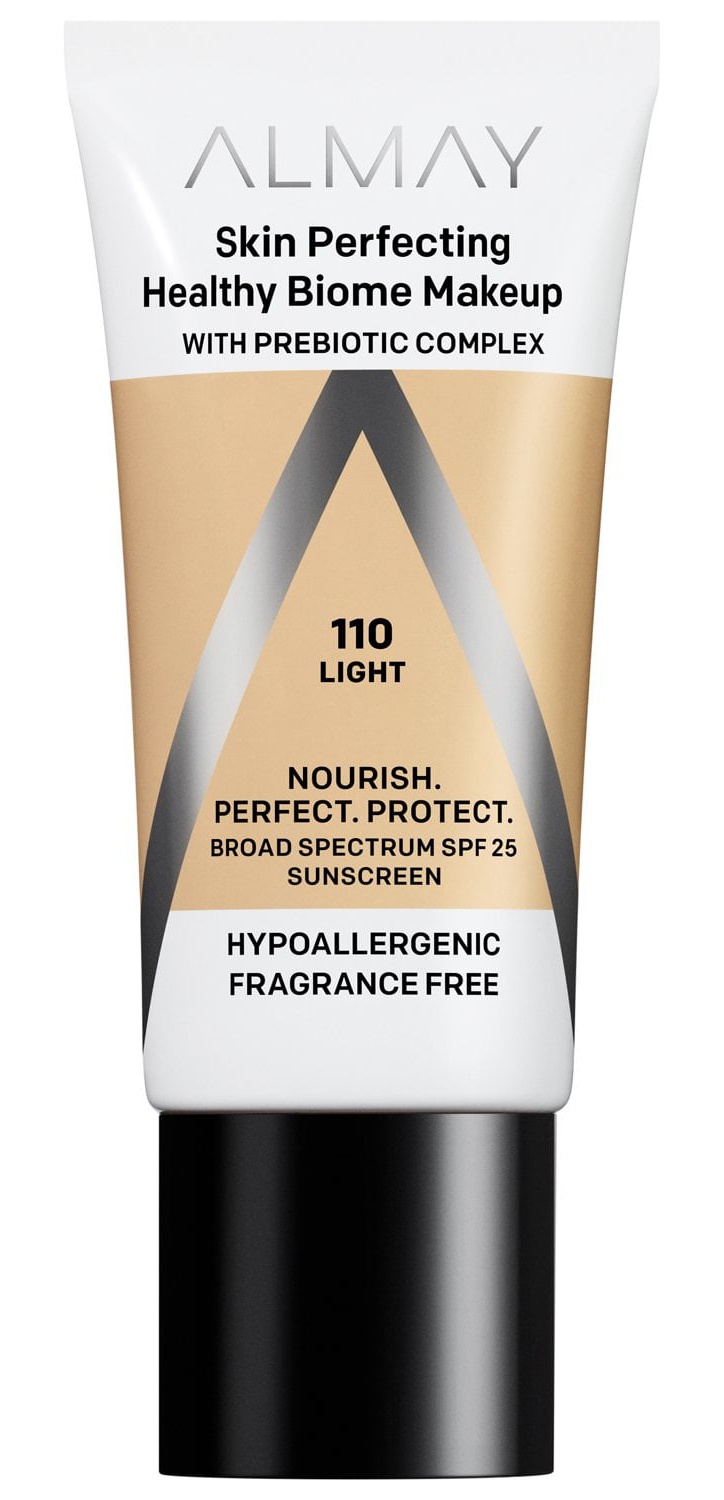
Skin Perfecting Healthy Biome Makeup
Ingredients overview
Highlights
Key Ingredients
Other Ingredients
Skim through
Almay Skin Perfecting Healthy Biome MakeupIngredients explained
Good old water, aka H2O. The most common skincare ingredient of all. You can usually find it right in the very first spot of the ingredient list, meaning it’s the biggest thing out of all the stuff that makes up the product.
It’s mainly a solvent for ingredients that do not like to dissolve in oils but rather in water.
Once inside the skin, it hydrates, but not from the outside - putting pure water on the skin (hello long baths!) is drying.
One more thing: the water used in cosmetics is purified and deionized (it means that almost all of the mineral ions inside it is removed). Like this, the products can stay more stable over time.
A super commonly used 5 unit long, cyclic structured silicone that is water-thin and does not stay on the skin but evaporates from it (called volatile silicone). Similar to other silicones, it gives skin and hair a silky, smooth feel.
It's often combined with the non-volatile (i.e. stays on the skin) dimethicone as the two together form a water-resistant, breathable protective barrier on the skin without a negative tacky feel.
A nice, multi-functional helper ingredient that's especially useful in sunscreens. It can solubilize some commonly used UV-filters like Oxybenzone or Avobenzone and it can also help to increase the SPF rating of sunscreens. It's also cosmetically elegant, has excellent spreadability and a pleasant, moisturizing skin feel. Oh, and according to Wikipedia, it even helps to stabilize famously unstable UVA-filter, Avobenzone.
A silicone emulsifier that helps water and silicone oils to mix nicely together.
A solid silicone resin that creates a permeable film over the skin. It makes makeup formulas more long-lasting and can enhance the water resistance of sunscreens. It leaves a non-tacky film when dried.
- A natural moisturizer that’s also in our skin
- A super common, safe, effective and cheap molecule used for more than 50 years
- Not only a simple moisturizer but knows much more: keeps the skin lipids between our skin cells in a healthy (liquid crystal) state, protects against irritation, helps to restore barrier
- Effective from as low as 3% with even more benefits for dry skin at higher concentrations up to 20-40%
- High-glycerin moisturizers are awesome for treating severely dry skin
A clear, colorless and odorless, highly volatile (meaning it does not absorb into the skin but evaporates from it) liquid that's used as an emollient. It gives a nice non-oily light skin feel and it can improve the slip of the formula without leaving a tacky residue behind.
It's also popular in make-up products as its volatility makes mascaras and foundations last longer. If that would not be enough, it's also an excellent solvent, and it's a regular not only on the ingredients lists of make-ups but also on makeup removers.
A multi-functional helper ingredient that's used mainly as a pigment carrier. The pigment can be an inorganic sunscreen (such as titanium dioxide) or a colorant that is blended with alumina platelets and then often coated with some kind of silicone (such as triethoxycaprylylsilane). This special treatment enables pigments to be evenly dispersed in the formula and to be spread out easily and evenly upon application. It is super useful both for mineral sunscreens as well as for makeup products.
Other than that, alumina can also be used as an absorbent (sometimes combined with the mattifying powder called polymethylsilsesquioxane), a viscosity controlling or an opacifying (reduces the transparency of the formula) agent.
A helper ingredient that is used as a bulking and viscosity controlling agent. It is also an emulsion stabilizer in water-in-oil emulsions, where water droplets are dispersed in the continuous oil phase and not the other way round.
It can also be used as a heat generating agent in water-less formulas as it has an instant heat-generating chemical reaction with water.
A white powdery thing that's the major component of glass and sand. In cosmetics, it’s often in products that are supposed to keep your skin matte as it has great oil-absorbing abilities. It’s also used as a helper ingredient to thicken up products or suspend insoluble particles.
A skin protecting ingredient obtained by enzymatic synthesis from natural sugars (sucrose and maltose). It's claimed to be a bio-selective substrate that protects and stimulates the beneficial microbial skin flora without doing the same with pathogens and undesirable flora. It also stimulates the antimicrobial peptide release by keratinocytes (skin cells).
A super common emollient that makes your skin feel nice and smooth. It comes from coconut oil and glycerin, it’s light-textured, clear, odorless and non-greasy. It’s a nice ingredient that just feels good on the skin, is super well tolerated by every skin type and easy to formulate with. No wonder it’s popular.
It’s a handy multi-tasking ingredient that gives the skin a nice, soft feel. At the same time, it also boosts the effectiveness of other preservatives, such as the nowadays super commonly used phenoxyethanol.
The blend of these two (caprylyl glycol + phenoxyethanol) is called Optiphen, which not only helps to keep your cosmetics free from nasty things for a long time but also gives a good feel to the finished product. It's a popular duo.
A white, waxy emollient that gives "body" to skincare formulas. Comes from coconut or palm kernel oil.
An organic derivative of hectorite clay, Disteardimonium Hectorite is used as a viscosity controller - it thickens up formulations to make them less runny.
It’s most popular use in cosmetics is in sunscreens, under the trademarked name Bentone 38 from Elementis. According to the manufacturer info, it is a real multi-tasker, including the ability to prevent pigments settling during storage, stabilizing a formula for longer, creating a light and smooth skin feel and enhancing the water-resistance of sunscreen formulas.
A silicone molecule that is half-way between Dimethicone and Methicone, meaning that some of the methyl (-CH3) groups are replaced with a hydrogen atom (in Methicone half of the CH3 groups are replaced). This makes Hydrogen Dimethicone a handy pigment bonding agent used for the hydrophobization treatment of powders as the H atoms can absorb traces of water from the surface of pigments.
It almost always comes stuck together with either Titanium Dioxide, Zinc Oxide or Mica. In suncare products, it binds to physical UV filters to maximize their protection while minimizing any white casts. It also has good chemical stability with no irritation. In makeup, it is often paired with Mica where it offers nice hydrophobic properties and improves skin adhesion - meaning it will make it easier for products to stay where they should be.
It's the chemically chopped up version of normal lecithin. Most often it's used to create liposomes and to coat and stabilize other ingredients.
 We don't have description for this ingredient yet.
It's a little helper ingredient coming from corn, rice or potato starch that can help to keep skin mat (absorbent), to stabilise emulsions, and to keep the product together (binding).
We don't have description for this ingredient yet.
We don't have description for this ingredient yet.
A natural emulsifier that brings a soft and powdery feel to the formula. It's also very gentle and is recommended for sensitive or baby skin products.
We don't have description for this ingredient yet.
A common little helper ingredient that helps water and oil to mix together, aka emulsifier.
The number at the end refers to the oil-loving part and the bigger the number the more emulsifying power it has. 20 is a weak emulsifier, rather called solubilizer used commonly in toners while 60 and 80 are more common in serums and creams.
We don't have description for this ingredient yet.
A type of silicone that's used mainly to stop the product from foaming when it's not needed. It's also often used to coat the sunscreen agent titanium dioxide for better spreading and easier formulation.
A popular, vegetable-derived oil-loving emulsifier that helps water to mix with oil. In itself, it is suitable for water-in-oil emulsions (where water droplets are dispersed in oil), but it is more often used as a co-emulsifier next to other, water-loving emulsifiers.
Chemically speaking, it comes from the attachment of sorbitan (a dehydrated sorbitol (sugar) molecule) with the fatty acid Stearic Acid, that creates a partly water (the sorbitan part) and partly oil soluble (stearic part) molecule.
A handy helper ingredient that helps products to remain nice and stable for a longer time. It does so by neutralizing the metal ions in the formula (that usually get into there from water) that would otherwise cause some not so nice changes.
It’s the most commonly used version of pure vitamin E in cosmetics. You can read all about the pure form here. This one is the so-called esterified version.
According to famous dermatologist, Leslie Baumann while tocopheryl acetate is more stable and has a longer shelf life, it’s also more poorly absorbed by the skin and may not have the same awesome photoprotective effects as pure Vit E.
A clear, light yellow liquid that is used to coat pigments (such as inorganic sunscreen agents or colorants) in cosmetic products. The coating helps to stabilize pigments in the formulas and also helps them to spread easily and evenly on the skin.
It’s pretty much the current IT-preservative. It’s safe and gentle, but even more importantly, it’s not a feared-by-everyone-mostly-without-scientific-reason paraben.
It’s not something new: it was introduced around 1950 and today it can be used up to 1% worldwide. It can be found in nature - in green tea - but the version used in cosmetics is synthetic.
Other than having a good safety profile and being quite gentle to the skin it has some other advantages too. It can be used in many types of formulations as it has great thermal stability (can be heated up to 85°C) and works on a wide range of pH levels (ph 3-10).
It’s often used together with ethylhexylglycerin as it nicely improves the preservative activity of phenoxyethanol.
A bit of a sloppy ingredient name as it covers not one but three pigments: red, yellow and black iron oxide.
The trio is invaluable for "skin-colored" makeup products (think your foundation and pressed powder) as blending these three shades carefully can produce almost any shade of natural-looking flesh tones.
A bit of a sloppy ingredient name as it covers not one but three pigments: red, yellow and black iron oxide.
The trio is invaluable for "skin-colored" makeup products (think your foundation and pressed powder) as blending these three shades carefully can produce almost any shade of natural-looking flesh tones.
A bit of a sloppy ingredient name as it covers not one but three pigments: red, yellow and black iron oxide.
The trio is invaluable for "skin-colored" makeup products (think your foundation and pressed powder) as blending these three shades carefully can produce almost any shade of natural-looking flesh tones.
Ci 77891 is the color code of titanium dioxide. It's a white pigment with great color consistency and dispersibility.
You may also want to take a look at...
| what‑it‑does | solvent |
| what‑it‑does | emollient | solvent |
| what‑it‑does | solvent |
| what‑it‑does | emulsifying | surfactant/cleansing |
| what‑it‑does | emollient |
| what‑it‑does | skin-identical ingredient | moisturizer/humectant |
| irritancy, com. | 0, 0 |
| what‑it‑does | emollient | solvent |
| what‑it‑does | viscosity controlling | abrasive/scrub |
| what‑it‑does | viscosity controlling |
| what‑it‑does | viscosity controlling |
| what‑it‑does | emollient |
| what‑it‑does | moisturizer/humectant | emollient |
| what‑it‑does | emollient |
| irritancy, com. | 0, 0 |
| what‑it‑does | viscosity controlling |
| what‑it‑does | emollient | emulsifying |
| what‑it‑does | cell-communicating ingredient |
| what‑it‑does | emulsifying |
| irritancy, com. | 0, 4 |
| what‑it‑does | emulsifying | surfactant/cleansing |
| irritancy, com. | 0, 0 |
| what‑it‑does | solvent | viscosity controlling |
| what‑it‑does | emollient |
| irritancy, com. | 0, 1 |
| what‑it‑does | emulsifying |
| irritancy, com. | 1, 0 |
| what‑it‑does | chelating |
| what‑it‑does | antioxidant |
| irritancy, com. | 0, 0 |
| what‑it‑does | preservative |
| what‑it‑does | colorant |
| irritancy, com. | 0, 0 |
| what‑it‑does | colorant |
| irritancy, com. | 0, 0 |
| what‑it‑does | colorant |
| irritancy, com. | 0, 0 |
| what‑it‑does | colorant |
| irritancy, com. | 0, 0 |