





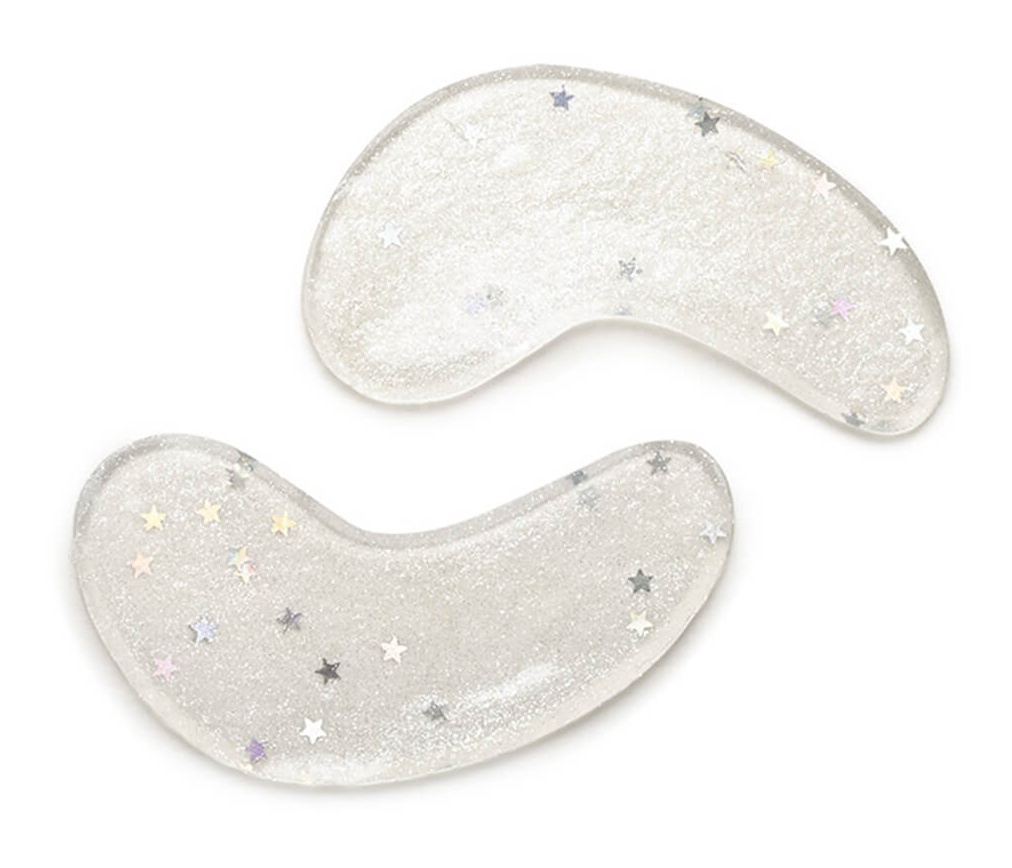
Wakey Wakey Hydrogel Under Eye Patches
Highlights
Key Ingredients
Skim through
| Ingredient name | what-it-does | irr., com. | ID-Rating |
|---|---|---|---|
| Aqua/Water/Eau | solvent | ||
| Hydrolyzed Vegetable Protein | |||
| Aloe Barbadensis Extract | soothing, emollient, moisturizer/humectant | goodie | |
| Ascorbic Acid | antioxidant, skin brightening, buffering | superstar | |
| Glycyrrhiza Glabra (Licorice/Reglisse) Root Extract | soothing, skin brightening | superstar | |
| Avena Sativa (Oat/Avoine) Peptide | |||
| Scutellaria Baicalensis Extract | antimicrobial/antibacterial | ||
| Hyaluronic Acid | skin-identical ingredient, moisturizer/humectant | goodie | |
| Caffeine | antioxidant, perfuming | goodie | |
| Trehalose | moisturizer/humectant | goodie |
Winky Lux Wakey Wakey Hydrogel Under Eye PatchesIngredients explained
Good old water, aka H2O. The most common skincare ingredient of all. You can usually find it right in the very first spot of the ingredient list, meaning it’s the biggest thing out of all the stuff that makes up the product.
It’s mainly a solvent for ingredients that do not like to dissolve in oils but rather in water.
Once inside the skin, it hydrates, but not from the outside - putting pure water on the skin (hello long baths!) is drying.
One more thing: the water used in cosmetics is purified and deionized (it means that almost all of the mineral ions inside it is removed). Like this, the products can stay more stable over time.
 We don't have description for this ingredient yet.
The extract coming from the juice containing leaves of the Aloe vera plant. It's usually a hydroglycolic extract (though oil extract for the lipid parts also exists) that has similar moisturizing, emollient and anti-inflammatory properties as the juice itself. We have written some more about aloe here.
- Works best between a concentration of 5-20%
- Boosts the skin’s own collagen production
- Fades pigmentation and brown spots
- If used under sunscreen it boosts its UV protection
- Extremely unstable and oxidizes very easily in presence of light or air
- Stable in solutions with water only if pH is less than 3.5 or in waterless formulations
- Vit E + C work in synergy and provide superb photoprotection
- Ferulic acid doubles the photoprotection effect of Vit C+E and helps to stabilize Vit C
- Potent Vit. C serums might cause a slight tingling on sensitive skin
You might know licorice as a sweet treat from your childhood, but it's actually a legume that grows around the Mediterranean Sea, the Middle East, central and southern Russia. It's sweet and yellow and not only used for licorice all sorts but it's also a skincare superstar thanks to two magic properties:
Nr. 1 magic property is that it has skin-lightening or to say it another way depigmenting properties. The most active part is called glabridin. The topical application (meaning when you put it on your face) of 0.5% glabridin was shown to inhibit UVB caused pigmentation of guinea pigs. Another study even suggested that licorice is more effective than the gold standard skin-lightening agent hydroquinone. All in all, licorice is considered to be one of the safest skin lightening agents with the fewest side effects.
There is just one catch regarding glabridin and licorice: the amount of glabridin in commercial licorice extracts can vary a lot. We have seen extracts with only 4% glabridin as well as 40% glabridin. The latter one is a very-very expensive ingredient, so if you are after the depigmenting properties try to choose a product that boasts its high-quality licorice extract.
Nr. 2 magic property is that licorice is a potent anti-inflammatory. Glabridin has also some soothing properties but the main active anti-inflammatory component is glycyrrhizin. It’s used to treat several skin diseases that are connected to inflammation including atopic dermatitis, rosacea or eczema.
Oh, and one more thing: glabridin seems to be also an antioxidant, which is just one more reason to be happy about licorice root extract on an ingredient list.
Bottom line: Licorice is a great skincare ingredient with significant depigmenting, anti-inflammatory and even some antioxidant properties. Be happy if it's on the ingredient list. :)
We don't have description for this ingredient yet.
We don't have description for this ingredient yet.
- It’s naturally in our skin and behaves there like a sponge
- It can bind up to 1000 times its own weight in water
- It is a big molecule from repeated subunits (polymer) so different molecular weight versions exist (unfortunately there is no way to determine MW from INCI list only)
- High-molecular-weight-HA (>500 kDa) is an excellent surface hydrator, skin protectant and can act as an osmotic pump helping water-soluble actives to penetrate deeper into the skin
- Low-molecular-weight-HA (< 500 kDa) can hydrate the skin somewhat deeper though it is still a big molecule and works mainly in the epidermis (outer layer of the skin)
- Low-molecular-weight-HA might also help the skin to repair itself by increasing its self-defense (~ 200kDa used in the study)
- Ultra-low-molecular-weight-HA (<50kDa) is a controversial ingredient and might work as a pro-inflammatory signal molecule
Hello, our favorite molecule that helps us wake up in the morning and then keeps us going through the day. As a super well-known stimulant from coffee, tea and plenty of other soft drinks, Caffeine needs no introduction. So we will skip right to the part where we talk about what the hell it does in so-so many cosmetic products.
Looking at the research, we were surprised to find how versatile Caffeine is. It is a small, water-loving molecule with pretty good skin penetration abilties. Once in the skin, it has nice antioxidant properties, meaning that it reduces the formation of evil free radicals and it might even be useful in preventing UV-induced skin cancers.
A well-known thing about Caffeine is that it improves the microcirculation of the blood vessels. Though conventional wisdom and anecdotal evidence says that this property is helpful for dark under-eye circles and puffy eyes, we have to mention that the double-blind research we have found about a 3% caffeine gel concluded that "the overall efficacy of the selected caffeine gel in reducing puffy eyes was not significantly different from that of its gel base." But you know, the proof is in the pudding.
Another thing Caffeine is used for in body care products is its anti-cellulite effects. In theory, it can speed up the lipolysis process (the "fat burning" by our cells) and stimulate the draining lymph system that might lead to the improvement of cellulite. But here again, the evidence that it actually makes a measurable, let alone visible, improvement on actual human beings is limited (we could find only some animal skin studies or caffeine being combined with other actives).
Last, but not least, we have to write about caffeine and hair growth. The theory is that it can inhibit the activity of the 5-α-reductase enzyme that plays an important role in hair loss and allows a renewed growth phase of the hair. We have found some recent and promising research to back this up. A 2017 study compared a 0.2% caffeine liquid with a 5% Minoxidil (an FDA approved active to treat baldness) solution and found that "a caffeine-based topical liquid should be considered as not inferior to minoxidil 5% solution in men with androgenetic alopecia", or English translation means that the caffeine liquid was pretty much as good as the FDA-approved Minoxidil stuff. Not bad!
Overall, we think that caffeine is a very versatile and biologically active ingredient. Even though some of its effects are more hyped up than backed up, it is still a nice to have on many ingredient lists.
A type of sugar that has water-binding properties and helps to keep your skin hydrated.
You may also want to take a look at...
| what‑it‑does | solvent |
| what‑it‑does | soothing | emollient | moisturizer/humectant |
| what‑it‑does | antioxidant | skin brightening | buffering |
| what‑it‑does | soothing | skin brightening |
| what‑it‑does | antimicrobial/antibacterial |
| what‑it‑does | skin-identical ingredient | moisturizer/humectant |
| what‑it‑does | antioxidant | perfuming |
| what‑it‑does | moisturizer/humectant |