





Highlights
Key Ingredients
Other Ingredients
Skim through
| Ingredient name | what-it-does | irr., com. | ID-Rating |
|---|---|---|---|
| Aqua/Water | solvent | ||
| Alcohol Denat | antimicrobial/antibacterial, solvent, viscosity controlling | icky | |
| Glycerin | skin-identical ingredient, moisturizer/humectant | 0, 0 | superstar |
| Sodium Citrate | chelating, buffering | ||
| Propylene Glycol | moisturizer/humectant, solvent | 0, 0 | |
| Salicylic Acid | exfoliant, anti-acne, soothing, preservative | superstar | |
| Citric Acid | buffering | ||
| Sodium Hydroxide | buffering | ||
| Glycolic Acid | exfoliant, buffering | superstar | |
| PEG-60 Hydrogenated Castor Oil | emulsifying, surfactant/cleansing | ||
| Dipotassium Glycyrrhizate | soothing, moisturizer/humectant | goodie | |
| Gluconolactone | exfoliant, chelating | superstar | |
| Trisodium Ethylenediamine Disuccinate | chelating | ||
| Parfum/Fragrance | perfuming | icky |
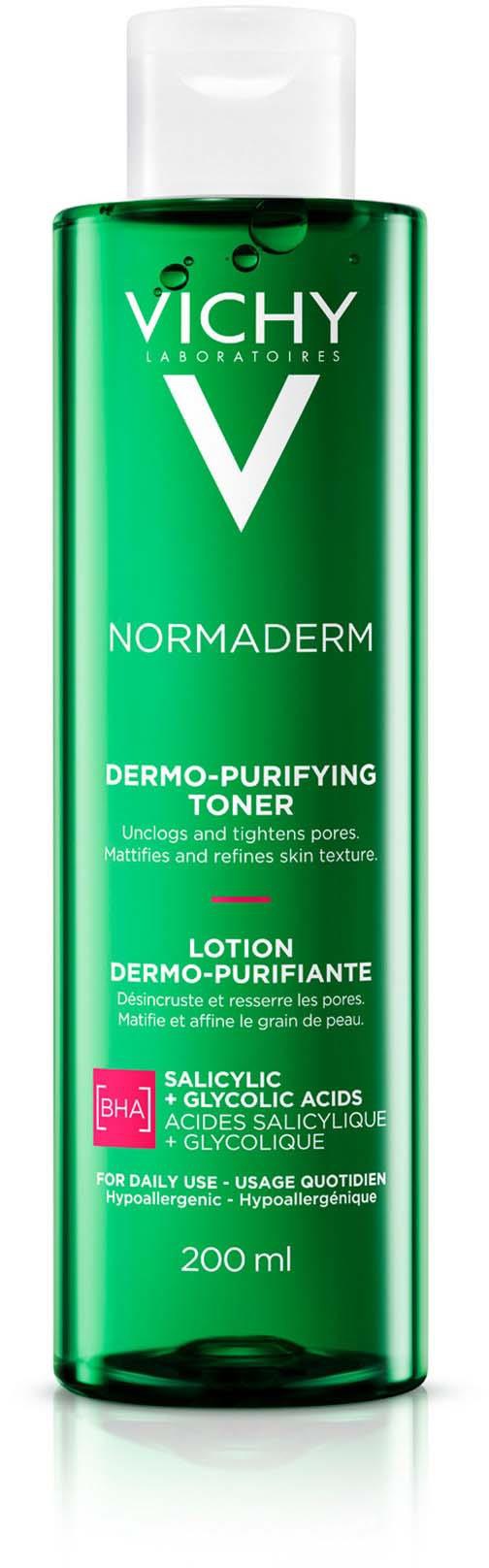
Vichy Dermo Purifying TonerIngredients explained
Good old water, aka H2O. The most common skincare ingredient of all. You can usually find it right in the very first spot of the ingredient list, meaning it’s the biggest thing out of all the stuff that makes up the product.
It’s mainly a solvent for ingredients that do not like to dissolve in oils but rather in water.
Once inside the skin, it hydrates, but not from the outside - putting pure water on the skin (hello long baths!) is drying.
One more thing: the water used in cosmetics is purified and deionized (it means that almost all of the mineral ions inside it is removed). Like this, the products can stay more stable over time.
- It's a super common and super debated skincare ingredient
- It has several benefits: great solvent, penetration enhancer, creates cosmetically elegant, light formulas, great astringent and antimicrobial
- It can be very drying if it's in the first few ingredients on an ingredient list
- Some experts even think that regular exposure to alcohol damages skin barrier and causes inflammation though it's a debated opinion (read more in geeky details tab)
- A natural moisturizer that’s also in our skin
- A super common, safe, effective and cheap molecule used for more than 50 years
- Not only a simple moisturizer but knows much more: keeps the skin lipids between our skin cells in a healthy (liquid crystal) state, protects against irritation, helps to restore barrier
- Effective from as low as 3% with even more benefits for dry skin at higher concentrations up to 20-40%
- High-glycerin moisturizers are awesome for treating severely dry skin
A little helper ingredient that is used to adjust the pH of the product. It also helps to keep products stay nice longer by neutralizing the metal ions in the formula (they usually come from water).
- It's a helper ingredient that improves the freeze-thaw stability of products
- It's also a solvent, humectant and to some extent a penetration enhancer
- It has a bad reputation among natural cosmetics advocates but cosmetic scientists and toxicology experts do not agree (read more in the geeky details section)
- It's one of the gold standard ingredients for treating problem skin
- It can exfoliate skin both on the surface and in the pores
- It's a potent anti-inflammatory agent
- It's more effective for treating blackheads than acne
- For acne combine it with antibacterial agents like benzoyl peroxide or azelaic acid
Citric acid comes from citrus fruits and is an AHA. If these magic three letters don’t tell you anything, click here and read our detailed description on glycolic acid, the most famous AHA.
So citric acid is an exfoliant, that can - just like other AHAs - gently lift off the dead skin cells of your skin and make it more smooth and fresh.
There is also some research showing that citric acid with regular use (think three months and 20% concentration) can help sun-damaged skin, increase skin thickness and some nice hydrating things called glycosaminoglycans in the skin.
But according to a comparative study done in 1995, citric acid has less skin improving magic properties than glycolic or lactic acid. Probably that’s why citric acid is usually not used as an exfoliant but more as a helper ingredient in small amounts to adjust the pH of a formulation.
The unfancy name for it is lye. It’s a solid white stuff that’s very alkaline and used in small amounts to adjust the pH of the product and make it just right.
For example, in case of AHA or BHA exfoliants, the right pH is super-duper important, and pH adjusters like sodium hydroxide are needed.
BTW, lye is not something new. It was already used by ancient Egyptians to help oil and fat magically turn into something else. Can you guess what? Yes, it’s soap. It still often shows up in the ingredient list of soaps and other cleansers.
Sodium hydroxide in itself is a potent skin irritant, but once it's reacted (as it is usually in skin care products, like exfoliants) it is totally harmless.
- It’s the most researched AHA with the most proven skin benefits
- It gently lifts off dead skin cells to reveal newer, fresher, smoother skin
- It can help skin’s own collagen production that results in firmer, younger skin
- It can fade brown spots caused by sun damage or PIH
- Choose a product where you know the concentration and pH value because these two greatly influence effectiveness
- Don’t forget to use your sunscreen (in any case but especially so next to an AHA product)
- Slight stinging or burning with a stronger AHA product is normal
- If your skin is very sensitive, rosacea prone choose rather a BHA or PHA product
A castor oil derived, white, lard-like helper ingredient that is used as a solubilizer to put fragrances (those are oil loving things) into water-based products such as toners.
The salt form of one of the main anti-inflammatory ingredients in the licorice plant, monoammonium glycyrrhizinate. It’s a yellowish powder with a nice sweet smell.
It’s used mainly for its soothing and anti-inflammatory properties, but according to manufacturer info, it’s also sebum regulating so it's a perfect ingredient for problem skin products.
Read more about licorice and why it's a skincare superstar here.
- It’s a polyhydroxy acid (PHA), that is often referred to as next generation AHA
- It gently lifts off dead skin cells form the skin surface making skin smooth and even
- In the long term it provides anti-aging benefits, like increased skin thickness and decreased wrinkles (though a tad less than even more proven superstar AHAs)
- It’s a great moisturizer and even helps to repair impaired skin barrier
- It’s antioxidant, and does not make your skin more sensitive to the sun
- It can be used even if your skin is very sensitive, rosacea prone or if you are post cosmetic procedure
A helper ingredient that helps to neutralize the metal ions in the formula (they usually come from water) so it stays nice longer. The special property of this particular ingredient is that it's more effective against more problematic ions, like Cu (copper) and Fe (iron) compared to less problematic ones like Ca (calcium) and Mg (magnesium).
Exactly what it sounds: nice smelling stuff put into cosmetic products so that the end product also smells nice. Fragrance in the US and parfum in the EU is a generic term on the ingredient list that is made up of 30 to 50 chemicals on average (but it can have as much as 200 components!).
If you are someone who likes to know what you put on your face then fragrance is not your best friend - there's no way to know what’s really in it.
Also, if your skin is sensitive, fragrance is again not your best friend. It’s the number one cause of contact allergy to cosmetics. It’s definitely a smart thing to avoid with sensitive skin (and fragrance of any type - natural is just as allergic as synthetic, if not worse!).
You may also want to take a look at...
| what‑it‑does | solvent |
| what‑it‑does | antimicrobial/antibacterial | solvent | viscosity controlling |
| what‑it‑does | skin-identical ingredient | moisturizer/humectant |
| irritancy, com. | 0, 0 |
| what‑it‑does | chelating | buffering |
| what‑it‑does | moisturizer/humectant | solvent |
| irritancy, com. | 0, 0 |
| what‑it‑does | exfoliant | anti-acne | soothing | preservative |
| what‑it‑does | buffering |
| what‑it‑does | buffering |
| what‑it‑does | exfoliant | buffering |
| what‑it‑does | emulsifying | surfactant/cleansing |
| what‑it‑does | soothing | moisturizer/humectant |
| what‑it‑does | exfoliant | chelating |
| what‑it‑does | chelating |
| what‑it‑does | perfuming |