





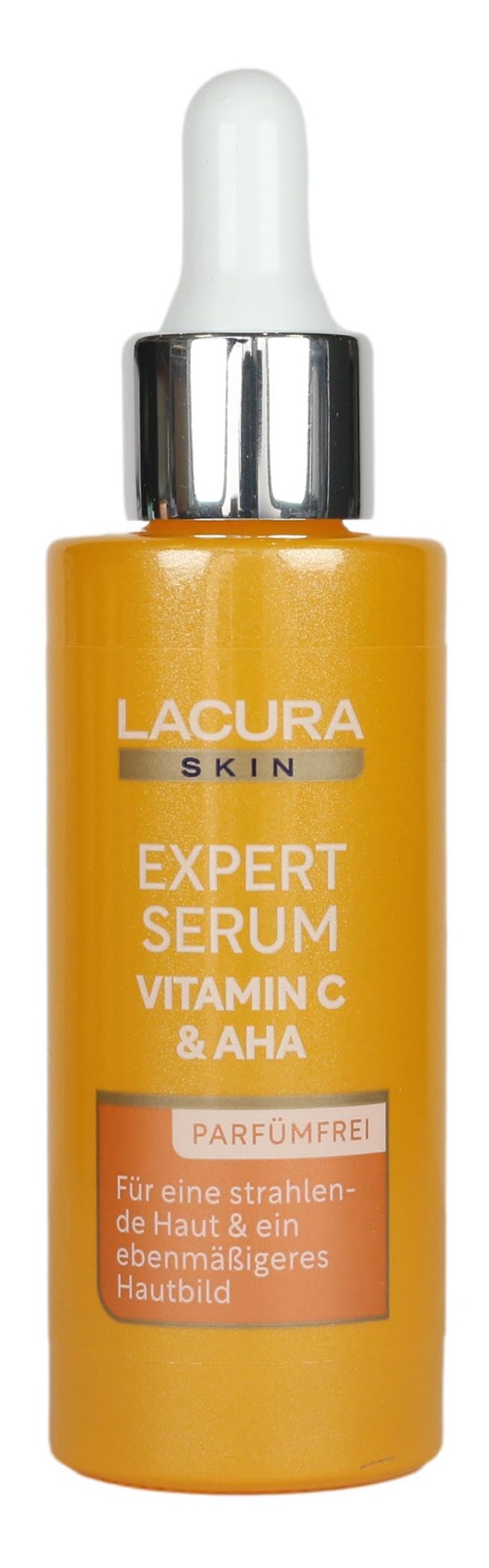
Expert Serum Vitamin C + AHA

Highlights
Key Ingredients
Skim through
| Ingredient name | what-it-does | irr., com. | ID-Rating |
|---|---|---|---|
| Aqua | solvent | ||
| Glycerin | skin-identical ingredient, moisturizer/humectant | 0, 0 | superstar |
| Niacinamide | cell-communicating ingredient, skin brightening, anti-acne, moisturizer/humectant | superstar | |
| Pentylene Glycol | solvent, moisturizer/humectant | ||
| Lactic Acid | exfoliant, moisturizer/humectant, buffering | superstar | |
| Hydroxypropyl Starch Phosphate | viscosity controlling | ||
| Sodium Lactate | buffering, moisturizer/humectant | goodie | |
| Ascorbyl Glucoside | antioxidant, skin brightening | goodie | |
| Palmitoyl Tetrapeptide-10 | cell-communicating ingredient | goodie | |
| Xanthan Gum | viscosity controlling | ||
| Ethylhexylglycerin | preservative |
LACURA Expert Serum Vitamin C + AHAIngredients explained
Good old water, aka H2O. The most common skincare ingredient of all. You can usually find it right in the very first spot of the ingredient list, meaning it’s the biggest thing out of all the stuff that makes up the product.
It’s mainly a solvent for ingredients that do not like to dissolve in oils but rather in water.
Once inside the skin, it hydrates, but not from the outside - putting pure water on the skin (hello long baths!) is drying.
One more thing: the water used in cosmetics is purified and deionized (it means that almost all of the mineral ions inside it is removed). Like this, the products can stay more stable over time.
- A natural moisturizer that’s also in our skin
- A super common, safe, effective and cheap molecule used for more than 50 years
- Not only a simple moisturizer but knows much more: keeps the skin lipids between our skin cells in a healthy (liquid crystal) state, protects against irritation, helps to restore barrier
- Effective from as low as 3% with even more benefits for dry skin at higher concentrations up to 20-40%
- High-glycerin moisturizers are awesome for treating severely dry skin
- A multi-functional skincare superstar with several proven benefits for the skin
- Great anti-aging, wrinkle smoothing ingredient used at 4-5% concentration
- Fades brown spots alone or in combination with amino sugar, acetyl glucosamine
- Increases ceramide synthesis that results in a stronger, healthier skin barrier and better skin hydration
- Can help to improve several skin conditions including acne, rosacea, and atopic dermatitis
A multi-functional, silky feeling helper ingredient that can do quite many things. It's used as an emulsion stabilizer, solvent and a broad spectrum antimicrobial. According to manufacturer info, it's also a moisturizer and helps to make the product feel great on the skin. It works synergistically with preservatives and helps to improve water-resistance of sunscreens.
- It’s the second most researched AHA after glycolic acid
- It gently lifts off dead skin cells to reveal newer, fresher, smoother skin
- It also has amazing skin hydrating properties
- In higher concentration (10% and up) it improves skin firmness, thickness and wrinkles
- Choose a product where you know the concentration and pH value because these two greatly influence effectiveness
- Don’t forget to use your sunscreen (in any case but especially so next to an AHA product)
 We don't have description for this ingredient yet.
The sodium salt of lactic acid. It's a great skin moisturizer and also used to regulate the pH value of the cosmetic formula. It's a natural ingredient approved by both ECOCERT and COSMOS.
A form of skincare superstar, vitamin C. If you do not know why vitamin C is such a big deal in skincare, we have a really detailed, geeky description that's good to read. :)
So now you know that because pure vitamin C is such a diva (very unstable and hard to formulate) the cosmetic industry is trying to come up with some derivatives that have the badass anti-aging properties of vitamin C (antioxidant protection + collagen boosting + fading hyperpigmentation) but without the disadvantages. This is a hard task, and there is not yet a derivative that is really proven to be better in every aspect, but Ascorbyl Glucoside is one of the best options when it comes to vitamin C derivatives. Let's see why:
First, it's really stable and easy to formulate, so the problems that come with pure vitamin C are solved here.
Second, in vitro (meaning made in the lab, not on real humans) studies show that ascorbyl glucoside can penetrate the skin. This is kind of important for an anti-aging ingredient to do the job, so this is good news, though in-vivo (made on real humans) studies are still needed.
Third, in-vitro studies show that after ascorbyl glucoside is absorbed into the skin it is converted to pure vitamin C (though the rate of conversion is still a question mark). It also shows all the three anti-aging benefits (antioxidant protection + collagen boosting + fading hyperpigmentation) that pure vitamin C does.
Bottom line: ascorbyl glucoside is one of the best and most promising vitamin C derivatives that shows similar benefits to that of pure vitamin C, but it's less proven (in vivo vs. in vitro studies) and the extent of the benefits are also not the same.
We don't have description for this ingredient yet.
It's one of the most commonly used thickeners and emulsion stabilizers. If the product is too runny, a little xanthan gum will make it more gel-like. Used alone, it can make the formula sticky and it is a good team player so it is usually combined with other thickeners and so-called rheology modifiers (helper ingredients that adjust the flow and thus the feel of the formula). The typical use level of Xantha Gum is below 1%, it is usually in the 0.1-0.5% range.
Btw, Xanthan gum is all natural, a chain of sugar molecules (polysaccharide) produced from individual sugar molecules (glucose and sucrose) via fermentation. It’s approved by Ecocert and also used in the food industry (E415).
If you have spotted ethylhexylglycerin on the ingredient list, most probably you will see there also the current IT-preservative, phenoxyethanol. They are good friends because ethylhexylglycerin can boost the effectiveness of phenoxyethanol (and other preservatives) and as an added bonus it feels nice on the skin too.
Also, it's an effective deodorant and a medium spreading emollient.
You may also want to take a look at...
| what‑it‑does | solvent |
| what‑it‑does | skin-identical ingredient | moisturizer/humectant |
| irritancy, com. | 0, 0 |
| what‑it‑does | cell-communicating ingredient | skin brightening | anti-acne | moisturizer/humectant |
| what‑it‑does | solvent | moisturizer/humectant |
| what‑it‑does | exfoliant | moisturizer/humectant | buffering |
| what‑it‑does | viscosity controlling |
| what‑it‑does | buffering | moisturizer/humectant |
| what‑it‑does | antioxidant | skin brightening |
| what‑it‑does | cell-communicating ingredient |
| what‑it‑does | viscosity controlling |
| what‑it‑does | preservative |