





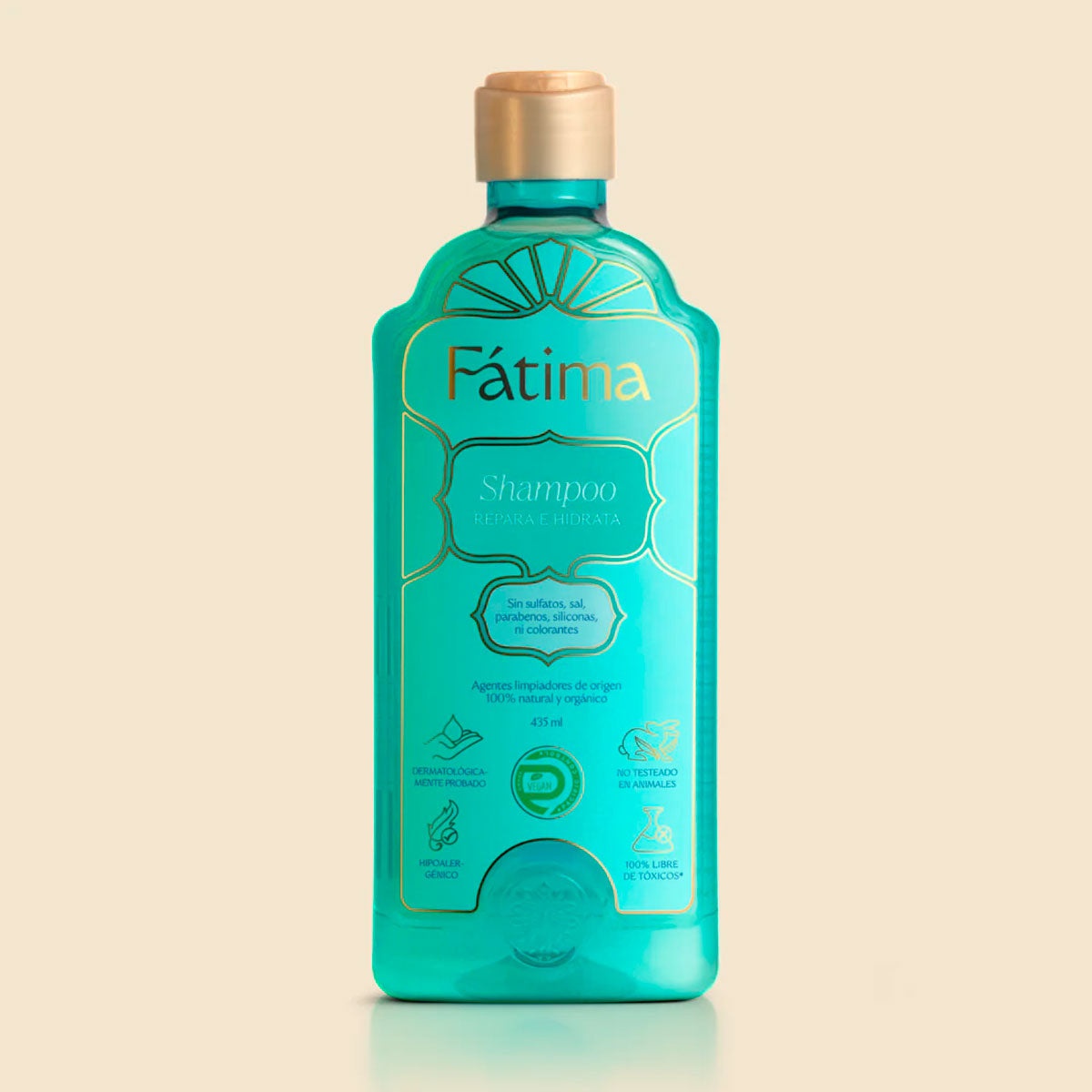
Shampoo Repara E Hidrata
Ingredients overview
Highlights
Key Ingredients
Other Ingredients
Skim through
Fátima Shampoo Repara E HidrataIngredients explained
Good old water, aka H2O. The most common skincare ingredient of all. You can usually find it right in the very first spot of the ingredient list, meaning it’s the biggest thing out of all the stuff that makes up the product.
It’s mainly a solvent for ingredients that do not like to dissolve in oils but rather in water.
Once inside the skin, it hydrates, but not from the outside - putting pure water on the skin (hello long baths!) is drying.
One more thing: the water used in cosmetics is purified and deionized (it means that almost all of the mineral ions inside it is removed). Like this, the products can stay more stable over time.
 We don't have description for this ingredient yet.
We don't have description for this ingredient yet.
Propanediol is a natural alternative for the often used and often bad-mouthed propylene glycol. It's produced sustainably from corn sugar and it's Ecocert approved.
It's quite a multi-tasker: can be used to improve skin moisturization, as a solvent, to boost preservative efficacy or to influence the sensory properties of the end formula.
A clear, colorless and odorless oily liquid that works as a fast-spreading emollient with a dry skin feel.
A vegetable origin (coconut or palm kernel oil and glucose) cleansing agent with great foaming abilities. It's also mild to the skin and readily biodegradable.
The attachment of glycerin and oleic acid that works mainly as a co-emulsifier and stabilizer to create stable water-oil mixes, aka emulsions. It is also popular in cleansing products as it helps to thicken them up and has some refatting and skin-smoothing effect.
It's a common little helper ingredient that helps water and oil to mix together. Also, it can help to increase the solubility of some other ingredients in the formula.
A chelating agent that helps to preserve cosmetic products by neutralizing the metal ions (especially iron) in the formula (that usually get into there from water). Its special thing is that it also acts as a biostatic and fungistatic agent and remains active even at high pH.
It is often coupled with antimicrobial glycols (such as propanediol) to create a "preservative free preservative system" for cosmetic products.
A 100% plant derived, natural (Ecocert approved) multi-functional ingredient that has emollient and moisturizing properties, can work as a co-emulsifier (meaning that next to other emulsifiers it can help water and oil to mix) and even more importantly has a strong antimicrobial activity.
Thanks to this last thing, it allows a lower percentage of traditional preservative or it might even be able to completely replace them.
- A natural moisturizer that’s also in our skin
- A super common, safe, effective and cheap molecule used for more than 50 years
- Not only a simple moisturizer but knows much more: keeps the skin lipids between our skin cells in a healthy (liquid crystal) state, protects against irritation, helps to restore barrier
- Effective from as low as 3% with even more benefits for dry skin at higher concentrations up to 20-40%
- High-glycerin moisturizers are awesome for treating severely dry skin
Exactly what it sounds: nice smelling stuff put into cosmetic products so that the end product also smells nice. Fragrance in the US and parfum in the EU is a generic term on the ingredient list that is made up of 30 to 50 chemicals on average (but it can have as much as 200 components!).
If you are someone who likes to know what you put on your face then fragrance is not your best friend - there's no way to know what’s really in it.
Also, if your skin is sensitive, fragrance is again not your best friend. It’s the number one cause of contact allergy to cosmetics. It’s definitely a smart thing to avoid with sensitive skin (and fragrance of any type - natural is just as allergic as synthetic, if not worse!).
We don't have description for this ingredient yet.
A traditional Chinese herbal medicine loaded with potent antioxidant and anti-inflammatory flavonoids such as baicalin, baicalein, and wogonin.
If that would not be enough, Skullcap Root is also claimed to have antimicrobial and antifungal properties (also against P.acnes and Malassezia furfur) as well as some skin-brightening activity. A multi-functional skin-goodie.
Astragalus Membranaceus, or Huangqi as the Chinese call it, is one of their most important medicinal herbs that is traditionally used to strengthen "qi", the body’s life force. It has a bunch of magic abilities including tonic, liver-protecting, immunomodulating, antihyperglycemic, anti-inflammatory, antioxidant, and antiviral properties.
Modern research does prove that Huangqi is a valuable medicinal herb and contains plenty of bioactive compounds such as saponins, flavonoids, and polysaccharides. As for skincare and Huangqi, it is well known and used for its general tonic and skin reinforcing properties, as well as for its anti-inflammatory and antioxidant action.
On top of that, we also found a manufacturer claiming that Astragalus Membranaceus Root Extract combines anti-aging and anti-blemish properties so it is especially useful for aging, acne-prone skin. In their in-vivo (made on real people) studies, 2% of liposomal Huangqi increased skin hydration, firmness, and smoothness by 20% after 14 days and decreased "blemish-prone skin signs" by 10-15% after 42 days.
We don't have description for this ingredient yet.
We don't have description for this ingredient yet.
We don't have description for this ingredient yet.
We don't have description for this ingredient yet.
- Green tea is one of the most researched natural ingredients
- The active parts are called polyphenols, or more precisely catechins (EGCG being the most abundant and most active catechin)
- There can be huge quality differences between green tea extracts. The good ones contain 50-90% catechins (and often make the product brown and give it a distinctive smell)
- Green tea is proven to be a great antioxidant, UV protectant, anti-inflammatory, anticarcinogenic and antimicrobial
- Because of these awesome properties green tea is a great choice for anti-aging and also for skin diseases including rosacea, acne and atopic dermatitis
The extract coming from the juice containing leaves of the Aloe vera plant. It's usually a hydroglycolic extract (though oil extract for the lipid parts also exists) that has similar moisturizing, emollient and anti-inflammatory properties as the juice itself. We have written some more about aloe here.
We don't have description for this ingredient yet.
Citric acid comes from citrus fruits and is an AHA. If these magic three letters don’t tell you anything, click here and read our detailed description on glycolic acid, the most famous AHA.
So citric acid is an exfoliant, that can - just like other AHAs - gently lift off the dead skin cells of your skin and make it more smooth and fresh.
There is also some research showing that citric acid with regular use (think three months and 20% concentration) can help sun-damaged skin, increase skin thickness and some nice hydrating things called glycosaminoglycans in the skin.
But according to a comparative study done in 1995, citric acid has less skin improving magic properties than glycolic or lactic acid. Probably that’s why citric acid is usually not used as an exfoliant but more as a helper ingredient in small amounts to adjust the pH of a formulation.
You may also want to take a look at...
| what‑it‑does | solvent |
| what‑it‑does | surfactant/cleansing | viscosity controlling |
| what‑it‑does | surfactant/cleansing | viscosity controlling | emulsifying |
| what‑it‑does | solvent | moisturizer/humectant |
| what‑it‑does | emollient | solvent |
| what‑it‑does | surfactant/cleansing |
| what‑it‑does | emollient | emulsifying | perfuming |
| what‑it‑does | emulsifying | surfactant/cleansing |
| irritancy, com. | 0, 0 |
| what‑it‑does | chelating |
| what‑it‑does | preservative |
| what‑it‑does | skin-identical ingredient | moisturizer/humectant |
| irritancy, com. | 0, 0 |
| what‑it‑does | perfuming |
| what‑it‑does | emulsifying | solvent | surfactant/cleansing | viscosity controlling |
| what‑it‑does | soothing | antioxidant | antimicrobial/antibacterial | moisturizer/humectant |
| what‑it‑does | antioxidant | emollient |
| what‑it‑does | antimicrobial/antibacterial |
| what‑it‑does | antioxidant | soothing |
| what‑it‑does | soothing | emollient | moisturizer/humectant |
| what‑it‑does | viscosity controlling |
| what‑it‑does | buffering |