





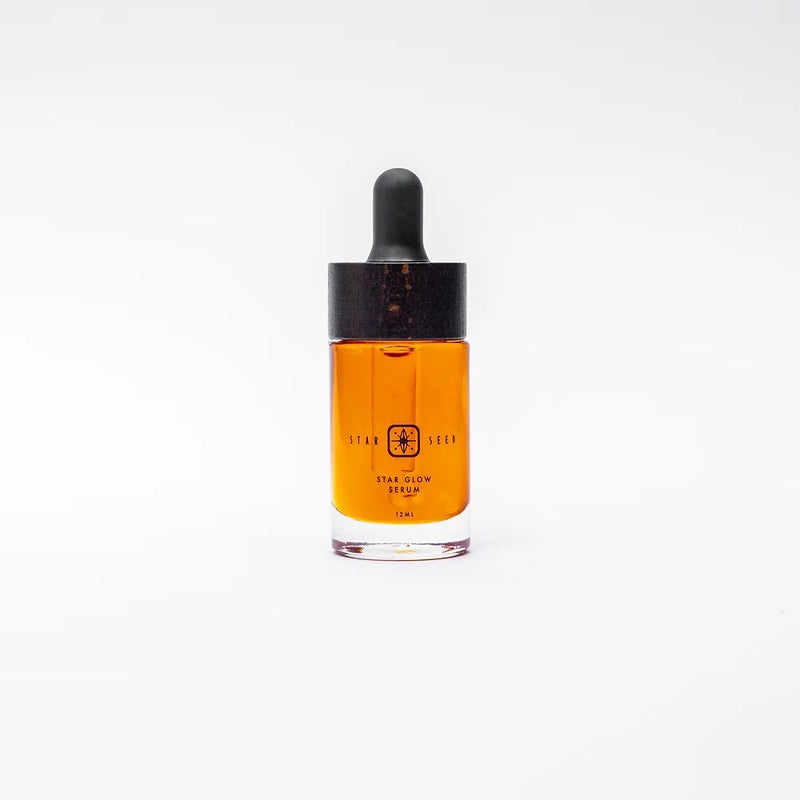
Star Glow Serum
Ingredients overview
Highlights
Key Ingredients
Other Ingredients
Skim through
| Ingredient name | what-it-does | irr., com. | ID-Rating |
|---|---|---|---|
| Simmondsia Chinensis Seed Oil (Jojoba) | emollient | 0, 0-2 | goodie |
| Argania Spinosa Kernel Oil (Argan) | antioxidant, emollient | goodie | |
| Rosa Canina Seed Oil (Rosehip) | emollient | goodie | |
| Adansonia Digitata Seed Oil (Baobab) | emollient | goodie | |
| Nigella Sativa Seed Oil (Black Seed) | soothing, antioxidant, emollient, perfuming | goodie | |
| Daucus Carota Sativa Seed Oil (Wild Carrot Seed) | emollient | ||
| Hippophae Rhamnoides Oil (Sea Buckthorn) | antioxidant, emollient | goodie | |
| Curcuma Longa Root Oil (Turmeric Root) | perfuming | ||
| Haematococcus Pluvialis Extract (Red Algae - Astaxanthin) | antioxidant | goodie | |
| Limonene | perfuming, solvent | icky |
Star Seed Star Glow SerumIngredients explained
Jojoba is a drought resistant evergreen shrub native to South-western North America. It's known and grown for jojoba oil, the golden yellow liquid coming from the seeds (about 50% of the weight of the seeds will be oil).
At first glance, it seems like your average emollient plant oil: it looks like an oil and it's nourishing and moisturizing to the skin but if we dig a bit deeper, it turns out that jojoba oil is really special and unique: technically - or rather chemically - it's not an oil but a wax ester (and calling it an oil is kind of sloppy).
So what the heck is a wax ester and why is that important anyway? Well, to understand what a wax ester is, you first have to know that oils are chemically triglycerides: one glycerin + three fatty acids attached to it. The fatty acids attached to the glycerin vary and thus we have many kinds of oils, but they are all triglycerides. Mother Nature created triglycerides to be easily hydrolyzed (be broken down to a glycerin + 3 fatty acid molecules) and oxidized (the fatty acid is broken down into small parts) - this happens basically when we eat fats or oils and our body generates energy from it.
Mother Nature also created wax esters but for a totally different purpose. Chemically, a wax ester is a fatty acid + a fatty alcohol, one long molecule. Wax esters are on the outer surface of several plant leaves to give them environmental protection. 25-30% of human sebum is also wax esters to give us people environmental protection.
So being a wax ester results in a couple of unique properties: First, jojoba oil is extremely stable. Like crazy stable. Even if you heat it to 370 C (698 F) for 96 hours, it does not budge. (Many plant oils tend to go off pretty quickly). If you have some pure jojoba oil at home, you should be fine using it for years.
Second, jojoba oil is the most similar to human sebum (both being wax esters), and the two are completely miscible. Acne.org has this not fully proven theory that thanks to this, jojoba might be able to "trick" the skin into thinking it has already produced enough sebum, so it might have "skin balancing" properties for oily skin.
Third, jojoba oil moisturizes the skin through a unique dual action: on the one hand, it mixes with sebum and forms a thin, non-greasy, semi-occlusive layer; on the other hand, it absorbs into the skin through pores and hair follicles then diffuses into the intercellular spaces of the outer layer of the skin to make it soft and supple.
On balance, the point is this: in contrast to real plant oils, wax esters were designed by Mother Nature to stay on the surface and form a protective, moisturizing barrier and jojoba oil being a wax ester is uniquely excellent at doing that.
When it comes to cosmetic oils and hype, argan oil is for sure leading the way. Dubbed as the "liquid gold of Morocco", we have to admit we have some trouble determining why this oil enjoys such a special miracle status. Not that it's not good, it is good, even great but reading the research about argan and a bunch of other plant oils we just do not see the big, unique differentiating factor (though that might be our fault not reading enough, obvs.)
So, argan oil comes from the kernel of the argan fruit that comes from the argan tree that grows only in Morocco. The tree is slow growing and getting the oil is a hard job. The traditional process is that the ripe argan fruits fall from the tree, then goats eat them up and poop out the seeds. The seeds are collected and smashed with a stone to get the kernels inside. This part is the hard one as the seeds have extremely hard shells. Once the kernels are obtained, the oil is pressed out from them (the kernels contain about 50% oil).
As for skincare, argan oil is loaded with lots of skin goodies (but so are many other plant oils): it contains 80% nourishing and moisturizing unsaturated fatty acids, mainly oleic (38-50%), linoleic (28-38%) and palmitic (10-18%). It also contains a relatively large amount of antioxidant vitamin E (600-900 mg/kg, about twice as much as olive), small amounts of antioxidant phenols (including caffeic acid, ferulic acid, and epicatechin), as well as some rare sterols with soothing and anti-inflammatory properties.
Thanks to all the above goodness in argan oil, it can greatly nourish and moisturize the skin and hair. It's also claimed to be able to neutralize collagen-damaging free radicals, help reduce scars, and revitalize and improve skin elasticity. You can even read that argan might help acne-prone skin, but being a high oleic oil, we would be careful with that.
All in all, argan oil is a real goodie but we do not fully understand the special miracle status it enjoys.
The oil coming from the seeds of dog-rose, a wild rose species native to Europe, northwest Africa and western Asia. It's a nice emollient, moisturizing plant oil loaded with skin-nourishing fatty acids (linoleic acid - 51%, linolenic acid - 19% and oleic acid - 20%).
If you start to dig a bit deeper into the rosehip oil topic, you will soon see that there are lots of species of rose, and it's all a bit confusing to know what the differences and similarities between the oils of the different roses are. As far as our research can tell, here is the gist.
In skincare two major types of rosehip oil are used:
1. Rosa Rubiginosa that is a synonym for Rosa Eglanteria and for Rosa Mosqueta. We will call it RR from now on.
2. Rosa Canina, or RC
The oil content and composition of RR and RC is similar, but there are some differences: RR contains 8% of oil, while RC contains a bit more, 10%. However, the quality of RR oil seems to be a bit better: it contains 78% essential unsaturated fatty acids while RC contains only 71%. Also, the linoleic-oleic ratio of RR is better (3.3 vs 2.5) that might be important if your skin is acne-prone (as linoleic acid is good for acne and oleic is not).
There is one more important thing to mention: RR oil is famous for containing the miracle active, tretinoin. Though Wikipedia puts RR and RC oil under the same article called as Rose hip seed oil, the referenced research about tretinoin content examines only Rosa Rubiginosa. We looked for a research paper explicitly stating that Rosa Canina also contains tretinoin, but could not find one, so we can neither deny nor confirm it. What we could find is a paper mentioning the tocopherols (vitamin E) and carotenoids (pro-vitamin A) content of Rosa Canina oil that gives it some nice antioxidant properties.
All in all, it is a great emollient plant oil with great fatty acids beneficial for any skin type.
Baobab is a really big, iconic tree native to Africa (here is a nice image of it). It's the largest succulent plant in the world and almost all parts of it have traditional medicinal uses in Africa.

The seed oil, similar to other plant oils, is loaded with things that are good-for-the-skin: it contains skin regenerating vitamin A, antioxidant vitamin E, and vitamin D3 that helps with calcium absorption. It's rich in nourishing fatty acids oleic (30-40%), linoleic (24-34%) and palmitic (18-30%).
Its moisturizing benefits are impressive, it absorbed into the skin quickly and might even improve skin elasticity. A great oil for drier skin types and excellent for eczema and psoriasis.
The (fixed or non-volatile) oil coming from the black seeds of Nigella Sativa, a smallish (20-30 cm) flowering plant native to Southwest Asia. The seed has a very complex chemical composition (it contains both fixed and volatile oil) and is used traditionally for a bunch of "anti-something" abilities including antitumor, antidiabetic, antihistaminic, anti-inflammatory, and antimicrobial properties. In Islam, black cumin seed was considered "a healing seed for all diseases except death”.
As for modern research and chemical composition, the fixed oil from the seeds is rich in skin-nourishing unsaturated fatty acids (mainly linoleic acid at 50 – 60% and oleic acid at 20%, but also contains some rare ones like C20:2 arachidic and eicosadienoic acids), amino acids, vitamins, and minerals. A component called thymoquinone (it's the main component of the volatile oil part, but the fixed oil also contains some) is considered to give the seed its main therapeutic properties including strong antioxidant and anti-inflammatory abilities.
As for black seed oil and cosmetics, the oil is great to nourish and moisturize the skin and is highly recommended to treat inflammatory skin diseases like psoriasis and eczema.
The oil coming from the seeds of the carrot, the orange root vegetable we all know and eat regularly. This oil is a really tricky one, as it can refer to two types of oil that can both be extracted from the carrot seeds: the essential oil (about 0.83% yield) and the fixed oil (about 7.84% yield).
The two seed oils are very different and to make matters even worse these two oils are also very different from carrot root oil, or carrot oil, that is basically carrot root extract macerated in a carrier oil such as sunflower or olive oil and is the one that contains the vitamin A precursor, carotene.
Let's start with the fixed oil: it's a nice emollient plant oil that is loaded with moisturizing fatty acids (petroselinic acid - 60% and linoleic acid - 12% are the main ones). Other important components are carotol (30%) and daucol (12%) that give the seed oil antifungal and antioxidant properties. Browsing cosmetic manufacturer info, the oil is also often described as revitalizing, toning and stimulating.
As for the essential oil, it is a light yellow colored oil with a rich, spicy and earthy fragrance. Its main component is carotol (about 65%) but similar to other essential oils, it is a chemically complex mixture with lots of compounds in small amounts. The essential oil also has antifungal and antioxidant properties but also contains fragrant components that might irritate sensitive skin types.
The oil coming from the pulp of the sea buckthorn berry. It has a pretty unique fatty acid composition: 65% is a combination of the rare Omega-7, aka palmitoleic acid and the more common palmitic acid. Fatty acids give the oil nice moisturizing and skin-protecting abilities.
But that's not all the goodness of sea buckthorn oil. It contains antioxidant superstar, Vitamin E (in multiple forms), antioxidant (and orange color giving) pigments beta-carotene and lycopene, as well as skin-soothing and replenishing beta-sitosterol.
Btw, used undiluted, it will make your skin orange.
All in all, a goodie emollient plant oil.
 We don't have description for this ingredient yet.
Haematococcus Pluvialis is a microalgae known for being a rich source of powerful, up-and-coming antioxidant, Astaxanthin. The extract comes as a red-colored oily liquid prepared from the resting and astaxanthin accumulating cells of the otherwise green algae.
As an antioxidant, it promises to protect against photodamage and thus help to delay skin photoaging. We have written more about Astaxanthin and its benefits here>>
A super common and cheap fragrance ingredient. It's in many plants, e.g. rosemary, eucalyptus, lavender, lemongrass, peppermint and it's the main component (about 50-90%) of the peel oil of citrus fruits.
It does smell nice but the problem is that it oxidizes on air exposure and the resulting stuff is not good for the skin. Oxidized limonene can cause allergic contact dermatitis and counts as a frequent skin sensitizer.
Limonene's nr1 function is definitely being a fragrance component, but there are several studies showing that it's also a penetration enhancer, mainly for oil-loving components.
All in all, limonene has some pros and cons, but - especially if your skin is sensitive - the cons probably outweigh the pros.
You may also want to take a look at...
| what‑it‑does | emollient |
| irritancy, com. | 0, 0-2 |
| what‑it‑does | antioxidant | emollient |
| what‑it‑does | emollient |
| what‑it‑does | emollient |
| what‑it‑does | soothing | antioxidant | emollient | perfuming |
| what‑it‑does | emollient |
| what‑it‑does | antioxidant | emollient |
| what‑it‑does | perfuming |
| what‑it‑does | antioxidant |
| what‑it‑does | perfuming | solvent |