





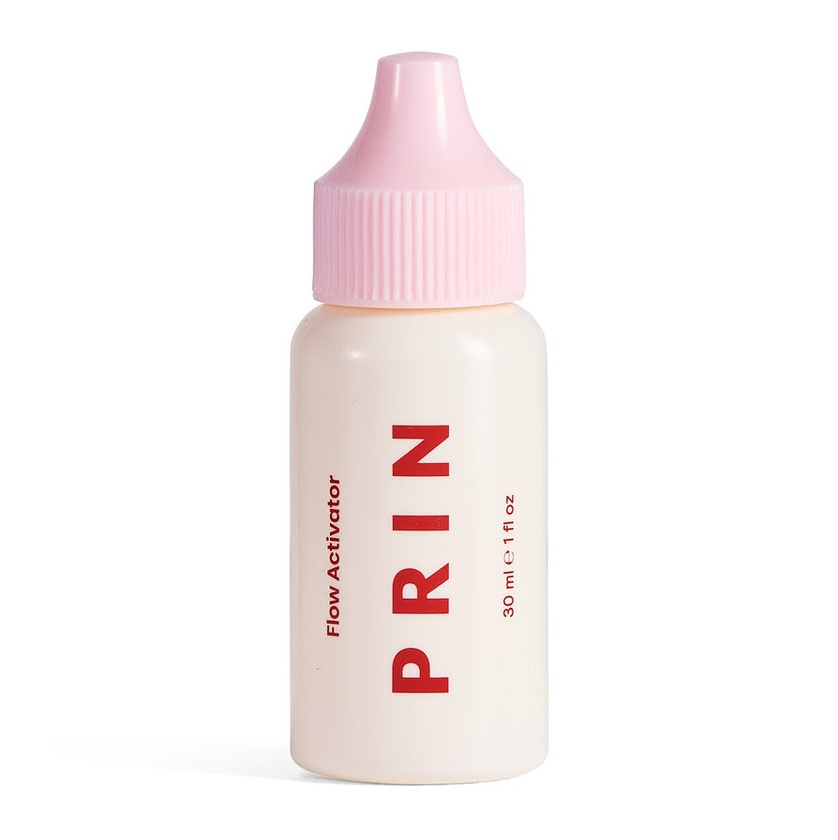
Flow Activator
Highlights
Key Ingredients
Skim through
| Ingredient name | what-it-does | irr., com. | ID-Rating |
|---|---|---|---|
| Aqua | solvent | ||
| Propanediol | solvent, moisturizer/humectant | ||
| Glycerin | skin-identical ingredient, moisturizer/humectant | 0, 0 | superstar |
| Citrus Australasica Fruit (Finger Lime Caviar) Extract | antioxidant, moisturizer/humectant | ||
| Niacinamide | cell-communicating ingredient, skin brightening, anti-acne, moisturizer/humectant | superstar | |
| Aloe Barbadensis Leaf Juice Powder* | soothing, moisturizer/humectant | goodie | |
| Caprylyl Glycol | moisturizer/humectant, emollient | ||
| 1,2-Hexanediol | solvent | ||
| Triethanolamine | buffering | 0, 2 |
Prin Flow ActivatorIngredients explained
Good old water, aka H2O. The most common skincare ingredient of all. You can usually find it right in the very first spot of the ingredient list, meaning it’s the biggest thing out of all the stuff that makes up the product.
It’s mainly a solvent for ingredients that do not like to dissolve in oils but rather in water.
Once inside the skin, it hydrates, but not from the outside - putting pure water on the skin (hello long baths!) is drying.
One more thing: the water used in cosmetics is purified and deionized (it means that almost all of the mineral ions inside it is removed). Like this, the products can stay more stable over time.
Propanediol is a natural alternative for the often used and often bad-mouthed propylene glycol. It's produced sustainably from corn sugar and it's Ecocert approved.
It's quite a multi-tasker: can be used to improve skin moisturization, as a solvent, to boost preservative efficacy or to influence the sensory properties of the end formula.
- A natural moisturizer that’s also in our skin
- A super common, safe, effective and cheap molecule used for more than 50 years
- Not only a simple moisturizer but knows much more: keeps the skin lipids between our skin cells in a healthy (liquid crystal) state, protects against irritation, helps to restore barrier
- Effective from as low as 3% with even more benefits for dry skin at higher concentrations up to 20-40%
- High-glycerin moisturizers are awesome for treating severely dry skin
 We don't have description for this ingredient yet.
- A multi-functional skincare superstar with several proven benefits for the skin
- Great anti-aging, wrinkle smoothing ingredient used at 4-5% concentration
- Fades brown spots alone or in combination with amino sugar, acetyl glucosamine
- Increases ceramide synthesis that results in a stronger, healthier skin barrier and better skin hydration
- Can help to improve several skin conditions including acne, rosacea, and atopic dermatitis
A spray-dried or freeze-dried version of Aloe Leaf Juice. The point of both drying methods is to make water evaporate from the juice and leave just the "useful" components behind.
So the aloe powder has similar soothing, emollient and moisturizing properties as the juice. You can read a bit more about the juice here.
It’s a handy multi-tasking ingredient that gives the skin a nice, soft feel. At the same time, it also boosts the effectiveness of other preservatives, such as the nowadays super commonly used phenoxyethanol.
The blend of these two (caprylyl glycol + phenoxyethanol) is called Optiphen, which not only helps to keep your cosmetics free from nasty things for a long time but also gives a good feel to the finished product. It's a popular duo.
A really multi-functional helper ingredient that can do several things in a skincare product: it can bring a soft and pleasant feel to the formula, it can act as a humectant and emollient, it can be a solvent for some other ingredients (for example it can help to stabilize perfumes in watery products) and it can also help to disperse pigments more evenly in makeup products. And that is still not all: it can also boost the antimicrobial activity of preservatives.
It’s a little helper ingredient that helps to set the pH of a cosmetic formulation to be just right. It’s very alkaline (you know the opposite of being very acidic): a 1% solution has a pH of around 10.
It does not have the very best safety reputation but in general, you do not have to worry about it.
What is true is that if a product contains so-called N-nitrogenating agents (e.g.: preservatives like 2-Bromo-2-Nitropropane-1,3-Diol, 5-Bromo-5-Nitro- 1,3-Dioxane or sodium nitrate - so look out for things with nitro, nitra in the name) that together with TEA can form some not nice carcinogenic stuff (that is called nitrosamines). But with proper formulation that does not happen, TEA in itself is not a bad guy.
But let’s assume a bad combination of ingredients were used and the nitrosamines formed. :( Even in that case you are probably fine because as far as we know it cannot penetrate the skin.
But to be on the safe side, if you see Triethanolamine in an INCI and also something with nitra, nitro in the name of it just skip the product, that cannot hurt.
You may also want to take a look at...
| what‑it‑does | solvent |
| what‑it‑does | solvent | moisturizer/humectant |
| what‑it‑does | skin-identical ingredient | moisturizer/humectant |
| irritancy, com. | 0, 0 |
| what‑it‑does | antioxidant | moisturizer/humectant |
| what‑it‑does | cell-communicating ingredient | skin brightening | anti-acne | moisturizer/humectant |
| what‑it‑does | soothing | moisturizer/humectant |
| what‑it‑does | moisturizer/humectant | emollient |
| what‑it‑does | solvent |
| what‑it‑does | buffering |
| irritancy, com. | 0, 2 |