





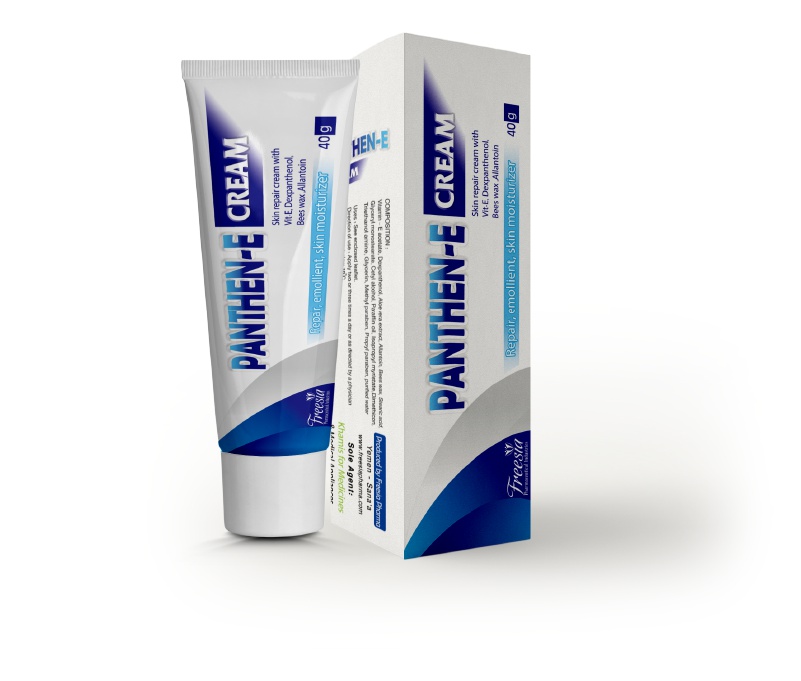
Highlights
Key Ingredients
Other Ingredients
Skim through
| Ingredient name | what-it-does | irr., com. | ID-Rating |
|---|---|---|---|
| Vitamin E Acetate | antioxidant | 0, 0 | |
| Dexpanthenol | soothing, moisturizer/humectant | 0, 0 | goodie |
| Aloe Vera | soothing, moisturizer/humectant | goodie | |
| Allantoin | soothing | 0, 0 | goodie |
| Beeswax | emollient, viscosity controlling, emulsifying, perfuming | 0, 0-2 | |
| Stearic Acid | emollient, viscosity controlling | 0, 2-3 | |
| Glyceryl Monostearate | emollient, emulsifying | 0, 1 | |
| Cetyl Alcohol | emollient, viscosity controlling | 2, 2 | |
| Paraffin Oil | emollient, solvent | 0, 0-2 | |
| Isopropyl Myristate | emollient, perfuming | 3, 3-5 | |
| Dimethicone | emollient | 0, 1 | |
| Triethanolamine | buffering | 0, 2 | |
| Glycerin | skin-identical ingredient, moisturizer/humectant | 0, 0 | superstar |
| Methylparaben | preservative | 0, 0 | |
| Propylparaben | preservative, perfuming | 0, 0 | |
| Purified Water | solvent |
Freesia Panthen-eIngredients explained
It’s the most commonly used version of pure vitamin E in cosmetics. You can read all about the pure form here. This one is the so-called esterified version.
According to famous dermatologist, Leslie Baumann while tocopheryl acetate is more stable and has a longer shelf life, it’s also more poorly absorbed by the skin and may not have the same awesome photoprotective effects as pure Vit E.
An easy-to-formulate, commonly used, nice to have ingredient that’s also called pro-vitamin B5. As you might guess from the “pro” part, it’s a precursor to vitamin B5 (whose fancy name is pantothenic acid).
Its main job in skincare products is to moisturise the skin. It’s a humectant meaning that it can help the skin to attract water and then hold onto it. There is also research showing that panthenol can help our skin to produce more lovely lipids that are important for a strong and healthy skin barrier.
Another great thing about panthenol is that it has anti-inflammatory and skin protecting abilities. A study shows that it can reduce the irritation caused by less-nice other ingredients (e.g. fragrance, preservatives or chemical sunscreens) in the product.
Research also shows that it might be useful for wound healing as it promotes fibroblast (nice type of cells in our skin that produce skin-firming collagen) proliferation.
If that wasn’t enough panthenol is also useful in nail and hair care products. A study shows that a nail treatment liquide with 2% panthenol could effectively get into the nail and significantly increase the hydration of it.
As for the hair the hydration effect is also true there. Panthenol might make your hair softer, more elastic and helps to comb your hair more easily.
Aloe Vera is one of today’s magic plants. It does have some very nice properties indeed, though famous dermatologist Leslie Baumann warns us in her book that most of the evidence is anecdotal and the plant might be a bit overhyped.
What research does confirm about Aloe is that it’s a great moisturizer and has several anti-inflammatory (among others contains salicylates, polysaccharides, magnesium lactate and C-glucosyl chromone) as well as some antibacterial components. It also helps wound healing and skin regeneration in general. All in all definitely a goodie.
Super common soothing ingredient. It can be found naturally in the roots & leaves of the comfrey plant, but more often than not what's in the cosmetic products is produced synthetically.
It's not only soothing but it' also skin-softening and protecting and can promote wound healing.
It's the yellow, solid stuff that you probably know from beeswax candles. It's a natural material produced by honey bees to build their honeycomb.
As for skincare, it's used as an emollient and thickening agent. It's super common in lip balms and lipsticks.
A common multi-tasker fatty acid. It makes your skin feel nice and smooth (emollient), gives body to cream type products and helps to stabilize water and oil mixes (aka emulsions).
A super common, waxy, white, solid stuff that helps water and oil to mix together, gives body to creams and leaves the skin feeling soft and smooth.
Chemically speaking, it is the attachment of a glycerin molecule to the fatty acid called stearic acid. It can be produced from most vegetable oils (in oils three fatty acid molecules are attached to glycerin instead of just one like here) in a pretty simple, "green" process that is similar to soap making. It's readily biodegradable.
It also occurs naturally in our body and is used as a food additive. As cosmetic chemist Colins writes it, "its safety really is beyond any doubt".
A so-called fatty (the good, non-drying kind of) alcohol that does all kinds of things in a skincare product: it makes your skin feel smooth and nice (emollient), helps to thicken up products and also helps water and oil to blend (emulsifier). Can be derived from coconut or palm kernel oil.
The famous or maybe rather infamous mineral oil. The clear oily liquid that is the "cheap by-product" of refining crude oil and the one that gets a lot of heat for its poor provenance. It is a very controversial ingredient with pros and cons and plenty of myths around it. So let us see them:
The pros of mineral oil
Trust us, if something is used for more than 100 years in cosmetic products, it has advantages. Chemically speaking, cosmetic grade mineral oil is a complex mixture of highly refined saturated hydrocarbons with C15-50 chain length. It is not merely a "by-product" but rather a specifically isolated part of petroleum that is very pure and inert.
It is a great emollient and moisturizer working mainly by occlusivity. Occlusivity is one of the basic mechanisms of how moisturizers work and it means that mineral oil sits on top of the skin and hinders so-called trans-epidermal water loss, i.e water evaporating out of your skin. When compared to heavy-duty plant oil, extra virgin coconut oil, the two of them were equally efficient and safe as moisturizers in treating xerosis, a skin condition connected to very dry skin.
The other thing that mineral oil is really good at is being non-irritating to the skin. The chemical composition of plant oils is more complex with many more possible allergens or irritating components, while mineral oil is simple, pure and sensitivity to it is extremely rare. If you check out the classic French pharmacy brands and their moisturizers for the most sensitive, allergy prone skin, they usually contain mineral oil. This is no coincidence.
The cons of mineral oil
The pros of mineral oil can be interpreted as cons if we look at them from another perspective. Not penetrating the skin but mostly just sitting on top of it and not containing biologically active components, like nice fatty acids and vitamins mean that mineral oil does not "nourish" the skin in the way plant oils do. Mineral oil does not give the skin any extra goodness, it is simply a non-irritating moisturizer working mainly by occlusivity.
The myths around mineral oil
Badmouthing mineral oil is a favorite sport of many, it is a cheap material and being connected to petrolatum makes it fairly easy to demonize.
While it is true that industrial grade mineral oil contains carcinogenic components (so-called polycyclic compounds), these are completely removed from cosmetic and food grade mineral oil and there is no scientific data showing that the pure, cosmetic grade version is carcinogenic.
What is more, in terms of the general health effects of mineral oils used in cosmetics, a 2017 study reviewed the data on their skin penetration and concluded that "the cosmetic use of mineral oils and waxes does not present a risk to consumers due to a lack of systemic exposure."
Another super common myth surrounding mineral oil is that it is comedogenic. A 2005 study titled "Is mineral oil comedogenic?" examined this very question and guess what happened? The study concluded that "based on the animal and human data reported, along with the AAD recommendation, it would appear reasonable to conclude that mineral oil is noncomedogenic in humans."
Overall, we feel that the scaremongering around mineral oil is not justified. For dry and super-sensitive skin types it is a great option. However, if you do not like its origin or its heavy feeling or anything else about it, avoiding it has never been easier. Mineral oil has such a bad reputation nowadays that cosmetic companies hardly dare to use it anymore.
A clear, colorless oil-like liquid that makes the skin feel smooth and nice (aka emollient) and it does so without it being greasy.
What's more, it can even reduce the heavy, greasy feel in products with high oil content. It's also fast-spreading meaning that it gives the formula a good, nice slip. It absorbs quickly into the skin and helps other ingredients to penetrate quicker and deeper.
Thanks to all this, it's one of the most commonly used emollients out there. There is just one little drawback: it has a high comedogenic index (5 out of 5...), so it might clog pores if you're prone to it.
Probably the most common silicone of all. It is a polymer (created from repeating subunits) molecule and has different molecular weight and thus different viscosity versions from water-light to thick liquid.
As for skincare, it makes the skin silky smooth, creates a subtle gloss and forms a protective barrier (aka occlusive). Also, works well to fill in fine lines and wrinkles and give skin a plump look (of course that is only temporary, but still, it's nice). There are also scar treatment gels out there using dimethicone as their base ingredient. It helps to soften scars and increase their elasticity.
As for hair care, it is a non-volatile silicone meaning that it stays on the hair rather than evaporates from it and smoothes the hair like no other thing. Depending on your hair type, it can be a bit difficult to wash out and might cause some build-up (btw, this is not true to all silicones, only the non-volatile types).
It’s a little helper ingredient that helps to set the pH of a cosmetic formulation to be just right. It’s very alkaline (you know the opposite of being very acidic): a 1% solution has a pH of around 10.
It does not have the very best safety reputation but in general, you do not have to worry about it.
What is true is that if a product contains so-called N-nitrogenating agents (e.g.: preservatives like 2-Bromo-2-Nitropropane-1,3-Diol, 5-Bromo-5-Nitro- 1,3-Dioxane or sodium nitrate - so look out for things with nitro, nitra in the name) that together with TEA can form some not nice carcinogenic stuff (that is called nitrosamines). But with proper formulation that does not happen, TEA in itself is not a bad guy.
But let’s assume a bad combination of ingredients were used and the nitrosamines formed. :( Even in that case you are probably fine because as far as we know it cannot penetrate the skin.
But to be on the safe side, if you see Triethanolamine in an INCI and also something with nitra, nitro in the name of it just skip the product, that cannot hurt.
- A natural moisturizer that’s also in our skin
- A super common, safe, effective and cheap molecule used for more than 50 years
- Not only a simple moisturizer but knows much more: keeps the skin lipids between our skin cells in a healthy (liquid crystal) state, protects against irritation, helps to restore barrier
- Effective from as low as 3% with even more benefits for dry skin at higher concentrations up to 20-40%
- High-glycerin moisturizers are awesome for treating severely dry skin
The most common type of feared-by-everyone-mostly-without-scientific-reason parabens. It's a cheap, effective and well-tolerated ingredient to make sure the cosmetic formula does not go wrong too soon.
Apart from the general controversy around parabens (we wrote about it more here), there is a 2006 in-vitro (made in the lab not on real people) research about methylparaben (MP) showing that when exposed to sunlight, MP treated skin cells suffered more harm than non-MP treated skin cells. The study was not done with real people on real skin but still - using a good sunscreen next to MP containing products is a good idea. (Well, in fact using a sunscreen is always a good idea. :))
A very common type of feared-by-everyone-mostly-without-scientific-reason parabens. It's a cheap, effective and well-tolerated ingredient to make sure the cosmetic formula does not go wrong too soon.
Good old water, aka H2O. The most common skincare ingredient of all. You can usually find it right in the very first spot of the ingredient list, meaning it’s the biggest thing out of all the stuff that makes up the product.
It’s mainly a solvent for ingredients that do not like to dissolve in oils but rather in water.
Once inside the skin, it hydrates, but not from the outside - putting pure water on the skin (hello long baths!) is drying.
One more thing: the water used in cosmetics is purified and deionized (it means that almost all of the mineral ions inside it is removed). Like this, the products can stay more stable over time.
You may also want to take a look at...
| what‑it‑does | antioxidant |
| irritancy, com. | 0, 0 |
| what‑it‑does | soothing | moisturizer/humectant |
| irritancy, com. | 0, 0 |
| what‑it‑does | soothing | moisturizer/humectant |
| what‑it‑does | soothing |
| irritancy, com. | 0, 0 |
| what‑it‑does | emollient | viscosity controlling | emulsifying | perfuming |
| irritancy, com. | 0, 0-2 |
| what‑it‑does | emollient | viscosity controlling |
| irritancy, com. | 0, 2-3 |
| what‑it‑does | emollient | emulsifying |
| irritancy, com. | 0, 1 |
| what‑it‑does | emollient | viscosity controlling |
| irritancy, com. | 2, 2 |
| what‑it‑does | emollient | solvent |
| irritancy, com. | 0, 0-2 |
| what‑it‑does | emollient | perfuming |
| irritancy, com. | 3, 3-5 |
| what‑it‑does | emollient |
| irritancy, com. | 0, 1 |
| what‑it‑does | buffering |
| irritancy, com. | 0, 2 |
| what‑it‑does | skin-identical ingredient | moisturizer/humectant |
| irritancy, com. | 0, 0 |
| what‑it‑does | preservative |
| irritancy, com. | 0, 0 |
| what‑it‑does | preservative | perfuming |
| irritancy, com. | 0, 0 |
| what‑it‑does | solvent |