





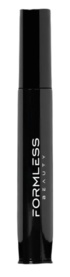
Ingredients overview
Highlights
Key Ingredients
Skim through
Formless Beauty Elevate MascaraIngredients explained
Good old water, aka H2O. The most common skincare ingredient of all. You can usually find it right in the very first spot of the ingredient list, meaning it’s the biggest thing out of all the stuff that makes up the product.
It’s mainly a solvent for ingredients that do not like to dissolve in oils but rather in water.
Once inside the skin, it hydrates, but not from the outside - putting pure water on the skin (hello long baths!) is drying.
One more thing: the water used in cosmetics is purified and deionized (it means that almost all of the mineral ions inside it is removed). Like this, the products can stay more stable over time.
Red Iron Oxide is the super common pigment that gives the familiar, "rust" red color. It is also the one that gives the pink tones in your foundation. Chemically speaking, it is iron III oxide (Fe2O3).
 We don't have description for this ingredient yet.
A sugar ester (sucrose + stearic acid) that works as a natural emulsifier (helps water and oil to mix). It's popular in oily gel cleansers as it improves the high-temperature stability of the formula.
A vegetable wax coming from the leaves of the Brazilian tropical palm tree, Copernicia cerifera. Similar to other waxes, it is used to stabilize and give body to products, or to keep stick type formulas solid. It is the hardest natural wax with a high melting point (around 85C) and high gloss making it a great wax choice for lip products.
We don't have description for this ingredient yet.
Propanediol is a natural alternative for the often used and often bad-mouthed propylene glycol. It's produced sustainably from corn sugar and it's Ecocert approved.
It's quite a multi-tasker: can be used to improve skin moisturization, as a solvent, to boost preservative efficacy or to influence the sensory properties of the end formula.
A hard wax coming from sunflower that has a high melting point and gives excellent thermal stability to the formulas. Similar to other waxes, it is used to stabilize products and give body to them, or to keep stick type formulas, such as lip balms, solid.
It’s pretty much the current IT-preservative. It’s safe and gentle, but even more importantly, it’s not a feared-by-everyone-mostly-without-scientific-reason paraben.
It’s not something new: it was introduced around 1950 and today it can be used up to 1% worldwide. It can be found in nature - in green tea - but the version used in cosmetics is synthetic.
Other than having a good safety profile and being quite gentle to the skin it has some other advantages too. It can be used in many types of formulations as it has great thermal stability (can be heated up to 85°C) and works on a wide range of pH levels (ph 3-10).
It’s often used together with ethylhexylglycerin as it nicely improves the preservative activity of phenoxyethanol.
Galactoarabinan is a natural polysaccharide (a big carbohydrate molecule) that comes from the Larch trees.
According to the manufacturer it can do all kinds of good in a formula: it can reduce trans-epidermal-water-loss (a fancy way of saying that it's moisturizing), improve the appearance of skin’s superficial fine lines, improve the uniformity and spreadability of a formulation and provides SPF enhancement. What's more it can also help to boost the efficacy of AHA exfoliants (while not boosting the irritation side effect).
It’s a handy multi-tasking ingredient that gives the skin a nice, soft feel. At the same time, it also boosts the effectiveness of other preservatives, such as the nowadays super commonly used phenoxyethanol.
The blend of these two (caprylyl glycol + phenoxyethanol) is called Optiphen, which not only helps to keep your cosmetics free from nasty things for a long time but also gives a good feel to the finished product. It's a popular duo.
It's one of those things that help your cosmetics not to go wrong too soon, aka a preservative. It’s not a strong one and doesn’t really work against bacteria, but more against mold and yeast. To do that it has to break down to its active form, sorbic acid. For that to happen, there has to be water in the product and the right pH value (pH 3-4).
But even if everything is right, it’s not enough on its own. If you see potassium sorbate you should see some other preservative next to it too.
BTW, it’s also a food preservative and even has an E number, E202.
We don't have description for this ingredient yet.
A natural polymer (big molecules from repeated subunits) that is harvested from the Acacia tree in the sub-Saharan region in Africa. It's a great thickening and binding agent. Often coupled with xanthan gum, as it helps to reduce its unpleasant stickiness.
You may also want to take a look at...
| what‑it‑does | solvent |
| what‑it‑does | colorant |
| irritancy, com. | 0, 0 |
| what‑it‑does | perfuming | viscosity controlling |
| what‑it‑does | emollient | emulsifying | surfactant/cleansing |
| irritancy, com. | 0, 0 |
| what‑it‑does | emollient |
| irritancy, com. | 0, 1 |
| what‑it‑does | solvent | moisturizer/humectant |
| what‑it‑does | emollient |
| what‑it‑does | preservative |
| what‑it‑does | antioxidant |
| what‑it‑does | moisturizer/humectant | emollient |
| what‑it‑does | preservative |
| what‑it‑does | viscosity controlling |