





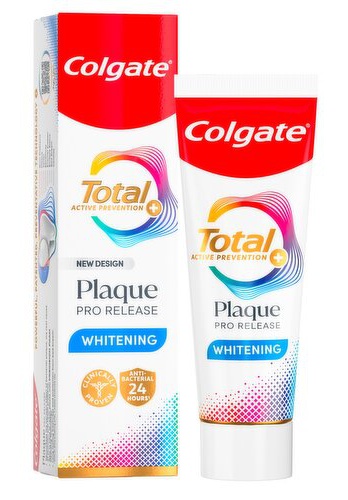
Total Active Prevention Plaque Pro Release With Precision Foam
Ingredients overview
 INCI photo pending approval
Highlights
Key Ingredients
Other Ingredients
Skim through
| Ingredient name | what-it-does | irr., com. | ID-Rating |
|---|---|---|---|
| Glycerin | skin-identical ingredient, moisturizer/humectant | 0, 0 | superstar |
| Hydrated Silica | abrasive/scrub, viscosity controlling | ||
| Aqua | solvent | ||
| Sodium Methyl Cocoyl Taurate | surfactant/cleansing | ||
| Arginine | skin-identical ingredient | goodie | |
| Aroma | |||
| Zinc Oxide | sunscreen | 0, 1 | goodie |
| Cocamidopropyl Betaine | surfactant/cleansing | ||
| Cellulose Gum | viscosity controlling | 0, 0 | |
| Benzyl Alcohol | preservative, perfuming, solvent, viscosity controlling | ||
| Tetrasodium Pyrophosphate | buffering, chelating | ||
| Zinc Citrate | |||
| Sodium Saccharin | |||
| Xanthan Gum | viscosity controlling | ||
| Sodium Fluoride | |||
| Anethole | |||
| Beta-Caryophyllene | perfuming | ||
| Carvone | perfuming | ||
| Limonene | perfuming, solvent | icky | |
| Mentha Piperita Oil | perfuming | icky | |
| Mentha Viridis Leaf Oil | |||
| Menthol | soothing | icky | |
| Pinene | |||
| Ci 73360 | colorant | 0, 3 | |
| Ci 74160 | colorant |
Colgate Total Active Prevention Plaque Pro Release With Precision FoamIngredients explained
- A natural moisturizer that’s also in our skin
- A super common, safe, effective and cheap molecule used for more than 50 years
- Not only a simple moisturizer but knows much more: keeps the skin lipids between our skin cells in a healthy (liquid crystal) state, protects against irritation, helps to restore barrier
- Effective from as low as 3% with even more benefits for dry skin at higher concentrations up to 20-40%
- High-glycerin moisturizers are awesome for treating severely dry skin
 We don't have description for this ingredient yet.
Good old water, aka H2O. The most common skincare ingredient of all. You can usually find it right in the very first spot of the ingredient list, meaning it’s the biggest thing out of all the stuff that makes up the product.
It’s mainly a solvent for ingredients that do not like to dissolve in oils but rather in water.
Once inside the skin, it hydrates, but not from the outside - putting pure water on the skin (hello long baths!) is drying.
One more thing: the water used in cosmetics is purified and deionized (it means that almost all of the mineral ions inside it is removed). Like this, the products can stay more stable over time.
A mild and non-drying cleanser that gives skin a nice and soft after-feel. It also has great foaming properties, comes from coconuts and it's biodegradable.
A semi-essential (infants cannot synthesize it, but adults can) amino acid that is one of the primary building blocks of hair keratin and skin collagen. It's a natural moisturizing factor, a skin hydrator and might also help to speed up wound healing.
Arginine usually has a positive charge (cationic) that makes it substantive to skin and hair (those are more negatively charged surfaces) and an excellent film former. Thanks to the positive charge, it also creates a complex with AHAs (AHAs like to lose a hydrogen ion and be negatively charged, so the positive and the negative ions attract each other) that causes a "time-release AHA effect" and reduces the irritation associated with AHAs.
We don't have description for this ingredient yet.
When it comes to sunscreen agents, Zinc Oxide is pretty much in a league of its own. It's a physical (or inorganic) sunscreen that has a lot in common with fellow inorganic sunscreen Titanium Dioxide (TiO2) but a couple of things make it superior even to TiO2.
If physical sunscreens don't tell you anything, go ahead and read about the basics here. Most of what we wrote about Titanium Dioxide is also true for Zinc Oxide so we will focus here on the differences.
The first main difference is that while TiO2 gives a nice broad spectrum protection, Zinc Oxide has an even nicer and even broader spectrum protection. It protects against UVB, UVA II, and UVA I almost uniformly, and is considered to be the broadest range sunscreen available today.
It's also highly stable and non-irritating. So much so that Zinc Oxide also counts as a skin protectant and anti-irritant. It's also often used to treat skin irritations such as diaper rash.
As for the disadvantages, Zinc Oxide is also not cosmetically elegant. It leaves a disturbing whitish tint on the skin, although, according to a 2000 research paper by Dr. Pinnell, it's slightly less white than TiO2. Still, it's white and disturbing enough to use Zinc Oxide nanoparticles more and more often.
We wrote more about nanoparticles and the concerns around them here, but the gist is that if nanoparticles were absorbed into the skin that would be a reason for legitimate health concerns. But luckily, so far research shows that sunscreen nanoparticles are not absorbed but remain on the surface of the skin or in the uppermost (dead) layer of the skin. This seems to be true even if the skin is damaged, for example, sunburnt.
All in all, if you've found a Zinc Oxide sunscreen that you are happy to use every single day, that's fantastic and we suggest you stick with it. It's definitely one of the best, or probably even the best option out there for sun protection available worldwide.
Super common ingredient in all kinds of cleansing products: face and body washes, shampoos and foam baths.
Number one reason for its popularity has to do with bubbles. Everyone loves bubbles. And cocamidopropyl betaine is great at stabilizing them.
The other reason is that it’s mild and works very well combined with other cleansing agents and surfactants. The art of cleansing is usually to balance between properly cleansing but not over-cleansing and cocamidopropyl betaine is helpful in pulling off this balance right.
Oh, and one more nice thing: even though it’s synthetic it’s highly biodegradable.
More info on CAPB on Collins Beaty Pages.
A cellulose (the big molecule found in the cell wall of green plants) derivative that is used as an emulsion stabilizer and thickener.
It's one of those things that help your cosmetics not to go wrong too soon, aka a preservative. It can be naturally found in fruits and teas but can also be made synthetically.
No matter the origin, in small amounts (up to 1%) it’s a nice, gentle preservative. Has to be combined with some other nice preservatives, like potassium sorbate to be broad spectrum enough.
In high amounts, it can be a skin irritant, but don’t worry, it’s never used in high amounts.
We don't have description for this ingredient yet.
We don't have description for this ingredient yet.
We don't have description for this ingredient yet.
It's one of the most commonly used thickeners and emulsion stabilizers. If the product is too runny, a little xanthan gum will make it more gel-like. Used alone, it can make the formula sticky and it is a good team player so it is usually combined with other thickeners and so-called rheology modifiers (helper ingredients that adjust the flow and thus the feel of the formula). The typical use level of Xantha Gum is below 1%, it is usually in the 0.1-0.5% range.
Btw, Xanthan gum is all natural, a chain of sugar molecules (polysaccharide) produced from individual sugar molecules (glucose and sucrose) via fermentation. It’s approved by Ecocert and also used in the food industry (E415).
We don't have description for this ingredient yet.
We don't have description for this ingredient yet.
A super common and cheap fragrance ingredient. It's in many plants, e.g. rosemary, eucalyptus, lavender, lemongrass, peppermint and it's the main component (about 50-90%) of the peel oil of citrus fruits.
It does smell nice but the problem is that it oxidizes on air exposure and the resulting stuff is not good for the skin. Oxidized limonene can cause allergic contact dermatitis and counts as a frequent skin sensitizer.
Limonene's nr1 function is definitely being a fragrance component, but there are several studies showing that it's also a penetration enhancer, mainly for oil-loving components.
All in all, limonene has some pros and cons, but - especially if your skin is sensitive - the cons probably outweigh the pros.
The essential oil coming from steam distillation of freshly harvested, flowering peppermint sprigs. Its major component is menthol that gives the oil its well-known refreshing and cooling properties. Peppermint oil is traditionally used as an inhalant for cold and coughs and there is also some clinical data validating its use against headaches by rubbing a peppermint oil cream on the forehead.
As for skincare, other than the nice grassy-minty smell and the refreshing sensations, we cannot write good things. It can be a skin irritant, so much so that it is a well-known counterirritant for muscle pains creating mild surface irritation to make things better in the deeper layers. But for everyday skincare, counterirritation is not something you wanna do, so we think that peppermint oil is better to avoid, especially if your skin is sensitive.
Menthol needs no introduction: it's the thing that causes the cooling sensation so well-known both from cosmetic products as well as a bunch of other things like chocolate, chewing gum, toothpaste or cigarette. It's a natural compound that comes from the essential oil of Mentha species (peppermint oil contains 40-50% menthol) and it gives them their typical minty smell and flavor.
As for skincare, menthol seems to be a mixed bag. Apart from the cool cooling sensation (that might last up to 70 mins!), it also has painkilling, itch reducing, antibacterial, antifungal and even penetration enhancing properties. On the other hand, it also seems to act as a skin irritant that increases trans-epidermal water loss (the water that evaporates from the outer layer of the skin) and thus contributes to drying out the skin.
We don't have description for this ingredient yet.
We don't have description for this ingredient yet.
You may also want to take a look at...
| what‑it‑does | skin-identical ingredient | moisturizer/humectant |
| irritancy, com. | 0, 0 |
| what‑it‑does | abrasive/scrub | viscosity controlling |
| what‑it‑does | solvent |
| what‑it‑does | surfactant/cleansing |
| what‑it‑does | skin-identical ingredient |
| what‑it‑does | sunscreen |
| irritancy, com. | 0, 1 |
| what‑it‑does | surfactant/cleansing |
| what‑it‑does | viscosity controlling |
| irritancy, com. | 0, 0 |
| what‑it‑does | preservative | perfuming | solvent | viscosity controlling |
| what‑it‑does | buffering | chelating |
| what‑it‑does | viscosity controlling |
| what‑it‑does | perfuming |
| what‑it‑does | perfuming |
| what‑it‑does | perfuming | solvent |
| what‑it‑does | perfuming |
| what‑it‑does | soothing |
| what‑it‑does | colorant |
| irritancy, com. | 0, 3 |
| what‑it‑does | colorant |