





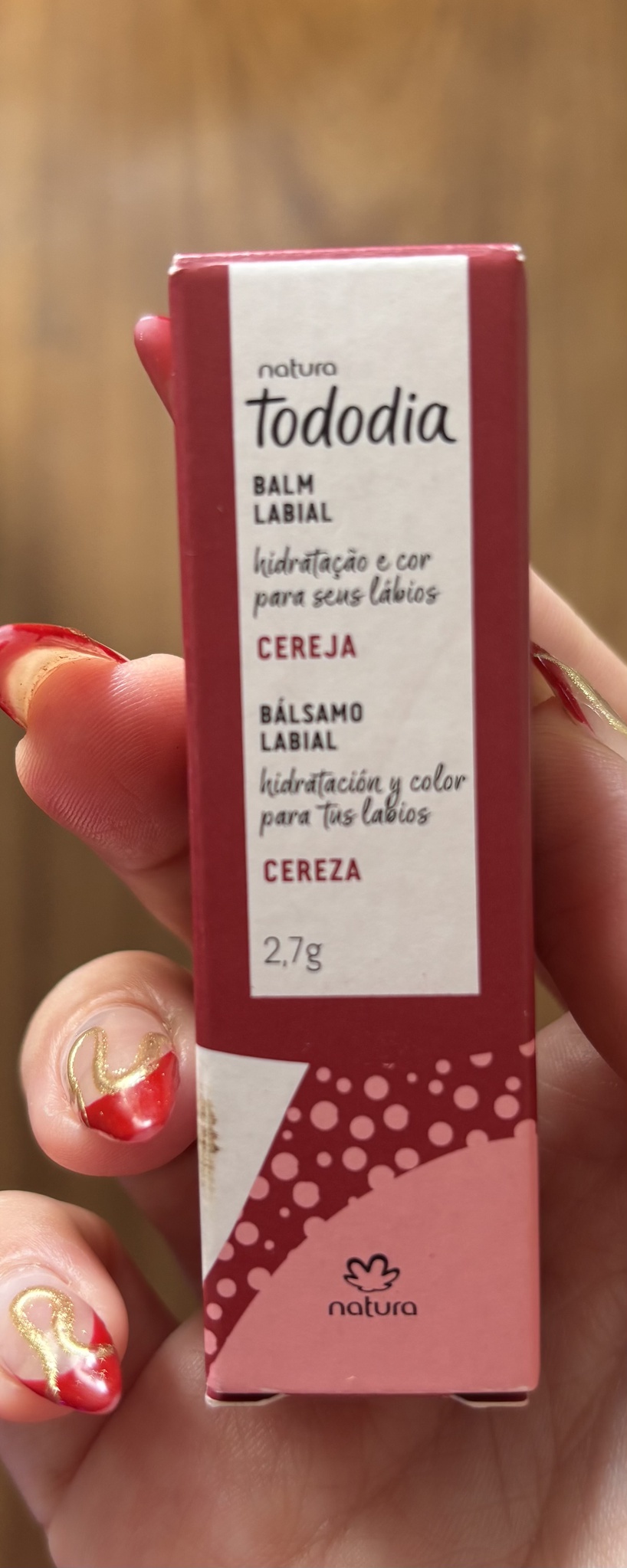
Highlights
Key Ingredients
Other Ingredients
Skim through
| Ingredient name | what-it-does | irr., com. | ID-Rating |
|---|---|---|---|
| Isopropyl Myristate | emollient, perfuming | 3, 3-5 | |
| Pentaerythrityl Tetraisostearate | emollient | 0, 2 | |
| Polybutene | viscosity controlling | ||
| Synthetic Wax | emollient, viscosity controlling | ||
| Cera Microcristallina | viscosity controlling | ||
| Polyglyceryl-2 Dipolyhydroxystearate | emulsifying | ||
| Cetearyl Behenate | |||
| Mica | colorant | ||
| Aroma | |||
| Benzyl Benzoate | solvent, perfuming, antimicrobial/antibacterial | icky | |
| Ci 15850 | colorant | 0, 1 | |
| Tocopherol | antioxidant | 0-3, 0-3 | goodie |
| Ci 77120 | colorant | ||
| Limonene | perfuming, solvent | icky | |
| Ascorbyl Palmitate | antioxidant | 0, 2 | icky |
| Rosin | viscosity controlling |
Natura Todo Dia Balm CerejaIngredients explained
A clear, colorless oil-like liquid that makes the skin feel smooth and nice (aka emollient) and it does so without it being greasy.
What's more, it can even reduce the heavy, greasy feel in products with high oil content. It's also fast-spreading meaning that it gives the formula a good, nice slip. It absorbs quickly into the skin and helps other ingredients to penetrate quicker and deeper.
Thanks to all this, it's one of the most commonly used emollients out there. There is just one little drawback: it has a high comedogenic index (5 out of 5...), so it might clog pores if you're prone to it.
A liquid emollient derived from isostearic acid that gives a rich, cushiony skin-feel and unusually high levels of gloss. It also has film-forming abilities but without leaving a sticky residue and it aids long-lasting and water-resistant properties. All this makes Pentaerythrityl Tetraisostearate an ideal emollient for long-lasting protective emulsions, like lip balms.
 We don't have description for this ingredient yet.
We don't have description for this ingredient yet.
We don't have description for this ingredient yet.
We don't have description for this ingredient yet.
A super versatile and common mineral powder that comes in different particle sizes. It is a multi-tasker used to improve skin feel, increase product slip, give the product light-reflecting properties, enhance skin adhesion or serve as an anti-caking agent.
It is also the most commonly used "base" material for layered composite pigments such as pearl-effect pigments. In this case, mica is coated with one or more metal oxides (most commonly titanium dioxide) to achieve pearl effect via the physical phenomenon known as interference.
We don't have description for this ingredient yet.
A common fragrance ingredient that has a faint sweet balsamic smell. It can also be a solvent and can fight against microbes and insects very well.
It's one of the “EU 26 fragrances” that has to be labelled separately because of allergen potential. Best to avoid if your skin is sensitive.
We don't have description for this ingredient yet.
- Primary fat-soluble antioxidant in our skin
- Significant photoprotection against UVB rays
- Vit C + Vit E work in synergy and provide great photoprotection
- Has emollient properties
- Easy to formulate, stable and relatively inexpensive
We don't have description for this ingredient yet.
A super common and cheap fragrance ingredient. It's in many plants, e.g. rosemary, eucalyptus, lavender, lemongrass, peppermint and it's the main component (about 50-90%) of the peel oil of citrus fruits.
It does smell nice but the problem is that it oxidizes on air exposure and the resulting stuff is not good for the skin. Oxidized limonene can cause allergic contact dermatitis and counts as a frequent skin sensitizer.
Limonene's nr1 function is definitely being a fragrance component, but there are several studies showing that it's also a penetration enhancer, mainly for oil-loving components.
All in all, limonene has some pros and cons, but - especially if your skin is sensitive - the cons probably outweigh the pros.
A form of skincare superstar, vitamin C. Even though we are massive vitamin C fans, Ascorbyl Palmitate (AP) is our least favorite. (Btw, if you do not know what the big deal with vitamin C is then you are missing out. You must go and read our geeky details about it.)
So, AP is one of the attempts by the cosmetics industry to solve the stability issues with vitamin C while preserving its benefits, but it seems to fall short on several things.
What's the problem?
Firstly, it's stability is only similar to that of pure ascorbic acid (AA), which means it is not really stable. A great study in the Journal of Cosmetic Dermatology compared a bunch of vitamin C derivatives and this derivative was the only one where the study said in terms of stability that it's "similar to AA". Not really that good.
Second, a study that examined the skin absorption of vitamin C found that ascorbyl palmitate did not increase the skin levels of AA. This does not mean that ascorbyl palmitate cannot penetrate the skin (because it can, it's oil soluble and the skin likes to absorb oil soluble things) but this means that it's questionable if ascorbyl palmitate can be converted into pure Vit C in the skin. Even if it can be converted, the palmitate part of the molecule is more than the half of it, so the efficacy will not be good and we have never seen a serum that contains a decent (and proudly disclosed) amount of AP. We are highly skeptical what effect a tiny amount of AP has in a formula.
Third, another study that wanted to examine the antioxidant properties of AP was surprised to find that even though AP does have nice antioxidant properties; following UVB radiation (the same one that comes from the sun) it also promotes lipid peroxidation and cytotoxicity. It was only an in-vitro study meaning that it was done on cell cultures and not on real people, but still, this also does not support the use of AP too much.
The only good thing we can write about Ascorbyl Palmitate is that there is an in-vitro (made in the lab, not on real people) study showing that it might be able to boost collagen production.
Regarding the skin-brightening properties of pure vitamin C, this is another magic property AP does not have, or at least there is no data, not even in-vitro, about it.
Overall, Ascorbyl Palmitate is our least favorite vitamin C derivative. It is there in lots of products in tiny amounts (honestly, we do not really understand why), however, we do not know about any vitamin C serum featuring AP in high amounts. That is probably no coincidence. If you are into vitamin C, you can take a look at more promising derivatives here.
You may also want to take a look at...
| what‑it‑does | emollient | perfuming |
| irritancy, com. | 3, 3-5 |
| what‑it‑does | emollient |
| irritancy, com. | 0, 2 |
| what‑it‑does | viscosity controlling |
| what‑it‑does | emollient | viscosity controlling |
| what‑it‑does | viscosity controlling |
| what‑it‑does | emulsifying |
| what‑it‑does | colorant |
| what‑it‑does | solvent | perfuming | antimicrobial/antibacterial |
| what‑it‑does | colorant |
| irritancy, com. | 0, 1 |
| what‑it‑does | antioxidant |
| irritancy, com. | 0-3, 0-3 |
| what‑it‑does | colorant |
| what‑it‑does | perfuming | solvent |
| what‑it‑does | antioxidant |
| irritancy, com. | 0, 2 |
| what‑it‑does | viscosity controlling |