





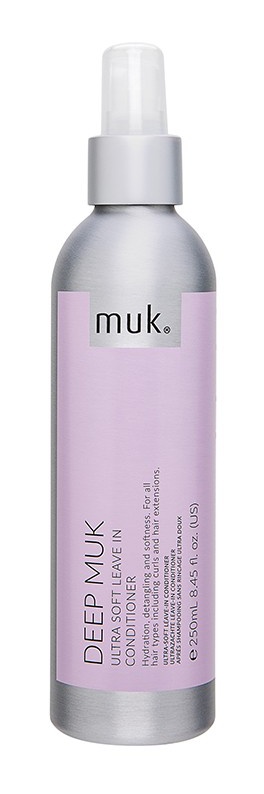
Deep Muk Ultra Soft Leave In Conditioner
Ingredients overview
Highlights
Other Ingredients
Skim through
| Ingredient name | what-it-does | irr., com. | ID-Rating |
|---|---|---|---|
| Water/Aqua | solvent | ||
| Sodium PCA | skin-identical ingredient, moisturizer/humectant | 0, 0 | goodie |
| Cocoglucosides Hydroxypropyltrimonium Chloride | surfactant/cleansing, emulsifying | ||
| Hydrolyzed Collagen Pg-Propyl Methylsilanediol | |||
| Amodimethicone | emollient | ||
| Steartrimonium Chloride | preservative | ||
| Panthenol | soothing, moisturizer/humectant | 0, 0 | goodie |
| Fragrance/Parfum | perfuming | icky | |
| DMDM Hydantoin | preservative | icky | |
| Methylparaben | preservative | 0, 0 | |
| Trideceth-12 | emulsifying, surfactant/cleansing | ||
| Citric Acid | buffering | ||
| Citronellol | perfuming | icky | |
| Hexyl Cinnamal | perfuming | icky | |
| Limonene | perfuming, solvent | icky | |
| Linalool | perfuming | icky | |
| Amyl Cinnamal | perfuming |
Muk Deep Muk Ultra Soft Leave In ConditionerIngredients explained
Good old water, aka H2O. The most common skincare ingredient of all. You can usually find it right in the very first spot of the ingredient list, meaning it’s the biggest thing out of all the stuff that makes up the product.
It’s mainly a solvent for ingredients that do not like to dissolve in oils but rather in water.
Once inside the skin, it hydrates, but not from the outside - putting pure water on the skin (hello long baths!) is drying.
One more thing: the water used in cosmetics is purified and deionized (it means that almost all of the mineral ions inside it is removed). Like this, the products can stay more stable over time.
PCA stands for Pyrrolidone Carboxylic Acid and though it might not sound like it, it is a thing that can be found naturally in our skin. The sodium salt form of PCA is an important skin-identical ingredient and great natural moisturizer that helps the skin to hold onto water and stay nicely hydrated.
 We don't have description for this ingredient yet.
We don't have description for this ingredient yet.
A modified dimethicone-type silicone molecule that also contains amino-groups. Having amino-groups means that Amodimethicone also has Nitrogen in its molecule that likes to have a positive charge. Positively charged (or quaternised) molecules are substantive to skin and hair as those are negatively charged surfaces and are excellent film formers. Amodiemthcone is no exception and it is especially recommended for hair-care products for its long-lasting hair conditioning benefits.
We don't have description for this ingredient yet.
An easy-to-formulate, commonly used, nice to have ingredient that’s also called pro-vitamin B5. As you might guess from the “pro” part, it’s a precursor to vitamin B5 (whose fancy name is pantothenic acid).
Its main job in skincare products is to moisturise the skin. It’s a humectant meaning that it can help the skin to attract water and then hold onto it. There is also research showing that panthenol can help our skin to produce more lovely lipids that are important for a strong and healthy skin barrier.
Another great thing about panthenol is that it has anti-inflammatory and skin protecting abilities. A study shows that it can reduce the irritation caused by less-nice other ingredients (e.g. fragrance, preservatives or chemical sunscreens) in the product.
Research also shows that it might be useful for wound healing as it promotes fibroblast (nice type of cells in our skin that produce skin-firming collagen) proliferation.
If that wasn’t enough panthenol is also useful in nail and hair care products. A study shows that a nail treatment liquide with 2% panthenol could effectively get into the nail and significantly increase the hydration of it.
As for the hair the hydration effect is also true there. Panthenol might make your hair softer, more elastic and helps to comb your hair more easily.
Exactly what it sounds: nice smelling stuff put into cosmetic products so that the end product also smells nice. Fragrance in the US and parfum in the EU is a generic term on the ingredient list that is made up of 30 to 50 chemicals on average (but it can have as much as 200 components!).
If you are someone who likes to know what you put on your face then fragrance is not your best friend - there's no way to know what’s really in it.
Also, if your skin is sensitive, fragrance is again not your best friend. It’s the number one cause of contact allergy to cosmetics. It’s definitely a smart thing to avoid with sensitive skin (and fragrance of any type - natural is just as allergic as synthetic, if not worse!).
A controversial preservative that has formaldehyde-releasing properties. It works great against bacteria and also has mild fungicide abilities.
Cosmetic chemist, Colin wrote a great article about formaldehyde and DMDM Hydantoin. He writes that formaldehyde is the perfect example of "the dose makes the poison" principle. It's a natural stuff that can also be found in fresh fruits and vegetables, and eating it in tiny amounts is totally ok. However, in larger amounts (according to Wikipedia 30 mL of a solution containing 37% formaldehyde) it's deadly.
The amount of formaldehyde used in cosmetics either neat or through formaldehyde-releasing preservatives is tiny. Probably that is why the Cosmetic Ingredient Review Broad concluded both in 1988 and in 2008 that DMDM Hydantoin is "safe as used in cosmetics".
However, Colins argues that in the case of formaldehyde-releasing preservatives, formaldehyde is released slowly and the skin has probably not evolved to deal with that. The lingering formaldehyde might be toxic to the Langerhans Cells that are important for the skin's defense system. Another potential issue is that formaldehyde-releasers might also release other things while reacting with amino acids in the skin that is probably the explanation why some people are not allergic to formaldehyde but are allergic to formaldehyde-releasing preservatives. These are all theories, far from proven facts, but we feel that there are some justified reasons why formaldehyde-releasing preservatives and Dmdm Hydantoin count as controversial.
All in all, it's up to you to decide if you wanna avoid this preservative group or not. If so, there are other, less risky and more skin-friendly options out there.
The most common type of feared-by-everyone-mostly-without-scientific-reason parabens. It's a cheap, effective and well-tolerated ingredient to make sure the cosmetic formula does not go wrong too soon.
Apart from the general controversy around parabens (we wrote about it more here), there is a 2006 in-vitro (made in the lab not on real people) research about methylparaben (MP) showing that when exposed to sunlight, MP treated skin cells suffered more harm than non-MP treated skin cells. The study was not done with real people on real skin but still - using a good sunscreen next to MP containing products is a good idea. (Well, in fact using a sunscreen is always a good idea. :))
We don't have description for this ingredient yet.
Citric acid comes from citrus fruits and is an AHA. If these magic three letters don’t tell you anything, click here and read our detailed description on glycolic acid, the most famous AHA.
So citric acid is an exfoliant, that can - just like other AHAs - gently lift off the dead skin cells of your skin and make it more smooth and fresh.
There is also some research showing that citric acid with regular use (think three months and 20% concentration) can help sun-damaged skin, increase skin thickness and some nice hydrating things called glycosaminoglycans in the skin.
But according to a comparative study done in 1995, citric acid has less skin improving magic properties than glycolic or lactic acid. Probably that’s why citric acid is usually not used as an exfoliant but more as a helper ingredient in small amounts to adjust the pH of a formulation.
Citronellol is a very common fragrance ingredient with a nice rose-like odor. In the UK, it’s actually the third most often listed perfume on the ingredient lists.
It can be naturally found in geranium oil (about 30%) or rose oil (about 25%).
As with all fragrance ingredients, citronellol can also cause allergic contact dermatitis and should be avoided if you have perfume allergy. In a 2001 worldwide study with 178 people with known sensitization to fragrances citronellol tested positive in 5.6% of the cases.
There is no known anti-aging or positive skin benefits of the ingredient. It’s in our products to make it smell nice.
A common fragrance ingredient that smells like jasmine. It is one of the “EU 26 fragrances” that has to be labelled separately because of allergen potential. Best to avoid if your skin is sensitive.
A super common and cheap fragrance ingredient. It's in many plants, e.g. rosemary, eucalyptus, lavender, lemongrass, peppermint and it's the main component (about 50-90%) of the peel oil of citrus fruits.
It does smell nice but the problem is that it oxidizes on air exposure and the resulting stuff is not good for the skin. Oxidized limonene can cause allergic contact dermatitis and counts as a frequent skin sensitizer.
Limonene's nr1 function is definitely being a fragrance component, but there are several studies showing that it's also a penetration enhancer, mainly for oil-loving components.
All in all, limonene has some pros and cons, but - especially if your skin is sensitive - the cons probably outweigh the pros.
Linalool is a super common fragrance ingredient. It’s kind of everywhere - both in plants and in cosmetic products. It’s part of 200 natural oils including lavender, ylang-ylang, bergamot, jasmine, geranium and it can be found in 90-95% of prestige perfumes on the market.
The problem with linalool is, that just like limonene it oxidises on air exposure and becomes allergenic. That’s why a product containing linalool that has been opened for several months is more likely to be allergenic than a fresh one.
A study made in the UK with 483 people tested the allergic reaction to 3% oxidised linalool and 2.3% had positive test results.
You may also want to take a look at...
| what‑it‑does | solvent |
| what‑it‑does | skin-identical ingredient | moisturizer/humectant |
| irritancy, com. | 0, 0 |
| what‑it‑does | surfactant/cleansing | emulsifying |
| what‑it‑does | emollient |
| what‑it‑does | preservative |
| what‑it‑does | soothing | moisturizer/humectant |
| irritancy, com. | 0, 0 |
| what‑it‑does | perfuming |
| what‑it‑does | preservative |
| what‑it‑does | preservative |
| irritancy, com. | 0, 0 |
| what‑it‑does | emulsifying | surfactant/cleansing |
| what‑it‑does | buffering |
| what‑it‑does | perfuming |
| what‑it‑does | perfuming |
| what‑it‑does | perfuming | solvent |
| what‑it‑does | perfuming |
| what‑it‑does | perfuming |